
Range Rover Sport Engine Rebuild vs Replacement: Which Option Is Right for You?
Deciding between rebuilding or replacing your Range Rover Sport's engine comes down to one thing: the extent of the damage. This guide breaks down the real differences between rebuilt, reconditioned, and used engines, along with UK pricing factors for models like the Ingenium, SDV6, TDV6, and AJ133 V8. Whether your engine has a worn timing chain or a cracked block, learn which option protects your reliability and your budget. A proper diagnostic inspection, not guesswork, is the key to making the right call.
Your Range Rover Sport's engine has failed, and now you're staring down two very different paths and two very different bills. Do you rebuild what's already under the bonnet, or do you replace it outright with a reconditioned unit?
It's not a small decision. Get it wrong, and you could be looking at thousands of pounds spent on a fix that doesn't last, or a replacement engine that never needed to happen in the first place. Get it right, and your Range Rover Sport can comfortably clock another 100,000 miles without drama.
This guide breaks down exactly how a rebuild differs from a replacement, what each option actually costs in the UK in 2026, and most importantly, how to know which one makes sense for your specific engine, your mileage, and your budget.
What's the Difference Between a Range Rover Engine Rebuild and a Replacement?
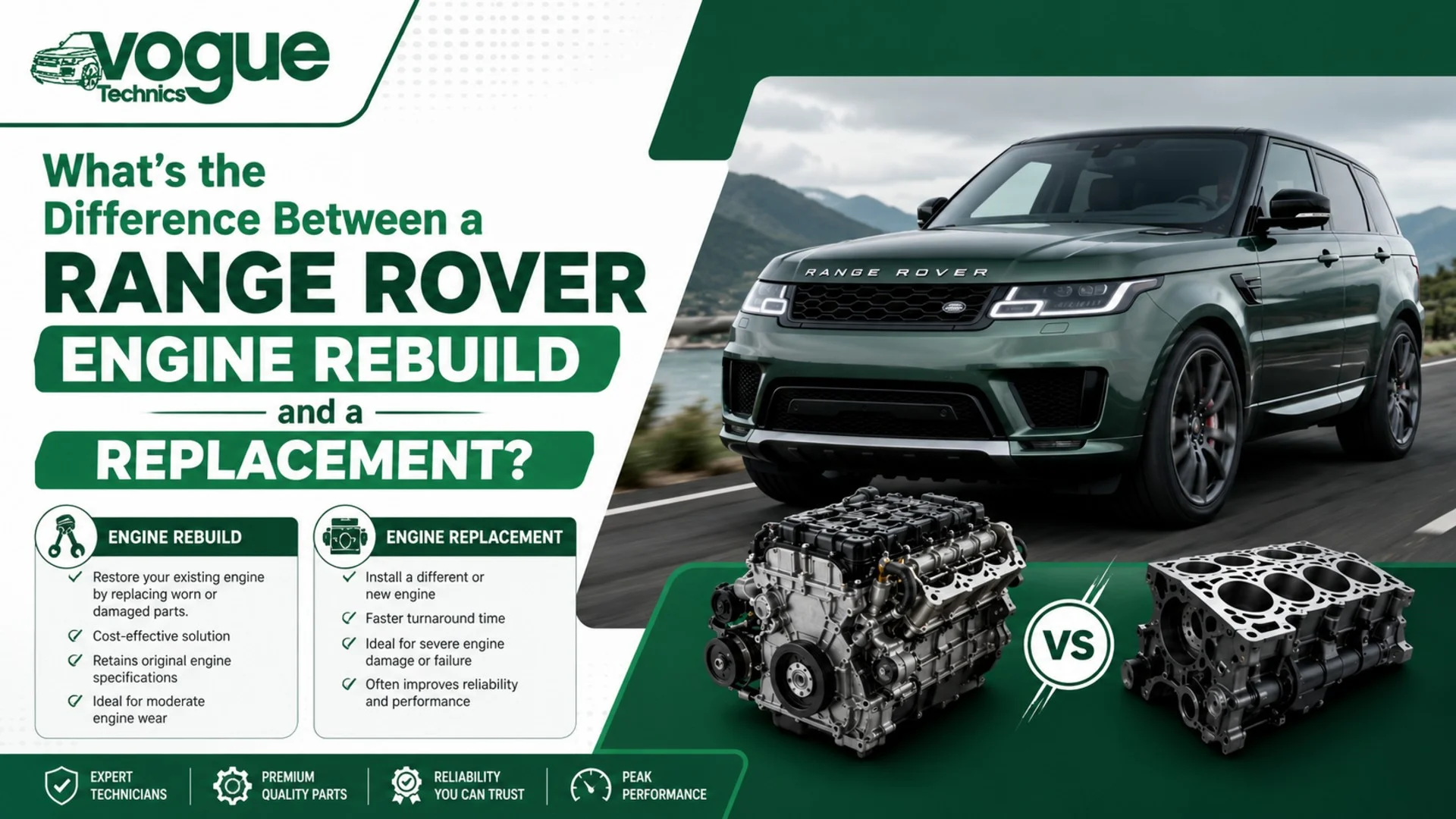
Before you can decide between the two, you need to understand what you're actually paying for. "Rebuild" and "replacement" get thrown around loosely by garages, and the two are not interchangeable.
What Does a Range Rover Sport Engine Rebuild Actually Involve?
A genuine engine rebuild means your original engine block stays in the car. A specialist strips it down completely, inspects every component, and replaces only the parts that have failed or worn out.
A typical rebuild covers:
- Crankshaft: reground or replaced if there's evidence of crankshaft failure or bearing damage
- Pistons and piston rings: replaced to restore proper compression
- Bearings and connecting rods: inspected for spun bearings and wear, replaced as needed
- Cylinder head: resurfaced or reconditioned, with new valve guides and valve seats fitted
- Timing chain and timing tensioner: replaced as standard on most rebuilds, since chain stretch is a common cause of repeat failure
- Gasket set: full replacement, including the head gasket
- Machining work: honing, balancing, and resurfacing to bring tolerances back to factory spec
Because the original block is retained and rebuilt to precise tolerances, this is essentially a full engine overhaul rather than a patch-up job.
What Does a Range Rover Sport Engine Replacement Actually Involve?
Replacement means your damaged engine comes out entirely, and a reconditioned, remanufactured, or used engine goes in its place. There's no repair work on your original unit, it's simply removed.
Replacement is typically the faster option, since a specialist isn't rebuilding a unit from scratch, they're supplying and fitting one that's already been prepared. This is why "supplied and fitted" is the phrase you'll see most often when specialists quote for replacement work.
Rebuilt vs Reconditioned vs Used Engines — What's the Real Difference?
This is where a lot of Range Rover and Land Rover owners get caught out, because these three terms are often used interchangeably online when they shouldn't be.
Engine Type | What It Means | Reliability | Typical Warranty |
| Rebuilt | Your original engine, stripped and rebuilt with new/reconditioned components | High, built to your car's specific history | Varies by specialist |
| Reconditioned/Remanufactured | A different engine, fully stripped and rebuilt to factory tolerances before fitting | High, consistent, tested standard | Varies by specialist |
| Used/Second-Hand | A donor engine taken from another vehicle, usually with no rebuild work | Unpredictable, unknown history and mileage | Often limited or none |
A reconditioned engine is the middle ground most specialists recommend: you get a unit that's been fully machined, tested, and rebuilt to factory tolerances, but without the labour cost of stripping your own damaged block. A used engine, by contrast, is a gamble. You're inheriting someone else's engine wear, oil pressure history, and mileage, often with no diagnostics, inspection, or engine warranty behind it.
If reliability matters more to you than upfront price and for a vehicle like the Range Rover Sport, it usually should, reconditioned or rebuilt beats used almost every time.
How Much Does a Range Rover Sport Engine Rebuild or Replacement Cost in the UK?
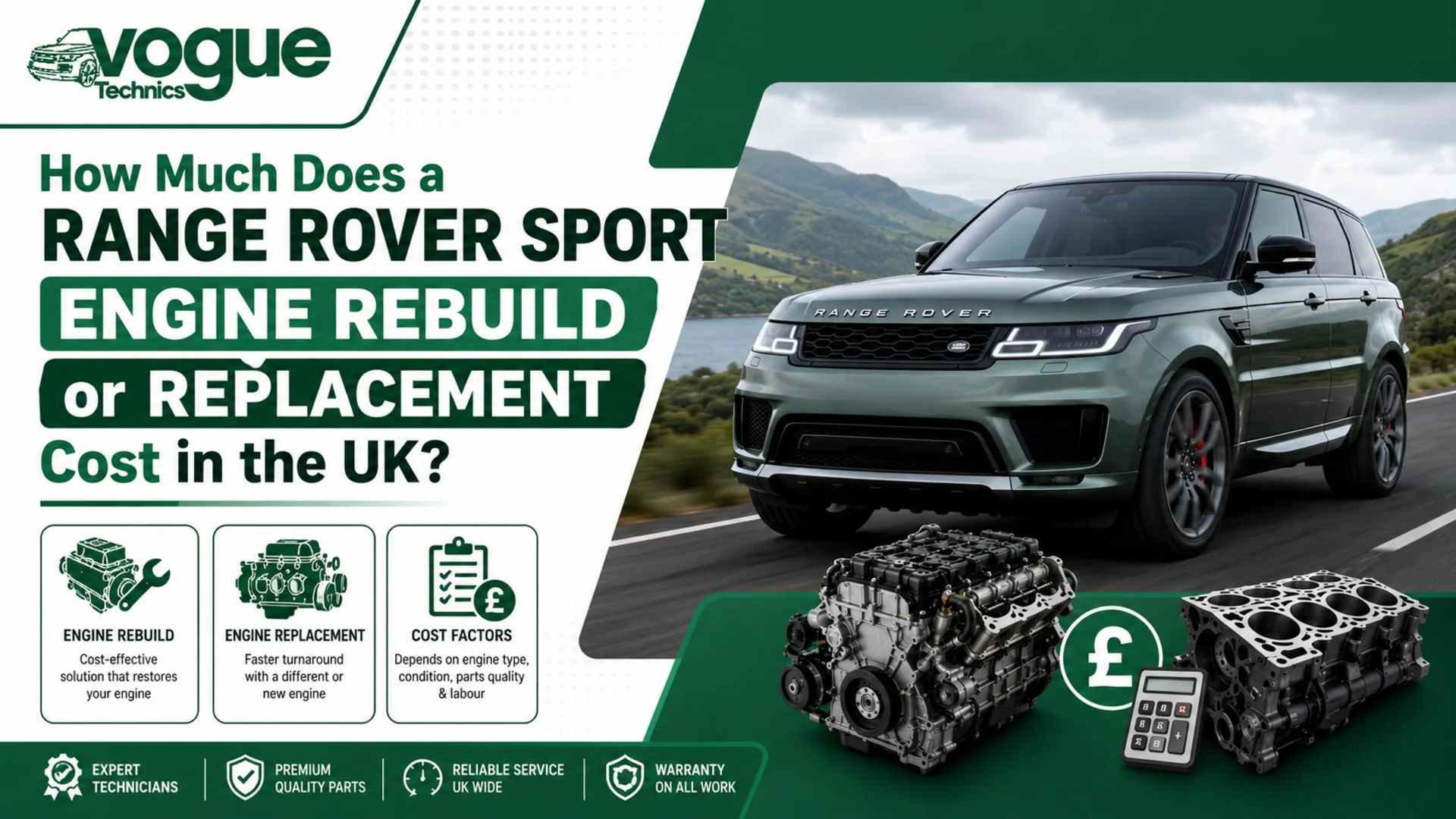
Cost is usually the deciding factor, so let's get specific. Pricing varies significantly depending on your engine variant, the extent of the damage, and whether you're going through a main dealer or an independent Land Rover specialist.
Range Rover Sport Engine Rebuild Cost Breakdown
A full engine rebuild typically costs less than a full replacement, because you're not paying for an entire replacement unit, just labour, machining, and the specific parts that need replacing.
Costs generally increase with:
- The severity of the damage (a worn timing chain costs far less to address than a cracked cylinder block)
- Whether the crankshaft needs regrinding or full replacement
- Labour costs, which vary by region and specialist
- Whether OEM or genuine engine parts are used versus aftermarket alternatives
Range Rover Sport Engine Replacement Cost Breakdown
Replacement costs more upfront because you're paying for a complete engine, either reconditioned, remanufactured, or new, plus the labour to remove your old unit and fit the replacement.
What Affects the Final Cost?
No two engine failures are identical, which is why "how much does it cost" rarely has a single answer. Two factors drive most of the variation.
Engine Variant (Ingenium, SDV6, TDV6, AJ133 V8)
Not all Range Rover and Range Rover Sport engines cost the same to rebuild or replace. A 2.0 Ingenium engine, common in newer L461 and L494 models, tends to have different labour and parts costs than a 3.0 SDV6, a 3.0 TDV6, or the 5.0 Supercharged AJ133 V8 found in older L320 models. Parts availability, complexity, and the amount of specialist machining required all vary by engine code.
Severity of Damage
A rebuild triggered by a worn timing chain and tensioner is a very different job from one triggered by a seized engine, a cracked cylinder block, or catastrophic crankshaft failure. The more extensive the mechanical inspection reveals the damage to be, the closer a rebuild's cost creeps toward full replacement, which is exactly why a proper diagnostic and inspection should always come before you commit to either option.
When Should You Rebuild vs Replace Your Range Rover Engine?
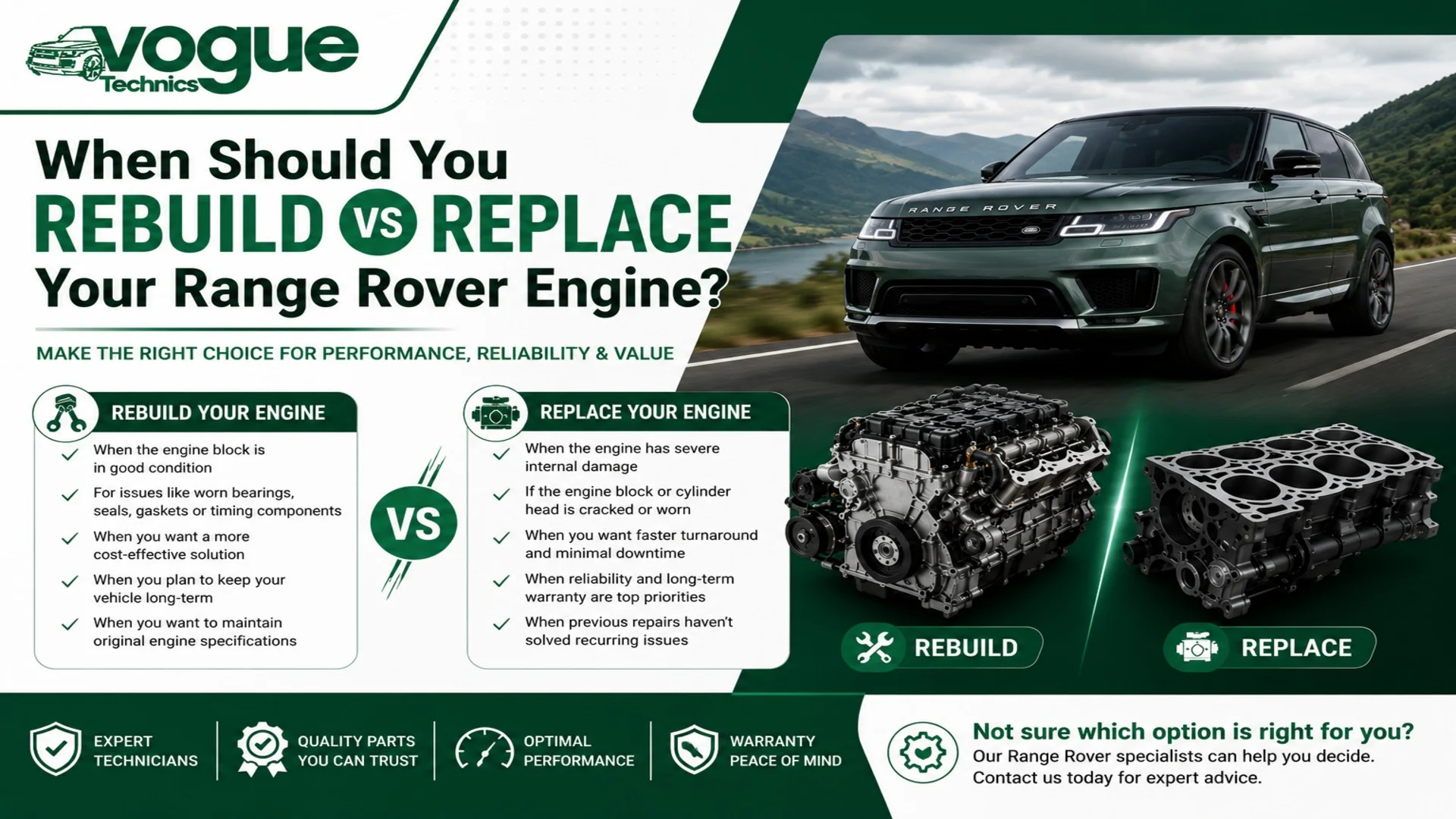
There's no universal right answer here, it depends on your engine's condition, your car's age and mileage, and how long you plan to keep it. Here's how to think it through properly.
When a Rebuild Is the Right Choice
A rebuild tends to make the most sense when:
- The damage is contained to specific components (timing chain, bearings, gaskets) rather than the block itself
- Your engine block and cylinder head are structurally sound after inspection
- You want to retain your original, "matching numbers" engine, a consideration that matters for some owners around resale value and vehicle history
- You're planning to keep the vehicle long-term and want a cost-effective route back to full reliability
When Replacement Makes More Sense
Replacement becomes the more sensible option when:
- The engine block itself is cracked, warped, or beyond machining tolerances
- The damage is catastrophic, for example, a seized engine caused by prolonged oil starvation
- You need the vehicle back on the road faster than a full rebuild timeline allows
- A reconditioned unit works out similarly priced to a rebuild once all the necessary rebuild parts are factored in
As a general rule: if a specialist's inspection shows the block and head are salvageable, a rebuild is usually the more economical route. If the core structure of the engine is compromised, replacement becomes the only realistic long-term fix.
Common Range Rover / Range Rover Sport Engine Failures We See
Understanding what typically goes wrong helps you spot problems early, and helps you understand what a specialist means when they explain your diagnosis.
Signs of Crankshaft Failure
A knocking noise from the engine, particularly one that changes with engine speed, is one of the most common early warning signs of crankshaft or bearing damage. Left unaddressed, a spun bearing can escalate quickly into full crankshaft failure, turning a moderate repair into a full rebuild or replacement job.
Signs of Timing Chain or Turbo Problems
A rattling noise on cold start-up is a classic symptom of timing chain wear, particularly on Ingenium and TDV6 engines. Turbocharger failure often presents differently, reduced power, unusual whining noises, or visible smoke from the exhaust and if ignored, can lead to oil contamination throughout the rest of the engine.
Catching either of these early, before they cause secondary damage, is often the difference between a moderate rebuild and a full engine replacement.
Why Choose Voguetechnics for Your Range Rover Engine Rebuild or Replacement?
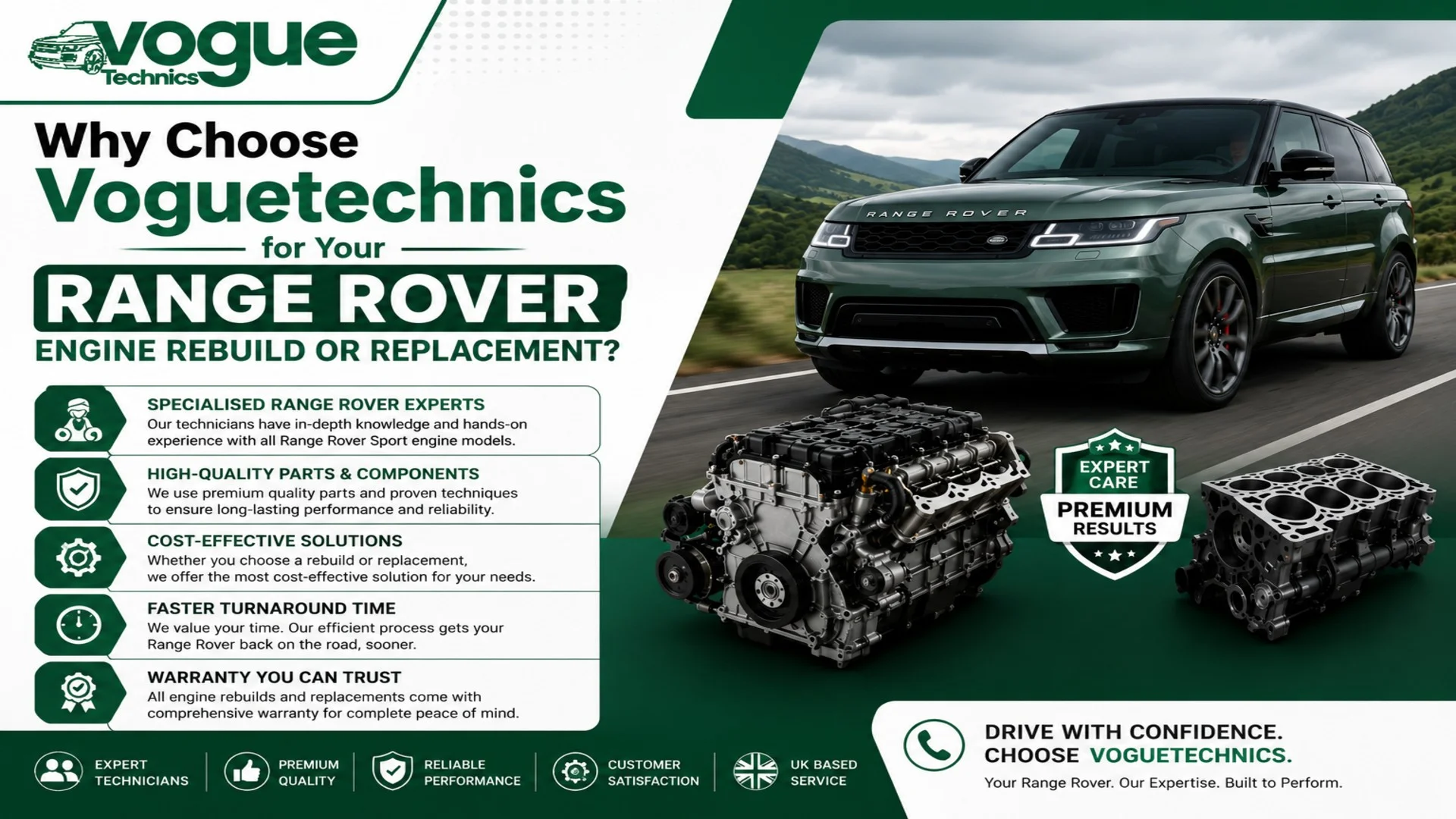
Whichever route you choose, the specialist doing the work matters as much as the decision itself. Range Rover and Range Rover Sport engines, particularly the SDV6, TDV6, Ingenium, and AJ133 variants, require specific expertise, not generalist mechanical work.
Supplied and Fitted Engines with Warranty
Every engine we work on goes through full diagnostics and inspection before any rebuild or replacement decision is made, so you're never paying for guesswork.
Nationwide Collection and Delivery from Grays, Essex
Based in Grays, Essex, we offer [insert actual logistics details, e.g. nationwide vehicle collection and delivery, typical turnaround time], meaning you don't need to be local to get expert-level engine work done on your Range Rover Sport.
Get a Free Quote or Book an Inspection Today
If you're currently weighing up a rebuild against a replacement, the most useful next step is a proper diagnostic inspection, not a guess based on symptoms alone.
Frequently Asked Questions
Is it worth rebuilding a Range Rover Sport engine, or should I replace it?
It depends on the extent of the damage. If the engine block and cylinder head are structurally sound, a rebuild is usually more cost-effective and lets you retain your original engine. If the block itself is cracked or the failure is catastrophic, replacement with a reconditioned unit is typically the more reliable long-term option.
How much does a Range Rover Sport engine rebuild cost in the UK?
Rebuild costs vary depending on your engine variant (Ingenium, SDV6, TDV6, or AJ133 V8) and the severity of the damage. A full diagnostic inspection is the only way to get an accurate quote for your specific vehicle.
How much does a Range Rover engine replacement cost?
Replacement costs more than a rebuild on average, since you're paying for a complete reconditioned or remanufactured engine plus fitting.
Is a reconditioned engine better than a used engine?
Yes, in almost every case. A reconditioned engine has been fully stripped, inspected, and rebuilt to factory tolerances before it's supplied. A used engine is typically fitted as-is, with unknown mileage, wear, and maintenance history, which makes long-term reliability far less predictable.
The Bottom Line
Choosing between a Range Rover engine rebuild and a full replacement isn't something you should decide based on price alone. The right call depends on how far the damage has spread, which engine variant you're running, and how long you're planning to keep the vehicle.
What matters most is getting an accurate diagnosis before any work starts, because a rebuild quoted on incomplete information can end up costing more than a replacement would have from the outset.
If your Range Rover Sport is showing signs of engine trouble knocking, rattling on start-up, reduced power, or warning lights, get it properly inspected before the damage spreads.