
Range Rover Sport Turbo Failure Symptoms: Causes, Diagnosis & Repair (Grays, Essex)
Turbo failure in a Range Rover Sport rarely happens without warning — subtle signs like turbo lag, whining noise, or blue exhaust smoke usually appear well before a full breakdown. This guide breaks down every stage of turbo failure, from early symptoms to fault codes like P0299 and P0234, and explains how to tell real turbo damage apart from a simple boost leak or blocked DPF. It also covers realistic repair costs, OEM vs aftermarket options, and simple habits that can meaningfully extend a turbo's lifespan. For anyone noticing a "Restricted Performance" warning or unusual noise, this is a practical starting point before booking a proper diagnostic.
Your Range Rover Sport just isn't pulling like it used to. Maybe there's a strange whine building under acceleration, or a puff of blue smoke in the rearview mirror when you pull away from the lights. Perhaps the dash has lit up with a "Restricted Performance" warning and the car suddenly feels like it's driving through treacle.
If any of that sounds familiar, you're likely dealing with turbo failure and you're not alone. It's one of the most common (and most misunderstood) issues we see on Range Rover Sport models at our workshop in Grays, Essex. The good news? Turbo problems rarely appear out of nowhere. There's almost always a warning period before things get serious, and knowing what to look for can save you thousands in engine damage.
This guide walks through every stage of turbo failure, the early symptoms, the root causes, how a proper diagnosis is carried out, and what repair actually costs. By the end, you'll know exactly what's happening under your bonnet and what to do about it.
What Are the Symptoms of Range Rover Sport Turbo Failure?
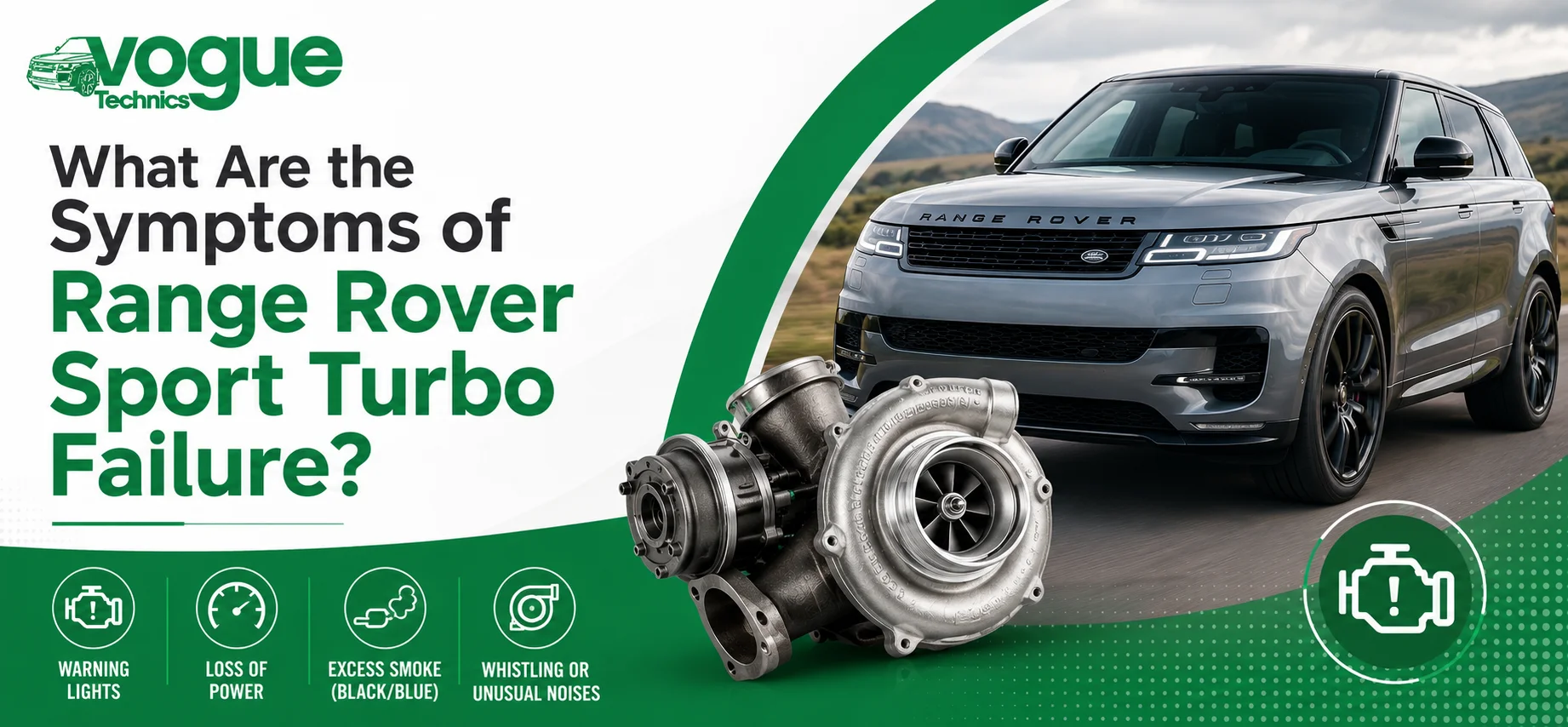
Turbo failure doesn't usually happen overnight. It tends to creep in gradually, which is exactly why so many drivers miss it until the car goes into limp mode on the motorway. Learning to spot the early signs means you can act before a simple repair turns into a full engine rebuild.
Early Warning Signs You Shouldn't Ignore
The first symptoms are often subtle enough to explain away, a bit of hesitation here, a slightly odd noise there. But these small clues matter:
- Turbo lag that feels worse than usual a noticeable delay between pressing the accelerator and the power actually arriving
- Inconsistent boost pressure the car surges unevenly instead of building power smoothly
- A faint whistle or hiss under light acceleration that wasn't there before
- Slightly reduced fuel economy, often the result of the engine compensating for lost efficiency
- Occasional check engine light that clears itself, only to return later
Any one of these on its own might not mean much. But two or three together is usually a sign the turbocharger is starting to wear.
Advanced Turbo Failure Symptoms
Once a turbo has progressed past the early stages, the symptoms become impossible to ignore. This is where most owners finally book a diagnostic, often after weeks of "it'll probably sort itself out."
Turbo Whining or Siren Noise When Accelerating
A failing turbo often produces a distinctive high-pitched whine, some owners describe it as sounding like a jet engine or a police siren spooling up. This noise usually points to worn turbo bearings or shaft play, where the internal components no longer spin true within the housing. It tends to get louder and more constant as the wear progresses.
Blue, Black or White Exhaust Smoke — What Each Colour Means
Exhaust smoke is one of the clearest diagnostic clues you have, and the colour tells a specific story:
Smoke Colour | Likely Cause | Urgency |
| Blue smoke | Oil is leaking past worn turbo seals and burning in the combustion chamber | High — indicates internal turbo damage |
| Black smoke | Overfuelling, often from a turbo unable to deliver correct boost pressure | Medium-High — check turbo and injectors |
| White smoke | Could be coolant intrusion or, less commonly, unburned fuel from a boost fault | Medium — needs proper diagnosis to rule out head gasket issues |
Blue smoke under acceleration is the most turbo-specific symptom on this list. If you see it consistently, oil is almost certainly getting past a damaged seal and that oil consumption will only get worse.
What Does "Restricted Performance" or Limp Mode Mean?
When the engine control module (ECU) detects a fault it can't safely ignore, commonly a boost pressure fault linked to the turbo, it pulls the engine into a protective state often called "limp mode" or, on Range Rover models, a Restricted Performance warning on the dash.
In this mode, the car deliberately limits power and revs to prevent further damage. It's frustrating to drive, but it's actually doing you a favour: it's the engine protecting itself from a turbo that can no longer be trusted to perform safely. Ignoring this warning and continuing to drive normally is one of the fastest ways to turn a turbo repair into a full engine rebuild.
What Causes Turbo Failure in a Range Rover Sport?
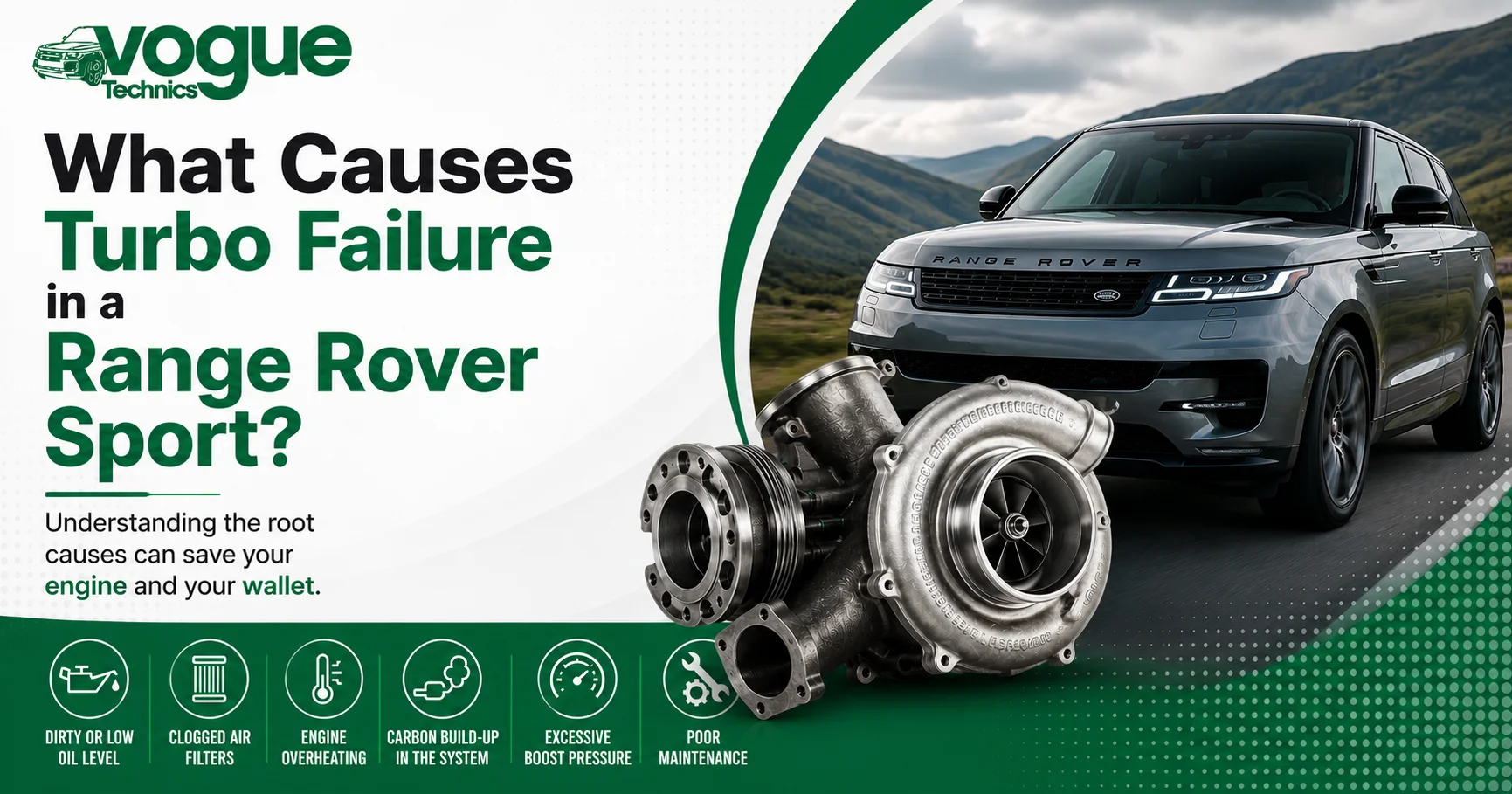
Understanding why turbos fail helps explain why some owners get 150,000 miles out of theirs while others see problems by 60,000. In our experience working on SDV6, TDV6, and Ingenium-engined Range Rover Sport models, the causes almost always fall into a handful of categories.
Oil Starvation and Contaminated Oil
The turbocharger spins at extraordinary speeds, often well over 100,000 RPM and relies entirely on a constant, clean supply of engine oil for lubrication and cooling. When that supply is compromised, damage happens fast.
Common causes of oil-related turbo failure include:
- Extended oil change intervals, allowing oil to break down and lose its lubricating properties
- Low oil level, starving the turbo bearings of lubrication under load
- Blocked oil feed lines, often from sludge build-up in engines that have missed service intervals
- Incorrect oil grade, which doesn't provide the protection the turbo was engineered around
Oil starvation is, in our experience, the single biggest cause of turbo bearing failure. It's also entirely preventable with correct servicing.
DPF and EGR-Related Turbo Damage
The diesel particulate filter (DPF) and EGR valve are closely linked to turbo health in TDV6 and SDV6 engines. When a DPF becomes blocked, it creates excessive back pressure in the exhaust system, pressure the turbo wasn't designed to work against continuously. Over time, this strains the turbine wheel and bearings.
Similarly, a faulty EGR valve can allow carbon deposits to build up in the intake system, restricting airflow and forcing the turbo to work harder than it should to maintain boost pressure. Left unchecked, this accelerates wear significantly.
Worn Bearings, Actuator and Wastegate Faults
Not every turbo issue is about oil or exhaust restriction. Mechanical and electronic components fail too:
- Worn bearings cause shaft play, the compressor and turbine wheels no longer spin on a stable axis, leading to internal contact and damage
- Actuator failure prevents the turbo from correctly adjusting boost pressure, often triggering underboost or overboost fault codes
- Wastegate problems can cause boost to leak away before it reaches the intake, leading to sluggish, underpowered driving
- Variable geometry vane failure, common on VGT turbos, causes the vanes to stick rather than adjust smoothly with engine load
SDV6 vs TDV6 Turbo Failure — Key Differences
Both engines are prone to turbo issues, but the failure patterns differ slightly based on real-world cases we see at our Grays workshop:
Engine | Common Turbo Issue | Typical Trigger |
| TDV6 | Actuator and wastegate faults | Electrical/vacuum line degradation over time |
| SDV6 | Twin-turbo imbalance and bearing wear | High mileage combined with delayed servicing |
If you drive an SDV6, it's worth knowing that twin-turbo setups can fail on just one side while the other continues working, which sometimes masks symptoms until the fault has progressed further than expected.
How Is Turbo Failure Diagnosed? (And How to Tell It Apart From Other Faults)
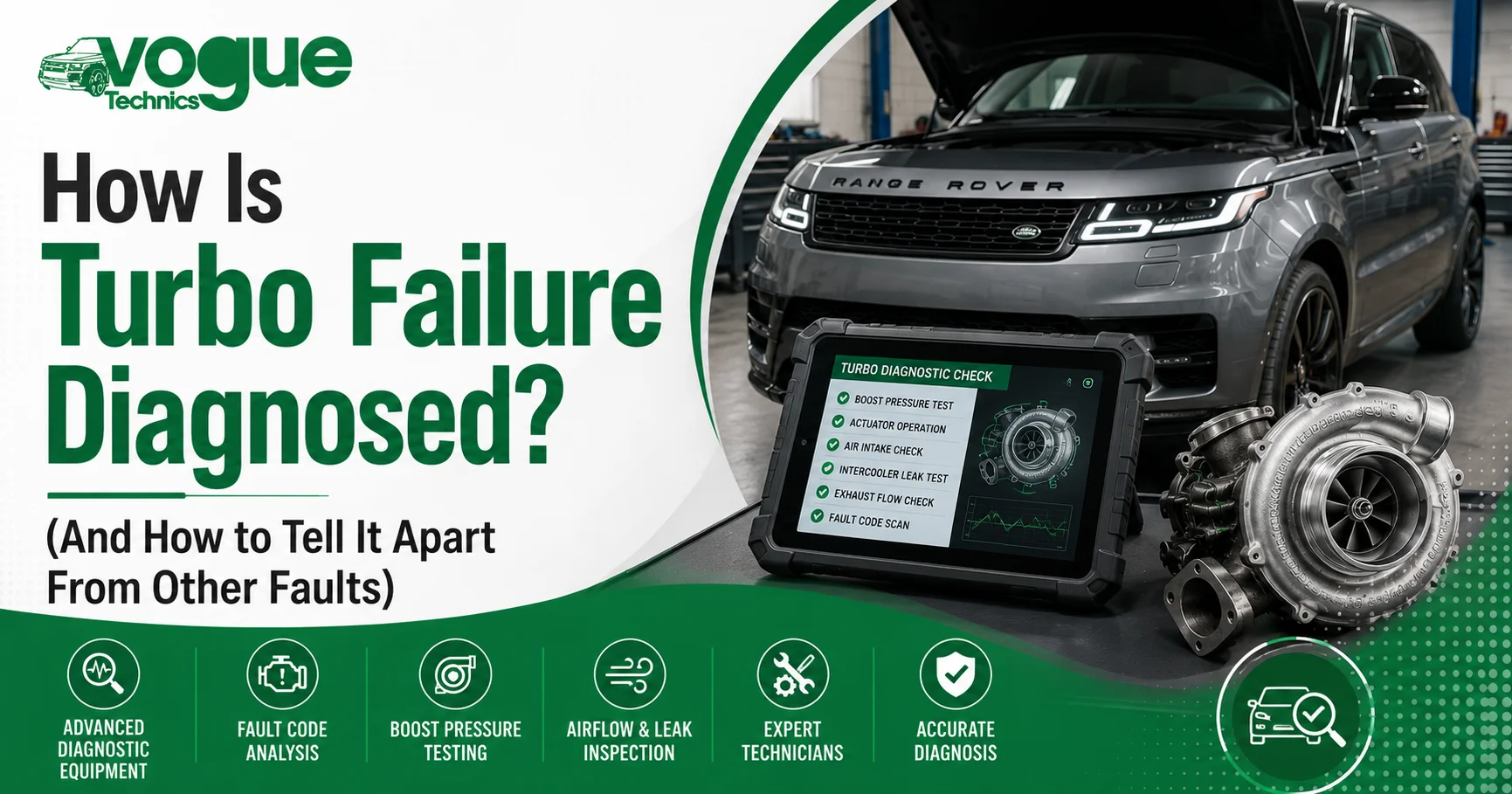
Here's the problem: several other faults mimic turbo failure almost perfectly. A boost leak, a failing MAF sensor, or even a clogged DPF can all produce reduced power and a check engine light. Guessing at repairs based on symptoms alone often means paying for parts that were never the actual problem.
Common Fault Codes Explained (P0299, P0234)
When you connect a diagnostic scanner, the fault codes stored in the ECU give the clearest starting point:
- P0299 — Turbo/Supercharger Underboost Condition. This means the ECU has detected boost pressure below expected levels. It's frequently linked to genuine turbo wear, but boost leaks and vacuum issues can trigger it too.
- P0234 — Turbo/Supercharger Overboost Condition. Less common, this points to boost pressure exceeding safe limits, often due to a stuck wastegate or faulty actuator.
Neither code alone confirms turbo failure, they're a starting point for further testing, not a final diagnosis.
Turbo Failure vs Boost Leak vs DPF Blockage
This is exactly where a lot of guesswork (and unnecessary spending) happens. Here's how the three compare:
Fault | Key Symptom Overlap | How to Tell Them Apart |
| Turbo failure | Loss of power, whining noise, smoke | Physical shaft play, oil in the intercooler, unusual internal noise |
| Boost leak | Loss of power, underboost codes | Smoke test reveals air escaping from pipework or connections; no internal turbo noise |
| DPF blockage | Reduced power, limp mode | Diagnostic shows high DPF soot load; turbo itself tests within spec |
A genuine turbo fault typically comes with physical evidence, play in the shaft, oil pooling in the intercooler piping, or visible wear on the compressor wheel. A boost leak or DPF issue can produce nearly identical driving symptoms without the turbo itself being damaged at all.
How We Diagnose Your Turbo at Our Grays, Essex Workshop
Because the symptoms overlap so heavily, we never assume it's the turbo until we've actually confirmed it. Our diagnostic process typically includes:
- Full OBD2 scan to read live and stored fault codes
- Boost pressure testing under real driving conditions, not just at idle
- Physical shaft play inspection to check for bearing wear
- Smoke testing the intake system to rule out boost leaks
- Visual inspection of the intercooler piping for oil contamination, a strong sign of internal seal failure
- Actuator and wastegate function testing
This structured approach means you're never paying to replace a turbo that was actually fine, or missing a genuine fault because the smoke test was skipped.
Turbo Repair, Rebuild & Replacement at Vogue Technics Engine Rebuild
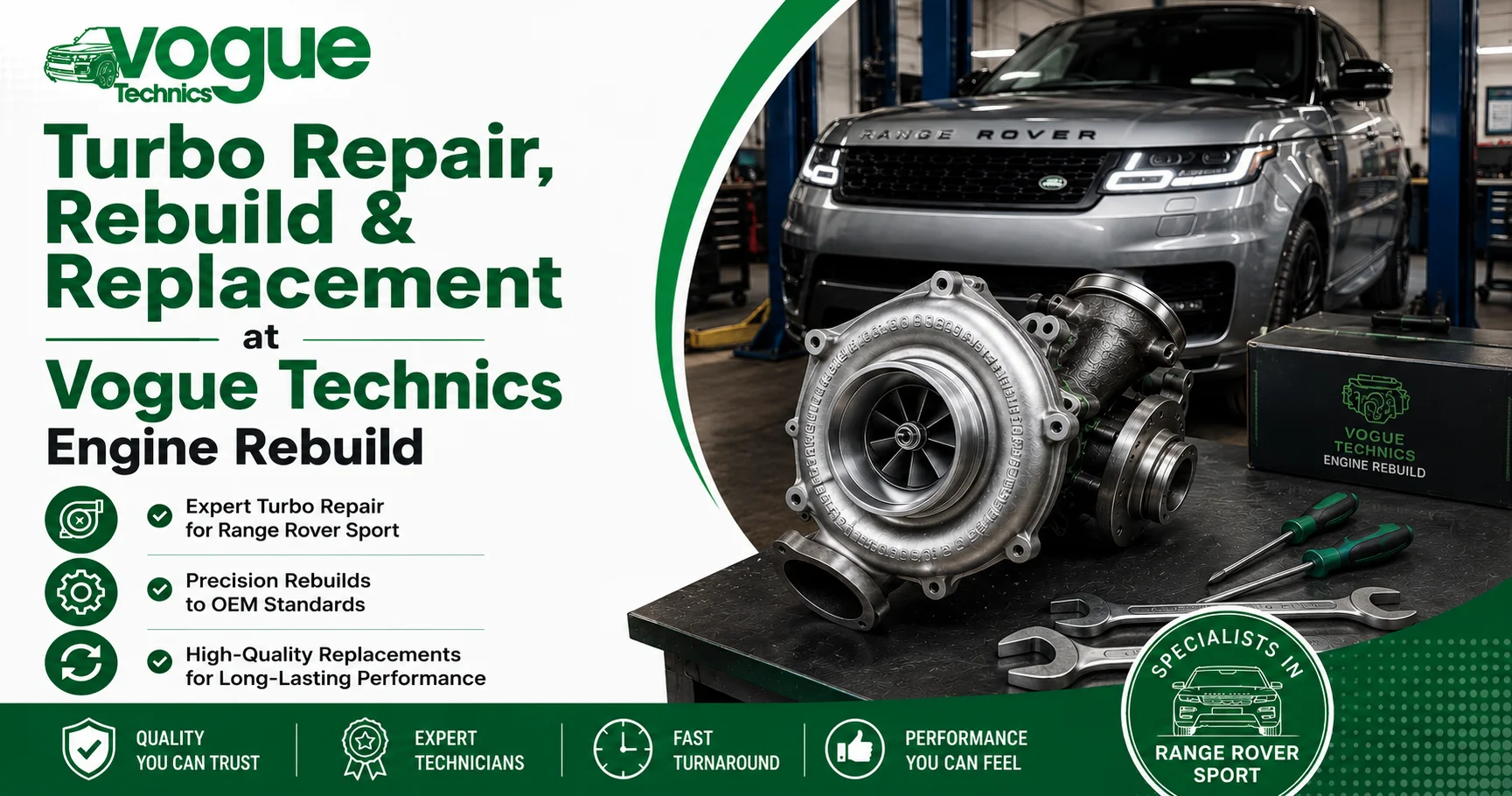
Once turbo failure is confirmed, the next question is always the same: repair or replace and what will it actually cost?
Repair Costs (Inc. VAT) — Rebuild vs Full Replacement
Costs vary depending on the extent of the damage, the specific engine variant, and whether a rebuild or full replacement is appropriate. As a general guide based on the work we carry out:
- Turbo rebuild (replacing bearings, seals and worn internals while retaining the original housing) tends to be the more cost-effective route where the core housing is undamaged
- Full turbo replacement becomes necessary where there's damage to the compressor or turbine wheel, or where a rebuild wouldn't offer reliable long-term performance
- Additional costs may apply where oil starvation has caused contamination, in these cases, an oil system flush is essential to prevent the new or rebuilt turbo from failing prematurely for the same reason
We always provide a written quote after diagnosis, so you know exactly what you're paying for before any work beginsm, no surprises once the car's already in pieces.
OEM vs Aftermarket Turbo — Which Should You Choose?
This is a genuine decision point, not just a sales upsell:
- OEM (genuine Land Rover) turbochargers are built to the exact original specification, which matters enormously on Ingenium and V6 diesel engines where tolerances are tight. They typically cost more upfront but tend to match the reliability of the original part.
- Quality aftermarket turbos can offer a more budget-friendly option, but quality varies significantly between suppliers. A poorly matched aftermarket unit can actually reintroduce the same underboost or actuator issues you started with.
Our recommendation genuinely depends on the vehicle's age, mileage, and how long you're planning to keep itm, we'll talk you through the trade-offs honestly rather than pushing whichever option is more profitable.
Prevention Tips to Extend Your Turbo's Lifespan
A turbo replacement is a significant expense, so prevention is always the cheaper path. A few habits make a real difference over the life of the engine:
- Stick to manufacturer oil change intervals or shorter, if the car sees a lot of stop-start driving
- Use the correct oil grade specified for your engine, not just "any" synthetic oil
- Let the engine idle for 30–60 seconds before switching off after hard driving, allowing the turbo to cool gradually rather than heat-soaking
- Avoid pulling away hard from cold give the oil a minute to circulate properly before demanding full boost
- Keep up with DPF and EGR maintenance, since both directly affect how hard the turbo has to work
None of these guarantee a turbo will never fail, but together they meaningfully reduce the risk and extend the interval between services.
Frequently Asked Questions
What are the first signs of turbo failure?
The earliest signs are usually subtle turbo lag, inconsistent power delivery, and a faint whistling noise under light acceleration, often mistaken for normal engine sounds until they worsen.
Can you drive with a failing turbo?
Short distances at low load are generally possible, but continuing to drive normally risks turning a turbo repair into a full engine rebuild, especially if oil is leaking into the intake or exhaust system.
Why is my Range Rover Sport losing power?
Power loss can stem from turbo failure, but also from boost leaks, a blocked DPF, or sensor faults. A proper diagnostic is the only reliable way to confirm the actual cause.
What does Restricted Performance mean on a Range Rover?
It's a protective mode triggered by the ECU when it detects a fault, commonly linked to boost pressure, that could risk engine damage if driving continued unrestricted.
Does turbo failure damage the engine?
It can. Oil leaking into the intake or exhaust, or debris from a shattered turbine wheel entering the engine, can cause damage well beyond the turbo itself if left unaddressed.
How much does turbo replacement cost on a Range Rover Sport?
Costs depend on whether a rebuild or full replacement is needed, and whether oil contamination requires a system flush. We provide a written quote after diagnosis so there's no guesswork.
Is a turbo rebuild worth it, or should I replace it entirely?
If the housing and major components are undamaged, a rebuild is often the more cost-effective choice. Where there's significant internal damage, replacement is usually the more reliable long-term option.
Book a Turbo Diagnostic or Request a Written Quote
If your Range Rover Sport is showing any of the symptoms covered in this guide, power loss, unusual noise, smoke, or a Restricted Performance warning, the sooner it's diagnosed, the more options (and the lower the cost) you're likely to have.
At Vogue Technics Engine Rebuild, based in Grays, Essex, we specialise in diagnosing and repairing turbo faults on Range Rover Sport, TDV6, SDV6, and Ingenium engines. We'll give you a straight answer on what's actually wrong, a written quote before any work begins, and a repair carried out to a standard that protects the investment you've already made in your car.
Get in touch today to book a diagnostic or request your written quote — and drive away knowing exactly what's under the bonnet.