
Range Rover Sport 5.0 V8 Supercharged Engine Problems: A Specialist's Guide to AJ133 Faults, Costs & Fixes
A specialist's honest guide to the most common Range Rover Sport 5.0 V8 supercharged engine problems from the tell-tale cold-start timing chain rattle and P0016/P0017 fault codes to coolant crossover pipe leaks and cylinder liner damage. It breaks down which model years (2012–2021) carry the most risk, what repairs and full rebuilds realistically cost in the UK, and how to catch a small £400 fault before it becomes a £9,000 one. Written by the AJ133 rebuild team at Vogue Technics in Grays, Essex.
That cold-start rattle you hear for two or three seconds before it settles? The whiff of coolant in the cabin after a motorway run? The orange engine light that flickers on, then off, then on again? If you own a Range Rover Sport with the 5.0 V8 supercharged engine, none of those signs are "just one of those things." They're the early language of an engine that, when neglected, can turn a £400 job into a £9,000 one.
We rebuild these engines for a living here in Grays, Essex. So instead of recycling the same vague warnings you'll find everywhere else, this guide walks you through exactly what goes wrong with the range rover sport 5.0 v8 supercharged, why it happens, which model years are most affected, and what it realistically costs to put right. The aim is simple: help you catch a small fault before it becomes a destroyed engine.
What Goes Wrong With the Range Rover Sport 5.0 V8 Supercharged Engine?
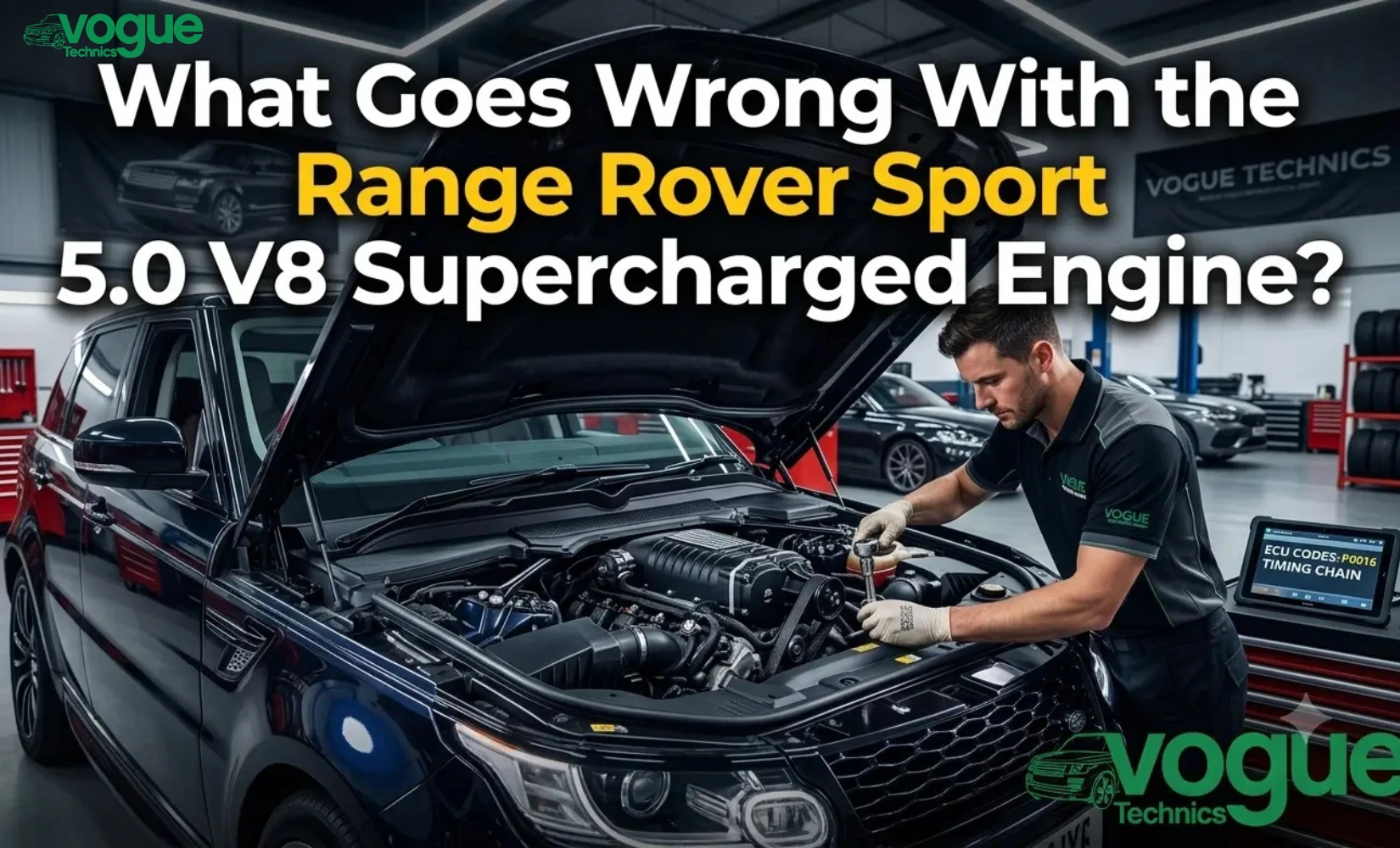
The engine in question is the AJ133, Jaguar Land Rover's 5.0-litre supercharged V8, fitted to the L320 and L494 Range Rover Sport, the full-size Range Rover, and the high-performance SVR. It's a genuinely brilliant engine to drive: 510 to 575 bhp depending on spec, that unmistakable Eaton supercharger whine, and the kind of effortless shove that makes a 2.5-tonne SUV feel light.
But power and longevity aren't the same thing. The AJ133 has a handful of well-documented weak points, and most of them share a frustrating trait: they start quietly and end expensively. Here's where the trouble usually lives.
Timing Chain Failure and Cold Start Rattle — The Most Common AJ133 Fault
If you only remember one thing from this article, make it this. Range rover timing chain failure is the single most common serious problem we see on the 5.0 V8, and the warning sign is almost always the same: a cold start rattle.
It sounds like a fistful of marbles or a brief metallic chatter for one to three seconds when you fire the engine from cold. Owners often dismiss it because it disappears once oil pressure builds. That disappearing act is exactly what makes it dangerous, the noise goes away, but the wear doesn't.
What's actually happening is that the plastic timing chain guides and the hydraulic tensioner are wearing out. As the guides degrade, the chain develops slack. On startup, before oil pressure fills the tensioner, that slack lets the chain slap against its housing, hence the rattle. Left long enough, the chain can jump a tooth or, in the worst cases, the cam phaser and valve timing drift far enough out of sync to cause a misfire or contact between pistons and valves.
What Do the P0016 and P0017 Fault Codes Actually Mean?
When the timing chain stretch reaches a certain point, the engine control module notices that the camshaft and crankshaft are no longer perfectly aligned. It logs a crankshaft–camshaft correlation fault and that's where the codes come in.
- P0016 and P0017: Bank 1 crankshaft/camshaft position correlation faults
- P0018 and P0019: the same problem on Bank 2
- P0008: engine position system performance, often appearing alongside the others
Seeing any of these on a 5.0 V8 should stop you in your tracks. They aren't random sensor glitches. On the AJ133, P0016 and P0017 are textbook symptoms of a worn timing chain and stretched guides, and they warrant a borescope inspection before you drive another mile under load.
Why the Plastic Timing Chain Guides Wear Out (and What Replaces Them)
The original guides were made from a plastic composite that simply doesn't cope well with heat soak, oil sludge, and 60,000-plus miles of cyclic loading. Skipped oil changes accelerate the decay dramatically old, contaminated oil strips the lubrication these guides rely on.
When we carry out an AJ133 timing chain replacement, we don't just refit like-for-like parts and wait for the same failure. We use upgraded guides and a revised tensioner, replace both chains, and inspect the cam phasers while everything's apart. Doing it once, properly, is far cheaper than doing it twice.
Cooling System & Coolant Crossover Pipe Failures Explained
The second great weakness of the range rover 5.0 v8 supercharged is its cooling system and the headline offender is the coolant crossover pipe (also called the rear coolant manifold).
This pipe sits in the engine valley, tucked under the supercharger where it's exposed to constant heat. Early versions used a plastic construction that becomes brittle over time and eventually cracks or splits. Because of where it lives, a small leak is almost impossible to spot from above the coolant quietly drips down into the V of the engine.
The classic owner experience goes like this: a faint burning coolant smell from the engine bay, a low coolant warning that keeps coming back despite topping up, and no obvious puddle on the driveway. That combination is the rear coolant crossover pipe waving a red flag.
Water Pump and Thermostat Housing Weak Points to Watch
The crossover pipe isn't the only cooling component that ages badly. Two others deserve your attention:
- Water pump bearing wear: a failing pump often produces a faint whirring or grinding from the front of the engine and may weep coolant from a weep hole. A seized pump means instant overheating.
- Thermostat housing cracks: like the crossover pipe, the early housings were plastic and prone to hairline cracks that seep coolant slowly, usually worsening as the engine heats and cools.
Because these parts share the same root cause, heat-aged plastic many specialists, ourselves included, recommend tackling them together once one fails. Opening the engine valley is the labour-intensive part; replacing two extra components while you're already in there costs comparatively little.
How Coolant Loss Quietly Leads to Overheating and Cylinder Damage
Here's the part most owners underestimate. Coolant loss on the AJ133 rarely announces itself with steam and a stranded car on the hard shoulder. It's gradual. You top up, it drops again, you top up again, life carries on.
Then one hot day in stop-start traffic, the level finally gets low enough that the engine overheats and aluminium does not forgive overheating. This is the chain reaction we see far too often:
Slow coolant intrusion or loss → localised hot spots → cylinder liner distortion → cylinder scoring → loss of compression and engine knock.
A £300 pipe ignored for six months becomes a destroyed bottom end. That's not scaremongering; it's the most common reason a 5.0 V8 lands on our ramps needing a full rebuild.
Supercharger Coupler Noise, Boost Loss & Snout Bearing Wear
The Eaton supercharger sitting in the engine valley is generally robust, but it has two recognised faults. The first is a supercharger coupler noise, a rattling or knocking from the centre of the engine at idle or on light throttle, caused by the rubber isolating coupler breaking down. It's irritating rather than catastrophic, and replacing the coupler usually cures it.
The second, less common, is snout bearing wear in the supercharger's front nose drive, which can cause a whine that changes with engine speed and, eventually, boost loss. Caught early, a supercharger rebuild is far cheaper than a replacement unit.
Cylinder Liner Scoring and Internal Engine Damage — The Costly One
This is the failure nobody wants. The AJ133 uses cylinder liners pressed into the aluminium block, and under certain conditions, usually overheating, oil starvation, or sheer high mileage, those liners can crack or score.
The symptoms build slowly: rising oil consumption, a persistent engine ticking noise, misfire codes, white smoke from the exhaust (a sign coolant or oil is entering the combustion chamber), and eventually limp mode and low compression confirmed by a compression or leak-down test.
By the time cylinder liner failure is confirmed, repair is no longer about a single part, it's about rebuilding or replacing the engine. Which brings us neatly to the question of whether some model years are simply better bets than others.
Are Some Model Years More Reliable? 2012–2021 Range Rover Sport V8 Compared

Owners constantly ask whether their specific year is a "good one." It's a fair question, because Jaguar Land Rover did make meaningful changes over the AJ133's life and the era you buy into genuinely affects your risk.
Pre-2015 vs Post-2015 AJ133 — Which Updates Actually Improved Reliability?
The most useful dividing line is roughly 2014–2015. The earlier L320-era and early L494 engines are the ones most associated with the original weak points: the fragile plastic coolant pipes, the early timing chain guides, and a higher reported rate of cold-start rattle.
From around 2015, revised parts and incremental engineering improvements reduced, though never entirely eliminated, some of these issues. A well-maintained post-2015 car carries lower inherent risk than a neglected 2013. That said, maintenance history matters more than model year. A 2013 with a documented timing chain and coolant pipe overhaul is a safer buy than a 2018 with a blank service book and a known rattle.
Which Years Report the Most Problems? (2012, 2013, 2016, 2017, 2018 & 2021)
Here's a realistic, experience-based snapshot of what tends to surface on each era. Treat it as a risk guide, not a guarantee, every car is the sum of how it's been treated.
Model Year | Primary Risk Areas | General Reliability Picture |
| 2012–2013 | Coolant crossover pipe, early timing chain guides, water pump | Highest risk if maintenance was skipped; many now need preventive work |
| 2014–2015 | Tail end of early faults; transitional updates appearing | Mixed — check exactly which revised parts are fitted |
| 2016–2017 | Timing chain wear at higher mileage, cooling components ageing | Improved, but mileage-driven faults now emerging |
| 2018 | Cooling system maintenance, supercharger coupler | Generally stronger; faults usually maintenance-related |
| 2021 | Low-mileage examples mostly trouble-free so far | Newest revisions; long-term data still building |
The pattern is clear: the 2012 and 2013 range rover sport 5.0 v8 supercharged cars carry the most baked-in risk, the 2016, 2017 and 2018 cars are increasingly about age and mileage rather than design, and the 2021 cars are still early in their story.
Is the Range Rover 5.0 Supercharged Engine Reliable at High Mileage?
Yes, with a crucial condition attached. We've seen AJ133 engines comfortably pass 130,000–150,000 miles when the owner stayed ahead of the known faults. The phrase that matters for range rover 5.0 supercharged engine reliability is preventive. The engine doesn't usually die of old age; it dies of a deferred coolant pipe or a rattle that was ignored for two winters. Look after the weak points and this is a long-lived engine. Ignore them and even a low-mileage car can fail early.
What Does It Cost to Repair or Rebuild a 5.0 V8 Supercharged Engine?
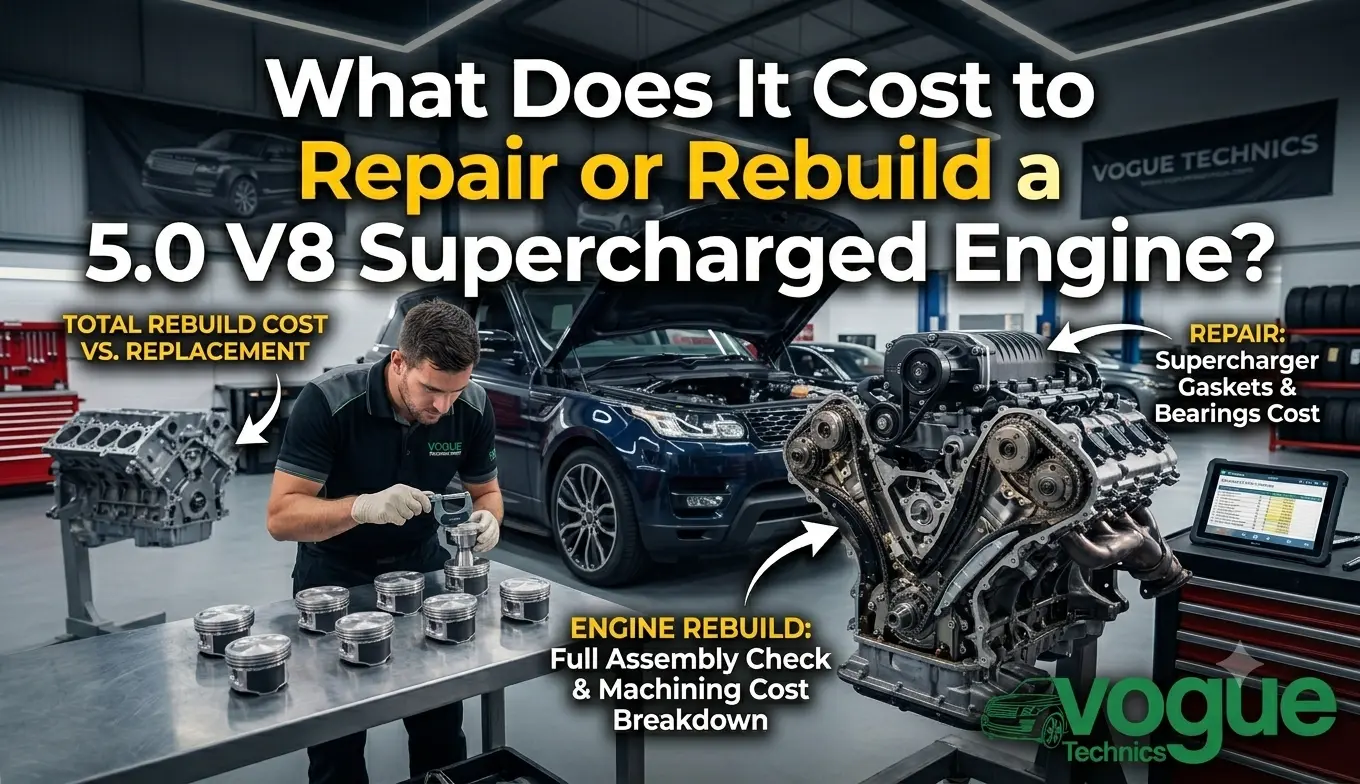
Let's talk money honestly, because vague answers help nobody. Costs vary with parts, labour rates, and how much damage has already been done but here's a realistic UK picture to frame your decision.
Timing Chain Replacement Cost vs Full Engine Rebuild Cost (UK)
The gap between fixing a problem early and fixing it late is enormous, and these figures show exactly why catching the cold-start rattle matters.
- Coolant crossover pipe replacement: typically a few hundred to around £900, depending on what's bundled in
- Water pump replacement: broadly £500–£1,200 with parts and labour
- Supercharger coupler replacement: usually a few hundred pounds
- Timing chain replacement (full kit, both banks, upgraded guides): commonly £1,800–£3,500 depending on parts and condition found on strip-down
- Full engine rebuild: generally £6,000–£9,000+, and a replacement engine can run higher still
Read those numbers again in order. A neglected timing chain or coolant pipe is what causes the engine that needs the £6,000–£9,000 rebuild. The cheapest engine you'll ever own is the one you maintained before it broke.
Rebuild or Replace? How to Decide When Your AJ133 Fails
When a 5.0 V8 has suffered serious internal damage, you're choosing between a quality rebuild and a replacement engine. A rebuild lets you address the known weak points with upgraded parts and gives you a known history, you know exactly what went in. A replacement can be quicker but you inherit another engine's unknown past unless it's a properly remanufactured unit.
In most cases, a specialist rebuild that corrects the original design weaknesses offers the better long-term value, because it tackles why the engine failed rather than just swapping in another one that can fail the same way.
Clear Signs Your Engine Needs a Full Rebuild, Not Just a Repair
Some symptoms tell you the problem has gone past a single component. Treat the following as rebuild territory rather than a quick fix:
- Confirmed low compression or failed leak-down on one or more cylinders
- Persistent white smoke from the exhaust indicating coolant or oil burning
- Cylinder scoring or liner cracking found on borescope inspection
- Engine knock or bearing failure noise under load
- Repeated overheating that has already cooked the top end
If you're seeing two or more of these together, stop driving the car. Every mile under load risks turning a rebuildable engine into scrap.
How to Prevent Expensive Failures — A Maintenance Checklist for Owners
The good news is that almost every catastrophic AJ133 failure is preventable. Stay ahead of these and you dramatically improve your odds:
- Change the oil more often than the schedule suggests: every 6,000–8,000 miles with the correct synthetic oil protects the timing chain and guides
- Treat any cold-start rattle as urgent, not cosmetic, book a borescope inspection promptly
- Watch coolant level weekly: a slow, repeated drop means a leak, not evaporation
- Act on the first burning-coolant smell rather than topping up indefinitely
- Replace ageing plastic cooling parts proactively on pre-2015 cars before they crack
- Don't ignore the orange engine light pull the codes, especially P0016/P0017
None of this is glamorous, but every owner we meet who's still running a healthy high-mileage V8 does these things almost without thinking. The ones facing a rebuild usually skipped them.
Where to Get Your Range Rover Sport V8 Rebuilt or Repaired in the UK
Diagnosing an AJ133 correctly takes specific experience. A general garage might replace a part and clear a code; a specialist understands why the range rover sport 5.0 v8 supercharged fails and fixes the underlying cause so it doesn't return.
Why Owners Choose Vogue Technics for AJ133 Engine Rebuilds in Grays, Essex
At Vogue Technics, based in Grays, Essex, the 5.0 V8 is core to what we do. We rebuild these engines properly, addressing the timing chain guides, cooling weak points, supercharger, and internal damage as a system, not as isolated parts. Every rebuild uses upgraded components where the original design fell short, so you're not simply resetting the clock on the same failure.
If your car is showing any of the warning signs in this guide, a cold-start rattle, recurring coolant loss, a misfire, or those correlation codes, we can inspect it, give you a straight answer, and tell you honestly whether you're looking at a repair or a rebuild. No guesswork, no upselling a new engine when a targeted fix will do.
Frequently Asked Questions About the 5.0 V8 Supercharged Engine
How Long Does a Range Rover Sport 5.0 V8 Last?
With disciplined maintenance, the AJ133 commonly reaches 130,000–150,000 miles and beyond. Longevity is far more about how the timing and cooling systems were cared for than about the badge or the year. A maintained engine lasts; a neglected one fails early regardless of mileage.
Should I Buy a High-Mileage Supercharged Range Rover Sport?
You can, if you buy on history, not hope. Insist on service records, listen for a cold-start rattle, check for any coolant smell, and ideally have a specialist inspection and a borescope check before purchase. A high-mileage car with documented timing chain and coolant work can be a smarter buy than a lower-mileage one with no paperwork.
Is Coolant Loss Normal on the Range Rover Sport V8?
No. A V8 in good health does not steadily lose coolant. Any repeated drop in level points to a leak, most often the rear coolant crossover pipe, water pump, or thermostat housing. Because slow coolant loss is the leading path to overheating and cylinder damage, it should be investigated quickly rather than managed with constant top-ups.
Does the Range Rover Sport 5.0 V8 Have a BMW Engine?
No. The 5.0 supercharged V8 is the Jaguar Land Rover-developed AJ133, not a BMW unit. The BMW association comes from older Range Rovers; the supercharged 5.0 is JLR's own design.
If your Range Rover Sport is showing even one of the symptoms above, the most expensive thing you can do is wait. Catch the rattle, chase the coolant, read the codes and if you'd like a specialist's honest assessment, Vogue Technics in Grays, Essex is here to take a proper look before a small fault becomes a big one.