
Range Rover Velar vs Discovery Sport Engine Reliability: Which Land Rover Lasts Longer?
Trying to decide between a Range Rover Velar and a Discovery Sport? This guide breaks down real workshop data on Ingenium engine reliability, comparing the Velar's petrol strengths against the Discovery Sport's diesel efficiency. You'll learn the most common faults for each model, typical repair costs, and which one suits your driving style best. Written by Ingenium specialists who service both models daily in Essex.
If you've spent any time searching "range rover velar vs discovery sport," chances are you're not just comparing badges and interiors. You're trying to work out which one is going to leave you stranded on the hard shoulder with a warning light on the dash, and which one is going to quietly rack up 100,000 miles without drama.
That's a fair question. We work on Ingenium engines every week at our workshop in Grays, Essex, and we see both these models come through the doors, sometimes for routine servicing, sometimes for a turbo that's given up or a timing chain that's stretched past its limit. So this isn't a spec-sheet comparison lifted from a brochure. It's what we actually see on the ramp.
By the end of this guide, you'll know exactly where each engine tends to fail, what it costs to put right, and which one makes more sense depending on how you drive.
Range Rover Velar vs Discovery Sport – Engine Reliability Compared
Both the Range Rover Velar and the Land Rover Discovery Sport sit on Jaguar Land Rover's Ingenium engine family, but they're not identical under the skin, and reliability doesn't split neatly along model lines. It splits along engine choice.
Here's the short answer: the Velar's petrol Ingenium engines (P250, P300, P400) tend to be more mechanically forgiving in daily use, while the Discovery Sport's diesel units (D180, D200) are more efficient but more sensitive to short journeys and poor maintenance.
That's the headline. The detail matters more, though, because reliability isn't really about the model — it's about the specific engine code, the mileage, the service history, and how the car has actually been driven.
Factor | Range Rover Velar | Discovery Sport |
| Common engines | P250, P300, P400 petrol; D200 diesel | D150, D180, D200 diesel; P200, P250 petrol |
| Typical weak points | Turbo actuator, timing chain tensioner (petrol) | EGR cooler, DPF blockages, oil dilution (diesel) |
| Best suited to | Mixed motorway/urban driving | Longer motorway commutes |
| Average repair cost range | £450–£2,800 depending on fault | £350–£2,500 depending on fault |
| Reliability by mileage | Strong to 80k, watch turbo after | Strong on motorway miles, weak on short trips |
Neither car is a bad buy. Both are far more dependable than their reputation on owner forums suggests, but only if you know what to look for and you're buying the right engine for your driving pattern.
Common Engine Problems & Faults in Both Models
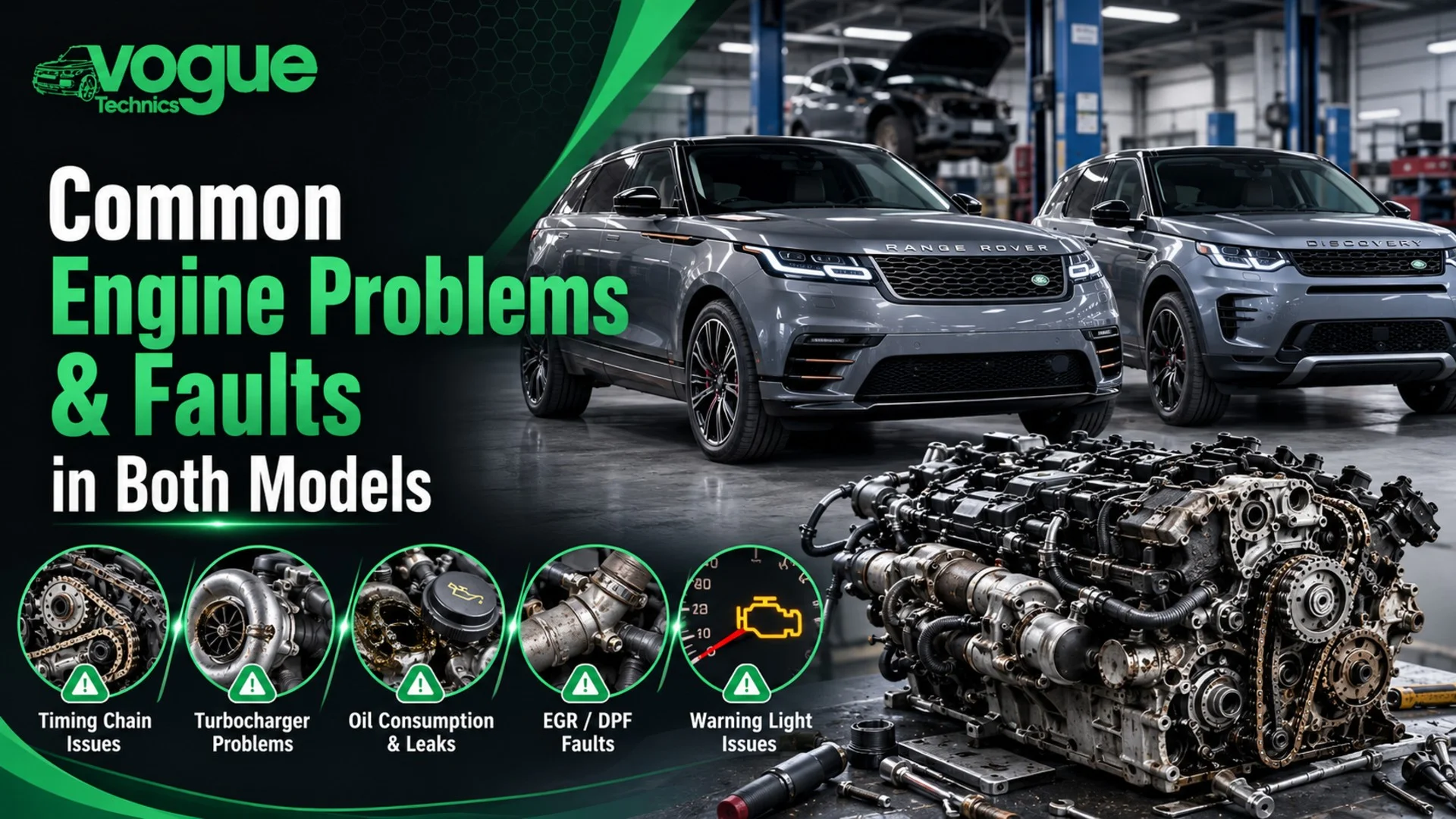
This is where most comparison articles stop at generic bullet points. We'd rather show you what actually turns up in the workshop, because that's what determines your real-world ownership cost.
Range Rover Velar Engine Problems (Timing Chain, Turbo & Oil Dilution)
The Velar's petrol Ingenium engines are generally strong performers, but they have three recurring issues worth knowing about before you buy or as you plan maintenance:
- Timing chain tensioner wear: Early production Ingenium petrol units (particularly pre-2019) can develop a rattle on cold start. Left unaddressed, this leads to chain stretch and, in worst cases, valve timing faults.
- Turbocharger actuator faults: A sticking actuator often shows up as reduced power or a limp mode warning. It's rarely catastrophic if caught early, but ignoring it can shorten turbo life significantly.
- Oil dilution on short journeys: This mainly affects earlier diesel-hybrid variants, but some petrol units used frequently for short trips show similar symptoms, oil level rising due to unburnt fuel contamination.
A Velar that's done consistent motorway miles with full-service history rarely gives trouble before 100,000 miles. A Velar used almost exclusively for the school run is a different story.
Discovery Sport Engine Problems (DPF, EGR & Coolant Leaks)
The Discovery Sport's diesel-heavy line-up brings a different set of issues, mostly tied to how diesel particulate systems behave under low-load driving:
- DPF blockages: Frequent short trips prevent the Diesel Particulate Filter from regenerating properly, leading to reduced power, increased fuel use, and eventually a costly filter replacement.
- EGR valve and cooler faults: A common cause of the engine management light, particularly on higher-mileage D150 and D180 units. Left unresolved, it can affect combustion efficiency and emissions readings.
- Coolant leaks from the thermostat housing: A known weak point on early Ingenium diesel units. It's a moderate repair cost but one that needs addressing quickly, since a slow leak can eventually cause overheating.
If most of your driving is longer motorway or A-road journeys, the Discovery Sport's diesel engines tend to run cleanly with far fewer DPF-related headaches. It's the stop-start urban owners who see the most engine warning lights.
Ownership Costs, Fuel Economy & Maintenance

Reliability and running costs go hand in hand, so it's worth putting real numbers against both cars rather than vague "diesel is cheaper to run" statements.
Maintenance & Repair Costs Compared (Velar vs Discovery Sport)
Here's roughly what we see in terms of typical repair spend, based on the faults above:
Repair Type | Range Rover Velar | Discovery Sport |
| Timing chain replacement | £900–£1,600 | £850–£1,500 |
| Turbocharger replacement | £1,200–£2,800 | £1,100–£2,600 |
| DPF replacement/clean | N/A (petrol-dominant) | £400–£1,400 |
| EGR valve/cooler replacement | £350–£700 | £400–£900 |
| Coolant leak repair | £250–£600 | £300–£750 |
On fuel economy, the Discovery Sport's diesel variants typically return better real-world MPG on longer runs, often into the mid-to-high 40s for the D180 and D200, compared to the low-to-mid 30s you'll usually see from the Velar's P250 and P300 petrol engines. The Velar's plug-in hybrid P400e narrows that gap considerably for owners who can charge regularly, similar to how the Discovery Sport's P300e hybrid variant performs.
Example scenario: A driver doing 15,000 miles a year, mostly motorway commuting, will typically find the Discovery Sport D180 cheaper to run day-to-day and gentler on the DPF system. A driver doing mixed urban and weekend driving, where a diesel would struggle to regenerate its filter, is usually better served by a Velar petrol variant, even with the lower MPG figures.
Warranty cover matters here too. Both models carry Land Rover's standard new-vehicle warranty, but once that expires, typically around the 3-year mark, is exactly when we start seeing more of these faults come through independent workshops rather than main dealers, largely because of the cost difference for the same repair.
Which Should You Buy? Verdict & Expert Support

If we had to sum it up in one line: choose the Velar if your driving is mixed and you want stronger petrol reliability; choose the Discovery Sport if you're doing serious motorway mileage and want diesel efficiency.
Neither engine is "bad." Both are typical of modern turbocharged, emissions-focused engineering, brilliant when maintained properly, expensive when neglected. The single biggest predictor of reliability in both cars isn't the badge on the boot, it's whether the previous owner kept up with servicing and didn't let short-trip driving quietly damage the DPF or dilute the oil.
Get a Professional Engine Inspection, Diagnosis or Rebuild in Essex
Whether you're buying used and want peace of mind before you commit, or you're already noticing a warning light, a rattle on cold start, or reduced power, it's worth getting the engine properly assessed before the fault escalates.
At Voguetechnics Engine Rebuild, based in Grays, Essex, we specialise in Ingenium engine diagnostics, repairs, and full rebuilds for Range Rover, Discovery Sport, and the wider Land Rover range. We see these exact faults regularly, and we'd rather catch a timing chain tensioner issue at an early stage than have a customer facing a full engine replacement bill six months later.
If you're weighing up a Velar against a Discovery Sport, or you already own one and something doesn't feel right, get in touch for an inspection. It's a lot cheaper than guessing.
Frequently Asked Questions
Is the Range Rover Velar more reliable than the Discovery Sport? It depends on the engine rather than the model. The Velar's petrol Ingenium units are generally more forgiving for mixed driving, while the Discovery Sport's diesel engines are reliable when driven on longer runs but more prone to DPF and EGR issues on short journeys.
What is the most common Discovery Sport engine problem? DPF blockages and EGR valve faults are the most frequently reported issues, particularly on cars used mainly for short, low-speed trips where the particulate filter can't regenerate properly.
What is the most common Velar engine problem? Timing chain tensioner wear and turbocharger actuator faults are the two issues we see most often, especially on earlier production petrol units.
Are Ingenium engines reliable overall? Generally, yes, when serviced on schedule and driven in a way that suits the fuel type. Diesel Ingenium engines need regular longer journeys to keep the DPF clear; petrol variants are more tolerant of mixed driving.
How much does it cost to replace a Land Rover engine? Full engine replacement costs vary significantly depending on the model and engine code, but typically range from £4,000 to £9,000+ for Ingenium units. A rebuild is often significantly cheaper than a full replacement and is worth exploring first.
Which is cheaper to maintain, the Velar or the Discovery Sport? Day-to-day servicing costs are broadly similar, but the Discovery Sport's diesel variants carry additional risk of DPF and EGR-related repairs if used mainly for short trips, which can push up long-term costs.
Should I buy a diesel or petrol Land Rover? If you regularly drive 20+ miles at a time, including motorway stretches, a diesel Ingenium engine (D180, D200) will usually reward you with better economy and fewer DPF issues. If your driving is mostly short and urban, a petrol Ingenium engine tends to hold up better over time.