
Range Rover Sport Oil Dilution: Complete Guide to Symptoms, Causes & Expert Repair Solutions
Range Rover Sport owners with Ingenium diesel engines face a hidden but serious threat: oil dilution caused by unburned fuel entering the crankcase during DPF regeneration. Left unchecked, it thins engine oil, damages the timing chain, turbocharger, and crankshaft bearings, and can lead to costly engine rebuilds. This guide covers the warning signs, root causes, and expert-recommended prevention and repair strategies to help owners catch the problem early and protect their engine.
Your engine is quietly failing, and most Range Rover Sport owners don't realize it until thousands of pounds in damage have already been done.
If you've noticed your oil level climbing on the dipstick, caught a diesel smell wafting from under the bonnet, or seen an "Oil Quality Warning" light flashing on your dashboard, you're not alone. Oil dilution has become a persistent issue affecting countless Ingenium diesel-powered Range Rover Sport owners across the UK and it's costing them dearly.
The problem? Unburned diesel fuel is infiltrating your engine oil, degrading its protective properties and putting your timing chain, turbocharger, and crankshaft bearings under relentless stress. What starts as a minor warning often spirals into catastrophic engine damage requiring a full rebuild.
But here's the good news: if you catch it early, oil dilution is preventable and manageable. This comprehensive guide walks you through everything you need to know, from understanding why it happens to recognizing the warning signs, grasping the real damage being done, and knowing exactly what repair options are available to you.
What Is Range Rover Sport Oil Dilution & Why It Matters
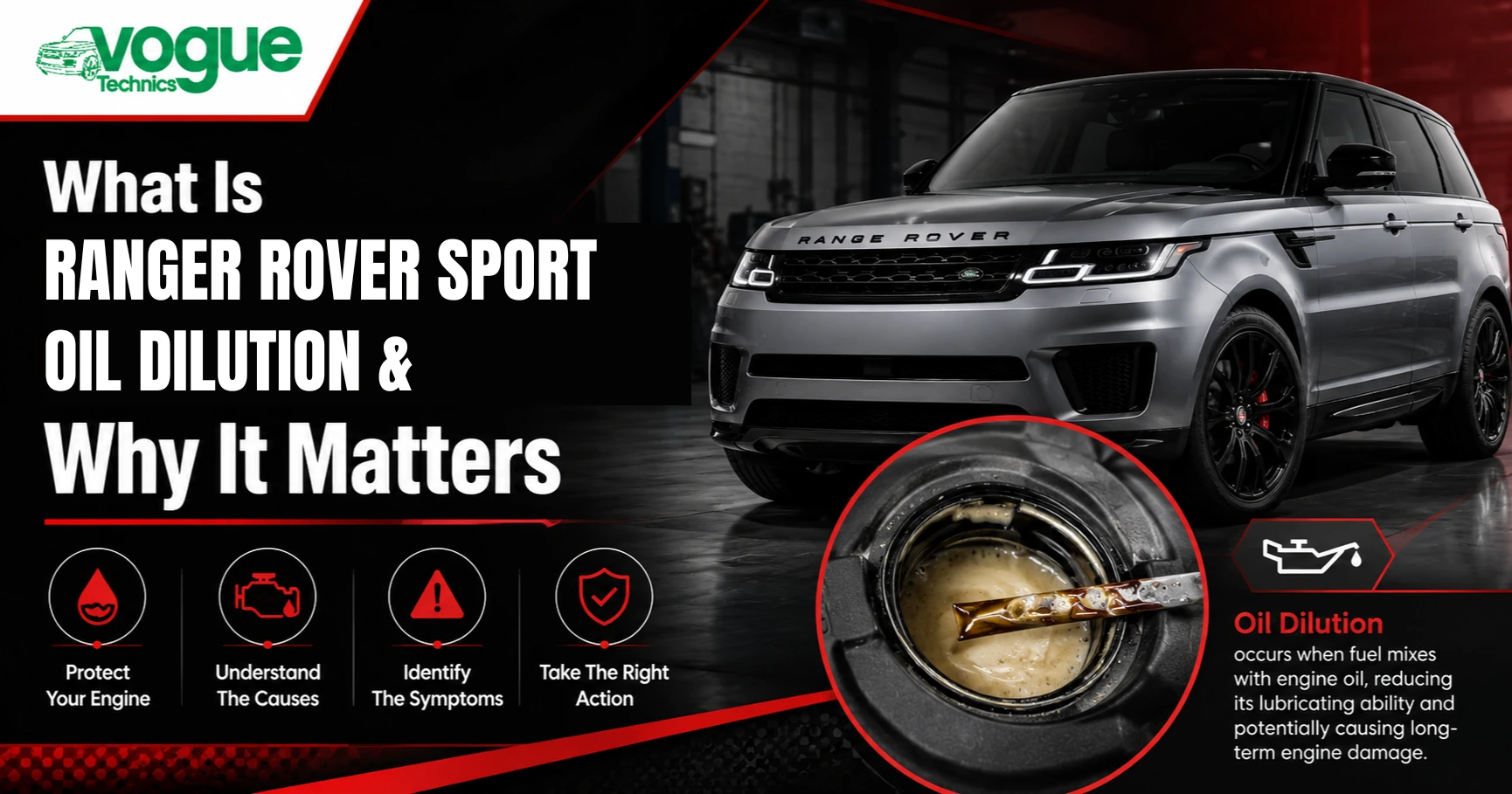
Understanding Oil Dilution in Your Ingenium Engine
Oil dilution sounds simple on the surface: fuel is entering your engine oil. But the reality is far more complex and damaging than most owners realize.
Engine oil serves a single, critical purpose in your Range Rover Sport, it lubricates moving metal parts and prevents them from grinding against each other. When diesel fuel enters this oil, something sinister happens: the fuel acts as a solvent, thinning the oil and breaking down its protective viscosity.
Think of it this way. Fresh engine oil maintains a specific thickness, a viscosity rating like 5W30 or 5W40. This thickness creates a microscopic film between moving components, preventing metal-on-metal contact. When fuel dilutes this oil, that protective film grows thinner and weaker. The oil can no longer hold the pressure it's designed to handle, and components that should glide effortlessly suddenly start wearing against each other.
The Science Behind Fuel Entering Engine Oil
Your Ingenium diesel engine relies on a precision fuel injection system. During normal operation, fuel is sprayed directly into the combustion chamber at exactly the right moment, where it ignites and drives the pistons. Perfect timing and complete combustion keep excess fuel out of the crankcase.
But here's where it gets complicated: your Range Rover Sport has a Diesel Particulate Filter (DPF) designed to trap harmful emissions. When this filter becomes clogged with soot, your engine activates an aggressive regeneration cycle. During this cycle, the engine injects extra fuel directly into the combustion chamber, a strategy called "post injection" to raise engine temperatures and burn away the trapped soot.
The trouble is, not all this fuel burns. Some of it slips past the piston rings and into the crankcase, mixing directly with your engine oil. This unburned diesel fuel doesn't belong there, and it immediately begins breaking down the oil's chemical structure.
Why This Problem Affects Range Rover Sport Owners Specifically
Not all diesel engines suffer from oil dilution equally. The Range Rover Sport, particularly models powered by the Ingenium 2.0-litre diesel engine, has shown a measurable vulnerability to this problem.
Several factors combine to create a perfect storm:
The Ingenium's aggressive post-injection strategy burns hot but doesn't always achieve complete combustion of the extra fuel. The crankcase ventilation design makes it easier for unburned fuel vapours to condense and drip into the sump. And the DPF regeneration frequency, how often your engine performs this cleaning cycle, depends entirely on your driving habits. Short city journeys demand more frequent regeneration, meaning more unburned fuel entering your oil more often.
This explains why a Range Rover Sport owner doing short school runs might experience severe oil dilution within months, while another owner doing regular motorway journeys might never face the problem.
The Role of DPF Regeneration in Oil Dilution
To understand oil dilution, you absolutely must understand DPF regeneration, the process that causes it.
What Is Active DPF Regeneration?
Your Range Rover Sport's Diesel Particulate Filter works like a catch basin for soot and particulates generated during combustion. Over time, this filter becomes clogged, restricting exhaust flow and reducing engine performance. To fix this, your engine's computer activates an active regeneration cycle.
During regeneration, something unusual happens: your engine's fuel injection system changes strategy. It introduces extra fuel directly into the combustion chamber via post injection. This extra fuel burns at extremely high temperatures, sometimes exceeding 600°C, to incinerate the accumulated soot and clear the filter.
When everything works perfectly, this process runs smoothly. The extra fuel burns completely, temperatures spike briefly, the soot burns away, and the filter emerges clean. The cycle completes, and your engine returns to normal operation.
But in the real world, regeneration doesn't always go perfectly.
How Failed or Incomplete Regeneration Leads to Fuel Dilution
A failed regeneration cycle is the primary culprit behind oil dilution. Several scenarios can prevent a complete regeneration:
Your Range Rover Sport might be driven predominantly on short journeys before the engine reaches the necessary operating temperature. Or the regeneration cycle might be interrupted say, you're driving through a car park or stop in traffic, halting the process mid-cycle. In some cases, the engine's computer simply fails to initiate regeneration, allowing soot to accumulate beyond critical levels.
When regeneration fails or completes incompletely, a cascading problem develops:
First, soot loading increases. Your DPF becomes more congested, forcing your engine's management system to attempt regeneration more frequently. Second, each attempted regeneration injects more unburned diesel into the crankcase. Third, the ECU fuel injection timing becomes increasingly erratic as the system struggles to manage the overloaded filter. Finally, you're left with progressively contaminated engine oil and an engine working harder than it should.
The result: your oil dilution worsens exponentially, not linearly.
Oil Level Rising: The Most Visible Warning Sign
One of the first things you'll notice is that your oil level is climbing.
Every time you check your dipstick, it reads higher than the previous check. This seems backwards shouldn't oil get consumed, not increase? This counter-intuitive signal is actually diesel fuel mixing into your oil and expanding the total volume.
Your Ingenium engines electronic oil level sensor continuously monitors this change. When fuel dilution exceeds a certain threshold, typically when fuel contamination reaches 5-7% of total oil volume, your Range Rover Sport displays an "Oil Quality Warning" on the dashboard.
Why Your Dipstick Reading Is Climbing
Fresh, uncontaminated engine oil has a specific density and volume. When diesel fuel enters the oil, it mixes with the base oil and increases the overall volume. A Range Rover Sport that showed "full" oil level last week might show 2-3mm higher on the dipstick this week—a telltale sign that fuel is contaminating your crankcase.
The rate at which this happens depends on your driving patterns. An owner doing exclusively short journeys with frequent regeneration cycles might see their oil level climb noticeably within 2-3 weeks. An owner doing longer motorway runs experiences slower dilution because regeneration happens less frequently.
Short Trips vs Long Motorway Drives: Understanding Your Driving Impact
Your driving behaviour is the single strongest predictor of oil dilution severity.
When you drive short distances in urban environments, several things happen in sequence:
Your engine never reaches full operating temperature. The DPF doesn't achieve passive regeneration (the natural cleaning that happens during sustained highway driving at consistent speeds). Your engine's computer initiates active regeneration more frequently to manage accumulated soot. Each active regeneration injects extra fuel. Unburned fuel enters your crankcase. Your oil becomes progressively diluted.
Contrast this with someone doing regular motorway journeys. At sustained motorway speeds, your engine reaches optimal operating temperature. The DPF naturally cleans itself through passive regeneration, a gentler process requiring no extra fuel injection. Active regeneration happens rarely. Oil dilution progresses slowly or not at all.
Here's the practical reality: if you're driving your Range Rover Sport for school runs, quick trips to town, or short commutes averaging less than 10 miles per journey, you're at high risk for oil dilution. If you're combining these short trips with at least one long motorway drive per week (30+ miles at sustained motorway speeds), you can mitigate the problem significantly.
Recognizing Oil Dilution: Symptoms Every Range Rover Sport Owner Must Know
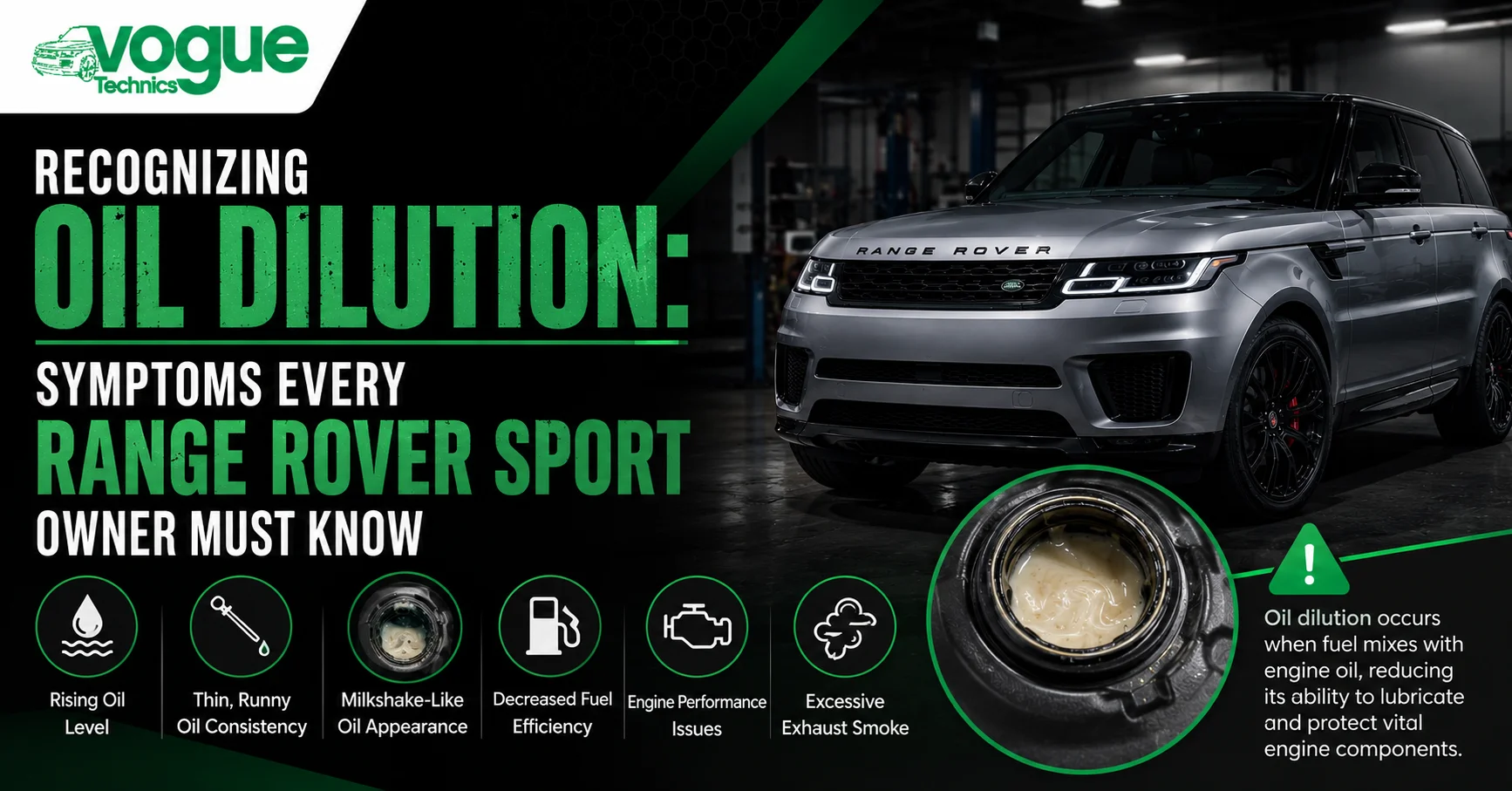
Physical Warning Signs You Can Detect Yourself
Oil dilution doesn't announce itself with a single obvious symptom. Instead, it creeps up gradually, with multiple subtle signs accumulating until the problem becomes impossible to ignore. Learning to recognize these early warnings gives you a critical window to address the problem before serious engine damage occurs.
Diesel Smell in Engine Oil (The Most Common Symptom)
This is often the first sign owners notice, and it's unmistakable once you know what to look for.
Open your engine bay and pull out the dipstick. If your oil smells strongly of diesel fuel, not a faint fuel odour from the engine compartment, but a clear, distinct diesel smell directly from the oil, you have fuel dilution.
Fresh engine oil has a characteristic burnt, almost metallic smell. It's hard to describe precisely, but once you've smelled it, you recognize it instantly. Diesel fuel has a completely different, sharper odour. When fuel is contaminating your oil, both smells are present, and the diesel component becomes progressively stronger as dilution worsens.
Why does the smell intensify after short journeys?
Unburned diesel is volatile. When your Range Rover Sport is driven for short distances and then parked, the engine cools down. As cooling happens, volatile fuel vapours evaporate more readily from the warm oil, intensifying the diesel smell in the engine bay. Many owners notice this smell strongest just after parking following a short drive.
Rising Oil Level on Your Dipstick
We discussed this briefly earlier, but it deserves deeper examination because it's so critical.
Establish a baseline by checking your oil level when your Range Rover Sport is parked on level ground, cold, at least five minutes after the engine has stopped (so oil has drained fully back to the sump). Record the exact reading on your dipstick, note whether it's between minimum and maximum, or at maximum.
Now check again two weeks later under identical conditions. If the level has risen noticeably say, from mid-way between minimum and maximum to closer to maximum, fuel is entering your crankcase.
What normal vs excessive levels look like:
A normal Range Rover Sport oil level fluctuates slightly (0.5-1mm on the dipstick) from week to week due to minor consumption during operation. Dilution, however, causes a consistent upward trend. If your level has climbed 2mm or more over two weeks, fuel dilution is almost certainly occurring.
Visible Oil Degradation & Discolouration
Contaminated engine oil looks different. Fresh synthetic oil (which Ingenium engines typically require) should be translucent and golden or amber in colour. Diluted oil often develops a milky or cloudy appearance, especially if you wipe it between your fingers or let a sample sit in a clear container.
As dilution continues, the oil darkens more rapidly than normal. A Range Rover Sport oil that should remain golden for 8,000-10,000 miles between changes might turn dark brown or even black after just 2,000-3,000 miles if significant fuel dilution is occurring.
In advanced cases, you might notice sludge formation in the sump, a thick, clay-like residue coating the inside of your oil pan. This represents oxidized oil, fuel byproducts, and combustion byproducts that have bonded together, severely compromising your oil's protective qualities.
Dashboard Warning Lights & ECU Alerts
Your Range Rover Sport's onboard computer is constantly monitoring engine oil condition through sophisticated sensors. When it detects fuel dilution, it communicates through a series of escalating warning lights and messages designed to catch your attention.
"Oil Quality Warning" Message
This is the most common alert associated with fuel dilution. Your instrument cluster displays this message when the engine's oil quality sensor detects contamination exceeding threshold levels.
This sensor works by measuring the electrical properties of the oil. Pure, uncontaminated oil has specific electrical characteristics. Fuel contamination changes these characteristics. When the deviation exceeds a predetermined threshold, the warning triggers.
Why does your Range Rover Sport display this warning specifically?
The warning appears because your engine's computer has detected a fundamental change in oil chemistry. This isn't a guess or a conservative alarm, it's a measured, factual detection of contamination. Your engine is telling you, in the clearest terms possible, that your oil is no longer fit for purpose.
Oil quality sensor sensitivity and false positives:
Occasionally, owners worry they're getting a false alarm. Here's the reality: the oil quality sensor is rarely wrong. While sensor faults do occur (extremely rarely), a legitimate "Oil Quality Warning" almost always indicates real fuel contamination.
The only exception is if you've just had an oil change performed incorrectly, using the wrong oil type, for instance, which would temporarily confuse the sensor. But if the warning appears weeks or months after a proper oil change, fuel dilution is the explanation.
"Restricted Performance" Mode Activation
This warning is more serious. When fuel dilution becomes severe enough to threaten engine protection, your Range Rover Sport automatically enters "limp mode", a reduced-performance operating state.
In this mode, your engine's power output is dramatically reduced. Acceleration feels sluggish. The engine might rev more slowly. Turbocharger boost is limited. Fuel injection timing is altered to reduce stress on engine components.
How does fuel dilution trigger this protection?
Your Ingenium engine's management system constantly calculates the oil's ability to protect engine components. When fuel dilution degrades oil viscosity and protective film thickness beyond safe levels, the system determines that normal operation risks immediate engine damage. Rather than allow catastrophic failure, it automatically reduces stress by limiting performance.
Think of it as your engine's emergency brake, a last-ditch effort to keep you limping to a workshop rather than seizing on the motorway.
Service Required & Scheduled Service Warnings
Before the more dramatic warnings appear, you might notice your service interval has suddenly compressed. If your Range Rover Sport normally displays "Service due in 8,000 miles," but suddenly changes to "Service due in 2,000 miles," your engine's computer is reacting to detected oil degradation.
This is actually a remarkably intelligent system. Your car has calculated that your oil is deteriorating faster than normal and is automatically shortening service intervals to protect engine longevity. You should heed this warning seriously.
Performance Changes & Engine Behaviour Indicators
Sometimes the first hint of oil dilution isn't a warning light or a smell, it's a change in how your Range Rover Sport feels to drive.
Cold Start Rattle & Engine Noise
This symptom particularly affects owners during winter months or after the car has been parked for several hours.
Start your Range Rover Sport cold (without warming it up first). Listen carefully to the engine for the first 10-15 seconds. If you hear a distinct metallic rattling noise, almost like someone shaking a tin of bolts—that fades away as the engine warms up, you likely have oil dilution.
Why does this happen?
Cold oil is thicker than warm oil. When fuel contaminates your oil, it thins the oil further, reducing viscosity at cold temperatures. This means that during cold starts, your oil can't maintain adequate film thickness between moving components. The timing chain, which should ride on a cushion of pressurized oil, temporarily loses that protection and rattles against its guides.
Timing chain slack from compromised lubrication is a direct result of insufficient oil film. The chain stretches slightly as it ages (normal wear), and this stretch is usually taken up by the tensioner, a spring-loaded component maintaining proper chain tension. But inadequate oil pressure during cold starts means the tensioner can't maintain tension effectively, allowing the chain to rattle.
This symptom progresses over time. Initially, you might hear the rattle for just 5-10 seconds after a cold start. As dilution worsens, the rattle lasts longer and sounds more pronounced. Eventually, the rattle might continue even after the engine has warmed up, a sign that timing chain wear has advanced significantly.
Loss of Power & Sluggish Acceleration
Beyond the restricted performance warning we discussed earlier, fuel-diluted oil affects how your Range Rover Sport accelerates even during normal driving.
You might notice that your throttle response feels delayed. The turbocharger takes longer to spool up. Pulling onto a motorway or passing another vehicle requires more time than you remember. The engine feels like it's working harder to produce the same power.
Why is this happening?
Multiple factors combine:
First, reduced fuel injection efficiency occurs because your engine's computer is adjusting injection timing and quantity to compensate for detected oil degradation. Second, your turbocharger response deteriorates because the turbo's bearings (which run on engine oil) aren't being lubricated adequately. The turbo lags as it accelerates. Finally, your engine management system activates limp-mode protection even without displaying a warning, limiting boost pressure and fuel injection rates to protect the engine.
The cumulative effect is a Range Rover Sport that feels noticeably less responsive than it should.
How Oil Dilution Damages Your Range Rover Sport Engine: The Repair Reality
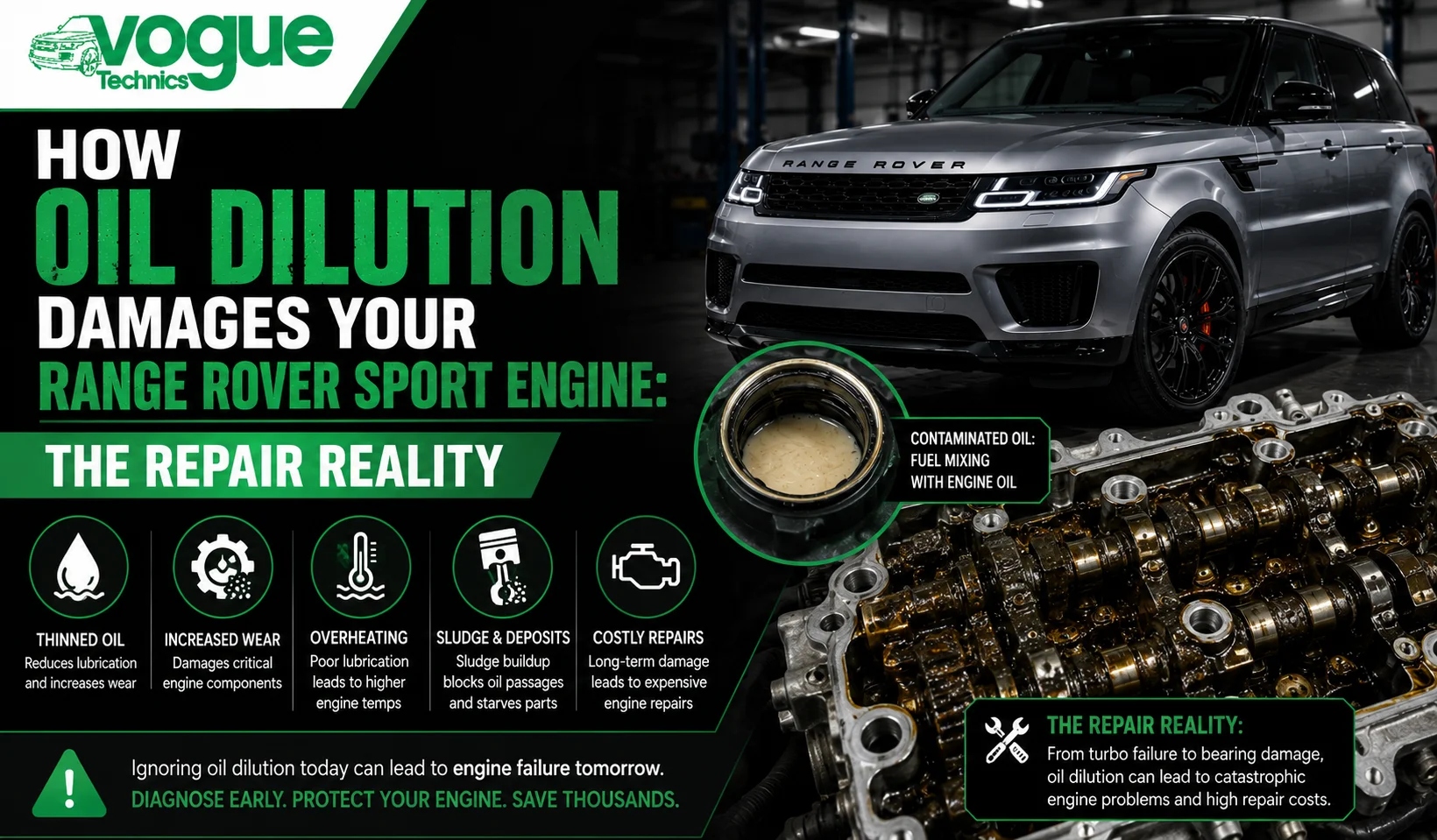
Understanding that oil dilution exists is one thing. Understanding what it's actually doing to your engine—the real, mechanical damage occurring inside your crankcase—is quite another. This is where the problem becomes genuinely serious.
Timing Chain Damage & Accelerated Wear
Your timing chain is a critical component that synchronizes the crankshaft (which drives the pistons) with the camshaft (which operates the valves). This synchronization must be perfect. If timing is off by even a few teeth on the timing sprockets, your engine misfires, runs rough, or fails to start.
The timing chain is kept tight by tensioners, spring-loaded devices that maintain constant tension. These tensioners ride on pressurized engine oil. When oil pressure is adequate and oil quality is good, the tensioners work perfectly, maintaining optimal chain tension.
How Degraded Oil Destroys Your Timing Chain
When fuel dilutes your engine oil, several destructive processes accelerate simultaneously:
Oil film breakdown: The protective film between the chain and its guides (called chain guides) becomes thinner and weaker. Metal-on-metal contact increases. Friction escalates. The chain begins to wear noticeably faster than it should.
Timing chain stretch progression: Chains, like all metal components, wear and stretch over time. Normal timing chains might stretch slightly over 100,000+ miles. A diluted oil environment accelerates this stretch dramatically. Owners with severe fuel dilution have reported timing chain stretch requiring replacement after just 40,000-50,000 miles.
Loss of lubrication film between chain and guides: As oil quality degrades, the viscosity required to maintain adequate film thickness diminishes. The protective cushion between the chain and its metal guides evaporates. The chain runs nearly dry, wearing rapidly.
Tensioner failure acceleration: The hydraulic tensioners maintaining chain tension rely on adequate oil pressure. When fuel dilution reduces oil viscosity, oil pressure drops. Tensioners can't maintain proper tension. The chain begins to rattle and move excessively. This excessive movement causes wear to accelerate even faster.
It's a vicious cycle. Diluted oil causes chain wear, which causes more chain movement, which causes more wear.
Symptoms of Timing Chain Failure
The progression is usually gradual enough that owners can catch it if they're attentive:
Early stage: Cold start rattle lasting 5-10 seconds, fading as the engine warms.
Intermediate stage: Rattle during cold starts lasting 30+ seconds; occasional rattle during normal driving; engine management warning light beginning to illuminate.
Advanced stage: Persistent rattle throughout the engine running; noticeable loss of power; check engine light constantly illuminated; engine running rough; possible misfires.
Critical stage: Severe rattling; severe power loss; restricted performance mode; or, in worst cases, catastrophic timing chain failure resulting in bent valves, damaged pistons, and complete engine seizure.
Can oil dilution alone destroy your timing chain?
Yes, absolutely. While timing chains are designed to last the life of your Range Rover Sport (typically 150,000+ miles with proper maintenance), fuel-diluted oil can cause complete timing chain failure within 50,000-60,000 miles. Some owners with particularly severe dilution have experienced timing chain replacement needs before 40,000 miles.
The key differentiator is how early the dilution is caught and corrected. Address it immediately, and you might limit damage to the chain itself, expensive but repairable. Ignore it for months, and you risk damage to the cam lobes, crankshaft, and pistons, turning a timing chain replacement into a full engine rebuild.
Repair Costs: Timing Chain Replacement
A timing chain replacement on a Range Rover Sport Ingenium engine is not a minor job. This is a substantial procedure requiring:
Labour hours: 12-18 hours for a qualified technician, depending on model year and engine variant. Your Range Rover Sport is essentially being partially disassembled to access the timing chain.
Parts costs: OEM (Original Equipment Manufacturer) timing chain components from Land Rover typically run £400-600 for the chain itself, plus £200-300 for the tensioner, guides, and seals. Aftermarket quality alternatives might reduce this to £600-800 total parts cost.
Additional work: Once the timing case is open, any wear to the crankshaft, camshaft, or related bearings must be addressed. If your mechanic discovers bearing damage (which is common in advanced dilution cases), costs escalate to £2,000-5,000 or more.
Total realistic cost: A straightforward timing chain replacement at an independent specialist runs £1,800-2,500. At a Land Rover main dealer, expect £2,500-3,500.
Why early intervention saves thousands: If caught when dilution is moderate, a timing chain replacement solves the problem. If ignored until the chain has stretched to the point of causing bearing damage or valve train wear, you're looking at a £4,000-6,000 partial engine rebuild. If allowed to progress to catastrophic failure, you need a complete £8,000-15,000 engine rebuild or replacement.
Turbocharger Failure & Bearing Wear
Your Range Rover Sport's turbocharger is a precision component spinning at speeds exceeding 250,000 RPM. It compresses incoming air, forcing more oxygen into the combustion chamber, and producing the power and torque you feel when accelerating.
Like all rotating components, the turbo's shaft rides on bearings, precision metal races that allow the shaft to spin freely while remaining supported. These bearings are cooled and lubricated by engine oil.
Turbo Bearing Damage from Poor Oil Quality
When fuel contaminates your engine oil, turbo bearing failure becomes increasingly likely:
Oil film degradation: The protective film between the turbo shaft and its bearing journals (the metal surfaces the shaft rides on) becomes thinner. As viscosity decreases, the film becomes inadequate. Metal-on-metal contact begins occurring.
Bearing clearance issues: Turbos operate with extremely tight bearing clearances—sometimes measured in hundredths of a millimetre. When oil viscosity drops even slightly, these tight clearances become problematic. The oil can't maintain adequate film thickness, and bearing wear accelerates.
Metal particulate damage: As bearings begin wearing, they shed microscopic metal particles into the oil. These particles circulate through your engine, embedding themselves in other bearing surfaces and accelerating wear throughout the engine. The turbo's damage spreads.
Heat buildup: Without adequate lubrication, turbo bearings generate excessive heat. The turbo's bearing housing temperature rises. Seals deteriorate. Bearing clearances expand slightly. More heat builds. Eventually, bearing material begins to soften and distort.
Can fuel dilution destroy a turbocharger?
Yes. Owners with severe fuel dilution have experienced complete turbocharger bearing failure resulting in total turbo seizure. In these cases, the turbo shaft locks up, unable to rotate. The turbocharger must be replaced, it cannot be repaired.
More commonly, fuel dilution causes progressive bearing wear that eventually requires turbo replacement to restore proper boost pressure and engine performance.
Symptoms of Turbocharger Failure
Turbo trouble typically announces itself through several characteristic signs:
Excessive turbo lag: The turbocharger takes noticeably longer to spool up and deliver boost. You press the accelerator, but power doesn't arrive for a second or two, a delay that shouldn't be there.
Blue or grey smoke from the exhaust: This is the most telltale sign. It indicates that bearing seals are failing and oil is leaking into the exhaust. The oil burns, producing the characteristic blue/grey plume.
Whining noise from the turbocharger housing: A high-pitched whine, particularly noticeable during acceleration, suggests bearing wear or shaft imbalance. The noise typically intensifies as the turbo ages.
Loss of boost pressure: Your engine management system can measure turbo boost pressure. If the turbo is failing, boost pressure drops below expected levels, triggering a check engine light and reduced performance.
Turbocharger Replacement Costs & Timeline
Turbocharger replacement is expensive:
OEM turbocharger cost: A genuine Land Rover turbocharger for the Ingenium engine runs £1,200-1,800.
Aftermarket alternatives: Quality aftermarket turbos cost £800-1,200, though rebuild services (where a worn turbo is refurbished) can run £600-800.
Labour and diagnostics: Turbo removal, installation, and related work requires 6-8 hours. Add diagnostic time, and you're looking at £600-1,000 in labour.
Ancillary costs: Turbo oil supply and return lines should be flushed or replaced (£100-200). The oil filter should be changed. The air filter should be inspected and likely replaced.
Total realistic cost: A complete turbocharger replacement runs £1,800-2,800 at an independent specialist. At a Land Rover dealer, expect £2,500-3,500.
Can you just clean a failing turbo? Unfortunately, modern turbos can't be effectively cleaned or repaired if bearings are damaged. Replacement is the only reliable solution.
Crankshaft Bearing & Engine Block Damage
We've discussed the timing chain and turbo, both expensive to replace. But the real catastrophic damage from extended fuel dilution occurs deeper in the engine: at the crankshaft bearings and the engine block itself.
Premature Bearing Wear in Diluted Oil Conditions
Your crankshaft is supported by a series of precision bearings (main bearings, connecting rod bearings) that allow it to rotate smoothly while withstanding tremendous forces. During the combustion cycle, pressures exceeding 1,000 PSI push downward on the piston, which transfers force through the connecting rod to the crankshaft.
These bearings operate under extreme conditions, pressures, temperatures, and loads most people can't conceptualize. They survive these conditions because they run on a film of pressurized engine oil approximately 25 microns thick (for reference, a human hair is about 70 microns thick).
When fuel dilutes engine oil, this film thins dramatically.
How fuel thins the oil film between journal and bearing:
Diesel fuel has approximately 40-50% the viscosity of engine oil. When fuel mixes with oil, the average viscosity of the mixture drops. A 10% fuel contamination might reduce effective viscosity by 10-15%. A 20% contamination reduces it by 20-30%.
For crankshaft bearings operating under extreme loads, even a 15% reduction in oil film thickness translates directly to increased friction, heat, and wear.
Metal-on-metal contact escalation:
As the oil film thins, the protective separation between the crankshaft journals and bearing surfaces decreases. Microscopic high points on the metal surfaces begin to touch. Friction escalates. Temperature at the bearing surface rises.
Once metal-on-metal contact begins, wear accelerates exponentially. Microscopic particles are torn from bearing surfaces. These particles circulate in the oil, embedding themselves in other bearings and accelerating wear throughout the engine.
Cumulative damage from repeated regeneration cycles:
A single fuel-dilution incident might cause limited damage. But your Range Rover Sport isn't suffering a single incident, it's suffering repeated, ongoing contamination. Every few weeks, another regeneration cycle injects more unburned fuel. Your bearings endure repeated stress cycles, with cumulative wear adding up relentlessly.
An owner with constant short-journey driving might be subjecting their crankshaft bearings to degraded oil conditions week after week, month after month. The cumulative damage is staggering.
Can Oil Dilution Cause Engine Seizure?
Yes. In worst-case scenarios with severe, uncorrected fuel dilution, crankshaft bearing wear progresses to the point where bearings fail catastrophically. When a bearing fails, the crankshaft is no longer adequately supported. It contacts the engine block. Friction becomes extreme. Heat spikes to dangerous levels. Metal begins to weld together.
Within seconds, the engine seizes completely. The crankshaft locks, unable to rotate. Your Range Rover Sport stops dead.
Timeline to catastrophic failure:
The progression varies, but typical timelines for severe dilution include:
- Months 1-3: Initial oil quality warning; mild symptoms like cold start rattle.
- Months 3-6: Oil quality warning persists; cold start rattle worsens; you might notice sluggish acceleration.
- Months 6-12: Timing chain wear becomes noticeable; turbo symptoms might appear; restricted performance warning possible.
- Months 12-18: Catastrophic bearing failure risk; engine seizure becomes possible; major repair work inevitable.
Some owners experience this timeline in just 6-9 months of short-journey driving. Others with mixed driving patterns might stretch it to 18-24 months before critical failure risk.
Engine Rebuild: The Worst-Case Scenario
If bearing wear goes uncorrected until bearing failure or crankshaft damage occurs, a simple bearing replacement isn't possible. The entire crankshaft must be removed, inspected for damage, and either replaced or (rarely) resurfaced.
While the crankshaft is out, the entire engine is essentially disassembled for inspection. The cylinder walls must be inspected for scoring (deep scratches caused by metal particles). The pistons and connecting rods must be checked. The camshaft and timing components must be thoroughly evaluated.
When bearing wear requires full engine rebuild:
A full engine rebuild becomes necessary when bearing wear has caused collateral damage—typically scoring of the cylinder walls or damage to the crankshaft itself. When this occurs, proper repair requires:
- Complete engine disassembly
- Machine shop inspection and resurfacing of critical components
- Replacement of all bearings, gaskets, and seals
- Reassembly to exacting specifications
- Complete dyno testing to confirm proper operation
This process requires 80-120 hours of skilled labour and £3,000-5,000 in parts.
Complete engine rebuild costs vs replacement:
A proper engine rebuild at a specialist workshop costs £6,000-10,000 in total. A remanufactured engine (rebuilt by a specialist with warranty coverage) costs £4,000-7,000 plus labour for installation. A new OEM engine runs £8,000-12,000 plus labour.
When costs are calculated, owners often find that replacing the entire engine with a remanufactured unit is more cost-effective and provides better warranty coverage than attempting to rebuild the existing engine.
Why early diagnosis prevents costly repairs:
This is the critical takeaway: oil dilution caught when it's only affecting oil quality costs £500 in oil changes and diagnostics. Caught when it's caused timing chain wear, it costs £2,000-3,000 for chain replacement. Caught when bearing wear is advanced, it costs £6,000-10,000 for engine rebuild.
The difference between catching dilution after three months versus eighteen months can be £5,000-8,000 in repair costs. Early action is genuinely life-changing financially.
Diagnosis, Prevention & Expert Solutions for Your Range Rover Sport

By this point, you understand what oil dilution is, why it happens, what symptoms to watch for, and what damage it causes. Now we address the practical question: What do you actually do about it?
Professional Diagnosis: From Symptom to Root Cause
If you suspect your Range Rover Sport has oil dilution, professional diagnosis is essential. DIY guessing can lead to unnecessary repairs or, worse, missed problems that allow damage to progress.
Step 1: Oil Analysis Testing
The single most definitive way to confirm fuel dilution is professional oil analysis—a laboratory examination of your engine oil that measures contamination levels with scientific precision.
Here's how it works: You collect a small oil sample from your engine (typically 100-200ml), send it to a specialist laboratory, and within a few days receive a detailed report measuring:
Fuel percentage in your oil: The lab measures hydrocarbon content to determine what percentage of your oil is unburned diesel fuel. This gives a concrete number, "Your oil contains 8% fuel contamination", that eliminates guesswork.
Viscosity measurements: The lab measures your oil's actual viscosity against specifications. Fuel-diluted oil will show viscosity below specification, confirming that fuel has thinned your oil.
Wear metal analysis: The lab measures microscopic metal particles in your oil, iron from engine block and bearings, copper from bearing materials, aluminium from piston materials. Elevated wear metals indicate advanced bearing wear from fuel dilution.
Fuel percentage thresholds in professional test results:
Understanding these thresholds is important:
- 0-3% fuel contamination: Borderline acceptable; not ideal but not immediately dangerous. Monitor closely and consider preventative maintenance.
- 3-7% fuel contamination: Definite fuel dilution confirmed; professional action recommended within the next 2-4 weeks.
- 7-15% fuel contamination: Severe dilution; immediate oil change and diagnostic work required; risk of engine damage is significant.
- 15%+ fuel contamination: Critical; engine damage is likely occurring or imminent; professional assessment required immediately.
How to interpret your used oil analysis report:
A comprehensive oil analysis report might seem technical, but the key information is straightforward:
Look for the "Fuel Content" line. If it's above 5%, you have confirmed fuel dilution. Look for the "Viscosity Index" measurement. If it's below specification (typically 5W30 should test between 100-120 centistokes at 40°C), your oil's protective properties are compromised.
Look for wear metals (Iron, Copper, Lead, Tin). Compare these to baseline values. Elevated readings indicate accelerated bearing wear.
Cost of professional oil analysis vs guesswork:
Professional oil analysis costs £40-80 per test through specialized labs. This seems expensive until you consider that a single wrong diagnosis say, replacing your turbo when the real problem is a fuel injector issue, costs thousands. A £60 oil analysis that confirms or rules out fuel dilution is the cheapest insurance you can buy.
Step 2: ECU Scan & Engine Diagnostic Data
A professional diagnostic scan of your Range Rover Sport's engine control unit (ECU) reveals what your engine's computer has been "seeing" and recording.
During an ECU scan, a diagnostic tool connects to your Range Rover's onboard computer and reads stored data including:
Fault codes: Specific error codes indicating what your engine management system has detected as problems. Codes related to fuel injection, oil pressure, or emissions system malfunction provide critical clues.
Real-time fuel injection data: Live measurements of fuel injection timing, quantity, and frequency. If regeneration is occurring abnormally frequently or injection timing is erratic, the diagnostic tool reveals this.
Oil pressure readings: Real-time oil pressure at various engine speeds. Low oil pressure (which diluted oil causes) is immediately apparent.
DPF load status: How loaded your Diesel Particulate Filter is and how frequently regeneration is occurring. Excessive regeneration is a red flag.
What engine management codes reveal about regeneration failures:
Common codes associated with fuel dilution include:
- P0101: Mass Airflow Sensor range or performance (indicates combustion irregularities often caused by failed regeneration)
- P0401: Exhaust Gas Recirculation flow insufficient (indicates DPF or regeneration system issues)
- P242F: Diesel Particulate Filter restriction (indicates soot overload and failed regeneration)
A diagnostic technician interprets these codes in context. A single code might indicate a sensor fault. Multiple codes related to emissions and fuel injection, combined with oil analysis showing fuel dilution, paint a clear picture.
Why ECU diagnostics are essential before repair decisions:
Imagine discovering fuel dilution, then having a mechanic recommend a £2,500 timing chain replacement, only to discover later that the real problem was a failed fuel injector (£600 to replace) that was causing excessive unburned fuel.
Professional ECU diagnostics prevent this costly mistake by identifying root causes before repair decisions are made.
Step 3: Workshop Inspection & Physical Assessment
Once oil analysis and ECU diagnostics have confirmed fuel dilution and identified severity level, a physical workshop inspection assesses actual engine damage.
Visual inspection of engine internals (borescope examination):
A borescope is a thin fiber-optic camera that can be inserted into your spark plug holes to visually inspect the inside of your engine cylinders. A skilled technician can assess:
- Cylinder wall condition: Are there deep scratches (scoring) indicating metal particles have been flowing through the engine? Scoring indicates advanced bearing wear.
- Piston condition: Are deposits excessive? Is the piston crown damaged? These indicate combustion stress from diluted oil.
- Valve condition: Are intake valves coated with excessive carbon? This suggests incomplete combustion from failed regeneration.
Compression tests to assess bearing wear:
A compression test measures the pressure your engine generates during the compression stroke of the piston cycle. Low compression indicates:
- Worn piston rings (allowing gas to escape)
- Valve sealing problems
- Or bearing wear (which allows pistons to rock excessively, reducing compression efficiency)
Low compression in the presence of fuel dilution is a strong indicator of bearing damage.
Crankcase pressure monitoring:
Excessive crankcase pressure indicates blow-by combustion gases escaping past piston rings into the crankcase. This occurs when:
- Piston rings are worn (from bearing wear allowing excessive piston movement)
- Fuel dilution has caused ring stiction (rings sticking in their grooves)
- Engine damage is advanced
Professional crankcase pressure testing reveals this condition.
Prevention Strategies: Stop Oil Dilution Before It Starts
Once you understand oil dilution, the most logical question is: How do I prevent it from happening in the first place?
The answer involves multiple complementary strategies working together.
Maintenance Schedule Optimization
The most basic and important prevention strategy is aggressive oil change intervals.
Your Range Rover Sport's service manual likely specifies oil changes every 10,000-15,000 miles, or annually, whichever comes first. For vehicles at risk of fuel dilution, this interval is dangerously long.
Recommended oil change intervals for Ingenium engines:
If your driving consists primarily of short journeys (less than 10 miles average per trip), consider changing oil every 5,000-6,000 miles or every 3-4 months, whichever comes first. This might seem extreme, but it's the most effective way to remove fuel-contaminated oil before it damages your engine.
If your driving mixes short journeys with regular motorway runs, extend this to 7,500-8,000 miles or every 4-6 months.
If your driving is primarily motorway journeys (sustained 50+ mph driving), you can likely safely follow manufacturer intervals of 10,000-15,000 miles.
Why standard intervals fail in dilution-prone vehicles:
Standard service intervals are based on average driving patterns and normal fuel injection performance. They assume your engine will successfully burn the fuel it injects. They don't account for systematic fuel dilution caused by regeneration failures and aggressive post-injection strategies.
For owners experiencing regular fuel dilution, standard intervals allow contamination to accumulate to dangerous levels between services.
Preventative oil change schedule by driving style:
Driving Pattern | Recommended Interval | Oil Analysis Frequency |
| Mostly city/short trips (under 5 miles average) | Every 5,000 miles or 3 months | Every oil change |
| Mixed short trips and motorway | Every 7,500 miles or 4 months | Every other oil change |
| Regular motorway driving | Every 10,000 miles or 6 months | Every other oil change |
| Primarily long-distance motorway | Every 12,000-15,000 miles | Once annually |
Best synthetic oil specifications for your Range Rover Sport:
Your Ingenium engine requires low SAPS (Sulfated Ash, Phosphorus, Sulphur) diesel engine oil to protect the DPF. The correct specification is typically ACEA C3 or Jaguar Land Rover Approved.
Common approved oils include:
- Castrol Edge Professional C3 (5W30)
- Shell Helix HX7 Professional (5W30 or 5W40)
- Mobil ESP Formula (5W30)
- Total Quartz Ineo Long Life (5W30)
Your Land Rover dealer can provide the complete list of approved oils. Using approved oil ensures maximum DPF compatibility and engine protection.
Driving Habits That Reduce Oil Dilution
Beyond mechanical maintenance, your actual driving behaviour dramatically affects dilution risk.
Combining short trips with regular motorway drives:
The most practical prevention strategy is to combine your essential short journeys with at least one substantial motorway drive weekly.
Here's why this works: Short city drives don't give your engine sufficient temperature for complete DPF regeneration. But a motorway drive at sustained 50-60 mph for 30+ minutes allows passive regeneration, a gentle, natural cleaning process that requires no extra fuel injection.
If you can commit to one 30-40 minute motorway journey weekly (even if that journey isn't strictly necessary), you dramatically reduce regeneration failures and fuel dilution risk.
Engine warm-up protocols for cold starts:
Modern engines reach operating temperature fastest under light driving load, not stationary warm-up. Avoid sitting in your driveway revving the engine to warm it up. Instead:
Allow 30 seconds of idle after starting, then drive gently for the first 5 minutes. This achieves temperature faster while putting minimal stress on cold engine components. Avoid hard acceleration until the engine has been running for at least 10 minutes.
How to complete DPF regeneration cycles successfully:
When your engine initiates an active regeneration cycle (you might notice increased fuel consumption for a few minutes), avoid interrupting it:
- Don't turn off the engine mid-regeneration
- Don't pull into a car park to stop during regeneration
- Drive steadily while regeneration occurs
Allow the cycle to complete typically 10-20 minutes. Once complete, you'll notice fuel consumption return to normal.
Regeneration frequency by driving style:
- City driving (frequent short trips): Regeneration every 400-600 miles
- Mixed driving: Regeneration every 600-900 miles
- Highway driving: Regeneration every 900-1,200 miles
Vehicles requiring regeneration every 400-500 miles are at vastly higher dilution risk than vehicles requiring it every 1,000+ miles.
Software Updates & ECU Recalibration
Land Rover periodically releases software updates addressing known issues, including fuel injection optimization to reduce dilution risk.
How manufacturer software updates improve fuel injection strategy:
Jaguar Land Rover engineers continuously refine the fuel injection algorithms controlling post-injection during DPF regeneration. Updates may:
- Reduce the quantity of extra fuel injected during regeneration
- Optimize timing of post-injection for better combustion
- Implement smarter regeneration scheduling to reduce frequency
These updates are released through dealer service updates or OTA (Over-The-Air) updates on newer vehicles.
Dealer service updates available for your model year:
When you bring your Range Rover Sport in for service, your Land Rover dealer can check for available software updates and install them free of charge (or as part of your service).
If you haven't had a software update in 12+ months, specifically ask your dealer whether fuel injection optimization updates are available. This is a conversation worth having.
Independent software solutions for oil dilution reduction:
Some independent tuning companies have developed alternative software for the Ingenium engine that modifies post-injection strategy to reduce fuel dilution. These are controversial—they void Land Rover warranty but some owners have reported significant improvement in oil dilution problems.
We'd recommend exploring this option only after exhausting dealer options and only with a reputable independent Land Rover specialist.
Can software alone fix your dilution problem?
Realistically, software can reduce future dilution but can't reverse existing damage. If your engine already has fuel-contaminated oil, oil changes and possibly additional repairs are necessary regardless of software updates.
Software updates should be viewed as prevention for the future, not a cure for the present.
Expert Repair Solutions at Vogue Technics Engine Rebuild
At Vogue Technics Engine Rebuild, we specialize in Range Rover Sport engine issues, including comprehensive diagnosis and repair of fuel dilution damage.
Diagnostic Assessment & Quote Process
When you bring your Range Rover Sport to us, here's exactly what happens:
Free initial consultation for Range Rover Sport owners:
We begin with a conversation. You describe your symptoms. We ask specific questions about your driving patterns, maintenance history, and any warning lights you've experienced. This conversation itself provides valuable diagnostic information, patterns emerge that guide further investigation.
Comprehensive diagnostic process:
We then perform a complete diagnostic workup:
- Oil analysis testing: We collect an oil sample and send it to our laboratory partners for detailed fuel contamination and wear metal analysis.
- ECU diagnostic scan: We connect professional diagnostic equipment and scan your engine's onboard computer, reading all fault codes and real-time data.
- Physical inspection: We perform a thorough visual inspection, checking your oil manually for smell and appearance, examining belts and hoses, and assessing overall engine condition.
- Workshop assessment: If initial diagnostics suggest significant wear, we discuss borescope inspection or compression testing to assess internal engine condition.
How we determine the severity of your oil dilution:
Based on all this information, we categorize your situation into one of three severity levels:
Minor dilution: Oil analysis shows 3-5% fuel contamination; no significant symptoms; no engine management codes. Treatment: Oil change, filter replacement, driving habit optimization, and repeat oil analysis in 4 weeks to confirm improvement.
Moderate dilution: Oil analysis shows 5-10% fuel contamination; cold start rattle or occasional sluggish acceleration; oil quality warning present. Treatment: Oil change, comprehensive diagnostic assessment, possible timing chain inspection, driving optimization, and monthly monitoring.
Severe dilution: Oil analysis shows 10%+ fuel contamination; multiple warning lights; noticeable performance issues; or ECU diagnostics suggesting timing chain or bearing wear. Treatment: Depends on specific findings but likely includes oil change, detailed workshop inspection, and repair recommendations based on damage assessment.
Transparent cost estimation before any work begins:
We provide a detailed written quote before beginning any work. You know exactly what we're proposing, why we're proposing it, and what it will cost. No surprises, no hidden charges.
Repair Options Based on Damage Assessment
Our approach is proportional, we recommend repairs matching the actual damage found, not unnecessary work.
Minor dilution: Oil change protocol + ECU scan + preventative plan:
If diagnostics show early-stage dilution without significant engine wear, we recommend:
- Complete oil and filter change using approved low-SAPS oil
- ECU diagnostic scan to rule out fuel injection or DPF issues
- Driving habit assessment and optimization recommendations
- Oil analysis in 4-6 weeks to confirm dilution is reversing
Cost: £250-400
Moderate damage: Timing chain inspection + turbo assessment:
If dilution is more established, we recommend:
- Complete oil and filter change
- ECU scan and diagnostics
- Physical inspection of accessible engine components
- Possible borescope inspection to assess timing chain condition
- Turbocharger visual inspection
- Detailed inspection plan identifying any components requiring replacement
Cost: £400-800 (diagnostic work only; repairs additional if needed)
Severe damage: Engine rebuild vs engine replacement decision tree:
For severe dilution with evidence of significant engine wear, we conduct detailed assessment determining whether:
- A targeted repair (timing chain + related components) will restore reliability
- A partial rebuild (replacing timing chain, inspecting and possibly servicing bearings) is necessary
- A complete rebuild or replacement is the most cost-effective solution
We present all options with honest cost-benefit analysis, allowing you to make an informed decision.
Why Choose Vogue Technics for Your Range Rover Sport Engine Rebuild:
Our specialists have dedicated the last 15+ years to Jaguar Land Rover Ingenium diesel engines. We understand these engines' strengths and their specific vulnerabilities. We've successfully diagnosed and repaired hundreds of fuel dilution cases, from simple oil changes preventing future problems to complex engine rebuilds restoring destroyed engines to full reliability.
15+ years specializing in Ingenium diesel engines:
When your Ingenium has a problem, you need someone who understands it completely. We do. We know which components fail first, which warning signs are critical versus benign, and which repair approaches restore genuine long-term reliability.
Genuine OEM parts with full warranty:
We exclusively use genuine OEM (Original Equipment Manufacturer) parts or quality equivalent components. We warranty all parts and labour for 12 months (or longer for major rebuilds), giving you confidence in our work.
Expert technicians trained on Range Rover Sport engine systems:
Our lead technicians hold Land Rover-specific qualifications and maintain continuous training on the latest engine technology and repair techniques. They're not generalists—they're specialists.
Post-repair monitoring and maintenance guidance:
After completing repairs, we don't simply hand back your car. We provide detailed guidance on maintenance schedules, driving habits to optimize longevity, and monitoring strategies to catch any future issues early.
Warranty & Aftercare Support:
All major repairs come with 12-month parts and labour warranty. For engine rebuilds, we offer extended warranties up to 24 months, reflecting our confidence in the work performed.
We include follow-up oil analysis testing in your repair package, confirming that the repaired engine is operating cleanly without re-contamination.
Frequently Asked Questions About Range Rover Sport Oil Dilution
Is oil dilution covered under my Range Rover warranty?
Unfortunately, most Range Rover warranties don't cover fuel dilution damage. Land Rover considers oil dilution related to DPF regeneration a maintenance issue—owners are responsible for appropriate maintenance including more frequent oil changes in dilution-prone driving conditions. However, if your Range Rover is still under warranty and you haven't been notified about increased maintenance requirements, contacting Land Rover customer service about warranty coverage for this specific issue is worth pursuing.
How long can I drive with oil dilution before damage occurs?
This varies dramatically based on dilution severity and engine stress. Mild dilution (3-5% fuel contamination) might not cause critical damage for 10,000+ miles if properly maintained. Severe dilution (15%+ fuel contamination) risks catastrophic engine failure within 2,000-3,000 miles of continued driving. The safest approach: address dilution immediately upon detection rather than gambling with your engine's longevity.
Will a software update fix my oil dilution problem?
Software updates can prevent future dilution by optimizing fuel injection and regeneration strategies, but they can't reverse existing contamination. If your oil is already diluted, you need immediate oil changes regardless of software updates. Think of updates as prevention going forward, not a cure for current problems.
Should I replace my Range Rover Sport engine or repair it?
This depends entirely on damage severity. Minor dilution caught early might require only oil changes and preventative maintenance (cost: £500). Moderate damage might need timing chain replacement (cost: £2,000-3,000). Severe bearing wear might necessitate engine rebuild (cost: £6,000-10,000) or replacement (cost: £4,000-12,000 depending on whether remanufactured or new).
A professional diagnostic assessment reveals your specific situation, allowing an honest cost comparison between repair and replacement options.
What's the normal oil change interval for Range Rover Sport?
Land Rover specifies 10,000-15,000 miles or annually, whichever comes first. However, for vehicles in severe dilution risk categories (short urban journeys, frequent city driving), more aggressive intervals of 5,000-7,500 miles every 3-4 months provide better engine protection. Your specific driving pattern determines the optimal interval.
Can I use regular diesel engine oil instead of the approved low-SAPS oil?
Technically, you can, it won't immediately damage your engine. However, regular engine oil damages your DPF over time by creating excessive ash deposits. More importantly, approved oils are specifically engineered to provide superior bearing protection under the demanding conditions of Ingenium engines. Using approved oils is genuinely worthwhile.
How do I know if my DPF regeneration is working correctly?
Successful regeneration typically completes within 10-20 minutes of initiation. You'll notice fuel consumption increase temporarily, then return to normal. If regeneration seems to occur every few hundred miles or if you're constantly receiving regeneration-related warnings, something is wrong. Professional diagnostics will identify whether your DPF is functioning properly or whether injector or sensor faults are preventing successful regeneration.
Final Thoughts: Taking Control of Your Range Rover Sport's Future
Oil dilution in the Range Rover Sport isn't a mysterious or inevitable problem. It's a manageable issue that becomes catastrophic only when ignored.
The owners who fare best are those who:
Recognize the symptoms early: Cold start rattle, diesel smell in the oil, rising oil level, or oil quality warnings are all clear signals to investigate immediately.
Get professional diagnosis quickly: A £60 oil analysis test might reveal a problem requiring a £500 oil change schedule adjustment, preventing a £5,000 engine rebuild later.
Optimize their driving and maintenance: Combining short journeys with regular motorway drives and following aggressive oil change intervals dramatically reduces future dilution risk.
Don't delay necessary repairs: Addressing timing chain wear when it first appears (£2,000 repair) prevents bearing damage that requires a full engine rebuild (£6,000-10,000).
At Vogue Technics Engine Rebuild, we've successfully guided hundreds of Range Rover Sport owners through this exact scenario. We understand the technical complexities, communicate clearly about costs and options, and execute repairs that restore your engine to genuine long-term reliability.
If you suspect your Range Rover Sport might have oil dilution, don't wait. The cost of professional diagnosis is minimal compared to the cost of ignoring the problem. Contact us today for a free consultation and diagnostic assessment. We'll determine exactly what's happening with your engine, explain your options in clear terms, and help you make the decision that's right for your specific situation.
Your Range Rover Sport's engine is worth protecting. Let's get ahead of this problem together.