
Range Rover Engine Problems: 7 Warning Signs & What To Do
Spot Range Rover engine problems early, timing chain rattle, white smoke, low oil pressure & more. Essex engine rebuild specialists. Call Vogue Technics: 01375 531355.
You bought a Range Rover because it's one of the most capable, prestigious vehicles on the road. But here's the uncomfortable truth, even the most well-engineered luxury 4x4s can develop serious engine problems, and when they do, the repair bills can be eye-watering. The difference between a £500 fix and a £6,000 engine replacement often comes down to one thing: how early you spot the warning signs.
At Vogue Technics Engine Rebuild in Grays, Essex, we've seen hundreds of Range Rovers arrive with problems that could have been caught weeks, sometimes months, earlier. Owners noticed something felt "off" but kept driving, hoping it would sort itself out. It rarely does.
This guide walks you through the 7 most critical signs of Range Rover engine problems, explains what's actually happening inside your engine, and tells you exactly what your next move should be before a manageable repair turns into a complete engine failure.
Why Range Rover Engine Problems Shouldn't Be Ignored
Range Rovers are precision-engineered machines. Every component inside the engine works in tight coordination, and when one part starts to fail, the stress doesn't stay isolated, it spreads. An ignored oil pressure warning today can mean a seized engine next month. A small coolant leak left unchecked can warp your cylinder head within weeks.
The cost of inaction is always higher than the cost of early diagnosis.
How Small Warning Signs Turn Into Expensive Engine Failures
Most catastrophic engine failures don't happen without warning. They follow a pattern. A warning light appears on the dashboard and gets dismissed. A strange noise shows up on cold starts and fades after a few minutes, so the owner assumes it's nothing. A small puddle forms under the car and gets ignored because the car still drives fine.
Each of those moments was an opportunity to prevent serious damage. Here's why they escalate so quickly:
- Oil starvation from a small leak or low pressure can score the crankshaft bearings within minutes of hard driving
- Coolant loss from a failing head gasket causes localised overheating that warps aluminium cylinder heads, a repair that costs significantly more than replacing the gasket alone
- Timing chain slack puts the entire valve timing system at risk, and if the chain jumps a tooth or snaps, the engine can suffer catastrophic internal damage in a fraction of a second
The pattern is always the same: small problem → ignored → bigger problem → expensive repair. Acting early is always the smarter financial decision.
What Makes Range Rover Engines More Vulnerable Than Other 4x4s
Range Rovers use sophisticated, high-specification engines, from the 2.0-litre Ingenium four-cylinder to the 3.0-litre TDV6 diesel and the 5.0-litre supercharged V8. These are performance-oriented units that run tighter tolerances than a standard family car engine.
That precision comes at a cost. Tighter tolerances mean:
- Oil quality and level matters more: even slightly degraded oil can accelerate wear on timing chain tensioners and bearing surfaces
- Cooling systems work harder: particularly in the V6 and V8 petrol variants where thermal management is critical
- Turbocharger systems are under higher stress: especially in diesel models where the turbo cycles constantly under load
Add in the fact that many Range Rover owners cover significant motorway miles and use their vehicles for towing, and you have an engine that is working hard every single day. Regular servicing at the correct intervals isn't optional with these vehicles, it's essential.
7 Warning Signs of Range Rover Engine Problems You Must Know
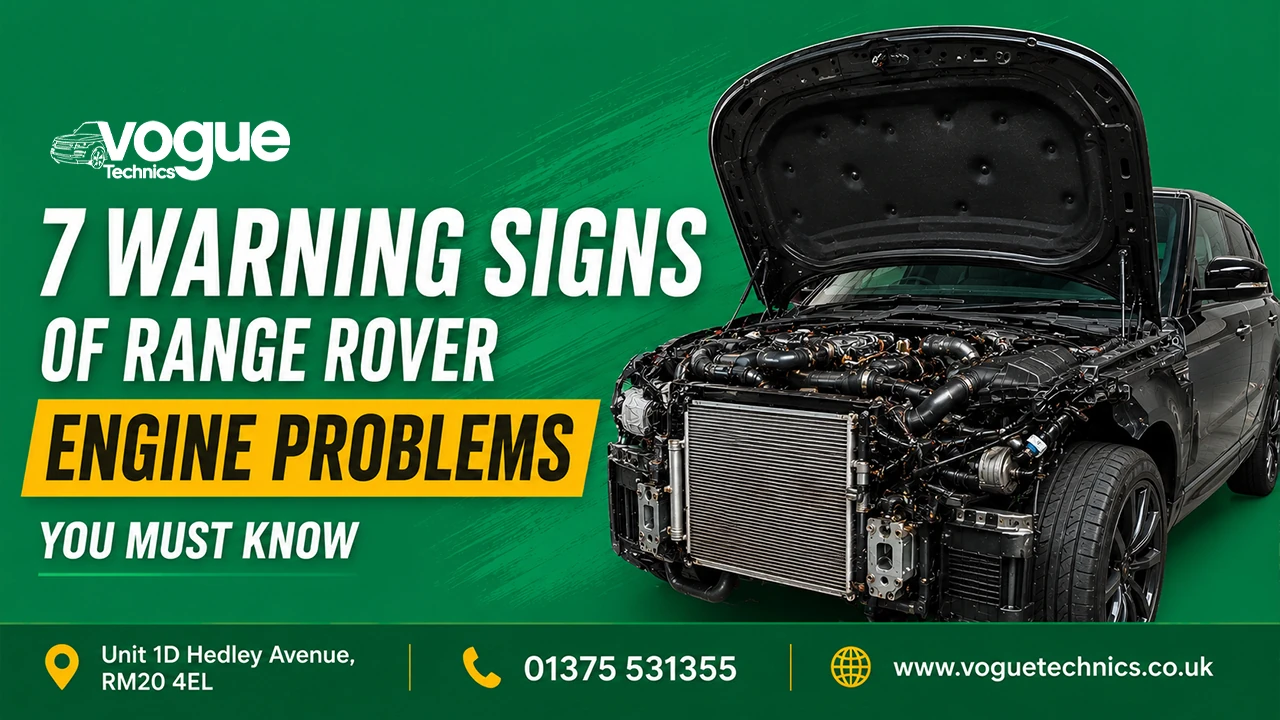
Not every engine problem announces itself with a dramatic breakdown. Most give you a window, sometimes a generous one, to intervene. Learn these seven warning signs and you'll never be caught off guard again.
1. Timing Chain Symptoms That Signal Internal Damage
The timing chain is one of the most critical components in your Range Rover's engine. It synchronises the rotation of the crankshaft and camshafts, ensuring the valves open and close at precisely the right moment. When it starts to wear, the consequences can be severe.
Common timing chain symptoms in Range Rovers include:
- A rattling or clattering noise on cold start that fades after a minute or two of running
- The engine management light illuminating, often with camshaft or crankshaft position sensor fault codes
- Rough or erratic idling as valve timing drifts out of specification
- Reduced power and poor throttle response, particularly noticeable under load
- In severe cases, a visible metal contamination in the engine oil, tiny chain fragments visible during an oil change
The 3.0-litre TDV6 and several 2.0-litre Ingenium engines have a documented history of timing chain issues, particularly when oil change intervals are extended beyond manufacturer recommendations.
Rattling on Cold Start — Is Your Timing Chain Worn?
That distinctive rattle you hear for the first few seconds after starting a cold engine is the sound of a worn timing chain tensioner struggling to maintain correct chain tension before oil pressure fully builds. The tensioner relies on oil pressure to function correctly, and when the chain has stretched beyond its serviceable limit, the tensioner can no longer compensate.
This is one of those symptoms that owners frequently dismiss because it disappears after warm-up. Don't be fooled. The fact that it disappears doesn't mean the problem is gone — it means the chain is at its worst when the engine is cold, and each cold start is putting additional stress on components that are already at the edge of their tolerance.
What Happens If You Ignore Timing Chain Failure
If a worn timing chain is left unaddressed, one of two things will happen and neither is good. The chain can jump a tooth on the sprocket, causing immediate misfiring and potentially bending valves if the pistons and valves collide. Or the chain can snap entirely, which on most modern engines causes immediate catastrophic internal damage.
At that point, you're no longer looking at a timing chain replacement. You're looking at a full engine rebuild or engine replacement. The difference in cost between catching this early and letting it go to failure is often £2,000 to £5,000 or more.
2. Head Gasket Signs Every Range Rover Owner Should Recognise
The head gasket sits between the engine block and cylinder head, sealing combustion chambers and oil and coolant passages. It operates under extreme heat and pressure, and when it fails, the results can quickly escalate into one of the most expensive repairs in automotive engineering.
Range Rovers, particularly the V6 diesel variants and certain V8 petrol models, have shown susceptibility to head gasket failure, especially in vehicles that have experienced overheating events or extended service intervals.
White Smoke, Coolant Loss and Milky Oil Explained
These three symptoms together are a classic head gasket failure triangle, and if you're seeing any two of them simultaneously, your head gasket should be your first suspect:
- White smoke from the exhaust particularly on start-up or under load, indicates coolant is being burned inside the combustion chamber, which only happens when the head gasket seal has failed between a coolant passage and a cylinder
- Unexplained coolant loss with no visible external leak means coolant is going somewhere internal either into the combustion chamber or into the oil
- Milky or creamy oil on the dipstick or filler cap is the most alarming sign, it means coolant and oil have mixed, which dramatically reduces the oil's lubricating properties and puts every bearing surface in the engine at risk
If you see milky oil, stop driving the vehicle immediately. Continued operation with contaminated oil can destroy the engine within miles.
Head Gasket Failure vs. Other Coolant Leaks, Know the Difference
Not every coolant loss is a head gasket failure but it's important to rule it out quickly. External coolant leaks from hoses, the water pump, or the expansion tank are far cheaper to fix, and the symptoms can sometimes overlap.
The key differentiators:
Symptom | Head Gasket Failure | External Coolant Leak |
| Visible leak under the car | Rarely | Usually present |
| White exhaust smoke | Yes, especially when cold | No |
| Milky oil | Yes | No |
| Coolant loss with no visible puddle | Yes | No |
| Overheating | Common | Possible |
| Bubbling in coolant reservoir | Yes | No |
A proper diagnosis using a combustion gas test on the coolant reservoir will confirm head gasket failure definitively. This is a quick, inexpensive test that any reputable engine specialist should perform before recommending a head gasket replacement.
3. Blue Smoke Meaning What Your Exhaust Is Telling You
Exhaust smoke colour is one of the most informative diagnostic signals your Range Rover can give you, and blue smoke in particular is a specific warning that should never be dismissed.
Blue or blue-grey smoke from the exhaust means your engine is burning oil. This happens when oil enters the combustion chamber and is burned alongside the fuel-air mixture. It's most noticeable on startup, during deceleration, or when accelerating hard after a period of light throttle.
Common causes of oil burning in Range Rovers include:
- Worn valve stem seals: oil seeps past the seals on the intake valves during deceleration when intake vacuum is highest
- Worn or damaged piston rings: oil from the cylinder walls enters the combustion chamber during the compression stroke
- Turbocharger oil seal failure: oil from the turbo bearing housing leaks into the intake or exhaust stream
Blue Smoke vs. White Smoke vs. Black Smoke in Range Rovers
Understanding what each colour means will help you communicate more effectively with your engine specialist and understand what you're dealing with:
- Blue smoke: Engine burning oil. Sources include valve seals, piston rings, or turbo seals. Requires prompt investigation.
- White smoke: Engine burning coolant (head gasket failure) or, on cold mornings, simply condensation burning off (normal if it disappears within a minute or two of warm-up).
- Black smoke: Engine running rich (too much fuel, not enough air). Common causes include a blocked air filter, faulty fuel injectors, a failing MAF sensor, or a clogged DPF in diesel models.
Blue smoke that persists beyond the first minute of running on a warm engine is always worth investigating. Left unchecked, oil burning accelerates internal wear and can foul the catalytic converter, adding significantly to repair costs.
4. Low Oil Pressure Warning and What It Really Means
The oil pressure warning light that red oil can symbol on your dashboard, is one of the most serious warnings any vehicle can display. It does not mean your oil is low (that's a separate warning on most Range Rovers). It means the oil pressure circulating through your engine has dropped below safe operating levels.
Oil pressure is what keeps a film of lubricant between every moving metal surface inside the engine. When pressure drops, those surfaces touch and they wear rapidly. Within minutes of running an engine with critically low oil pressure, bearing surfaces, crankshaft journals, and camshaft lobes can sustain damage that cannot be reversed.
Can You Drive a Range Rover With Low Oil Pressure?
The short answer is: no. If the red oil pressure warning illuminates while driving, you should:
- Reduce speed immediately and avoid high revs
- Pull over safely as soon as possible
- Switch the engine off
- Do not restart the engine until the cause has been diagnosed
Driving even a short distance with low oil pressure can turn a £300 oil pump replacement into a £4,000 engine rebuild. The risk is simply not worth it.
Common causes of low oil pressure in Range Rover engines include a failing oil pump, a blocked oil pickup strainer, worn main bearings, or critically low oil level due to an undetected leak. All of these are diagnosable and most are repairable but only if you stop driving before serious damage occurs.
5. Turbo Failure Symptoms You Shouldn't Dismiss
The turbocharger is one of the hardest-working components in any modern Range Rover engine. Whether you're driving a 2.0-litre diesel, a 3.0-litre TDV6, or a supercharged V8 petrol, forced induction is central to how these vehicles deliver their performance. When the turbo starts to fail, the effects are felt throughout the entire engine system.
Loss of Power, Whining Noise and Oil in the Intercooler
Turbo failure rarely happens without warning. The symptoms build gradually and become progressively more noticeable:
- Significant loss of power, particularly under hard acceleration or at motorway speeds. The engine feels flat and unresponsive compared to how it used to feel.
- A high-pitched whining or whistling noise from the engine bay, particularly under boost. This is often the turbo's bearing beginning to fail.
- Excessive black or blue smoke from the exhaust under acceleration, a sign the turbo is either burning oil through a failed seal or running inefficiently.
- Oil found inside the intercooler or boost pipes, this is a reliable indicator that the turbo's oil seals have failed and oil is being pushed into the intake system.
- Increased oil consumption without any visible external leak.
Any one of these symptoms warrants investigation. Two or more together strongly suggests the turbocharger requires either rebuild or replacement.
When Does Turbo Failure Lead to Full Engine Damage?
This is the question many Range Rover owners don't think to ask until it's too late. A failing turbocharger doesn't just affect boost pressure, it can actively damage the engine in several ways:
- Oil starvation to the turbo causes the turbine shaft to wear rapidly. Metal fragments from the failing turbo can then travel into the engine through the intake or oil system, scoring cylinder walls and contaminating bearings.
- Compressor wheel contact with the housing, caused by worn bearings, can send aluminium fragments directly into the combustion chamber.
- Sustained oil burning through a failed turbo seal accelerates piston ring wear and contaminates the catalytic converter.
A turbo replacement carried out at the right time is a contained, manageable repair. Ignoring it until the turbo fails catastrophically can mean an engine that requires full rebuild or replacement.
6. Overheating and Cooling System Breakdown
Range Rover engines, particularly the V6 and V8 variants, run hot by design. The cooling system is engineered to manage this heat precisely, but it has several components that are known to fail over time: the water pump, thermostat, cooling fans, EGR cooler, and expansion tank.
When the cooling system fails to maintain correct operating temperature, the consequences unfold quickly. Aluminium engine components expand beyond design tolerances, head gaskets are placed under extreme stress, and if the temperature climbs high enough, cylinder head warping becomes a real risk.
Warning signs of cooling system problems include:
- Temperature gauge climbing higher than normal or fluctuating unexpectedly
- The coolant warning light illuminating on the dashboard
- Heater suddenly blowing cold air (a sign of air in the cooling system or low coolant)
- A sweet smell from the engine bay (characteristic of coolant vapour)
- Visible coolant puddles under the vehicle after parking
Never ignore an overheating warning. Pull over, allow the engine to cool, and have it inspected before driving further. A single serious overheating event can cause damage that costs thousands to repair.
7. Misfires, Rough Idle and Unexplained Power Loss
A misfiring engine is one that is failing to combust fuel correctly in one or more cylinders. In a Range Rover, this can manifest as a shuddering or vibrating sensation at idle, a lumpy or uneven engine note, or a juddering feeling during acceleration, particularly noticeable at lower speeds or when pulling away.
The engine management light will almost always illuminate alongside these symptoms, typically storing misfire codes (P0300 series) that an OBD diagnostic tool can read.
Common causes of misfires in Range Rover engines include:
- Failing spark plugs or ignition coils (petrol models), these are wear items that require periodic replacement
- Dirty or failing fuel injectors, causing poor fuel atomisation and incomplete combustion
- Low compression in one or more cylinders, a sign of worn piston rings, damaged valves, or a failing head gasket
- Vacuum leaks affecting the air-fuel mixture
- Camshaft position sensor failures, more common in higher-mileage examples
While misfires are sometimes caused by relatively minor components like spark plugs, persistent or worsening misfires can indicate underlying mechanical problems that require proper diagnosis. Never assume a misfire is minor until compression and fuel delivery have been tested.
Range Rover Engine Repair or Replacement, Which Option Makes Sense?
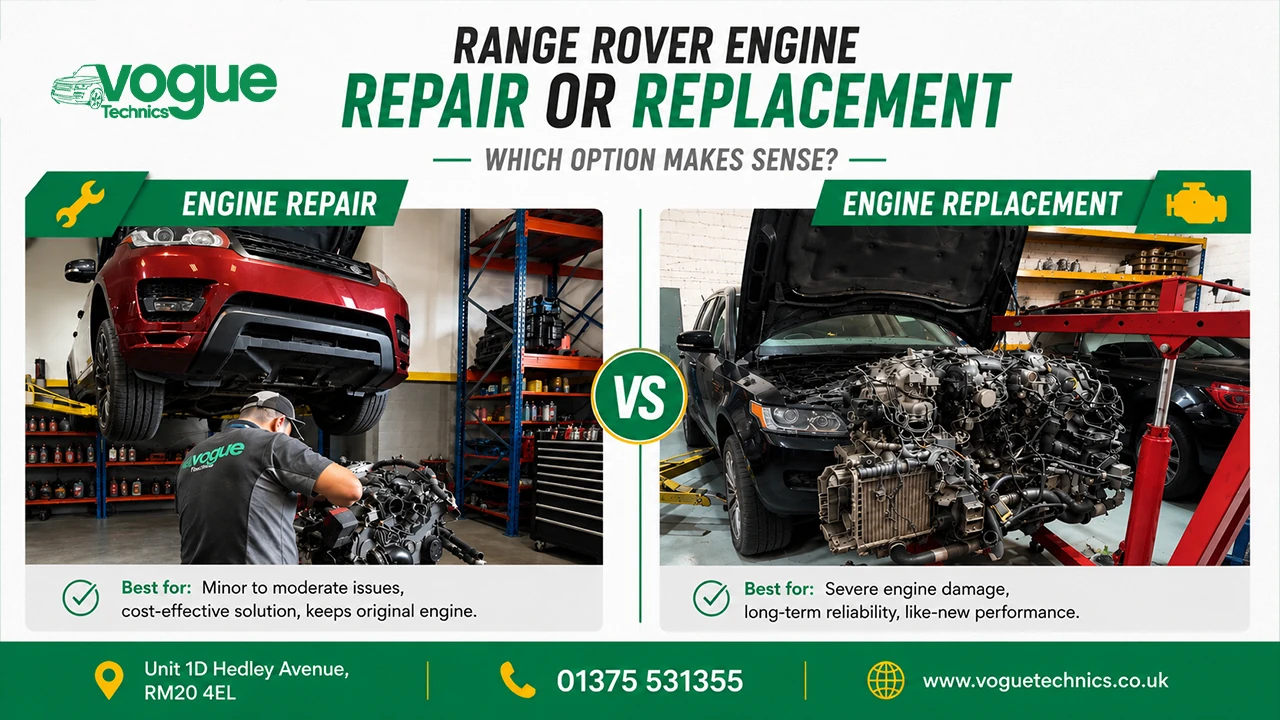
Once a serious engine problem has been diagnosed, Range Rover owners face a critical decision: repair, replace, or rebuild? Each option has its place, and the right choice depends on the nature of the damage, the age and mileage of the vehicle, and your long-term plans for it.
When Engine Repair Is Still a Viable Option
Not every serious engine symptom means the engine is beyond saving. In many cases, targeted engine repair is the most cost-effective route, provided the damage hasn't progressed too far.
Engine repair is typically the right choice when:
- The problem is isolated to a specific component (timing chain, head gasket, oil pump, turbocharger) and the rest of the engine is in good condition
- Compression tests confirm that cylinder bores and piston rings are within serviceable limits
- The vehicle has been maintained regularly and hasn't experienced repeated overheating events
- A qualified engine specialist has confirmed through thorough diagnosis that the core engine block is sound
The key is having the work done by specialists who understand Range Rover engines specifically, not a general garage that will simply quote for the most obvious fix without assessing the engine's overall condition.
Turbo Replacement, Standalone Fix or Sign of a Bigger Problem?
Turbo replacement on a Range Rover is a common repair, but it's important to understand what caused the turbo to fail in the first place. In many cases, turbo failure is a symptom rather than a root cause.
If the turbocharger failed due to oil starvation (caused by a blocked oil feed pipe or chronic low oil pressure), simply fitting a new turbo without addressing the underlying oil system problem will result in the replacement turbo failing in the same way, often within months.
A responsible approach to turbo replacement includes:
- Inspecting and cleaning the turbo oil feed and return lines
- Checking oil pressure at the turbo feed point
- Assessing the intercooler and boost pipes for oil contamination
- Confirming the engine oil and filter are in good condition before the new turbo is commissioned
At Vogue Technics, every turbo replacement is treated as part of a wider engine assessment — not just a component swap.
Engine Replacement vs. Reconditioned Engine, Cost and Value Compared
When engine damage is severe, whether from catastrophic timing chain failure, a badly warped cylinder head, or extended running with contaminated oil, a full engine replacement becomes the most practical option. At this point, the choice between a brand-new engine, a second-hand unit, or a reconditioned engine becomes critically important.
What Is a Reconditioned Engine and Is It Worth It?
A reconditioned engine (sometimes called a remanufactured or rebuilt engine) is an engine that has been stripped down to its bare components, inspected, and rebuilt using a combination of original parts that are within tolerance and new replacement parts where necessary. Key wear items — including bearings, seals, gaskets, timing components, and piston rings — are replaced as standard.
The advantages of a reconditioned engine are significant:
- Substantially lower cost than a brand-new manufacturer-supplied engine
- Known condition: unlike a second-hand engine from a vehicle of unknown history
- Warranty coverage: reputable engine rebuild specialists offer warranties on reconditioned units
- Extended service life: a properly reconditioned engine can deliver the same service life as a new unit
For many Range Rover owners, a reconditioned engine from a trusted specialist represents the best combination of cost, quality, and long-term reliability.
How Much Does Range Rover Engine Replacement Cost in the UK?
Costs vary depending on the engine variant, the extent of associated work required, and the type of replacement unit chosen:
Engine Option | Approximate Cost (UK) |
| Brand new OEM engine (supply only) | £6,000 – £12,000+ |
| Second-hand engine (unknown history) | £1,500 – £3,500 |
| Reconditioned / rebuilt engine | £2,500 – £5,500 |
| Full engine rebuild (in-situ) | £2,000 – £6,000+ |
Prices are indicative and vary based on engine specification, model year, and required ancillary work.
These figures highlight why a professionally reconditioned engine often represents the best value, particularly when you factor in the warranty and the known condition of the rebuilt unit.
Why Vogue Technics Is Trusted for Range Rover Engine Rebuild in Essex
At Vogue Technics Engine Rebuild, we specialise exclusively in engine work, and that focus matters. We're not a general repair garage that handles engines as one of dozens of job types. Engine rebuilding is what we do, and our team has extensive hands-on experience with the full range of Range Rover and Land Rover engine variants.
Based at Unit 1D Hedley Ave, Grays, Essex, RM20 4EL, we serve Range Rover owners across Essex, London, and the wider South East. Our work includes:
- Full engine rebuilds and reconditioning
- Timing chain replacement and repair
- Head gasket replacement and cylinder head skimming
- Turbocharger replacement and assessment
- Oil system diagnosis and repair
- Engine replacement using quality reconditioned units
Every job starts with a thorough diagnostic assessment, because we believe in fixing the right problem, not just the most visible one.
Frequently Asked Questions About Range Rover Engine Problems
What Are the Most Common Range Rover Engine Problems?
The most frequently reported Range Rover engine problems include timing chain wear and failure (particularly in TDV6 and Ingenium engines), head gasket failure (especially in V6 and V8 variants following overheating events), turbocharger failure in both diesel and petrol models, oil leaks and low oil pressure caused by worn seals and pump wear, and cooling system failures including water pump and thermostat issues. Many of these problems are avoidable with correct servicing intervals and quality engine oil.
How Do I Know If My Range Rover Needs an Engine Replacement?
Your Range Rover is likely to need engine replacement when: a specialist has found low compression across multiple cylinders, the engine block has suffered physical damage (cracked block, scored bores, damaged crankshaft journals), or the cost of repairing all identified faults exceeds the economic value of a rebuilt or replacement unit. A compression test, oil analysis, and thorough internal inspection are the diagnostic steps that inform this decision — not just a visual assessment or fault code reading.
Is a Reconditioned Engine as Good as a New One?
A professionally reconditioned engine built by experienced engine specialists, using quality replacement parts and thorough quality control, can deliver performance and longevity that is comparable to a new unit. The key word is "professionally." The quality of a reconditioned engine is entirely dependent on the skill, experience, and parts quality of the rebuilder. At Vogue Technics, every reconditioned engine is built to exacting standards and backed by warranty.
How Long Does a Range Rover Engine Rebuild Take?
A typical Range Rover engine rebuild takes between 5 to 10 working days, depending on the complexity of the work, parts availability, and whether any additional damage is discovered during the strip-down process. At Vogue Technics, we provide a realistic timeframe at the outset and keep customers updated throughout the process. We understand that being without your vehicle has real practical consequences.
Can I Drive My Range Rover With a Blown Head Gasket?
In a word: no. Driving with a blown head gasket risks allowing coolant into the combustion chamber (hydrolocking the engine), mixing coolant with engine oil (destroying lubrication), and causing severe overheating that warps the cylinder head. What might start as a £800–£1,500 head gasket repair can become a £4,000+ cylinder head replacement, or a complete engine rebuild — if the vehicle is driven on a compromised gasket. If you suspect head gasket failure, have the vehicle transported to a specialist rather than driven.
If your Range Rover is showing any of the warning signs covered in this guide, don't wait until a manageable problem becomes a full engine failure. The team at Vogue Technics Engine Rebuild has the specialist knowledge, hands-on experience, and diagnostic capability to assess your engine accurately and give you honest, straightforward advice on the best course of action.
Get in touch today:
📍 Unit 1D Hedley Ave, Grays, Essex, RM20 4EL 📞 01375 531355 📧 [email protected] 🌐 voguetechnicsenginerebuild.co.uk
Early diagnosis saves engines — and thousands of pounds. Call us before the problem calls you.