
Land Rover TDV6 Engine Problems: Common Faults, Symptoms, Causes & Repair Options (Essex Specialists)
This guide breaks down Land Rover TDV6 engine problems, comparing the 2.7 and 3.0 litre variants and their distinct failure patterns. It covers key issues like crankshaft and bearing failure, oil pump faults, timing belt wear, turbo problems, and EGR/DPF issues, along with early warning signs to watch for. The article also outlines diagnostic steps and repair options, from targeted fixes to full engine replacement, with cost considerations. Written by Essex-based specialists Voguetechnics Engine Rebuild, it helps owners catch faults early and make informed repair decisions.
That knock you heard on cold start this morning wasn't nothing. If you're reading this, chances are your Land Rover, Range Rover, or Discovery has started making a noise it shouldn't, the oil light's flickered on, or you're simply trying to work out whether buying a used TDV6 is a smart move or a slow-motion mistake. Either way, you're in the right place.
The TDV6 engine has a reputation, and not always a fair one. Some of that reputation is earned. Some of it comes from owners lumping every TDV6 variant into one basket, when in reality the 2.7 and 3.0 litre versions fail in quite different ways, for quite different reasons. We've spent years pulling these engines apart at our workshop in Grays, Essex, and what follows is everything we've learned about where they go wrong, how to spot trouble early, and what your realistic repair options actually are.
What Is the Land Rover TDV6 Engine and Which Models Use It?

The TDV6 is a V6 diesel engine, developed jointly with Ford and PSA under what's often referred to as the Lion V6 project. It found its way into a huge range of Land Rover, Range Rover, and Jaguar models through the 2000s and into the 2010s, and for a long time it was praised for its refinement and torque delivery. The trouble is, refinement doesn't always mean durability, and this engine has a few well-documented weak points that owners need to understand.
2.7 TDV6 (276DT) vs 3.0 TDV6 (306DT): What's the Difference?
This is the single most important distinction competitor articles tend to skip, and it matters enormously if you're trying to diagnose a fault or judge reliability.
- 2.7 TDV6 (engine code 276DT), the earlier version, fitted mainly to the Discovery 3, early Range Rover Sport, and Jaguar S-Type/XF. Its most notorious weakness is the oil pump housing and timing belt tensioner relationship, which we'll cover in detail below.
- 3.0 TDV6 (engine code 306DT), the later, more powerful development, used across the Discovery 4, later Range Rover Sport, Range Rover, and Jaguar XF/XJ. This version is more associated with crankshaft and bottom-end bearing failure, which tends to be the more catastrophic of the two failure patterns.
- 3.0 SDV6, a higher-output, later-generation variant sharing the 306DT block but with revised calibration. It carries a broadly similar failure profile to the 3.0 TDV6, though with its own set of quirks around turbo and emissions components.
Treating these as one single "TDV6 problem" is where a lot of guidance online goes wrong. If you own a 2.7, your priority list looks different to someone running a 3.0.
Which Land Rover, Range Rover and Jaguar Models Have the TDV6?
You'll find the TDV6 engine family across:
- Land Rover Discovery 3 and Discovery 4
- Range Rover and Range Rover Sport (various model years)
- Land Rover Freelander 2 (2.2 variant is a different engine, but the 3.2 badge occasionally causes confusion, worth double-checking your engine code)
- Jaguar XF, XJ, and S-Type
If you're not sure which variant sits under your bonnet, the engine code (276DT or 306DT) stamped on the block is the definitive way to check, don't rely on the badge or trim level alone.
Is the TDV6 Engine Reliable?
Honestly? It depends which one you've got, how it's been maintained, and a fair bit of luck. The 3.0 TDV6 in particular has a well-known crankshaft failure risk that isn't always mileage-dependent, we've seen it happen on engines with surprisingly low mileage where oil maintenance had lapsed. That said, plenty of TDV6 engines run well past 150,000 miles with no drama, provided oil changes are kept on schedule and early warning signs aren't ignored. Reliability here is less about the engine design being fundamentally flawed and more about how forgiving (or unforgiving) it is of neglect.
Common Land Rover TDV6 Engine Problems and Their Symptoms
Below is a quick-reference view of the faults we see most often at our workshop, roughly in order of severity.
Problem | Typical Symptoms | Severity |
| Crankshaft/bearing failure | Knocking, vibration, oil pressure warning | Critical |
| Oil pump/low oil pressure | Oil warning light, rattling on startup | Critical |
| Timing belt/tensioner failure | Rattle from front of engine, sudden misfire | Critical |
| Turbocharger failure | Smoke, loss of power, whistling noise | High |
| EGR valve/cooler faults | Rough idle, limp mode, emissions fault codes | Medium |
| DPF blockage | Warning light, poor regeneration, sluggish power | Medium |
| Injector faults | Misfire, knocking, excess smoke | High |
| Overheating/coolant loss | Rising temp gauge, coolant smell, steam | High |
Let's go through each of these in more depth.
Crankshaft and Bearing Failure (Most Serious Fault)
This is the fault that gives the 3.0 TDV6 its reputation, and it's the one worth taking most seriously.
Why Does the TDV6 Crankshaft Snap?
The root cause almost always traces back to the bottom-end bearings. When the main or big-end bearings wear down, often due to oil starvation or degraded oil pressure, the crankshaft loses proper support and begins to flex under load. Over time this fatigue leads to fracture. It's rarely a sudden, unexplained event; there are usually warning signs in the weeks or months before, but they're easy to dismiss as "just an old diesel noise."
Early Warning Signs Before the Crank Fails
Watch for:
- A knocking or rattling noise on cold start that fades once the engine warms up
- Metallic flecks or debris visible in the oil on a dipstick check
- A drop in oil pressure reading, even briefly
- Unusual vibration through the cabin at idle
- Any combination of the above getting progressively worse over a few weeks
If you notice any of this, the smart move is to stop driving the vehicle and get the oil pressure and bottom end properly inspected before it turns into a full rebuild. Catching bearing wear before it reaches the crankshaft is the difference between a moderate repair bill and a full engine replacement.
Low Oil Pressure and Oil Pump Failure
Oil pressure problems and crankshaft failure are closely linked, one is often the cause of the other. A failing oil pump, blocked oil gallery, or degraded oil pickup can starve the bearings of lubrication, and that starvation is what accelerates bearing wear in the first place.
What Causes Oil Starvation on a TDV6?
Common culprits include:
- Extended oil change intervals allowing sludge to build in the galleries
- A failing oil pump losing pressure under load
- A blocked or partially blocked oil pickup strainer
- Using the wrong oil specification or viscosity for the engine
A simple oil pressure test can flag this early, and it's a check we'd recommend on any TDV6 with unexplained knocking or an intermittent oil warning light.
Timing Belt and Tensioner Failure
Unlike engines with a timing chain, the TDV6 uses a timing belt system, and it's not something to leave beyond its service interval.
Why the 2.7 TDV6 Timing System Fails More Often
The 2.7 TDV6 has a particular quirk worth knowing: the oil pump housing and the timing belt tensioner are closely related in this engine's design, and a failing oil pump housing can compromise the tensioner's stability. When the tensioner loses tension, the belt can slip or snap, and on an interference engine like this, that means valve-to-piston contact and serious internal damage. If you own a 2.7 TDV6, this is arguably a bigger priority than the crankshaft concerns more associated with the 3.0.
Turbocharger Problems
TDV6 engines (particularly later 3.0 and SDV6 variants) use twin-turbo setups, which adds complexity and more potential failure points. Common issues include actuator failure, boost leaks, and turbo bearing wear leading to oil consumption and blue smoke. A whistling noise under acceleration, along with a noticeable drop in power, is usually the first clue.
EGR Valve and EGR Cooler Faults
The EGR system recirculates exhaust gas to reduce emissions, but it's also prone to clogging with soot and carbon over time, especially on vehicles used mostly for short journeys. A sticking EGR valve or a cracked EGR cooler can trigger rough idling, fault codes, and in some cases coolant loss if the cooler itself has cracked internally.
DPF Blockage and Regeneration Failures
Diesel particulate filters need regular high-temperature runs to burn off accumulated soot. Vehicles that mostly do short, low-speed trips are far more likely to suffer DPF blockages, triggering warning lights and, eventually, reduced power as the ECU protects the engine.
Injector Faults and Over-Fuelling
Worn or failing injectors can cause misfires, excess smoke, and in worst cases, over-fuelling that washes oil from the cylinder walls, indirectly contributing to bearing wear. Injector correction values drifting out of range is often the first diagnostic clue a technician will check.
Overheating and Coolant Loss
Coolant leaks, whether from hoses, the EGR cooler, or the water pump, are common enough on higher-mileage TDV6 engines. Left unchecked, overheating can warp the cylinder head or damage head gaskets, turning a modest repair into a much bigger one.
How to Diagnose a TDV6 Engine Fault
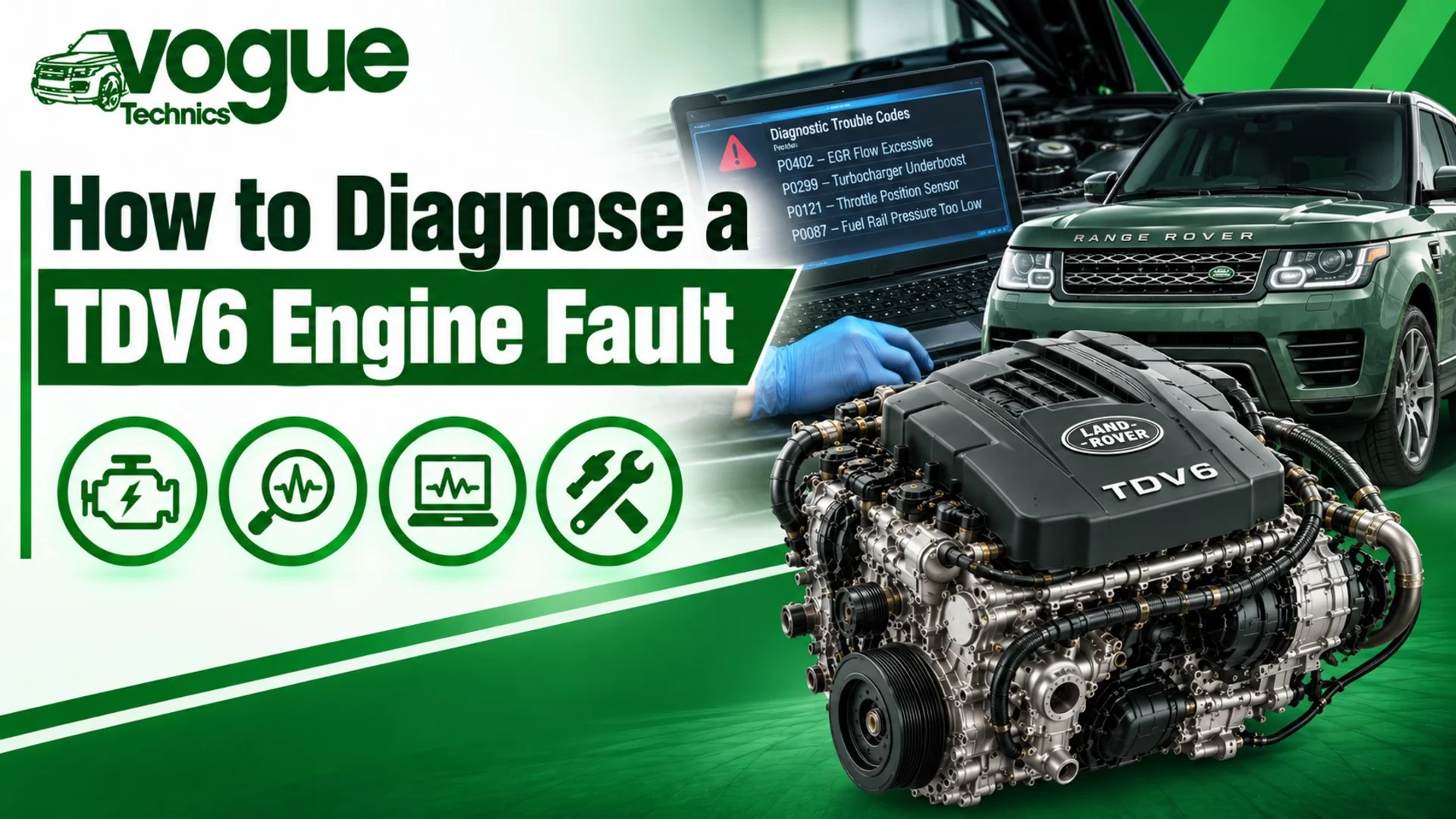
Guesswork is expensive on this engine. A structured, symptom-led approach saves time and money.
TDV6 Knocking or Rattling Noise: What It Means
A knock on cold start that disappears as the engine warms typically points toward bearing wear. A knock that persists or worsens under load is more concerning and often bottom-end related. Either way, this isn't a noise to "keep an eye on" for months, it's worth an oil pressure test and a proper listen from someone who knows this engine.
TDV6 Losing Power or Stuck in Limp Mode
Limp mode is the ECU's protective response to a detected fault, and on the TDV6 it's commonly triggered by boost pressure issues, EGR faults, or DPF problems. A diagnostic scan for fault codes is the fastest way to narrow down which system is responsible.
TDV6 Won't Start or Stalls Unexpectedly
This can range from something as simple as a fuel system issue to something as serious as timing belt failure. If the engine turns over but won't catch, or stalls suddenly without warning, don't keep attempting to restart it repeatedly, that can worsen underlying mechanical damage.
Step-by-Step Diagnostic Checklist (Symptom → Test → Likely Cause)
- Knocking noise → check oil level and colour → oil pressure test → inspect filter for metal debris → likely cause: bearing/crankshaft wear
- Loss of power → scan for fault codes → check boost pressure and EGR/DPF data → likely cause: turbo, EGR, or DPF fault
- Oil pressure warning → stop the engine immediately → check oil level → mechanical oil pressure test → likely cause: oil pump, blocked gallery, or bearing wear
- Rattling from the front of the engine → inspect timing belt and tensioner condition → likely cause: tensioner or oil pump housing fault (2.7 TDV6 especially)
TDV6 Repair, Rebuild and Replacement Options in Essex

Once you know what's wrong, the next question is what to actually do about it, and that decision has real cost implications.
Can a Failed TDV6 Crankshaft or Engine Be Repaired?
In some cases, yes. If caught early, worn bearings can sometimes be replaced without a full engine rebuild. Once the crankshaft itself has fractured, though, repair isn't realistic, you're looking at a rebuild or replacement engine at that point. This is exactly why early diagnosis matters so much with this particular fault.
Repair vs Reconditioned Engine vs Full Replacement: Which Is Right for You?
- Targeted repair, suitable when the fault is isolated (a single injector, turbo actuator, or EGR component) and the bottom end is otherwise healthy.
- Reconditioned engine, a strong middle-ground option when bottom-end damage has occurred but the vehicle is otherwise worth keeping. A reconditioned long engine addresses the crankshaft, bearings, and related components as a complete unit, rather than patching around the problem.
- Full replacement, worth considering on higher-mileage vehicles where multiple systems are showing wear simultaneously, or where the cost of repeated repairs starts approaching the value of a replacement unit.
How Much Does TDV6 Engine Repair or Replacement Cost?
Costs vary significantly depending on the fault, the model, and whether you're looking at a component-level repair or a full reconditioned engine supply-and-fit. A turbo replacement or EGR repair sits at the lower end of the scale, while a reconditioned long engine replacement, covering crankshaft, bearings, and internals, represents a much larger investment, but often works out more cost-effective than repeated partial repairs on a tired bottom end. We'd always recommend getting a written quote based on your specific vehicle and fault rather than relying on generic figures, since model year and specification genuinely change the number.
Why Choose Voguetechnics Engine Rebuild for Your TDV6
We work on TDV6 engines regularly, across both the 2.7 and 3.0 variants, and we understand that they don't fail in identical ways. That distinction shapes how we diagnose and quote every job, no generic "replace the engine" recommendation without first checking whether a targeted repair could save you money.
Get a Written Quote or Book Your Repair
If you're hearing a knock you're not sure about, seeing an oil pressure warning, or just want a professional inspection before a fault becomes a full rebuild, get in touch with our team in Grays, Essex. We'll talk you through what we find, what your realistic options are, and give you a straightforward written quote, no pressure, no upselling.
Frequently Asked Questions About TDV6 Problems
Is the Land Rover TDV6 engine reliable?
It can be, provided oil maintenance is kept up to date and early warning signs aren't ignored. The 3.0 TDV6 carries a known crankshaft failure risk, while the 2.7 TDV6 is more associated with timing belt and oil pump housing issues. Neither is inherently unreliable if maintained properly.
What is the most serious TDV6 problem?
Crankshaft and bottom-end bearing failure, most commonly seen on the 3.0 TDV6, is the most serious fault. It's also the most expensive to fix if it progresses to a full fracture, which is why early diagnosis matters.
How often should the TDV6 timing belt be changed?
Interval recommendations vary by model year and manufacturer guidance, but this is not a component to run past its scheduled interval, particularly on the 2.7 TDV6 where tensioner and oil pump housing wear compound the risk.
Can a blocked DPF be cleaned instead of replaced?
In many cases, yes. A forced regeneration or professional clean can resolve moderate blockages. Severe or repeated blockages, however, may point to an underlying issue, such as short-journey driving patterns or an EGR fault, that needs addressing alongside the DPF itself.
How many miles can a TDV6 engine do?
Well-maintained TDV6 engines can comfortably exceed 150,000 miles. High mileage alone isn't a reliable predictor of failure, oil maintenance history and how early warning symptoms were responded to matter more.
Why does my TDV6 make a knocking noise on startup?
A cold-start knock that fades as the engine warms is a common early sign of bearing wear. It's worth having the oil pressure tested rather than waiting to see if it gets worse.
Final Thoughts
The TDV6's reputation isn't entirely deserved, but it isn't entirely undeserved either. The engines that fail catastrophically are almost always the ones where early warning signs, a knock, a pressure warning, a rattle, went unchecked for weeks or months. The ones that run well past 150,000 miles are usually the ones where owners took those small signals seriously and got them looked at.
If your TDV6 is showing any of the symptoms covered above, don't wait for it to get worse. Get in touch with our team at Voguetechnics Engine Rebuild in Grays, Essex for a proper diagnostic check, a straightforward written quote, and repair or reconditioned engine options built around what your vehicle actually needs, not a one-size-fits-all recommendation.