
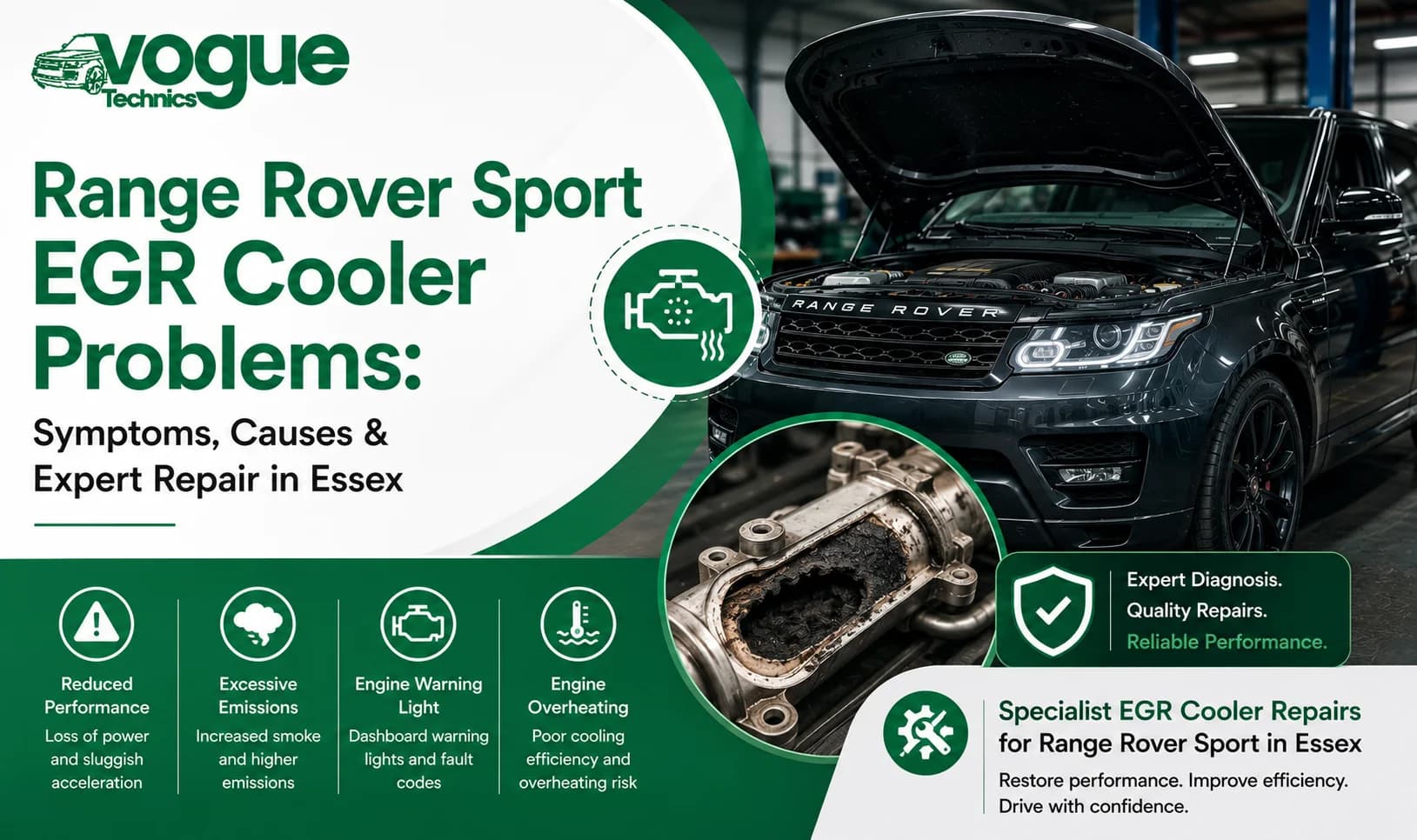
Range Rover Sport EGR Cooler Problems: Symptoms, Causes & Expert Repair in Essex
This guide breaks down the most common EGR cooler problems on Range Rover Sport SDV6 and TDV6 engines, including unexplained coolant loss, white exhaust smoke, and warning lights tied to fault codes like P0401 and P2457. It explains how internal cracking in the cooler core causes coolant to leak into the exhaust or intake rather than externally, making the fault easy to miss without proper testing. The blog also covers how to correctly diagnose the issue versus a head gasket failure, and outlines Voguetechnics' full diagnostic-to-repair process in Grays, Essex. It closes with guidance on OEM vs aftermarket parts and realistic repair costs and timelines.
You've noticed white smoke puffing from the exhaust on cold mornings. The coolant level keeps dropping and you can't find a puddle anywhere on the driveway. Maybe the engine management light flicked on last week, and now the car feels sluggish, like it's holding itself back.
If any of that sounds familiar, you're probably dealing with an EGR cooler problem — and if you drive an SDV6 or TDV6 Range Rover Sport, you're far from alone. This is one of the most common (and most misdiagnosed) faults on these engines, and leaving it unchecked can turn a moderate repair into a full engine rebuild.
We've stripped down enough SDV6 and TDV6 units at our Grays, Essex workshop to know exactly what this failure looks like at every stage. This guide walks you through the symptoms, the mechanical cause, how a proper diagnosis should be done, and what a genuine repair actually involves.
What Are the Symptoms of a Failing EGR Cooler on a Range Rover Sport?
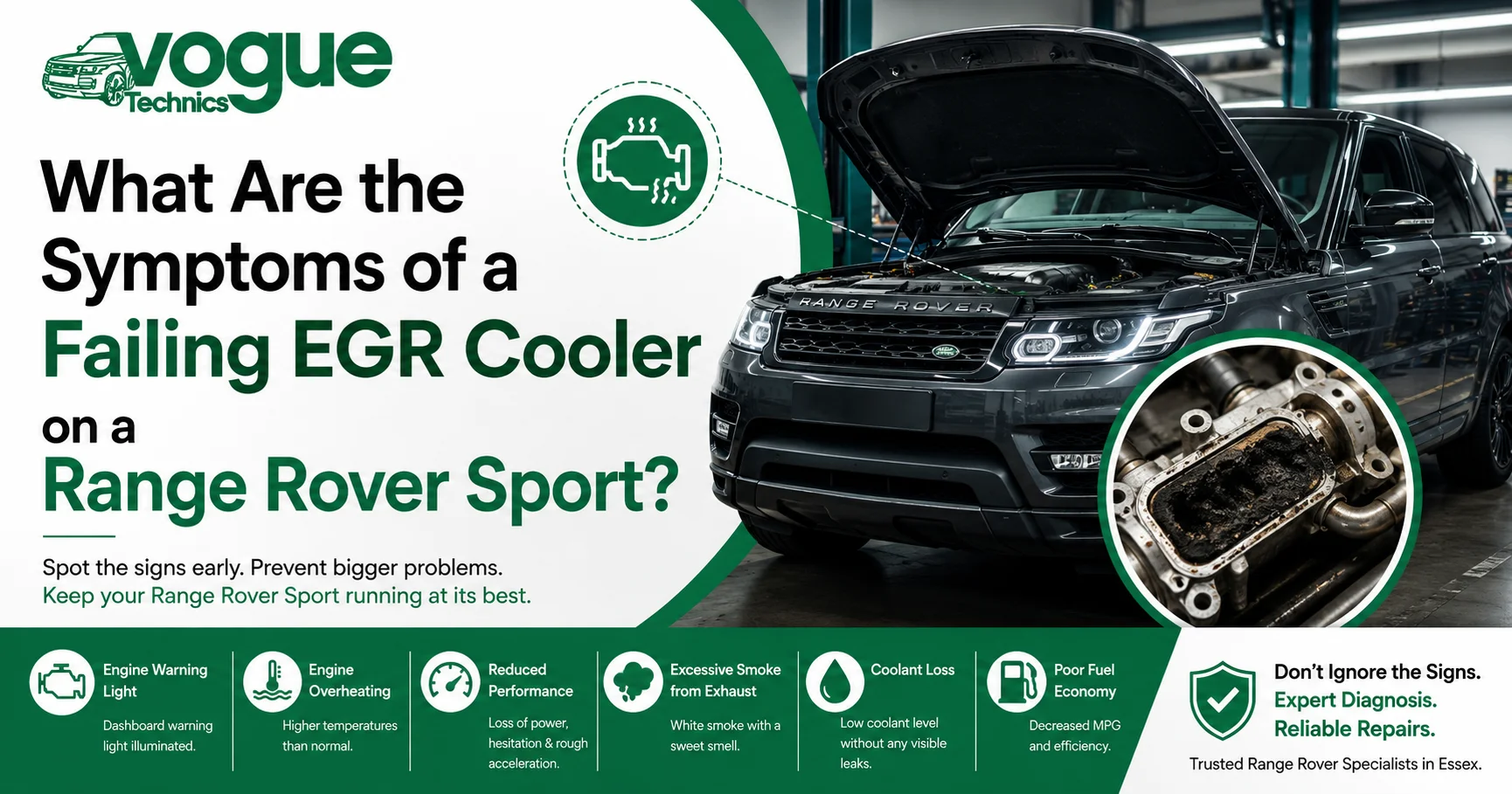
EGR cooler failure rarely announces itself with one dramatic symptom. It tends to creep in gradually, which is exactly why so many owners drive around for weeks — sometimes months — before the real damage starts.
Why Is My Range Rover Sport Losing Coolant Without a Visible Leak?
This is the symptom that catches most owners off guard. You check under the car, you check the driveway, you check the engine bay, nothing. No hoses weeping, no stains, no obvious culprit. Yet the coolant reservoir keeps dropping week after week.
Here's what's actually happening. The EGR cooler sits at the junction between your engine's exhaust and intake systems, and it uses coolant flowing through internal passages to cool exhaust gas before it's recirculated back into the intake manifold. When the cooler's internal core cracks — which is exactly what tends to happen on the SDV6 and TDV6 — coolant doesn't leak onto the ground. It leaks internally, straight into the exhaust or intake path, where it gets burned off or drawn into the cylinders.
That's why you get an internal coolant leak with no external trace. It's also why so many independent garages struggle to find it without the right diagnostic approach.
What Does White Smoke From the Exhaust Actually Mean?
White smoke, particularly thick, persistent white smoke on startup or under load, is coolant burning inside the combustion chamber or exhaust system. It's one of the clearest visible signs that coolant is finding its way somewhere it shouldn't.
A quick way to tell it apart from normal cold-morning condensation: condensation clears within a few seconds of driving. Coolant-related white smoke tends to persist, often has a faintly sweet smell, and can reappear consistently every time you start the engine from cold.
Engine Overheating, Limp Mode & Warning Lights Explained
As coolant loss progresses, three things typically follow in sequence:
- Rising engine temperature: with less coolant circulating properly, the engine starts running hotter than it should, especially under load or in traffic.
- Reduced power or limp mode: the ECU detects abnormal readings from temperature, pressure, or emissions sensors and deliberately restricts engine performance to protect the drivetrain.
- Dashboard warning lights: the check engine light and, in more advanced cases, a coolant or temperature warning light will appear.
None of these are symptoms to drive through. Continuing to use the vehicle once limp mode activates significantly raises the risk of head gasket damage or a cracked cylinder head.
Common Fault Codes You'll See on the Scanner (P0401, P0402, P0404, P2457)
If you or your mechanic run an OBD scanner, these are the codes most closely associated with EGR cooler and EGR valve faults on Land Rover diesel engines:
- P0401: Insufficient EGR flow, often linked to carbon buildup restricting the system
- P0402: Excessive EGR flow, sometimes triggered by a stuck-open valve
- P0404: EGR circuit range/performance issue
- P2457: EGR cooler performance code, one of the most direct indicators of cooler failure
These codes point you in the right direction, but they don't confirm the fault on their own, which is exactly where a lot of misdiagnosis happens, and exactly what we'll cover next.
What Causes EGR Cooler Failure in SDV6 and TDV6 Engines?
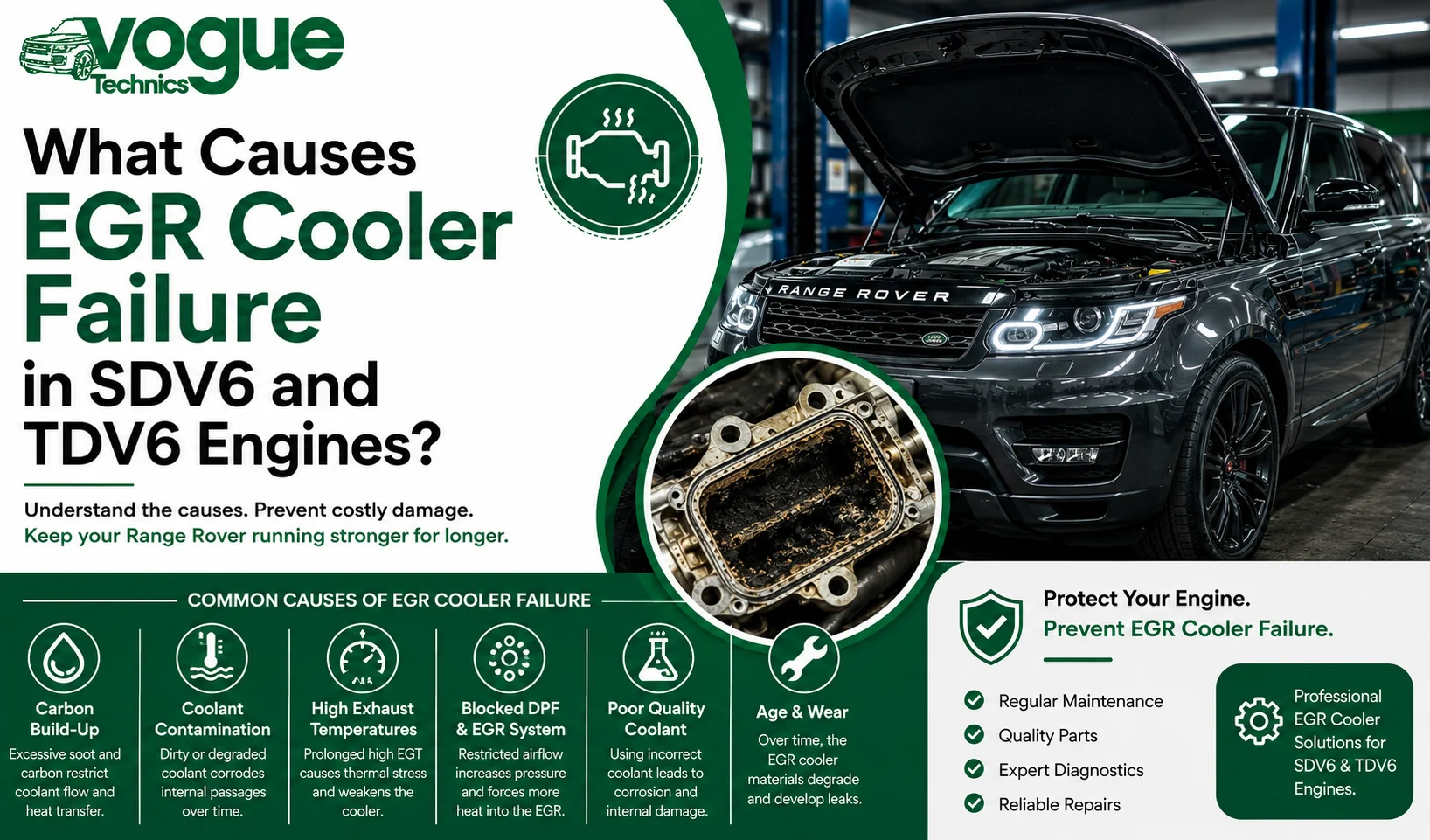
Understanding the "why" behind this fault matters, because it explains why the problem is so common on these specific engines and why patch repairs rarely hold up long-term.
Carbon Buildup and Thermal Stress Inside the Cooler Core
The EGR cooler's job is inherently harsh. It's constantly cycling between extreme heat (from exhaust gas) and rapid cooling (from coolant flow), thousands of times over the vehicle's life. That thermal cycling, combined with soot and carbon deposits building up inside the core over time, gradually weakens the metal.
Short journeys, frequent stop-start driving, and infrequent long motorway runs all accelerate carbon accumulation, because the engine rarely reaches the sustained temperatures needed to burn deposits off naturally.
How Internal Cracking Leads to Coolant Ingress
Once thermal stress and carbon buildup have weakened the cooler's internal structure, small cracks begin to form in the core. These cracks sit directly between the coolant passage and the exhaust gas passage, so once they open up, coolant has a direct route into the exhaust system, and from there, potentially into the intake manifold and combustion chambers.
This is the mechanical root of almost every symptom we covered above: the mysterious coolant loss, the white smoke, the overheating. It all traces back to this one point of failure.
SDV6 vs TDV6 — Which Engine Is More Prone to EGR Failure?
Factor | TDV6 (earlier generation) | SDV6 (later generation) |
| EGR cooler design | Simpler, single-stage cooling | Dual-stage EGR cooling system |
| Common failure point | Core cracking under thermal stress | Core cracking, plus increased carbon buildup from tighter emissions tuning |
| Typical mileage at failure | Often 90,000–130,000 miles | Often 80,000–110,000 miles |
| Emissions system complexity | Lower | Higher (added strain on cooling demands) |
Both engines are genuinely at risk. The SDV6's tighter emissions calibration and dual-stage cooling design mean it can actually show symptoms slightly earlier in some cases, despite being the newer platform — which surprises a lot of owners who assume newer automatically means more reliable.
How Do You Properly Diagnose an EGR Cooler Problem?
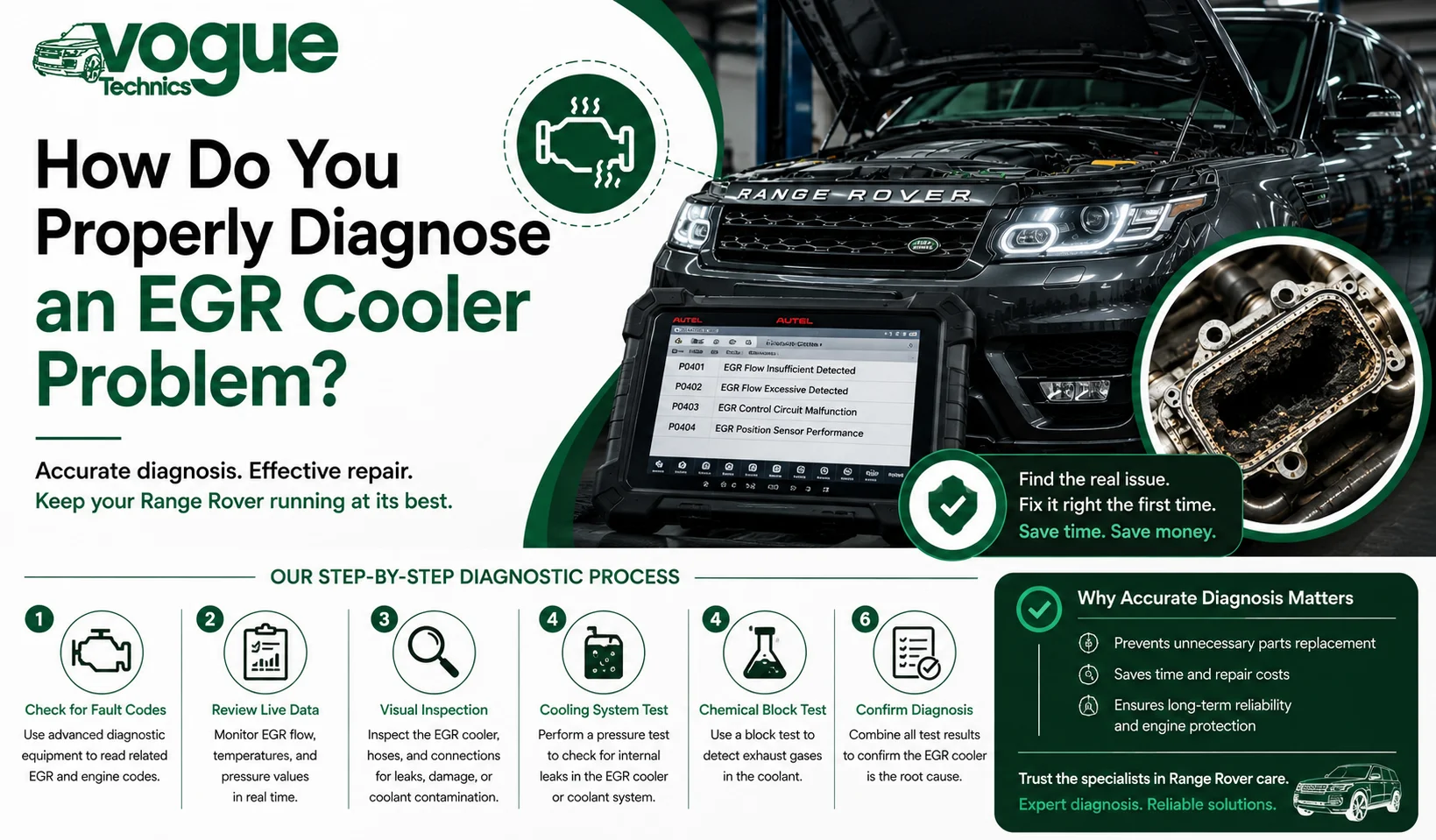
This is the part most repair guides skip entirely, and it's where a lot of money gets wasted on the wrong fix. A fault code alone doesn't confirm an EGR cooler failure, it just tells you where to start looking.
Pressure Testing the Cooling System — What It Reveals
A proper diagnosis starts with a cooling system pressure test. By pressurising the system and monitoring for pressure drop, a technician can confirm whether coolant is escaping somewhere in the system — and combined with an exhaust gas inspection or borescope check of the EGR cooler itself, this narrows the fault down with real confidence, rather than guesswork.
Skipping this step is exactly how owners end up paying for a head gasket replacement that doesn't fix the real problem, or an EGR cooler swap when the actual issue was elsewhere.
EGR Cooler Failure vs Head Gasket Failure: How to Tell the Difference
Both faults share overlapping symptoms, coolant loss, white smoke, overheating, which is why they get confused so often. A few distinguishing signs:
- Combustion gas testing on the coolant will typically show contamination with head gasket failure, but may present differently with EGR cooler ingress depending on where the crack sits
- Oil condition a milky, emulsified oil cap is more commonly associated with head gasket failure than EGR cooler failure
- Pattern of white smoke EGR-related smoke often appears more consistently on cold starts, while head gasket smoke can worsen progressively under load
None of these signs are 100% conclusive on their own. That's why a combined approach, fault codes, pressure testing, visual inspection, and where needed, a borescope look inside the cooler — gives the most reliable answer.
Is It Safe to Keep Driving With a Faulty EGR Cooler?
Short answer: not for long. In the early stages, some owners do continue driving while topping up coolant, but this is a genuine gamble. Once coolant ingress reaches the combustion chamber consistently, you risk hydrolock, cylinder damage, or accelerated wear on the turbocharger from coolant contamination in the intake path. What starts as an EGR cooler repair can turn into a full engine rebuild if it's ignored.
Quick DIY Inspection Checklist Before You Book a Diagnostic
Before bringing the car in, a few quick checks can help you describe the problem more accurately:
- Check the coolant reservoir level and note how quickly it's dropping over a week
- Look (and smell) for white exhaust smoke on a cold start
- Note whether the check engine light is on, and whether the car has entered limp mode
- Check under the car and around the EGR cooler housing for any external staining, even though internal leaks are more common
- Keep a record of recent driving patterns, mostly short trips can point toward carbon buildup as a contributing factor
This won't replace a proper diagnostic, but it gives your technician a clearer starting point.
EGR Cooler Replacement & Repair — What to Expect From Voguetechnics
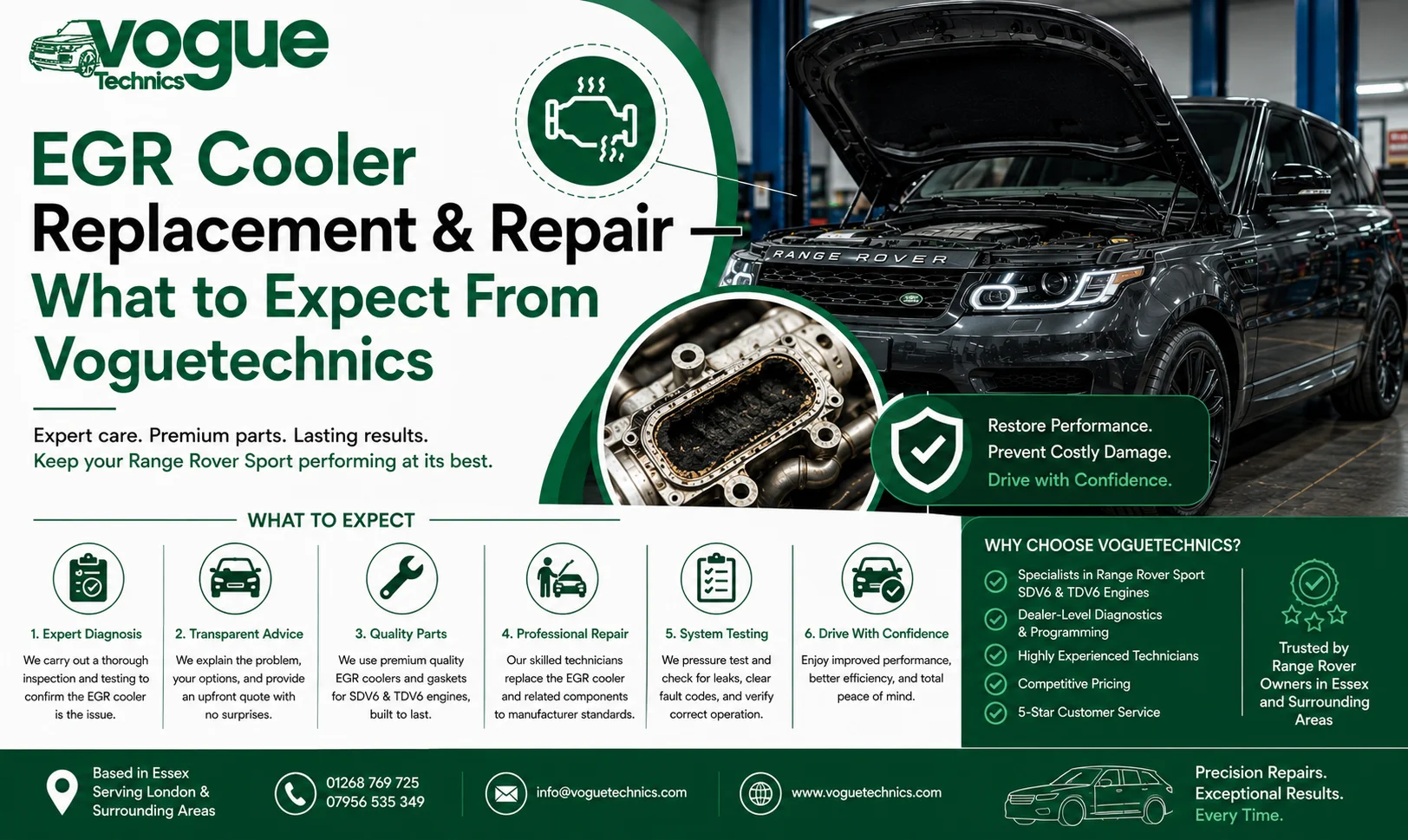
Once the fault is confirmed, the focus shifts to getting it repaired properly, not just replacing the cooler, but making sure the surrounding system is clean and functioning correctly so the same failure doesn't recur in another 60,000 miles.
Our Step-by-Step Diagnostic-to-Repair Process
At Voguetechnics, every EGR cooler job follows the same structured process:
- Full diagnostic scan to capture all relevant fault codes across the emissions and cooling systems
- Cooling system pressure test to confirm internal coolant loss
- Visual and borescope inspection of the EGR cooler and surrounding components
- Intake and exhaust path inspection for carbon buildup or coolant contamination that may need addressing alongside the cooler
- Replacement of the EGR cooler, using new gaskets and seals throughout, not just the cooler itself
- Coolant system flush to remove any contamination introduced during the failure
- Post-repair road test and re-scan to confirm the fault is fully resolved
Skipping any of these steps is how repairs fail early. We don't.
OEM vs Aftermarket EGR Coolers — Which Should You Choose?
This is a genuine decision point, and the honest answer depends on your priorities:
Consideration | Genuine Land Rover (OEM) | Quality Aftermarket |
| Upfront cost | Higher | Lower |
| Fit and tolerance accuracy | Guaranteed factory spec | Generally good, varies by brand |
| Long-term reliability | Consistent with original design life | Depends heavily on manufacturer |
| Warranty backing | Manufacturer-backed | Varies by supplier |
We typically recommend genuine parts for long-term reliability, particularly given how demanding this component's operating environment is. That said, reputable aftermarket coolers can be a sensible option for older vehicles where cost matters more than maximising lifespan. We'll talk you through the trade-off honestly based on your specific car.
Realistic Repair Costs & Turnaround Time in Grays, Essex
EGR cooler repair costs vary depending on the extent of contamination and whether additional components need attention. As a general guide, expect the job to involve parts, labour for the removal and refit (which is a fairly involved process on both the SDV6 and TDV6 due to the cooler's position), and a coolant flush. Turnaround is typically completed within one to two working days once the vehicle is booked in and the fault is confirmed.
We'll always give you a clear, itemised quote after diagnosis, before any work begins.
Book a Professional EGR Diagnosis With Voguetechnics Today
If you're seeing any combination of coolant loss, white smoke, or warning lights on your Range Rover Sport, the most cost-effective thing you can do is get it properly diagnosed before the damage spreads. Our Grays, Essex workshop specialises in SDV6 and TDV6 engine work, and we'll give you a straight answer on what's actually wrong — not just a fault code guess.
Frequently Asked Questions
What are the symptoms of a bad EGR cooler on a Range Rover Sport?
The most common signs are unexplained coolant loss with no visible external leak, white smoke from the exhaust (especially on cold starts), engine overheating, reduced power or limp mode, and warning lights linked to fault codes like P0401, P0402, P0404, or P2457.
Does an EGR cooler cause coolant loss?
Yes. When the internal core cracks, coolant leaks directly into the exhaust or intake path rather than externally, which is why the coolant level drops without any visible puddles or stains.
Can I drive with a faulty EGR cooler?
It's possible in the very early stages, but not advisable. As coolant ingress worsens, the risk of cylinder damage, hydrolock, or turbocharger contamination increases significantly. Getting it diagnosed and repaired early is always the cheaper option.
How much does EGR cooler replacement cost?
Costs depend on the extent of the fault and whether related components (like the intake manifold or turbo) have also been affected by coolant contamination. We provide a full itemised quote after diagnosis, so you know exactly what you're paying for and why.
Which Range Rover engines are most prone to EGR cooler failure?
Both the TDV6 and SDV6 diesel engines are known for this issue, typically appearing between 80,000 and 130,000 miles. The SDV6's dual-stage EGR cooling and tighter emissions tuning mean it can sometimes show symptoms even earlier than the older TDV6.
How do you tell the difference between EGR cooler failure and head gasket failure?
A combination of combustion gas testing, oil condition checks, and cooling system pressure testing is needed to tell them apart reliably, since both faults share overlapping symptoms like coolant loss and white smoke. A borescope inspection of the EGR cooler often gives the clearest confirmation.
EGR cooler problems on the Range Rover Sport are common, but they're also well understood, and when they're diagnosed properly and repaired correctly the first time, there's no reason your engine can't run reliably for years afterward. The key is catching it early and not settling for a guess-and-replace approach.
If your Range Rover Sport is showing any of the symptoms covered here, get in touch with our team at Voguetechnics Engine Rebuild in Grays, Essex. We'll run a proper diagnostic, tell you exactly what's going on, and give you a straightforward, honest repair plan — no unnecessary work, no guesswork.