
Range Rover Evoque Coolant Leak Diagnosis: Causes, Symptoms & Expert Repair Guide
A coolant leak on a Range Rover Evoque can quickly escalate from a minor seep into a blown head gasket or a seized engine if left unaddressed. This guide covers every common cause, from cracked thermostat housings and failing water pumps to head gasket failure, alongside real symptoms to watch for and honest repair cost estimates. You'll also find a step-by-step diagnosis process using pressure testing, UV dye, and OBD2 fault codes, exactly as used by Land Rover specialists at Vogue Technics Engine Rebuild in Grays, Essex. Whether you're losing coolant with no visible leak or your temperature gauge is climbing, this is the resource you need before the problem gets expensive
If you've noticed your temperature gauge creeping up, spotted a puddle under your Evoque, or caught a faint sweet smell drifting through the cabin vents, your cooling system is trying to tell you something. A coolant leak on a Range Rover Evoque is not a problem you can park at the back of your mind. Left unaddressed, what starts as a minor seepage can escalate into a blown head gasket, a seized engine, or a repair bill that makes your eyes water.
At Vogue Technics Engine Rebuild in Grays, Essex, we diagnose and repair coolant leaks on Land Rover and Range Rover vehicles every single week. This guide draws directly from that hands-on experience, giving you a clear, honest breakdown of what causes coolant leaks on the Evoque, how to diagnose them properly, what symptoms to watch for, and what you can realistically expect to pay for repairs.
Whether you're losing coolant with no visible leak, dealing with an amber engine warning light, or your coolant warning light keeps flashing on the dash, this article has you covered.
What Causes a Coolant Leak in a Range Rover Evoque?
The Range Rover Evoque is a well-engineered compact SUV, but its cooling system has a handful of known weak points that owners tend to encounter, particularly on models from 2012 through to 2018. Understanding the root cause is the first step toward a lasting fix, not just a temporary top-up.
Thermostat Housing Failure — A Common Evoque Weak Point
If there's one component that comes up time and again in Evoque cooling system repairs, it's the thermostat housing. On the 2.0-litre Si4 petrol and the 2.2-litre SD4 diesel variants, the thermostat housing is manufactured from plastic and plastic, under years of heat cycling and coolant pressure, simply degrades.
Signs Your Thermostat Housing Is Leaking
The signs are usually unmistakable once you know what to look for:
- Dried coolant crust or orange residue around the housing itself
- Coolant dripping from the front of the engine after the car has been running
- Temperature gauge fluctuating between normal and hot, particularly at idle
- Coolant warning light illuminating shortly after a top-up
The leak often starts as a hairline crack that weeps coolant slowly, which is precisely why so many owners find their reservoir empty with no obvious puddle on the driveway.
Why the Evoque Thermostat Housing Cracks Over Time
Plastic housings expand and contract with every heat cycle. Over time, especially in the stop-start traffic common across Essex and the wider UK, thermal fatigue causes micro-fractures to develop. Once the engine reaches operating temperature and the cooling system pressurises, coolant finds those weak points and escapes. It's not a manufacturing defect so much as an inevitable material limitation. Replacing the OEM plastic housing with an upgraded unit is the correct long-term solution.
Water Pump Failure and Coolant Loss
The water pump is the heart of your Evoque's cooling circuit, it keeps coolant circulating between the engine block, radiator, heater core, and expansion tank. When it starts to fail, the consequences move fast.
Symptoms of a Failing Water Pump on the Evoque
- Coolant pooling directly beneath the front-centre of the vehicle
- Engine overheating at idle or during low-speed driving
- A grinding or whining noise from the front of the engine
- Coolant level dropping steadily despite no visible external leak point
How a Worn Water Pump Bearing Causes Coolant Seepage
Inside every water pump is a shaft bearing. As mileage accumulates, that bearing wears and when it does, the shaft develops play. That movement compromises the pump's internal seal, allowing coolant to weep past and escape through the pump's weep hole. It's a gradual process, but once it starts, it only gets worse. Catching it early saves you from the far more serious consequence of the impeller detaching entirely and causing catastrophic overheating.
Radiator and Radiator Hose Leaks
The radiator and its associated hose network are under constant pressure during normal operation. On higher-mileage Evoques, both the radiator itself and the silicone or rubber hoses connecting it to the engine can develop leaks, sometimes in locations that are surprisingly difficult to spot during a casual inspection.
How to Spot a Radiator Hose Leak on Your Evoque
Run your fingers along the length of each visible coolant hose when the engine is cold. Feel for:
- Soft or spongy sections that indicate internal wall deterioration
- Swelling near the clamp ends a classic sign that the hose is about to fail
- Dried coolant staining on the outer surface of the hose
- Visible cracks in the rubber, particularly where the hose bends
Hose clamps that have loosened over time are another common culprit and one of the easiest fixes in the cooling system if caught early enough.
Radiator End Tank Cracks and Corrosion
The Evoque's radiator uses plastic end tanks crimped onto an aluminium core. These end tanks are susceptible to cracking, particularly at the corners and when they do, coolant loss can be steady and substantial. Corrosion at the junction between the aluminium core and the plastic tank is also a known failure point, especially on vehicles where the coolant has never been flushed or replaced on schedule.
Expansion Tank and Coolant Reservoir Cracks
The expansion tank, sometimes called the coolant reservoir or header tank — is another plastic component that takes a punishing on the Evoque. It sits in the engine bay, exposed to heat from all directions, and it's under pressure every time the engine reaches operating temperature.
Why the Evoque Expansion Tank Is Prone to Failure
The tank itself can develop hairline cracks that are virtually invisible to the naked eye. The pressure cap on the reservoir is equally important, a cap that no longer holds pressure correctly will allow coolant to escape as steam rather than recirculating it through the system.
Coolant Reservoir Empty — What It Really Means
Finding your coolant reservoir empty is never just bad luck. It means coolant has left the system, either through a visible external leak, through internal combustion (head gasket failure), or through a failed pressure cap allowing it to boil off. Simply topping it up without investigating the cause is a short-term fix that frequently leads to a much larger repair further down the road.
Head Gasket Failure and Internal Coolant Loss
This is the scenario every Evoque owner hopes to avoid but it's important to address it honestly, because head gasket failure is a genuine cause of coolant loss on these vehicles, particularly on higher-mileage examples or those that have previously overheated.
Milky Oil and White Exhaust Smoke — Warning Signs You Cannot Ignore
When a head gasket fails, coolant crosses into the combustion chamber or the oil galleries. The warning signs are distinct:
- White or grey sweet-smelling smoke from the exhaust, particularly on startup
- Milky, frothy residue on the underside of the oil filler cap
- Coolant level dropping with no external leak anywhere on the vehicle
- Engine running rough or misfiring alongside temperature fluctuations
- Coolant bubbling in the reservoir, caused by combustion gases entering the cooling system
If you're seeing any combination of these signs, stop driving the vehicle immediately and book a professional diagnosis. Continuing to run the engine accelerates the damage and can turn a head gasket repair into a full engine rebuild.
How to Diagnose a Coolant Leak on a Range Rover Evoque — Step by Step
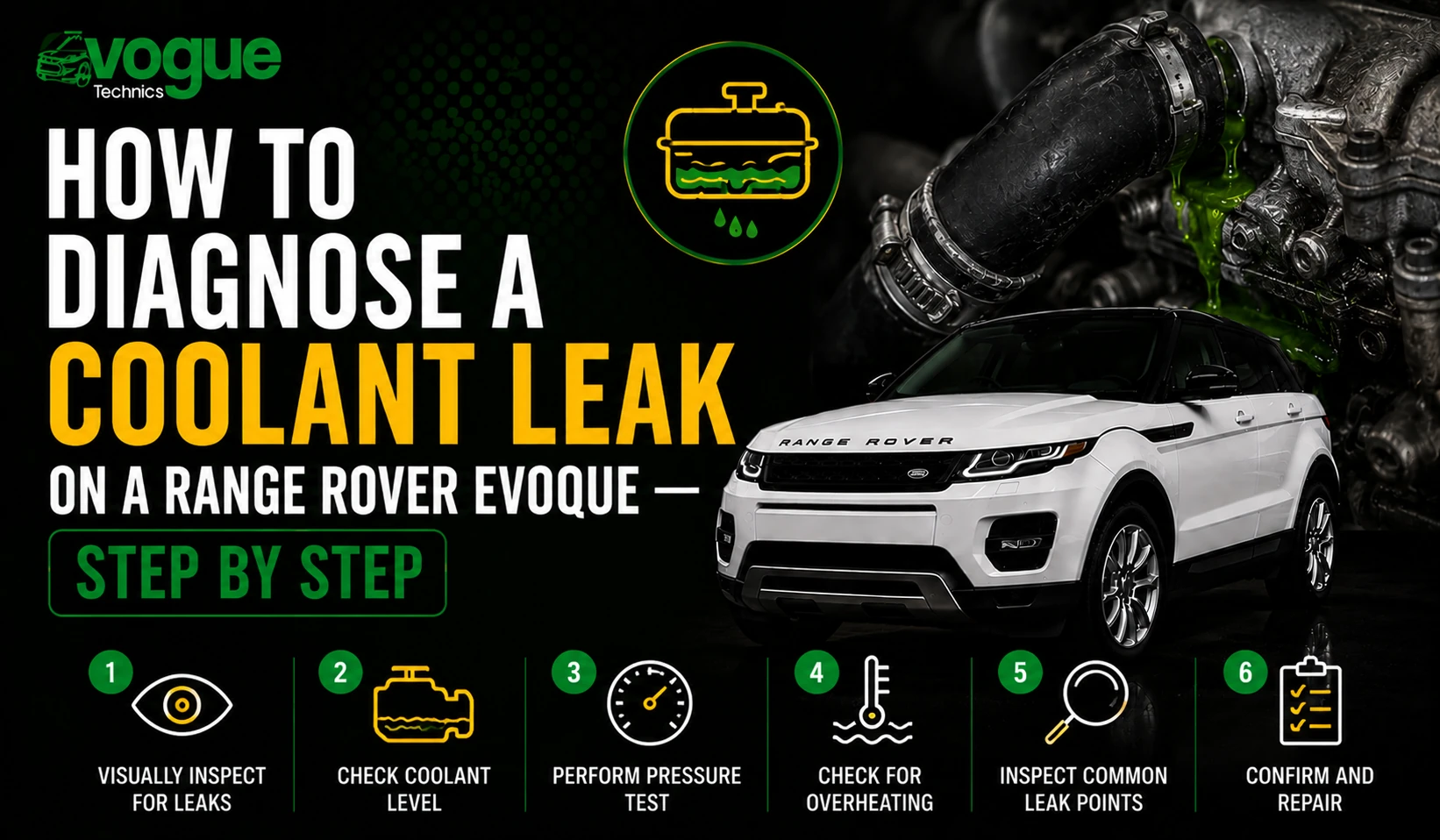
Accurate diagnosis separates a targeted, cost-effective repair from a guessing game that drains your wallet. Here's the structured approach our technicians at Vogue Technics use on every cooling system job.
Visual Inspection — Where to Look First
Before reaching for any diagnostic tools, a thorough visual inspection in good lighting covers a surprising amount of ground.
Checking for Coolant Puddles Under the Vehicle
Park on a clean, dry surface and run the engine to operating temperature, then switch it off and let it sit for ten to fifteen minutes. Check beneath the vehicle for:
- Pink, orange, or green fluid the colour depends on which coolant specification Land Rover used at the last service
- Puddles positioned beneath the front of the engine (water pump, thermostat housing area)
- Drips near the radiator or along the underside of hose runs
Bear in mind that air conditioning condensation is clear and watery, coolant has a slightly oily, slippery feel and a recognisable sweet smell.
Identifying Coolant Stains and Crystallisation Around the Engine Bay
With the bonnet up, look for:
- White or orange crusty deposits around hose connections, the thermostat housing, or the expansion tank
- Staining on the engine block below any potential leak source
- Residue on the underside of the bonnet directly above the engine, a sign of pressurised coolant misting
These dried deposits show you exactly where coolant has been escaping, even if there's no active drip at the moment of inspection.
How to Perform a Cooling System Pressure Test on an Evoque
A pressure test is the single most reliable method for pinpointing a coolant leak, including leaks that are invisible during a visual inspection.
Tools You Need — Pressure Tester, UV Dye, OBD2 Scanner
Tool | Purpose |
| Cooling system pressure tester kit | Pressurises the system to replicate operating conditions |
| UV dye and UV torch | Highlights leak paths invisible to the naked eye |
| OBD2 scanner | Reads fault codes including P0128, P0299, P0234 |
| Infrared thermometer | Checks temperature distribution across the radiator |
| Coolant combustion test kit | Detects exhaust gases in coolant (head gasket check) |
Step-by-Step Pressure Testing Procedure
1. Allow the engine to cool completely, never remove the pressure cap from a hot cooling system.
2. Remove the expansion tank cap and attach the pressure test adaptor.
3. Pump the system up to the pressure rating printed on the cap, typically 1.2 to 1.4 bar on the Evoque.
4. Hold the pressure for a minimum of 15 to 20 minutes while inspecting all components.
5. Any visible seepage, dripping, or hissing indicates your leak location.
6. If the system loses pressure but no external leak is visible, suspect an internal leak, head gasket territory.
What Pressure Drop Tells You About the Leak Source
A fast pressure drop points to a significant external leak, a cracked reservoir, a split hose, or a failed pump seal. A slow, gradual drop with no visible external source strongly suggests the cooling system is losing pressure internally, either past the head gasket or through a cracked engine block. This distinction is critical for repair planning.
Using UV Dye for Coolant Leak Detection
Adding UV dye to the cooling system is particularly effective for tracking down slow seeps that evaporate before leaving a visible trace.
How to Interpret UV Dye Results on the Evoque
After adding the dye and running the engine through a full heat cycle, inspect the entire engine bay with a UV torch in a darkened environment. The dye fluoresces bright green or yellow at every point where coolant has escaped, including hairline cracks in the expansion tank or thermostat housing that would otherwise be impossible to identify.
Reading OBD2 Fault Codes Related to Coolant Loss
Modern Evoques store fault codes that can point directly toward cooling system problems. Connecting a quality OBD2 scanner to the diagnostic port gives you data that a visual inspection alone simply cannot provide.
P0128, P0299, P0234 — What These Codes Mean for Your Cooling System
- P0128: Coolant temperature below thermostat regulating temperature. Often indicates a stuck-open thermostat, meaning the engine never reaches proper operating temperature and coolant circulation is compromised.
- P0299: Turbocharger underboost. While primarily a boost code, coolant leaks near the turbocharger coolant feed line can contribute to this fault on the Evoque's turbocharged variants.
- P0234: Turbocharger overboost condition. Similarly, cooling efficiency problems caused by coolant loss can affect turbocharger thermal management.
Fault codes should always be interpreted alongside physical symptoms and pressure test results, they provide direction, not a definitive standalone diagnosis.
Diagnosing Coolant Loss With No Visible Leak
This is one of the most frustrating situations Evoque owners face, the reservoir is consistently low, but there's no puddle, no staining, and no obvious source. The explanation almost always falls into one of two categories.
Internal Leaks vs External Leaks — Key Differences
Factor | External Leak | Internal Leak |
| Visible puddle | Usually present | Rarely present |
| Exhaust smoke | Normal | White/grey smoke |
| Oil condition | Normal | Milky or frothy |
| Pressure test result | Drops with visible source | Drops with no visible source |
| Reservoir | Drops gradually | Drops with no trace |
Why Your Evoque Loses Coolant Overnight With No Puddle
If coolant is disappearing overnight with no trace on the driveway, it's being consumed internally, either burning off through a compromised head gasket into the combustion chamber, or being absorbed into the engine oil. In either case, a combustion leak test using a chemical test kit is the definitive next step before committing to any repair.
Range Rover Evoque Coolant Leak Symptoms You Should Never Ignore
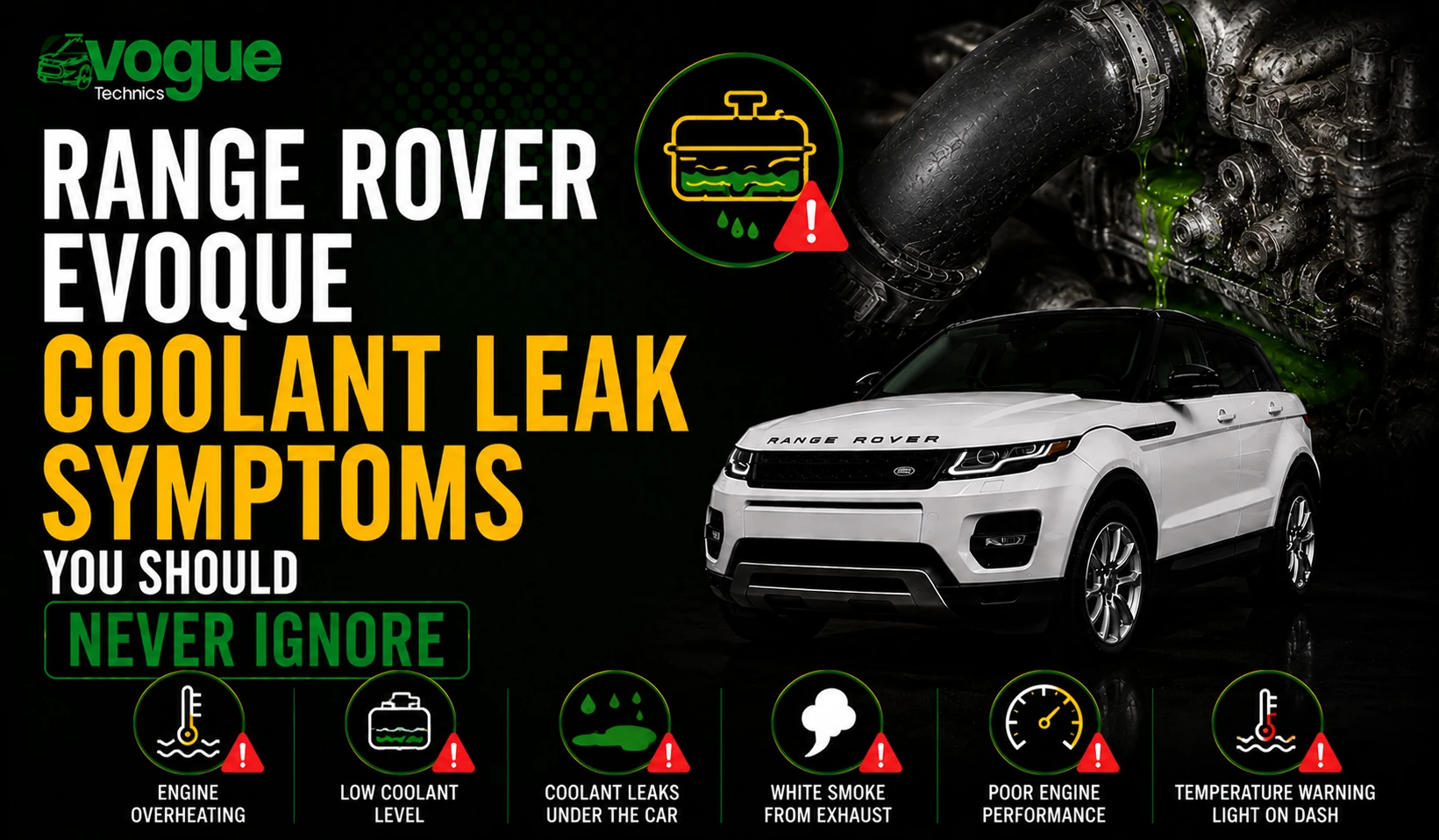
Knowing the symptoms of a developing cooling system problem gives you the opportunity to act before the damage compounds. These are the signals your Evoque will send you and what each one means in plain terms.
Engine Overheating at Idle or Highway Speed
An engine that runs hot at idle is usually suffering from either reduced coolant volume or a cooling fan fault. An engine that overheats at highway speed, when airflow through the radiator should be at its maximum, points more directly toward insufficient coolant circulation, a failing water pump or a blocked radiator.
Why Coolant Loss Leads to Sudden Temperature Spikes
Coolant doesn't just carry heat away from the engine, it also prevents localised hot spots from developing within the cylinder head. When the coolant level drops significantly, those hot spots form rapidly, and the temperature gauge can spike from normal to red in a matter of minutes. This is why an Evoque that has been running fine for months can suddenly overheat without warning after a slow, unnoticed coolant loss.
Amber Engine Warning Light and Coolant Warning Light
Both of these lights appearing on the Evoque's instrument cluster demand attention, not a mental note to check it later.
What the Coolant Warning Light Means on a Range Rover Evoque
The dedicated coolant warning light illuminates when the coolant level sensor detects that the fluid in the expansion tank has dropped below the minimum threshold. At this point, the system is already compromised. Top up with the correct OAT coolant specification, not tap water and investigate the source immediately.
Can a Low Coolant Level Trigger Restricted Performance Mode?
Yes, on the Evoque, persistent overheating or coolant loss that triggers associated fault codes can initiate a restricted performance mode, limiting engine output to protect internal components. This is the vehicle's self-preservation mechanism activating, and it should be treated as an urgent signal, not an inconvenience.
Sweet Antifreeze Smell Inside the Cabin
A sweet, slightly sickly smell coming through the heating vents is one of the most telling signs of a specific type of coolant leak, one that doesn't leave a puddle outside the vehicle at all.
Heater Core Leak — Why You Smell Coolant Inside Your Evoque
The heater core sits inside the dashboard and uses hot coolant from the engine to warm the cabin air. When it develops a leak, coolant vapourises and is drawn through the ventilation system directly into the passenger compartment. You may also notice the inside of the windscreen fogging with a greasy, difficult-to-clear film, a classic heater core symptom. Heater core replacement on the Evoque is a labour-intensive job, but catching it early prevents coolant contaminating the carpets and causing far more damage.
White Smoke From the Exhaust and Coolant Burning Smell
A small amount of white vapour from the exhaust on a cold morning is perfectly normal, it's simply condensation burning off. What you're looking for is sustained, thick white or grey smoke that continues after the engine has fully warmed up and carries a distinctly sweet smell.
Is It Safe to Drive a Range Rover Evoque With a Coolant Leak?
No, and we'll be direct about this. Driving with a confirmed or suspected coolant leak is one of the fastest ways to turn a manageable repair into a catastrophic engine failure. Heat is the enemy of every internal engine component, and without adequate coolant circulation, temperatures rise to destructive levels within minutes of sustained driving. If your temperature gauge is rising, pull over safely, switch off the engine, and arrange recovery rather than risking the consequences.
Coolant Bubbling in the Reservoir
Seeing coolant actively bubbling or boiling in the expansion tank, particularly when the engine is only at normal operating temperature, is a serious symptom that should never be dismissed.
What Causes Coolant to Boil or Bubble in the Expansion Tank?
Bubbling under normal temperature conditions almost always indicates that combustion gases are entering the cooling system through a compromised head gasket. The combustion pressure forces gas into the coolant, creating the bubbling effect visible in the reservoir. A chemical combustion leak test, which changes colour in the presence of exhaust gases, will confirm this definitively. If confirmed, this requires professional attention without delay.
Range Rover Evoque Coolant Leak Repair Costs, Services & Why Choose Vogue Technics in Essex
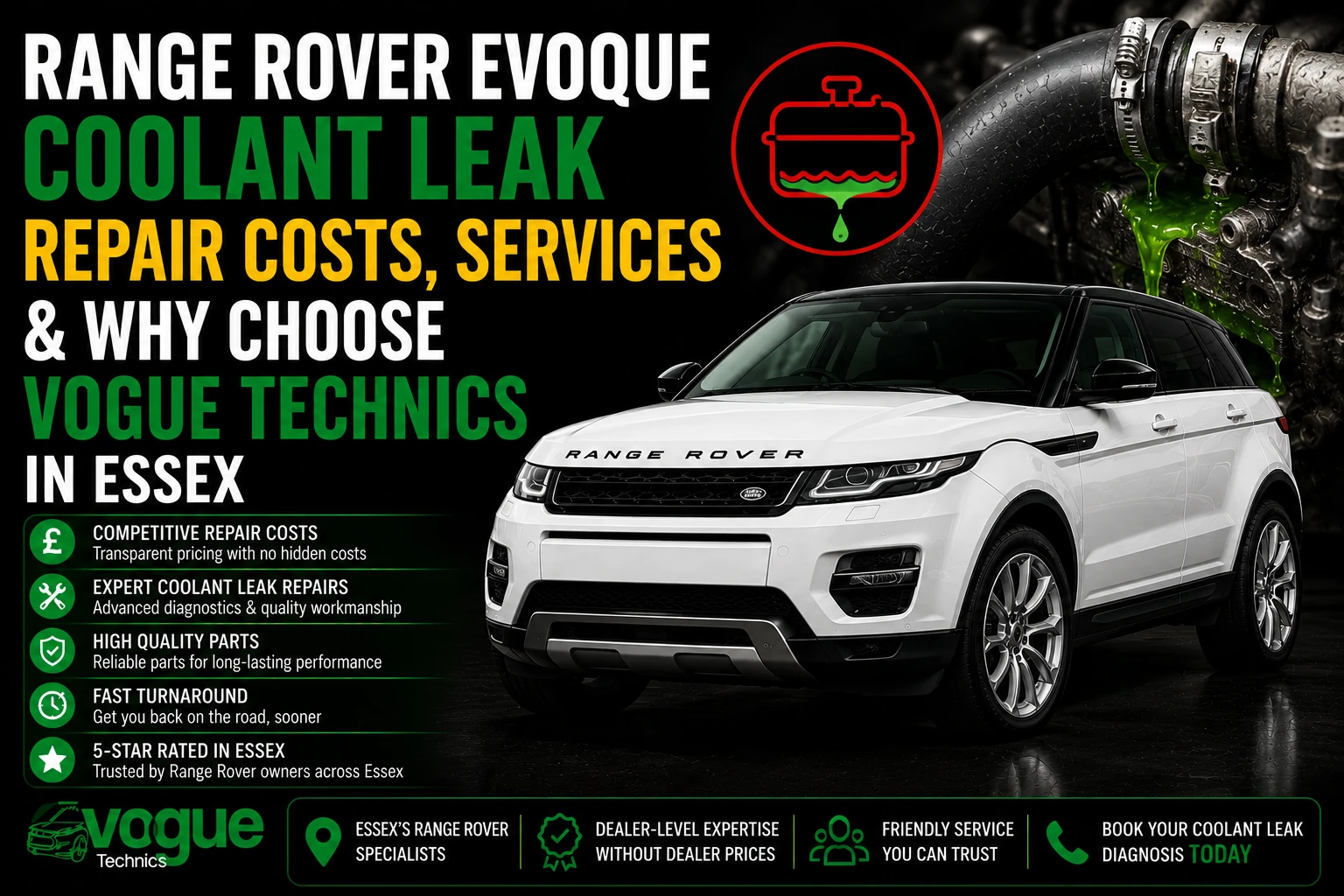
Understanding what a coolant leak repair realistically costs helps you make an informed decision and avoid being caught off-guard by an invoice. The figures below reflect typical UK labour rates and OEM parts pricing as of 2025.
How Much Does It Cost to Fix a Coolant Leak on a Range Rover Evoque?
Repair costs vary significantly depending on which component has failed and whether OEM or aftermarket parts are used. Here's an honest breakdown:
Thermostat Housing Replacement Cost
Component | Parts Cost | Labour | Estimated Total |
| Thermostat Housing (OEM) | £80 – £150 | £100 – £180 | £180 – £330 |
This is one of the more common and relatively straightforward Evoque coolant repairs. Using a genuine Land Rover or quality OEM housing is strongly recommended over cheap aftermarket alternatives.
Water Pump Replacement Cost
Component | Parts Cost | Labour | Estimated Total |
| Water Pump (OEM) | £120 – £220 | £180 – £300 | £300 – £520 |
Many technicians recommend replacing the thermostat at the same time as the water pump, as both share similar labour access and it avoids revisiting the job within months.
Radiator and Radiator Hose Replacement Cost
Component | Parts Cost | Labour | Estimated Total |
| Radiator Replacement | £180 – £350 | £150 – £250 | £330 – £600 |
| Radiator Hose Kit | £40 – £90 | £60 – £120 | £100 – £210 |
Head Gasket Replacement Cost — What to Expect
Component | Parts Cost | Labour | Estimated Total |
| Head Gasket (Full Job) | £150 – £350 | £600 – £1,200 | £750 – £1,550+ |
Head gasket work is the most labour-intensive repair in the cooling system and on an Evoque, the cylinder head should always be pressure-tested and skimmed before a new gasket is fitted to ensure a lasting seal.
OEM vs Aftermarket Parts — What We Recommend for Your Evoque
This is a question we're asked regularly at our Essex workshop, and the answer matters more on a Land Rover than on many other vehicles.
Why Genuine Land Rover Coolant and OEM Components Matter
The Evoque's cooling system is designed to operate with a specific OAT (Organic Acid Technology) coolant — typically pink in colour for post-2012 Land Rover applications. Using incorrect coolant types, or mixing different specifications, accelerates corrosion within the aluminium engine components and can cause premature seal failure throughout the cooling circuit.
The same principle applies to components. A cheap aftermarket thermostat housing might cost half the price of an OEM unit, but if it fails twelve months later, you're paying labour costs twice. At Vogue Technics, we fit OEM or genuine Land Rover parts as standard, and we back every job with a clear warranty on both parts and labour.
Why Evoque Owners in Essex Trust Vogue Technics Engine Rebuild
We're not a general garage that sees the occasional Land Rover. We are Land Rover and Range Rover specialists, based in Grays, Essex, with specific expertise in cooling system diagnostics, engine rebuilds, and the kind of faults that other workshops either misdiagnose or decline to take on.
Specialist Land Rover Diagnostics at Our Grays, Essex Workshop
Every cooling system investigation at our workshop begins with a full diagnostic process, pressure testing, OBD2 fault code reading, UV dye inspection where required, and a visual inspection by a technician who works on these vehicles daily. We don't guess and replace. We diagnose accurately and repair with precision.
Our team understands the specific failure patterns of the Evoque across all engine variants, from the 2.0 Si4 petrol to the 2.2 SD4 diesel and we carry the specialist tooling to do the job correctly the first time.
Book a Cooling System Inspection or Repair Appointment Today
If your Range Rover Evoque is losing coolant, running hot, or showing warning lights you don't fully understand, don't wait for it to become a breakdown. Contact Vogue Technics Engine Rebuild in Grays, Essex today to book your cooling system inspection. We'll give you an honest assessment, a transparent quote, and a repair carried out to the standard your vehicle deserves.
📍 Vogue Technics Engine Rebuild — Grays, Essex 🌐 voguetechnicsenginerebuild.co.uk
Frequently Asked Questions — Range Rover Evoque Coolant Leaks
Why is my Range Rover Evoque losing coolant?
The most common causes on the Evoque are thermostat housing cracks, water pump seal failure, expansion tank deterioration, and radiator hose leaks. In more serious cases, a failing head gasket can cause internal coolant loss with no visible external leak at all.
Can I drive my Evoque with a coolant leak?
No. Driving with an active coolant leak risks severe engine overheating, which can cause permanent damage to the cylinder head, head gasket, and engine block. If you suspect a leak, have the vehicle inspected before driving it further.
How do I pressure test a cooling system at home?
You'll need a cooling system pressure test kit with an adaptor that fits your Evoque's expansion tank cap thread. With the engine cold, attach the tester, pump to the cap's rated pressure (typically 1.2–1.4 bar), and inspect all hoses, joints, and components for seepage over 15–20 minutes.
What colour is Range Rover Evoque coolant?
Post-2012 Range Rover Evoque models use a pink OAT coolant. Never mix coolant colours or specifications, doing so causes chemical reactions that damage seals and accelerate corrosion inside the cooling system.
How much does a coolant leak repair cost on a Range Rover Evoque?
Costs range from approximately £100–£210 for a hose replacement up to £1,550+ for a full head gasket job. Thermostat housing and water pump replacements typically fall in the £180–£520 range depending on parts specification and labour time.
Can a bad thermostat cause coolant loss in an Evoque?
A stuck-closed thermostat causes the coolant to overheat and pressurise rapidly, which can force coolant past seals and out of weak points in the system. A stuck-open thermostat prevents the engine from reaching operating temperature, which also affects cooling efficiency over time.
Why does coolant only leak when the engine is hot?
Because the cooling system only reaches full operating pressure once the engine is warm. At cold idle, pressure is low enough that minor cracks and weak seals hold, but once the system reaches 1.2–1.4 bar operating pressure, those same weak points allow coolant to escape.
How often should coolant be replaced on a Range Rover Evoque?
Land Rover recommends coolant replacement approximately every 5 years or 100,000 miles, whichever comes first. Degraded coolant loses its anti-corrosion properties and becomes acidic, accelerating the very component failures that lead to coolant leaks.
Final Word
A coolant leak on a Range Rover Evoque is one of those problems that rewards early action and punishes delay. The difference between catching a cracked thermostat housing at the £250 mark and ignoring it until the head gasket fails at £1,500 is simply time and knowledge.
We hope this guide gives you both. If you're based in Essex or the surrounding areas and you need a specialist who understands these vehicles inside out, Vogue Technics Engine Rebuild in Grays, Essex is ready to help.
Don't top it up and hope for the best. Diagnose it properly, fix it correctly, and drive with confidence.