
Range Rover Sport Overheating: Causes, Diagnosis, and Trusted Repair in Essex
Overheating is one of the most common, and most misdiagnosed problems facing Range Rover Sport owners. This guide breaks down the real causes, from failing water pumps to trapped air after a coolant flush, and explains how to tell them apart based on when the overheating happens. It also covers realistic UK repair costs, the warning signs that mean a simple fix won't cut it, and why a Range Rover specialist in Essex can catch what a generic garage might miss. The goal: help owners act early, before a cheap fix turns into a costly engine rebuild.
You're sitting in traffic, the temperature needle creeps past the halfway mark, and a warning light flashes across the dashboard. If you've owned a Range Rover Sport for any length of time, this scenario probably feels familiar. Overheating is one of the most common and most misunderstood, problems these vehicles face, and it rarely fixes itself.
The frustrating part is that overheating isn't always caused by the obvious thing. We've seen owners top up coolant for months, replace a thermostat that wasn't faulty, or drive on despite warning signs, only to end up with a cracked cylinder head that could have been avoided. This guide walks through exactly why your Range Rover Sport overheats, how to diagnose it properly, what repairs actually cost, and when a full engine rebuild becomes the smarter and cheaper, option.
Why Is My Range Rover Sport Overheating?
Overheating happens when the cooling system can't remove heat from the engine fast enough. On a Range Rover Sport, whether it's running the supercharged V6, V8, or the Ingenium diesel, the cooling circuit relies on several components working in sync: the water pump, thermostat, radiator, electric cooling fan, and expansion tank. If any single part fails, the whole system struggles.
Common Causes of Range Rover Sport Overheating
Most overheating cases trace back to one of these issues:
- Low coolant level or a slow leak: often from a cracked expansion tank, a perished coolant hose, or a failing radiator seam. Coolant loss with no visible puddle is extremely common on these vehicles.
- Faulty thermostat: stuck closed, it blocks coolant flow to the radiator entirely.
- Radiator problems: internal blockages or external debris reduce the radiator's ability to dissipate heat.
- Cooling fan failure: a fan that won't kick in at idle or low speed is one of the most frequent causes of overheating in stop-start traffic.
- Water pump issues: a worn impeller or failing bearing reduces coolant circulation, and on some engines the water pump is plastic, making failure more likely with age.
- Air trapped in the cooling system: often left behind after a coolant flush or repair that wasn't bled properly, causing pockets that prevent even circulation.
Each of these has a slightly different fingerprint, which is why guessing rarely works and proper diagnosis matters.
Range Rover Sport Overheating at Idle vs While Driving
The pattern of when overheating happens tells you a lot about the cause.
Symptom Pattern | Likely Cause | Why It Happens |
| Overheats at idle, fine while driving | Cooling fan failure | Airflow at speed masks a fan that isn't switching on |
| Overheats while driving, fine at idle | Thermostat stuck closed or low coolant | Increased engine load demands more circulation than the system can provide |
| Overheats with AC running | Fan relay or fan control module fault | AC adds extra load on the cooling fan circuit |
| Gradual overheating over weeks | Slow coolant leak | Coolant loss builds up until the system can no longer cope |
| Sudden overheating after a repair | Trapped air or improper bleeding | Air pockets block proper coolant flow |
If your Range Rover Sport only overheats at idle or in traffic, start by checking whether the cooling fan is actually spinning. If it overheats on the motorway but seems fine in town, coolant level and thermostat function should be your first checks.
Overheating After a Coolant Flush or Thermostat Replacement
This one catches a lot of owners off guard. You've just had the cooling system serviced, and now it's overheating worse than before. In most cases, this comes down to air trapped in the system during the bleed process. Range Rover Sport cooling systems are notoriously difficult to bleed correctly without the right sequence and equipment, and even a small air pocket near the cylinder head can cause a hot spot that trips the temperature sensor.
We regularly see vehicles arrive after a "successful" thermostat or water pump replacement elsewhere, still overheating because the system was never properly purged of air. It's one of the most avoidable and most common comebacks in this line of work.
Is It Safe to Keep Driving a Range Rover Sport That's Overheating?
No. This is worth being direct about. Continuing to drive an overheating Range Rover Sport risks warping the cylinder head, blowing the head gasket, or in worse cases, cracking the engine block entirely. What might have been a £300 thermostat replacement can turn into a £4,000+ engine rebuild if you push through an overheating warning.
If the temperature gauge climbs into the red or a warning light appears, pull over as soon as it's safe, turn off the engine, and let it cool before checking anything. Never open the radiator cap or expansion tank while the engine is hot, pressurised coolant can cause serious burns.
How to Diagnose an Overheating Range Rover Sport
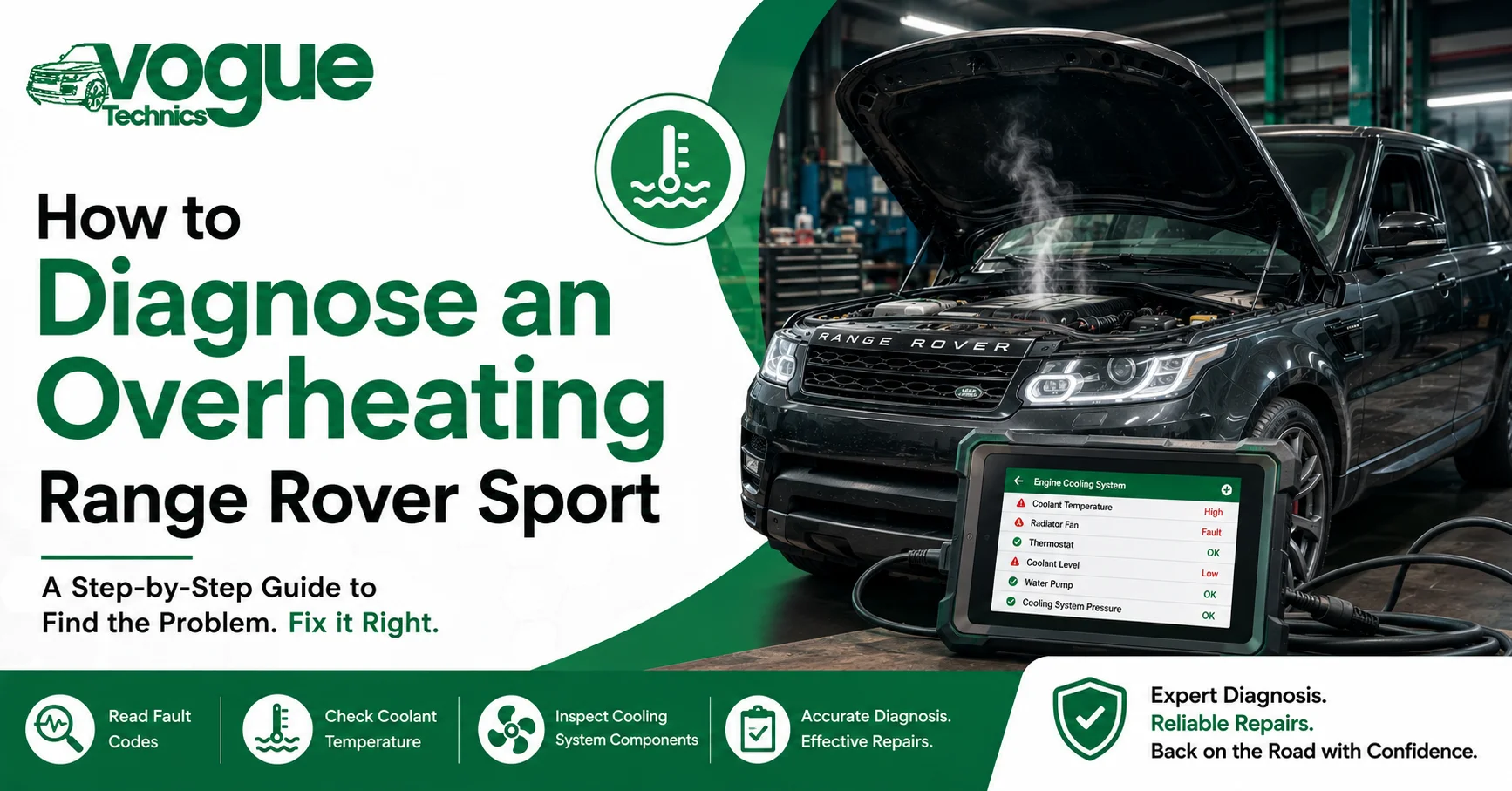
Proper diagnosis is where most DIY attempts and, frankly, some general garages, go wrong. Overheating symptoms often overlap, and treating the wrong component wastes money without solving the problem.
Warning Signs on the Dashboard and Under the Bonnet
Before any tools come out, these are the signs worth paying attention to:
- Temperature gauge sitting above the normal midpoint
- Dashboard warning light or message for engine temperature
- Steam or a sweet smell coming from the engine bay
- White smoke from the exhaust, which can indicate coolant entering the combustion chamber
- Coolant bubbling or spitting in the expansion tank
- Heater blowing cold air even though the engine feels hot
Any combination of these points strongly toward a cooling system fault rather than something minor.
Coolant Loss With No Visible Leak — What It Means
This is one of the trickiest scenarios we deal with. If coolant keeps disappearing but there's no puddle under the car, no wet patches, and no obvious external leak, the coolant may be entering the engine oil or being burned in the combustion chamber. This usually points to a head gasket issue or a cracked cylinder head, both of which require proper pressure testing to confirm, not guesswork.
DIY Checks vs When You Need a Professional Diagnosis
There's a lot you can safely check at home before booking it in:
- Coolant level in the expansion tank (only when cold)
- Visible hose condition, look for cracking, swelling, or white crusty deposits
- Whether the cooling fan spins when the AC is switched on with the engine idling
- Any obvious coolant staining around hose clamps or the water pump housing
However, some diagnostics genuinely need professional equipment:
- Pressure testing the cooling system to find leaks that aren't visible under normal conditions
- OBD-II fault code reading to check for temperature sensor faults or ECM-logged cooling issues
- Combustion leak testing to rule out a head gasket without removing the head
- Infrared temperature scanning across the radiator to spot blockages or cold zones
If your checks don't turn up an obvious cause, or if the vehicle has overheated more than once, it's time for a proper diagnostic rather than another guess-and-replace cycle.
Common Misdiagnosis Mistakes Owners Make
We see the same mistakes repeatedly:
- Replacing the thermostat when the actual fault is a failing cooling fan relay
- Assuming a full coolant top-up has "fixed" a slow leak that will simply return in a few weeks
- Not bleeding the system correctly after a repair, leading to a second overheating event
- Ignoring intermittent overheating because it "went back to normal," when the underlying fault is still present
Each of these delays the real fix and, in some cases, allows further engine damage to build up quietly in the background.
Range Rover Sport Overheating Repair Costs and Solutions
Once the cause is confirmed, the next question is always the same: how much is this going to cost, and is it worth fixing?
Typical Repair Costs by Component
Costs vary by engine type and whether parts are OEM or aftermarket, but here's a realistic guide based on UK repair pricing:
Component | Typical Repair Cost (Parts + Labour) |
| Thermostat replacement | £250 – £450 |
| Water pump replacement | £400 – £700 |
| Radiator replacement | £500 – £900 |
| Expansion tank replacement | £200 – £400 |
| Cooling fan / fan module | £350 – £650 |
| Coolant flush and bleed | £120 – £220 |
| Head gasket repair | £1,200 – £2,000+ |
| Full engine rebuild | £3,500 – £6,500+ |
These figures give a general sense of scale, but exact pricing depends on the specific engine (AJ133 V6/V8 or Ingenium), the extent of damage, and whether the issue was caught early or after repeated overheating.
When a Repair Isn't Enough — Signs You Need an Engine Rebuild
Not every overheating problem ends with a simple part swap. If your Range Rover Sport has overheated more than once, or was driven for any distance while the temperature gauge was in the red, these are warning signs that internal damage may already be done:
- White, milky residue on the oil dipstick or under the oil filler cap
- Persistent white smoke from the exhaust after the engine has warmed up
- Coolant disappearing with no external leak, alongside a drop in engine performance
- Rough idle or misfiring that developed after an overheating event
- A mechanic's compression or leak-down test showing uneven cylinder pressure
If several of these apply, a head gasket repair or full engine rebuild is usually the more sensible route — patching individual symptoms on a damaged engine tends to lead to repeat failures and higher total cost over time.
How We Diagnose and Rebuild Range Rover Sport Engines at Voguetech Nics
At Voguetech Nics Engine Rebuild in Grays, Essex, we specialise specifically in Land Rover and Range Rover engines, which means we're not learning on your vehicle — we're applying diagnostic and rebuild processes we've refined across hundreds of these engines.
Our approach on every overheating case includes:
- Full cooling system pressure test to isolate the exact leak or fault
- Compression and combustion leak testing to rule out (or confirm) head gasket failure
- Component-level inspection of the water pump, thermostat, and fan assembly before any parts are replaced
- Where a rebuild is needed, full machining and resurfacing of the cylinder head, replacement of gaskets and seals, and a proper multi-stage coolant bleed before the vehicle leaves our workshop
We explain exactly what we find and why, before any work begins, no guesswork, no unnecessary parts changed on a hunch.
Why Choose a Specialist in Grays, Essex Over a Generic Garage
Range Rover Sport cooling systems are more layout-specific than most vehicles on the road. A general garage may not have encountered the plastic water pump housings, the specific bleed sequence, or the known weak points on the AJ133 or Ingenium engines. That unfamiliarity is exactly how avoidable misdiagnoses happen.
Being based in Grays, Essex, we work on these vehicles daily, which means faster, more accurate diagnosis, and repairs done to a standard that holds up not just a temporary fix that brings the car back in six weeks.
Preventing Future Overheating Issues
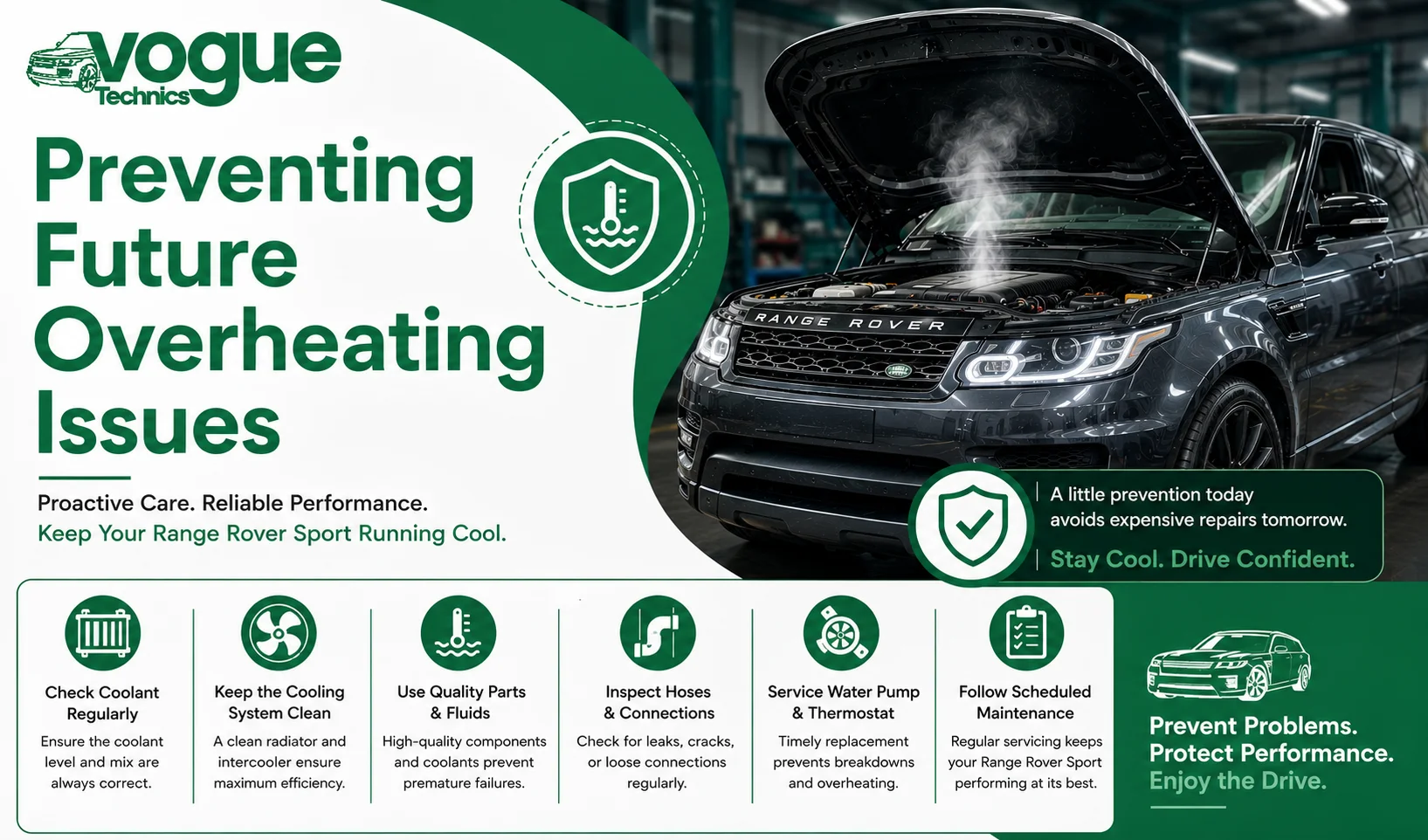
Once your Range Rover Sport is running properly again, a bit of regular attention goes a long way toward avoiding a repeat visit.
Recommended Coolant Type and Maintenance Schedule
Always use the specific coolant type recommended for your engine, typically a genuine Land Rover-approved OAT (Organic Acid Technology) coolant. Mixing coolant types can cause corrosion inside the cooling system over time, leading to exactly the kind of failures covered above.
- Check coolant level monthly when the engine is cold
- Have the full cooling system inspected at every major service interval
- Replace coolant according to manufacturer intervals, typically every 4-5 years, rather than "topping up forever"
How Often Should You Service Your Cooling System?
Beyond routine coolant checks, we'd recommend a full cooling system inspection roughly every 24,000 miles or two years, whichever comes first, checking hose condition, fan operation, thermostat function, and pressure testing for hidden leaks. Catching a failing component before it causes overheating is almost always cheaper than repairing the aftermath.
Frequently Asked Questions
How long should I wait before opening the bonnet if my Range Rover overheats?
Wait at least 15-20 minutes after switching off the engine. Opening the bonnet or the expansion tank cap too soon exposes you to scalding steam and pressurised coolant.
How far can I drive an overheating Range Rover Sport safely?
Realistically, not far at all. As soon as the temperature gauge rises noticeably or a warning appears, pull over safely and stop the engine. Continuing to drive even a short distance while overheating risks head gasket or cylinder head damage.
What is the best coolant for a Range Rover Sport?
A genuine Land Rover-approved OAT coolant is recommended, correctly diluted per the manufacturer's specification. Using the wrong coolant type can cause internal corrosion and contribute to future cooling system failures.
How much does it cost to fix overheating in a Range Rover Sport in Essex?
It depends entirely on the cause. A thermostat or water pump replacement typically falls between £250 and £700, while more serious cases involving a head gasket or engine rebuild can range from £1,200 to £6,500+. A proper diagnosis is the only way to know which category your vehicle falls into.
Can I drive my Range Rover Sport if it overheats occasionally but seems fine afterward? No, intermittent overheating still causes cumulative stress on the head gasket and cylinder head each time it happens, even if the engine appears to recover. It should be diagnosed properly rather than ignored.
Getting Your Range Rover Sport Back on the Road, Properly
Overheating is one of those problems that punishes hesitation. Caught early, it's usually a straightforward, affordable fix. Left unaddressed, it can turn into engine damage that costs thousands more than it should have.
If your Range Rover Sport has been showing any of the warning signs covered here, whether it's a flickering temperature gauge, coolant that keeps disappearing, or a cooling fan that won't kick in, the team at Voguetech Nics Engine Rebuild in Grays, Essex can give you a straight answer: what's actually wrong, what it'll cost to fix, and whether a repair or a full rebuild is the right call for your engine.
Get in touch with us today for a proper diagnosis before a small overheating issue turns into a much bigger bill.