

Range Rover Sport Injector Problems: Symptoms, Diagnosis & Cost-Effective Solutions (UK Guide 2026)
This comprehensive UK guide covers Range Rover Sport fuel injector problems, from identifying symptoms like rough idle, black smoke, and hard starting, to understanding diagnosis procedures and professional repair costs (£400-£3,200+). Learn why fuel contamination, injector seal failure, and lack of ECU coding cause injector failures, explore preventive maintenance strategies including fuel filter replacement every 20,000 miles, and discover when single vs. full injector replacement makes financial sense for long-term vehicle health.
Your Range Rover Sport won't start properly. The engine shakes at traffic lights. Black smoke pours from the exhaust. You're staring at a dashboard warning light, wondering if your pride and joy is about to cost you thousands in repair bills.
The culprit? Injector problems.
This is one of the most common issues we see at Vogue Technics and it's one that many owners delay addressing, hoping it'll go away. It won't. In fact, ignoring faulty fuel injectors can lead to catastrophic engine damage, turning a fixable problem into a complete engine rebuild costing £4,000 or more.
This guide walks you through everything you need to know about Range Rover Sport injector problems: what causes them, how to spot the warning signs, what a professional diagnosis reveals, and exactly how much you'll pay for repairs in 2026. By the end, you'll understand precisely what's happening under your bonnet and why acting quickly is essential.
What Causes Range Rover Sport Injector Problems? (Engine-Specific Guide)
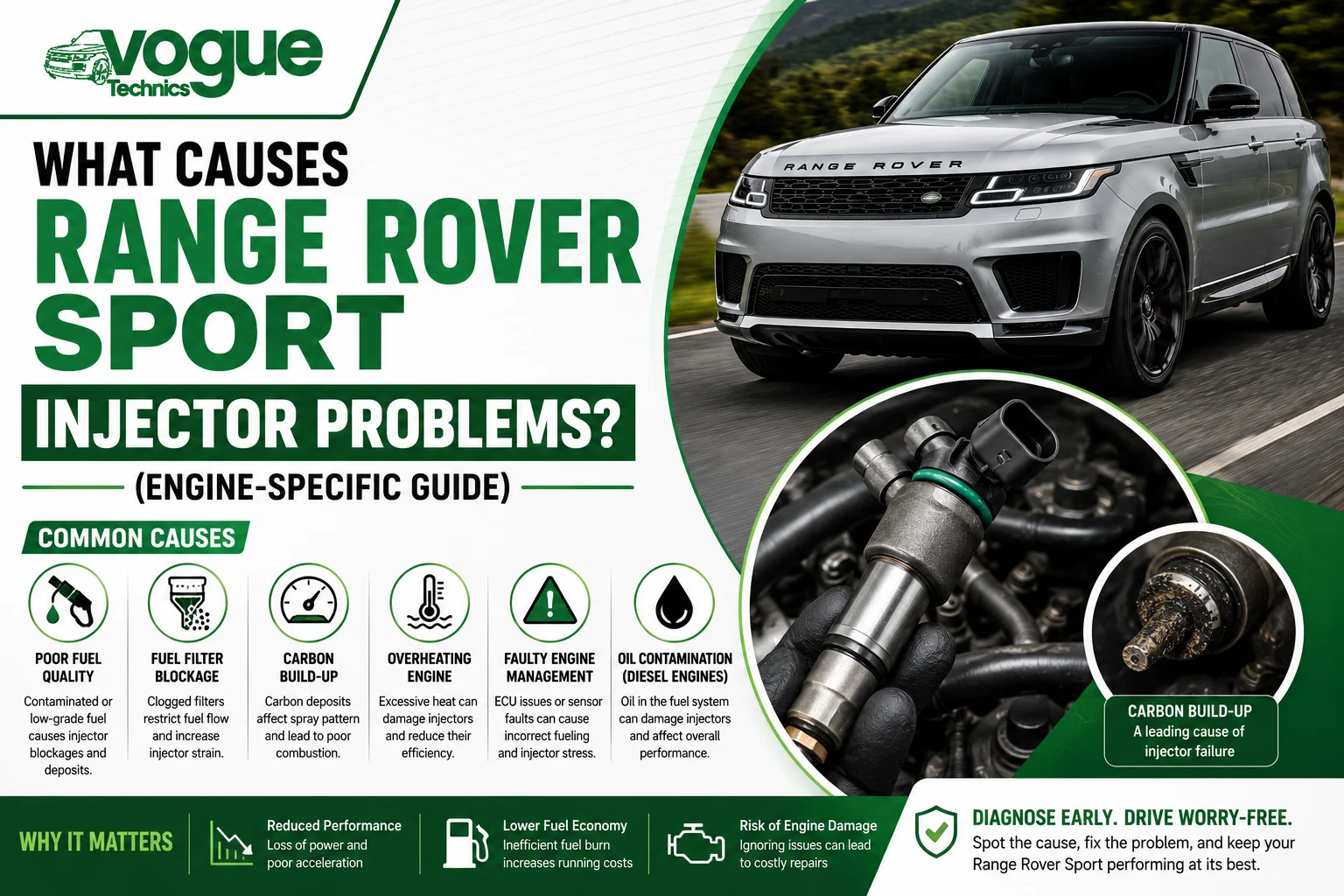
Injector failures don't just happen randomly. There are specific, identifiable reasons why the fuel injectors in your Range Rover Sport deteriorate over time and these reasons vary significantly depending on which engine you're driving.
TDV6 vs SDV6 Injector Failures—Why Your Engine Type Matters
This is critical: not all Range Rover Sport injector problems are equal. Your vehicle could have a TDV6, SDV6, or Ingenium engine, and each one has its own injector vulnerabilities.
Understanding your engine type is the first step towards understanding why your injector is failing.
Why TDV6 Common Rail Injectors Fail More Frequently
The TDV6 is a workhorse engine reliable, powerful, and found in countless Range Rovers across the UK. But it's also equipped with Bosch common rail injectors that have a documented weakness: they're susceptible to fuel contamination.
Here's why: The TDV6 uses a high-pressure common rail system operating at pressures exceeding 1,600 bar. At these pressures, even microscopic particles dirt, water, metal fragments from a failing fuel pump, can lodge inside the injector nozzle and damage the precision-engineered spray pattern.
Over time, you'll notice:
- Rough idle that worsens in cold weather
- Difficulty starting in the morning (even when the engine is warm)
- A noticeable loss of power during acceleration
- Fuel consumption climbing by 10-15%
The TDV6 is particularly vulnerable to water contamination in fuel tanks. If rainwater has entered your fuel tank through a damaged filler neck or vent, the injectors will be among the first components to suffer. The high pressures force this contaminated fuel through impossibly small openings, wearing the seals and damaging the nozzle geometry.
SDV6 Diesel Injector Issues—Bosch Design Weaknesses
The SDV6, while newer and more advanced, isn't immune to injector problems. In fact, some of our clients have reported that SDV6 injectors fail just as frequently as TDV6 units, sometimes even sooner.
The SDV6 uses an updated version of the Bosch common rail system with piezoelectric injectors. These are more precise than their predecessors, but they're also more sensitive to electrical faults.
SDV6 injector problems typically manifest as:
- Check engine lights triggered by P0263 or P0266 fault codes (injector balance rate errors)
- Misfires in specific cylinders (usually caught by the engine control unit immediately)
- Reduced engine power mode (limp mode) activation
- Difficulty starting after sitting for several days
What makes the SDV6 different is that problems often show up as electrical failures rather than purely mechanical ones. A faulty injector driver circuit, a corroded injector connector, or an ECU software glitch can trigger injector faults even when the physical injector is in reasonable condition.
This is why some SDV6 owners have had injectors replaced, only to discover the real problem was a wiring harness issue or a failed injector driver module inside the ECU.
Ingenium Petrol Injector Problems—A Different Challenge
If you have one of the newer Range Rover Sport models with a petrol Ingenium engine, your injector problems typically stem from carbon buildup rather than fuel contamination.
Ingenium petrol engines use direct fuel injection (DI), which means the injectors spray fuel directly into the combustion chamber under extreme pressure. This is more efficient than traditional port injection, but it also means injectors are exposed to intense heat and combustion byproducts.
Over 80,000-100,000 miles, carbon deposits accumulate on the injector tip. This narrows the spray holes, altering the fuel atomization pattern. The result:
- Rough idle and hesitation during acceleration
- Increased emissions
- Possible catalytic converter damage from incomplete combustion
- MOT failures due to high emissions
Interestingly, Ingenium petrol injector problems are more likely to be solved by professional fuel system cleaning than diesel variants. A quality fuel system flush with specialized additives can restore normal operation in many cases.
Fuel Contamination & Injector Seal Leaks (The #1 Preventable Cause)
If we had to identify the single most common cause of Range Rover Sport injector failure, it would be fuel contamination.
Contaminated fuel is the silent killer of diesel fuel systems. It doesn't announce itself with a dramatic failure. Instead, it slowly degrades your injectors month after month, until one day they simply stop working properly.
How Dirty Fuel Damages Your Fuel Injectors Internally
Think of your fuel injector as a precision instrument. The nozzle contains holes measured in tens of microns, that's roughly one-tenth the thickness of a human hair. The internal valve mechanism must seal perfectly at 1,600+ bar pressure.
Now, introduce contamination into this system.
Dirt particles as small as 10 microns, invisible to the naked eye, will damage the sealing surfaces inside the injector. They'll score the valve needle, creating micro-scratches that destroy the seal. Water will corrode the internal components and promote rust formation. Even fuel degradation products (varnish and sludge that form when fuel sits in your tank) will clog the spray holes.
This is why fuel quality is absolutely critical. Supermarket diesel, unfortunately, is often the cheapest because suppliers cut corners on filtration and additive packages. Premium diesel from dedicated fuel retailers typically costs 2-3p per litre more, but it's an investment in your fuel system's longevity.
Water Contamination in Diesel Tanks
This is shockingly common. Water enters your fuel tank through:
- Condensation forming inside the tank (especially in winter when temperatures fluctuate)
- A damaged fuel filler cap or seal
- A leaking filler neck
- Rainwater entering through a corroded vent line
Once water is in the tank, it doesn't mix with diesel. It sits at the bottom, where the fuel pickup tube draws fuel from. Your fuel pump then forces this contaminated water and diesel mixture through the fuel filter and directly to your injectors.
The results are immediate: rough running, difficulty starting, and increased exhaust smoke. But the damage continues long after you've noticed the symptoms. Water promotes microbial growth in fuel tanks—algae and bacteria that feed on diesel and leave behind sludge.
This sludge clogs fuel filters and damages injector nozzles.
Microbial Growth & Fuel System Corrosion
Diesel bug—the nickname given to microbial growth in fuel tanks, is a genuine problem in the UK climate. The warm months allow bacteria and algae to flourish in the water that accumulates at the bottom of your tank.
These microorganisms produce corrosive acids and leave behind sticky biofilm and sludge. This sludge:
- Clogs the fine mesh of fuel filters
- Blocks fuel rail lines
- Deposits inside fuel injectors, narrowing the spray pattern
- Accelerates corrosion of fuel tank internals and fuel injection components
Once diesel bug is established, flushing your fuel tank isn't always enough. You may need to:
- Drain and clean the fuel tank
- Replace the fuel filter
- Flush all fuel lines
- Install a fresh fuel filter and biocide treatment
- Possibly replace injectors if damage is extensive
Prevention is always simpler than cure. Use a reputable fuel supplier. Don't let your fuel tank level drop below a quarter tank for extended periods (this increases condensation). Keep your filler cap and seal in good condition. Store your vehicle in a garage if possible to minimize temperature fluctuations.
Injector Seal Failure: Why Copper Washers Matter
Every fuel injector in your Range Rover Sport is sealed to the fuel rail using a copper washer or O-ring. This isn't a trivial component, it's essential for maintaining system pressure and preventing fuel leaks.
Over time, these seals degrade. The copper washer can corrode. O-rings can harden and lose elasticity. When they fail, you get fuel leaking around the outside of the injector body.
Recognizing O-Ring Degradation Early
The first sign of seal failure is often a smell, raw diesel odour around the engine bay, especially when parked overnight. You might also see:
- Wet spots around the injector body where fuel has dripped
- A slight fuel mist smell during cold starts
- Fuel-stained metal around the injector housing
Don't ignore this. A leaking injector seal means fuel is escaping into the engine bay instead of being injected into the combustion chamber. This leads to:
- Reduced fuel pressure in the rail
- Incomplete combustion
- Rough running and poor fuel economy
- Potential fire risk (though rare, fuel leaks near hot engine components are a concern)
Cost of Ignoring Seal Leaks (Engine Damage Risk)
A leaking seal might seem like a minor issue, just a copper washer, right? Wrong.
Fuel seeping into the engine bay can accumulate in crevices and under covers. In warm conditions, fuel vapors accumulate. This creates an explosion and fire risk. More commonly, the escaping fuel creates a flammable atmosphere under the bonnet, particularly dangerous if there's any electrical spark.
Beyond the fire risk, leaking injectors cause fuel starvation. If three out of six injectors are leaking, fuel pressure drops significantly. The remaining three injectors must compensate, working harder and running hotter. This accelerates their wear and can trigger a cascade of injector failures.
We've seen clients ignore a single leaking injector, only to return weeks later with three failed injectors and a repair bill tripled.
Replacing a seal costs £80-150 per injector. Replacing the seal plus a second failed injector costs £600-900. Replacing multiple injectors due to fuel starvation? That's £1,800-3,000.
The lesson: address seal leaks immediately.
Faulty Injector Coding After Replacement (Why DIY Replacements Fail)
Here's a scenario we see regularly: An owner replaces their own injectors to save money, installs new units, and expects everything to work normally. Within days, the engine runs poorly. The check engine light reappears.
The problem? The new injectors were never coded to the vehicle's ECU.
This is where many DIY repairs fail, and it's why professional injector replacement includes coding as standard.
ECU Adaptation Failures: What Happens When Injectors Aren't Coded
Your Range Rover Sport's engine control unit (ECU) doesn't just turn injectors on and off. It actively manages their performance by monitoring:
- Fuel rail pressure
- Injector opening and closing times (measured to microseconds)
- Injector flow rates (how much fuel is delivered per pulse)
- Cylinder-to-cylinder fuel delivery balance
When you install new injectors without coding, the ECU doesn't recognize them. It attempts to operate them using parameters learned from the old, worn injectors. This causes:
- Rough idle as cylinders receive uneven fuel amounts
- Black smoke (over-fueling) from cylinders receiving too much fuel
- White smoke or hesitation from cylinders receiving too little
- Reduced power and poor fuel economy
- Potential check engine lights (P0263, P0266 fault codes indicating injector balance issues)
Injector coding is the process of recalibrating the ECU to work optimally with the new injectors. Modern diagnostic equipment communicates with your vehicle's ECU and performs an "adaptation" procedure, essentially telling the ECU: "These are new injectors. Learn their characteristics again."
Balance Rate Misalignment & Cylinder Imbalance
One specific measurement is critical: injector balance rate. This is the amount of corrective adjustment the ECU applies to each injector to ensure all cylinders receive equal fuel.
If your TDV6 has a balance rate of:
- Cylinder 1: -2.0 mm³
- Cylinder 2: +1.5 mm³
- Cylinder 3: -0.8 mm³
- Cylinder 4: +2.2 mm³
- Cylinder 5: -1.1 mm³
- Cylinder 6: +0.2 mm³
This indicates the ECU is compensating for injector variations. The ECU adds extra fuel to cylinders showing negative values and reduces fuel to cylinders showing positive values, maintaining balance.
When you install new injectors, these balance rates change dramatically. If the new injectors aren't coded, balance rates can swing by 5-10 mm³, creating massive cylinder imbalances. The result is violent misfires and rough running.
Professional coding recalculates these balance rates for the new injectors, re-establishing equilibrium within 0.5 mm³ variation.
Why "Plug-and-Play" Injectors Don't Work on Range Rover Sport
You'll find online forums suggesting that modern Bosch injectors are "plug-and-play" and don't need coding. This is misleading at best, dangerously wrong at worst.
Range Rover Sport injectors, particularly in TDV6 and SDV6 engines, are calibrated components. Each injector is manufactured with specific tolerances that vary slightly from unit to unit. The ECU must learn these variations to maintain balance.
Attempting to use a "plug-and-play" approach, installing new injectors without professional coding, is one of the most common reasons we see injector jobs fail. Owners waste money on parts, then waste more money on labour, and end up right back in the shop with rough running engines.
Don't fall for this false economy. Professional coding costs £150-250 but prevents £1,000+ in additional repairs down the line.
Recognizing Injector Failure: Symptoms Every Range Rover Owner Should Know
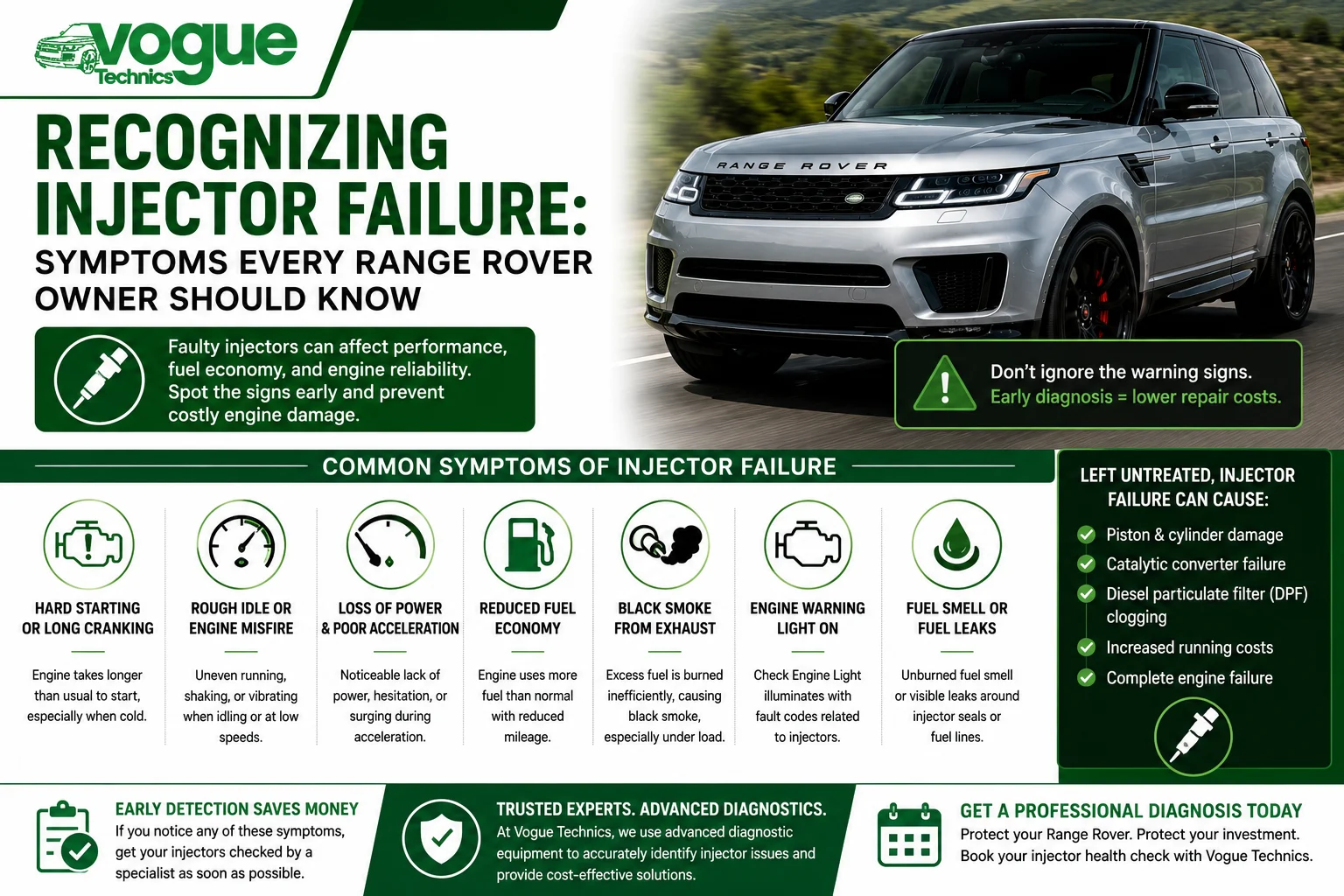
Your Range Rover Sport is trying to tell you something is wrong. The question is: are you listening?
Injector problems don't arrive with a sudden bang. They announce themselves gradually, through a series of symptoms that many owners mistake for other issues. By understanding these warning signs, you can catch injector problems early, before they escalate into catastrophic engine damage.
Early Warning Signs (Before the Check Engine Light Appears)
The most insidious injector problems are those that start subtle. Your Range Rover might drive perfectly fine, but something feels slightly off. The engine doesn't respond quite as quickly. Fuel economy seems worse than usual. There's a barely perceptible hesitation during acceleration.
These early symptoms are often ignored because they're not dramatic enough to warrant immediate attention. But they're your window of opportunity to address the problem before it worsens.
Hard Starting—Even in Warm Weather (Symptom of Weak Spray Pattern)
Cold starts are always tougher than warm starts. That's normal. But if your Range Rover is struggling to start even when the engine is warm or hot, you likely have an injector problem.
Here's why: Modern diesel engines rely on precise fuel atomization for combustion. The fuel injector creates a fine mist that ignites when exposed to the hot compressed air in the combustion chamber. If the spray pattern is degraded, if the fuel comes out as larger droplets rather than a fine mist—combustion becomes incomplete.
The engine needs more cranking time to ignite, and the starter motor works harder. In cold conditions (below 5°C), this problem worsens dramatically because the compression temperatures are lower.
What to listen for:
- Longer cranking time before the engine fires
- A rough "catch" as the engine catches, not smooth
- Multiple attempts needed on cold mornings
- A slight cloud of white or grey smoke on first start
If you're experiencing this, your fuel injector spray pattern is likely degraded. This happens when:
- The injector nozzle has carbon deposits narrowing the spray holes
- Internal wear has damaged the needle and seat, preventing a clean seal
- Fuel contamination has scored the injector surfaces
When to act: If hard starting persists for more than a few days, have it checked. Hard starting that worsens over weeks suggests progressive injector wear.
Rough Idle at Traffic Lights (Combustion Imbalance)
A healthy diesel engine at idle should be smooth and stable, revving at around 600-750 RPM with minimal vibration.
An injector problem creates the opposite. You'll notice:
- Engine vibration transmitted through the steering wheel and seat
- RPM fluctuating between 500 and 800 RPM
- A slight "shaking" sensation, especially noticeable in the cabin
- The sensation worsens when the air conditioning or power steering is engaged
This happens because one or more cylinders are receiving less fuel than others. If cylinder three has a faulty injector delivering only 80% of the fuel compared to other cylinders, that cylinder produces less power on its combustion stroke. The engine becomes unbalanced, and you feel the vibration.
Rough idle caused by injectors is distinct from rough idle caused by other problems:
- Bad injector idle: Improves slightly when revved, returns to rough when descending back to idle
- Bad spark plug (petrol): Rough across all RPM ranges
- Bad diesel glow plug: Only rough during cold starts
Why it matters: Rough idle is often accompanied by a check engine light. Diagnostic equipment will show P0300 (random misfire) or P0301-P0306 (specific cylinder misfires). This points directly at the injector.
Poor Acceleration During Overtaking (Under-Fueling Zones)
When you press the accelerator pedal hard, perhaps to overtake on a motorway, you expect immediate, powerful response. Your Range Rover should leap forward.
If acceleration feels sluggish, with a noticeable delay before power builds, you likely have an under-fueling injector.
Here's the scenario: At idle and cruise speeds, a faulty injector might deliver 90-95% of the fuel it should. The engine compensates through ECU adjustments, and you don't notice much difference. But when you demand maximum fuel delivery, during hard acceleration that injector hits its limit. It can't increase fuel delivery proportionally.
The result is reduced power on the acceleration stroke. You feel it as hesitation or delayed response, as if the engine is reluctant to rev.
This is particularly noticeable:
- During motorway merges when you need instant power
- When ascending hills
- When towing (if your Range Rover is equipped for towing)
- When pushing the engine above 3,500 RPM
The danger zone: Prolonged hard acceleration with a faulty injector creates stress throughout the fuel system. The fuel rail pressure sensors report unusual readings. The ECU may trigger limp mode, reducing maximum RPM to protect the engine.
Excessive Fuel Consumption—5-10% Higher Than Normal
You know your Range Rover's fuel consumption. You've tracked it over months and years. Suddenly, you're filling up more frequently, or your fuel consumption has crept up from 35 MPG to 30 MPG.
An injector problem is one of the most common culprits.
When an injector is faulty, the ECU detects fuel pressure variations and cylinder imbalances. It compensates by increasing fuel delivery to ensure ignition occurs. This is a safety mechanism, the ECU prioritizes engine starting and smoothness over efficiency.
The result:
- More fuel per combustion cycle
- Unburned fuel in the exhaust (black smoke)
- Overall consumption climbing 8-15% above normal
- Your fuel costs increasing by £15-30 per week
Over a year, this adds up to £800-1,500 in extra fuel costs. That alone justifies a professional diagnostic check.
How to track consumption changes:
- Fill your fuel tank to full
- Drive 300 miles at normal speeds (mix of motorway, A-roads, town)
- Fill up again and note the total fuel added
- Calculate: Fuel added ÷ Miles driven = MPG
If your MPG drops noticeably and persists for more than one fill-up cycle, have a professional diagnostic performed.
Visible Symptoms You'll See & Hear
Some injector symptoms are impossible to ignore. You'll see them visually or hear them unmistakably. These are your "act now" warning signs.
Black Smoke from the Exhaust (Over-Fueling Pattern)
Black smoke from a diesel exhaust is unmistakable and alarming. A plume of dark smoke trailing behind your Range Rover isn't just an emissions violation—it's a clear sign something is seriously wrong.
Black smoke indicates over-fueling: the engine is receiving more fuel than it can burn completely. The excess fuel exits the exhaust as visible smoke particles.
Why does an injector problem cause over-fueling?
- A faulty injector delivers fuel at the wrong time in the combustion cycle
- The fuel doesn't ignite completely within the cylinder
- Raw fuel exits the exhaust system as smoke
- The ECU detects the misfire and compensates by increasing fuel delivery to cylinders, creating a feedback loop
Continuous vs Intermittent Black Smoke
Understanding the pattern helps diagnosis:
Continuous black smoke (present whenever revved): Indicates at least one injector is severely faulty and consistently delivering too much fuel or at the wrong timing. This requires immediate repair—continued driving risks expensive damage.
Intermittent black smoke (only during hard acceleration or cold starts): Indicates the ECU is struggling to compensate for injector variance. Under normal driving, the problem is masked. Under stress, it becomes visible.
Why It's Worse on Cold Starts
During a cold start, the engine relies more heavily on the ECU's fuel enrichment strategy. The engine block and combustion chambers are cold, so the ECU increases fuel delivery to ensure ignition.
If you have a faulty injector, this increased fuel demand exposes the problem dramatically. You'll see a heavy cloud of black smoke at startup, which clears as the engine warms. This pattern specifically suggests injector issues.
Health warning: Continuous exposure to black smoke indicates dangerous emissions levels. If you're leaving visible smoke trails, your vehicle will fail MOT, and you're contributing to poor air quality. More importantly, continued driving risks catalytic converter and diesel particulate filter damage, which costs £1,500-3,000 to repair.
White Smoke—When Injectors Aren't the Problem
White smoke is less common than black smoke but equally concerning. However, white smoke is less likely to be caused by injectors and more likely to indicate:
- Incomplete combustion (usually from low compression or worn pistons)
- Water vapor in the exhaust (often a sign of head gasket failure or coolant leaking into cylinders)
- Excessive fuel delivery from another component (high-pressure pump, fuel pressure regulator)
The distinction matters because fixing white smoke from an injector is different from fixing it from a head gasket failure.
If your Range Rover is producing white smoke, a professional diagnostic is essential before assuming injector replacement is the answer. Changing injectors when the real problem is a leaking head gasket will be expensive and ineffective.
Injector Ticking/Knocking Noise at Idle Speed
Diesel engines naturally produce some noise. That's part of their character. But an abnormal ticking or knocking sound at idle is worth investigating.
This sound comes from combustion pressure spikes. When an injector is faulty, fuel ignites at the wrong time in the combustion cycle. Instead of a controlled, smooth power stroke, ignition is delayed or erratic. This creates pressure spikes that produce a distinctive knock, similar to the sound of a worn engine, but coming specifically from the injector area.
How to identify injector knock:
- Start the engine and let it idle
- Listen carefully to the area around the fuel rail (top of the engine)
- You'll hear a metallic ticking, distinct from the normal diesel clatter
- The knock increases in intensity as you raise RPM slightly
- The sound is often loudest from one specific cylinder (the one with the faulty injector)
This sound indicates the injector timing is out, or the injector nozzle is damaged and creating abnormal combustion patterns.
Engine Vibration or Shaking Below 1500 RPM
Engine vibration is one of the most noticeable symptoms of an injector problem, and it's one of the most common reasons owners book a diagnostic appointment.
When you're sitting at traffic lights or crawling in traffic below 1,500 RPM, does your Range Rover:
- Shake or vibrate noticeably?
- Transmit vibration through the steering wheel?
- Feel like it might stall (though it doesn't)?
- Require constant throttle adjustment to maintain idle?
These are classic signs of cylinder imbalance caused by injector variance.
Here's what's happening: Each cylinder contributes equally to engine rotation. In a six-cylinder TDV6, each cylinder fires once every two crankshaft rotations. If one cylinder is receiving 20% less fuel than others (due to a faulty injector), it produces 20% less power on its power stroke. This imbalance creates vibration that pulses twice per revolution.
Why it's worse at low RPM:
At idle and low speeds, the engine's inertia is lower. Each combustion event contributes proportionally more to driving the crankshaft. A weak combustion stroke is very noticeable.
At high RPM, the engine's momentum smooths out these irregularities, and you feel less vibration.
The progression:
- Week 1: Slight vibration at idle, barely noticeable
- Week 4: Vibration is obvious; you feel it in the seat and steering wheel
- Week 8: Vibration is accompanied by rough running and hesitation
- Week 12: Engine enters limp mode to protect itself
This is why early intervention matters. Addressing the problem at week 4 means a single injector replacement. Waiting until week 12 might mean two or three injectors have failed.
Dashboard Warning Lights & OBD Fault Codes Explained
Your Range Rover's onboard diagnostics system is constantly monitoring engine performance. When something goes wrong, it logs a fault code and illuminates the check engine light.
Understanding these codes helps you grasp what's happening mechanically and why professional repair is necessary.
P0201 & P0202 Fault Codes—Injector Circuit Faults
P0201 translates to "Injector Circuit Malfunction, Cylinder 1" P0202 translates to "Injector Circuit Malfunction, Cylinder 2"
(Similar codes P0203-P0206 apply to cylinders 3-6)
These codes indicate the ECU detected an electrical problem with the injector or its circuit. This could be:
- A faulty injector solenoid (the electromagnetic coil that opens and closes the injector)
- A corroded injector connector
- A broken wire in the injector harness
- A faulty injector driver module inside the ECU
- The injector itself
What These Codes Actually Mean
When you see P0201, the ECU has attempted to fire the cylinder 1 injector, but the electrical signal didn't return to normal as expected. Either the injector didn't fire, or it fired but resistance was abnormal.
This is a critical distinction because it tells you the problem might be electrical rather than mechanical:
- If the injector solenoid is faulty, it won't respond to the electrical signal
- If the connector is corroded, resistance will be high, and the ECU detects this
- If the wiring is broken, the circuit is incomplete
- If the injector driver (the circuit within the ECU that controls the injector) is faulty, it can't deliver the required current
Why One Cylinder vs Multiple Cylinders Matter
A single P0201 code (one cylinder) usually indicates:
- A problem specific to that injector or its individual circuit
- Most likely a faulty injector solenoid or corroded connector
- Standard repair: replace the injector and/or clean connectors
Multiple codes (P0201, P0202, P0203) usually indicate:
- A systemic fuel system problem affecting multiple cylinders
- Could be low fuel pressure (a fuel pump issue, not injectors)
- Could be an ECU fault affecting multiple injector drivers
- Repair strategy is different, diagnostics focus on fuel pressure and ECU function first
P0263 & P0266—Injector Balance Rate Faults (Most Common)
P0263 translates to "Cylinder 1 Contribution/Balance Fault" P0266 translates to "Cylinder 4 Contribution/Balance Fault"
(Similar codes apply to other cylinders)
These codes are far more common than P0201 and indicate the ECU has detected cylinder imbalance. The injector is firing, but fuel delivery is out of balance compared to other cylinders.
The ECU monitors combustion through the crankshaft position sensor, which detects variations in engine speed during each power stroke. If one cylinder produces significantly less power (because its injector is delivering less fuel), the crankshaft slows more during that cylinder's exhaust stroke.
The ECU calculates this and determines: "Cylinder 1 is contributing less than expected. Either the injector isn't delivering enough fuel, or there's a mechanical problem (bad compression, burnt valve, etc.)."
P0263/P0266 fault codes point directly at injector variance, one or more injectors are failing to deliver the correct fuel quantity.
Why these codes are important:
They confirm the problem is an injector problem, not a spark plug, compression, or mechanical issue. This dramatically narrows down the repair path.
P0088—High-Pressure Fuel System Malfunction
P0088 indicates a problem with fuel rail pressure. The ECU expected high-pressure readings (typically 350-400 bar in common rail systems) but either didn't achieve those pressures or lost pressure unexpectedly.
This code can be triggered by:
- A faulty high-pressure fuel pump (the most common cause)
- Leaking fuel injectors (pressure escaping past seals)
- A faulty fuel pressure regulator
- Damaged fuel lines (cracks allowing pressure loss)
Why it's relevant to injectors:
If you have leaking injector seals, fuel escapes from the high-pressure fuel rail. This causes the overall rail pressure to drop. The ECU detects this and triggers P0088.
Additionally, if multiple injectors are faulty and over-fueling, they're extracting fuel from the rail faster than normal, which can suppress pressure readings.
How to Read Live Data on Your Diagnostic Scanner
Professional diagnosticians don't just read fault codes, they analyse live data streams from the ECU. This shows real-time sensor readings and injector operation.
If you have a basic OBD scanner (like those available on eBay for £30-50), you can access some live data:
- Fuel rail pressure: Should be stable and within normal range (350-400 bar for TDV6/SDV6, higher for petrol Ingenium)
- Fuel trim: Should show minimal adjustment (within ±5%)
- Injector duty cycle: Shows the percentage of time each injector is energized. Should be roughly equal across cylinders at idle.
- Engine load: Should be proportional to throttle input
Abnormal readings in these parameters confirm an injector problem and help pinpoint which cylinder is faulty.
However, comprehensive live data requires professional equipment (like Bosch KTS diagnostic systems used at Vogue Technics) that can display hundreds of parameters simultaneously. This level of analysis is essential for accurate diagnosis.
Professional Diagnosis & Repair: How Vogue Technics Solves Range Rover Injector Problems

At this point, you understand the problem. You know what symptoms to look for, what fault codes mean, and why injector issues aren't something to ignore.
Now comes the critical question: How do you fix it?
This section walks you through our professional diagnostic and repair process, so you understand exactly what happens when you bring your Range Rover to Vogue Technics—and why our approach delivers results.
Step-by-Step Professional Diagnostic Process
Professional diagnosis is where the real expertise shines. It's the difference between a successful repair and a repeat visit when symptoms persist.
Our diagnostic process follows a systematic methodology that eliminates guesswork and pinpoints the exact problem.
Live Data Analysis—Fuel Rail Pressure Testing
The diagnostic journey begins with fuel rail pressure measurement. This is foundational because abnormal pressure reveals underlying fuel system issues that might be causing the injector symptoms.
We connect our Bosch diagnostic equipment directly to the fuel rail pressure sensor (on the fuel rail itself, not via OBD port) and observe real-time pressure readings.
Normal Pressure Ranges for TDV6/SDV6
A healthy TDV6 at idle should maintain fuel rail pressure of:
- Idle: 350-380 bar
- 2,000 RPM: 370-400 bar
- 3,000+ RPM: 400-420 bar
The SDV6 operates similarly:
- Idle: 370-400 bar
- 2,000 RPM: 400-430 bar
- 3,000+ RPM: 430-460 bar
If your fuel rail pressure is:
- Below 300 bar at any RPM: The high-pressure fuel pump is failing or fuel delivery is significantly restricted. Injectors are starving for fuel.
- Fluctuating wildly (±50 bar or more): Fuel pressure regulator is faulty or a fuel injector seal is leaking severely.
- Normal: Fuel system pressure is healthy, so any injector problems are mechanical or electrical, not fuel-supply related.
How Low Pressure Reveals Hidden Pump Issues
Many owners assume low pressure automatically means they need new injectors. Actually, low fuel pressure often means the high-pressure fuel pump is failing—a completely different repair.
Here's why this distinction matters:
- Faulty fuel pump: Replace the pump (£800-1,200 including labour)
- Faulty injectors: Replace injectors (£400-3,000+ depending on quantity and coding needs)
- Clogged fuel filter: Replace the filter (£80-150)
Diagnosing low fuel pressure first saves you from unnecessary injector replacement. We've had customers arrive convinced they need new injectors, only to discover the real problem was a £150 fuel filter change.
Injector Balance Test Results & What They Indicate
Once fuel pressure is confirmed healthy, we move to the critical test: injector balance testing.
This test measures how much fuel each injector is delivering and compares the results. It's the most direct way to identify which injector (or injectors) are faulty.
Our Bosch diagnostic system connects to the ECU and initiates a controlled procedure:
- The engine is run at a set RPM (usually 1,500)
- Each injector is pulsed for a specific, measured duration
- The fuel rail pressure change during that pulse is recorded
- This pressure change is converted to a fuel flow rate (mm³ per 1,000 pulses)
Understanding Balance Rate Variance
In a healthy six-cylinder engine, injector flow rates should be nearly identical. Typically:
- Cylinder 1: 98 mm³
- Cylinder 2: 97 mm³
- Cylinder 3: 99 mm³
- Cylinder 4: 96 mm³
- Cylinder 5: 98 mm³
- Cylinder 6: 99 mm³
This variance of ±2 mm³ is normal, manufacturing tolerances ensure no two injectors are identical. The ECU compensates through balance rate adjustments.
But a faulty injector might show:
- Cylinder 1: 98 mm³
- Cylinder 2: 87 mm³ ← 11 mm³ below normal
- Cylinder 3: 99 mm³
- Cylinder 4: 96 mm³
- Cylinder 5: 98 mm³
- Cylinder 6: 99 mm³
An 11 mm³ variance is significant. Cylinder 2 is delivering only 88% of the fuel it should. This creates the exact symptoms you've been experiencing: rough idle, reduced power, possibly a check engine light.
When Variance Means Replacement
As a general rule:
- Variance of ±3 mm³: Within acceptable tolerance; no replacement needed
- Variance of ±4-6 mm³: Injector is beginning to fail; monitor closely; consider replacement if symptoms worsen
- Variance of ±7 mm³ or greater: Injector must be replaced; continued operation risks further damage
Injector Return Flow Test (Leak Detection)
This test checks whether fuel is leaking around the outside of each injector.
The procedure is simpler than balance testing:
- A fuel return line from each injector is connected to a measuring cylinder
- The injector is pulsed repeatedly (usually 1,000 pulses)
- The fuel volume collected in the cylinder is measured
Normal return flow:
A small amount of fuel returns from each injector during normal operation (this is part of the design—it helps cool the injector). Typically, 2-5 mm³ of fuel returns per 1,000 pulses.
Abnormal return flow:
If an injector returns 20+ mm³ per 1,000 pulses, the seal is leaking. Fuel that should be injected into the combustion chamber is leaking around the seal and returning to the tank.
This test is particularly useful for identifying seal failure as the root cause.
Compression & Smoke Tests to Rule Out Engine Damage
Injector symptoms can mimic other engine problems. Before concluding the problem is injectors, we rule out mechanical issues:
- Compression test: Measures cylinder pressure. Low compression in one cylinder might explain poor performance from that cylinder and it's a mechanical problem (worn piston rings, burnt valve), not an injector problem.
- Smoke test: Introduces smoke into the crankcase to detect oil leaks. If smoke emerges from the exhaust, it confirms the problem is within the engine (worn piston rings, damaged seals) rather than external.
These tests are especially important if you have a high-mileage Range Rover (over 100,000 miles). At this mileage, mechanical wear is common.
If compression is low and an injector is also faulty, you need to address both problems—replacing just the injector won't restore full power if the piston rings are worn.
Injector Replacement vs Injector Cleaning—When Each Works
Not every faulty injector requires replacement. Sometimes, professional cleaning restores function. Other times, replacement is the only viable solution.
Understanding when each approach works helps you budget correctly and avoid unnecessary expense.
Can Injector Cleaner Solve Your Problem? (Reality Check)
There are numerous "fuel injector cleaner" products on the market, bottles you pour into your fuel tank for £8-15. These products contain detergent additives designed to dissolve carbon and varnish deposits.
Do they work?
The honest answer: Sometimes, but rarely for severe problems.
Fuel injector cleaners are most effective for early-stage carbon buildup, particularly on petrol Ingenium engines. If your Range Rover has 80,000 miles and you've never used premium fuel, injector deposits are likely. A quality fuel system cleaner might restore 50-80% of flow, improving rough idle and fuel economy.
However, fuel injector cleaners are ineffective for:
- Corroded injector seals (mechanical damage requiring replacement)
- Damaged injector nozzles from fuel contamination
- Worn injector solenoids
- Internal mechanical wear
If your diagnostic testing shows a 15 mm³ variance (severe flow loss) and a visual inspection reveals corrosion or deposits inside the injector, no bottle of cleaner will fix it.
Cost consideration:
A quality fuel system cleaning service (professional-grade cleaner injected directly into the fuel rail under pressure) costs £150-300 and has a better success rate than over-the-counter products. We recommend this as a first step if:
- Injector variance is mild (4-7 mm³)
- Symptoms are early-stage (slight hesitation, slightly rough idle)
- The vehicle has no known contamination history
If this doesn't resolve the issue, injection replacement follows.
When Professional Cleaning Is Sufficient
Professional fuel system cleaning differs fundamentally from pouring a bottle of additive into your tank.
Our process involves:
- Disconnecting the fuel rail from the engine
- Connecting specialized equipment that delivers pressurized cleaning solution directly to each injector
- Running controlled cleaning cycles that dissolve carbon and varnish
- Measuring injector performance before and after to confirm improvement
This approach is highly effective when:
- Injector variance is 5-8 mm³ (mild-to-moderate wear)
- Carbon buildup is visible but the injector isn't structurally damaged
- The vehicle has been serviced regularly with decent fuel quality
Success rates for professional cleaning in these scenarios are 70-85%. Many customers see improved idle quality, better acceleration, and restored fuel economy.
Cost: £200-350 for the cleaning service alone (not including fuel filter or fuel system flush if needed)
Time: 2-3 hours
Why Complete Injector Replacement Is Often Necessary
Professional cleaning fails when the injector is mechanically damaged beyond cleaning's capability.
Common damage that requires replacement:
- Corroded seats and needles: The injector's internal valve (the needle) sits on a seat and seals at pressures over 1,600 bar. Corrosion from fuel contamination roughens these surfaces, destroying the seal. Cleaning can't restore this; only replacement can.
- Plugged spray holes: The injector nozzle has 6-8 extremely small holes (around 100 microns in diameter). Severe deposits can permanently block these holes. Ultrasonic cleaning (a professional technique) sometimes works, but often damage is too extensive.
- Damaged solenoid: The electromagnetic coil that opens and closes the injector can be damaged by electrical faults. Cleaning won't fix this.
- Leaking seals: If the copper washer or O-ring is damaged, fuel escapes around the outside of the injector. New seals are sometimes available separately, but often the injector must be replaced as a complete unit.
When diagnostic testing shows:
- Variance of 10+ mm³
- Visual inspection reveals deep corrosion or scarring
- Return flow test shows significant leakage
Replacement is the only solution.
Single Injector Replacement vs Full Set Replacement
This is a question we hear regularly: "Should I replace all six injectors, or just the faulty one?"
The practical answer depends on several factors:
Replace just the faulty injector if:
- Diagnostic testing shows only one injector is severely faulty (variance over 10 mm³)
- Other injectors show normal variance (within ±3 mm³)
- Your vehicle is relatively young (under 80,000 miles)
- You've maintained it with decent fuel quality
In this scenario, replacing a single injector works fine. You'll restore balance and symptoms disappear. The new injector will be coded, and the ECU will relearn its characteristics.
Cost: £400-700 (parts and labour including coding)
Replace all six injectors if:
- Multiple injectors show elevated variance (several in the 6-9 mm³ range)
- Your vehicle has over 100,000 miles
- You know the fuel quality has been poor (using supermarket diesel consistently)
- You've had previous injector problems
When multiple injectors are wearing, replacing just one is treating a symptom, not the root cause. Within 6-12 months, another injector will fail. You'll be back in the workshop, paying for labour and coding again.
Additionally, if your fuel quality or fuel system health is compromised, the new injector will face the same contamination as the old ones. Addressing all six ensures uniform fuel delivery and maximum longevity.
Cost: £1,800-3,200 (parts and labour including coding)
Long-Term Cost Analysis: One vs Six Injectors
Let's compare two scenarios:
Scenario 1: Replace one injector now
- Initial cost: £500
- After 8 months: Another injector fails, costs £500 again
- After 16 months: Third injector fails, costs £500 again
- Total cost over 2 years: £1,500
- Plus frustration of repeated breakdowns
Scenario 2: Replace all six injectors now
- Initial cost: £2,200
- Guaranteed to be balanced and harmonious
- No repeat failures for 100,000+ miles (with proper fuel maintenance)
- Total cost: £2,200
On paper, scenario 1 seems cheaper. But in reality, scenario 2 eliminates the hassle and actually costs less if you account for repeat labour.
Our recommendation: If more than one injector shows variance over 5 mm³, replace all six. The peace of mind and elimination of repeat visits justify the investment.
Why ECU Coding & Adaptation Are Non-Negotiable
At this point, your injectors are installed. New components in place. Everything should be perfect, right?
Not quite. Without ECU coding, your Range Rover will run poorly.
This is the step that separates professional repairs from failed DIY attempts.
What Happens If New Injectors Aren't Coded
Let's walk through a real scenario:
An owner replaces their own fuel injectors using YouTube tutorials and Haynes manuals. They source quality Bosch injectors, install them correctly (physically), start the engine, and... it runs rough.
The symptoms:
- Black smoke from the exhaust
- Rough idle, worse than before
- Check engine light for P0266 (injector balance fault)
- Sluggish acceleration
Why? Because the ECU learned the characteristics of the old, worn injectors. The ECU had compensated for their deficiencies through balance rate adjustments. When brand-new injectors with different characteristics are installed without coding, the ECU is still trying to use the old compensation values.
The mismatch is dramatic:
- Old injector: Delivered 85 mm³ per pulse (due to wear)
- ECU learned: "This injector is weak; I need to adjust it upward by +3.5 mm³"
- New injector: Delivers 99 mm³ per pulse (new, full flow)
- ECU applies the same +3.5 mm³ adjustment: New injector now delivers 102.5 mm³ (over-fueling)
- Result: Cylinder runs rich, producing black smoke and rough running
This is why unencoded injector replacement fails.
Rough Running & Poor Fuel Economy
Unencoded injectors create cylinder imbalance. Some cylinders run rich (over-fueling, black smoke), others run lean (hesitation, white smoke). The result is rough running across the entire RPM range.
Fuel consumption climbs 10-20% because the ECU is fighting imbalance by increasing overall fuel delivery.
Potential Engine Damage from Coding Failure
Beyond rough running, continuous over-fueling creates heat stress on pistons and rings. The extreme combustion temperatures in over-fueled cylinders accelerate wear. The unburned fuel washing past piston rings into the crankcase dilutes the engine oil, reducing its protective properties.
While engine damage from unencoded injectors usually takes weeks or months to manifest (and isn't always catastrophic), it's a real risk.
Vogue Technics Certified Coding Process
Professional coding addresses these issues through systematic ECU recalibration.
Our process:
- Vehicle connection: We connect our Bosch diagnostic equipment to the vehicle's OBD port and establish secure communication with the engine ECU
- System analysis: The diagnostic system reads current ECU programming, identifies the vehicle variant (TDV6, SDV6, petrol Ingenium), and determines which coding procedure to follow
- Adaptation initiation: We start the ECU's adaptation procedure, which tells the ECU: "New components detected. Prepare to relearn their characteristics"
- Test cycles: The engine runs through a series of test cycles at various RPM and load conditions. The ECU monitors injector performance and calculates new balance rates
- Verification: We analyse the new balance rates. In a successful coding, all cylinders should show variance within ±1.5 mm³
- Final check: We verify fault codes are cleared and take the vehicle for a test drive to confirm smooth running
Our Advanced Diagnostic Equipment
We don't use basic scanners or generic diagnostic software. Our Bosch KTS diagnostic systems are professional-grade equipment specifically designed for Land Rover and Range Rover vehicles. These systems have:
- Direct ECU access with manufacturer-level authority
- Real-time data streaming from 500+ parameters simultaneously
- The ability to perform manufacturer-authorized adaptations and coding procedures
- Integrated with the latest software updates from Land Rover
This ensures our coding is accurate and aligned with Land Rover's specifications.
Guaranteed Adaptation Success Rate
When we perform ECU coding using professional equipment, the success rate is 98-99%. The adaptation takes 15-30 minutes, and injector balance rates are restored to within ±1 mm³ of factory specification.
This is why we guarantee our coding work. If symptoms persist after professional coding, we investigate further at no additional cost until the issue is resolved.
Range Rover Sport Injector Replacement Costs & Preventive Maintenance (UK 2026)
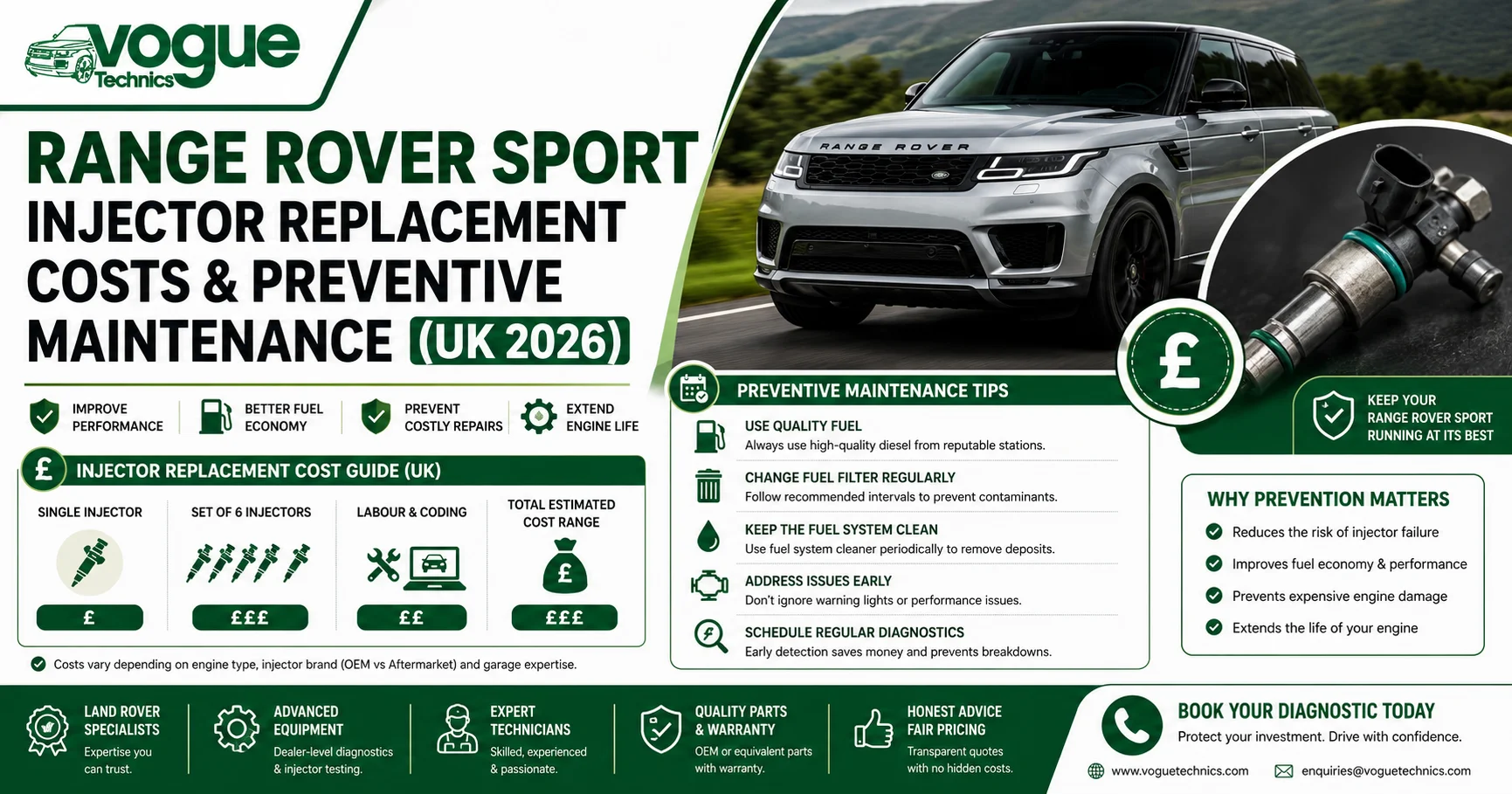
Money matters. Let's talk numbers.
Injector repair costs vary dramatically depending on what's actually wrong, whether it's one injector or six, and whether you choose genuine components or quality aftermarket alternatives.
Complete Cost Breakdown—What You'll Actually Pay
Transparency is essential. When you call a garage and ask, "How much will injector replacement cost?" you get vague answers because the real cost depends on several variables.
Let's break down those variables so you understand exactly what you're paying for.
Genuine Bosch Injector Price vs Quality Aftermarket Options
Genuine Bosch Injectors (original equipment manufacturer)
- Cost per injector: £250-350
- Warranty: 12 months
- Reliability: Manufacturer-guaranteed quality
- Advantages: You know exactly what you're getting; manufacturer warranty covers defects
- Disadvantages: Higher cost per unit
Quality Aftermarket Injectors (reputable manufacturers like Delphi, Denso)
- Cost per injector: £120-180
- Warranty: Usually 6-12 months (varies by supplier)
- Reliability: Good, from established manufacturers
- Advantages: Significant cost savings; equivalent performance to Bosch in most cases
- Disadvantages: Warranty may be shorter; some counterfeit Delphi/Denso units exist, so supplier reputation matters
Budget/No-Name Injectors (from unknown suppliers)
- Cost per injector: £40-80
- Warranty: Often 0 months or very limited
- Reliability: Highly variable; many fail within weeks
- Advantages: Lowest upfront cost
- Disadvantages: Extremely high failure rate; you'll be back in the workshop within months
Our recommendation: We use Bosch and Denso injectors exclusively. The cost difference between genuine Bosch and quality Denso is minimal (perhaps £30-50 per injector), but both are reliable and compatible with your Range Rover.
Why Genuine Isn't Always Better Value
Here's a nuance: Bosch injectors are OEM (original equipment) for Range Rover Sport engines, but they're not necessarily more durable than quality alternatives. Denso injectors, for example, use equivalent precision manufacturing and materials.
The price premium you pay for "genuine" Bosch largely reflects the brand name and the certainty of manufacturer support. For cost-conscious owners, quality aftermarket Denso or Delphi injectors offer equivalent reliability at £50-100 less per unit.
If replacing all six injectors, that's a £300-600 saving, significant enough to influence the decision.
Warranty Differences (3yr vs 12-month)
We offer a three-year warranty on all injector work we perform, regardless of whether you choose genuine Bosch or quality aftermarket injectors. This warranty covers:
- Injector failure from manufacturer defect
- Coding/adaptation issues
- Seal failures within the warranty period
This warranty is superior to what you'd get buying injectors alone from a parts supplier. If an injector fails six months after replacement due to a manufacturing defect, we replace it at no cost.
Labour Costs: Diagnostic (1-2 hrs) + Replacement (2-4 hrs)
Labour varies based on several factors:
Diagnostic time: 1-2 hours
Our complete diagnostic (pressure testing, balance test, return flow test, compression and smoke tests if needed) typically takes 90-120 minutes.
Replacement labour: 2-4 hours
Injector removal and installation varies by how many injectors you're replacing:
- Single injector replacement: 1-2 hours (you're removing the fuel rail, accessing one injector, reseating, and refitting)
- Three injectors: 2-3 hours
- Full set (six injectors): 3-4 hours
Why does replacement take so long? You're not just pulling injectors out and popping new ones in. The process includes:
- Depressurizing the fuel system safely
- Removing fuel rail covers and any components blocking access
- Carefully extracting each injector (they can be seized if corroded)
- Cleaning the injector seats (the recess where each injector sits)
- Installing new copper washers or O-rings
- Installing new injectors and torquing to specification
- Refitting the fuel rail
- Reconnecting fuel lines and electrical connectors
- Pressure testing the system to ensure no leaks
Each step is critical. Rushing leads to leaks or improper seating.
Labour rates:
- Diagnostic labour: £80-100 per hour = £120-180 total
- Replacement labour: £60-80 per hour = £120-320 depending on quantity
Hidden Costs Customers Don't Expect
When you budget for injector replacement, factor in additional costs:
Fuel Rail Seals & Gaskets Replacement
When the fuel rail is removed, seals and gaskets are disturbed. Some may be damaged during removal. Land Rover's recommendation is to replace all fuel rail seals when the rail is off.
Cost: £40-80 for seal kit + labour to install (included in replacement labour)
Fuel Line Replacement (If Contamination Found)
If diagnostic testing reveals fuel contamination in the system, fuel lines themselves may be compromised. Rubber fuel lines can absorb water and degradation products, becoming brittle and cracked.
If we identify contamination, we recommend fuel line inspection and replacement if needed.
Cost: £80-180 per metre of fuel line (includes both supply and return lines)
ECU Coding Fees
Professional ECU coding using diagnostic equipment isn't free labour. It requires specialized software, equipment, and expertise.
Cost: £150-250 for the coding procedure itself
Some garages include this in their "injector replacement" labour rate. We itemize it separately so you understand what you're paying for.
Additional Services (Often Recommended)
- Fuel filter replacement: £80-150 (highly recommended if contamination is found; the filter is likely clogged)
- Fuel system flush: £150-300 (if contamination is extensive, flushing all fuel lines and the tank is prudent)
- Fuel tank cleaning: £300-500 (only if diesel bug is suspected; not common but necessary in severe cases)
Total Cost Estimate Range (TDV6 vs SDV6)
Now let's calculate real-world scenarios:
Scenario 1: Single Injector Replacement (TDV6)
- Diagnostic: £150
- Injector (Denso): £160
- Labour (replacement + coding): £280
- Fuel rail seals: £50
- Total: £640
Scenario 2: Single Injector Replacement (SDV6)
- Diagnostic: £150
- Injector (Bosch): £280
- Labour (replacement + coding): £280
- Fuel rail seals: £50
- Total: £760
Scenario 3: Full Set Replacement—Six Injectors (TDV6)
- Diagnostic: £150
- Six injectors (Denso): £960
- Labour (replacement + coding): £360
- Fuel rail seals: £50
- Total: £1,520
Scenario 4: Full Set Replacement with Fuel System Issues (SDV6)
- Diagnostic: £150
- Six injectors (Bosch): £1,560
- Labour (replacement + coding): £400
- Fuel rail seals: £60
- Fuel filter replacement: £120
- Fuel system flush: £200
- Total: £2,490
Real-world range:
- Single injector (most economical): £400-850
- Full set (best long-term value): £1,800-3,200
These prices are based on 2026 rates at independent specialists like Vogue Technics. Main Land Rover dealers typically charge 20-30% more for the same work.
Can You Drive with a Bad Injector? (Short & Long-Term Risks)
You've got a faulty injector. The thought crosses your mind: "Can I just keep driving until I have time to get it fixed?"
The answer is no—but the reasons why matter, because understanding the risks helps you prioritize the repair.
Immediate Risks (First 100 Miles)
When you first notice injector symptoms (rough idle, hesitation, check engine light), you might not immediately understand the severity. After all, the car still starts and drives.
But within the first 100 miles of continued driving, real risks emerge:
Reduced Engine Power & Limp Mode Activation
Your Range Rover's ECU is constantly monitoring engine health. When it detects cylinder imbalances (which faulty injectors cause), it activates limp mode, a protective strategy that reduces engine power to prevent damage.
In limp mode, your vehicle:
- Limits maximum RPM (often to 3,000 RPM)
- Reduces maximum throttle response
- May limit speed to 50-60 MPH
You might be on the motorway, planning to merge into faster traffic, and suddenly the engine won't respond. The vehicle slows to 50 MPH. Behind you, traffic piles up. This is dangerous.
Additionally, with maximum RPM limited, you can't effectively drive. A 100-mile journey becomes a grueling, unsafe crawl.
Increased Emissions & Failed MOT
A faulty injector causes:
- Unburned fuel in the exhaust (black smoke)
- Incomplete combustion (higher CO and HC levels)
- Potential damage to the catalytic converter and diesel particulate filter (DPF) due to excessive soot
An MOT test includes emissions measurement. A vehicle with a faulty injector will fail on emissions grounds.
You're legally prohibited from driving it until it's repaired and you face a £1,000+ fine if caught driving a failed vehicle.
Medium-Term Damage (500-1000 Miles)
If you ignore the problem and keep driving over several weeks (accumulating 500-1000 miles), damage cascades:
Fuel System Contamination Spread
A faulty injector often indicates fuel system contamination or quality issues. As you continue driving with the faulty injector, unburned fuel accumulates in the exhaust and potentially flows backward into the fuel system.
The longer you drive, the more contamination spreads through fuel lines and potentially into the fuel tank.
Catalytic Converter/DPF Clogging
The diesel particulate filter (DPF) on your Range Rover captures soot from the exhaust. It regenerates (burns off the soot) periodically during normal driving.
A faulty injector causes excessive soot production. The DPF becomes overloaded faster than it can regenerate. Soon, the DPF light illuminates, and the system enters a forced regeneration mode—a very hot, fuel-intensive process.
If the DPF light appears and you ignore it, the DPF clogs completely. Your vehicle enters limp mode until the DPF is cleaned or replaced.
A DPF replacement costs £1,500-2,500.
Long-Term Consequences (5,000+ Miles)
Drive 5,000+ miles on a faulty injector and you're playing Russian roulette with your engine.
Engine Block Carbon Buildup
Unburned fuel from a faulty injector creates deposits inside the combustion chamber, on piston tops, and on intake valves. Carbon buildup:
- Raises compression ratios artificially, creating hot spots
- Narrows intake ports, reducing breathing
- Builds up on injector tips, accelerating their failure
- Creates a cycle where more injectors fail
Total Engine Failure & Rebuild Costs (£4,000+)
In severe cases, continuous over-fueling and carbon buildup cause:
- Piston ring failure (blow-by, loss of compression)
- Bearing wear from diluted oil (excess fuel in the crankcase thins the oil)
- Head gasket failure from extreme combustion temperatures
Once you've got bearing wear or piston ring failure, the engine is done. A complete engine rebuild—machine work, new pistons, rings, bearings, gaskets, valve work, costs £3,500-5,500 depending on engine variant.
This is why a £600 injector repair now costs £4,500 later if you delay.
Preventing Future Injector Failures—Maintenance Schedule
At this point, you've learned the hard way that injector maintenance matters. Here's how to prevent future failures.
Fuel Filter Replacement Intervals (Every 20,000 Miles)
This is the single most important prevention measure.
Your fuel filter catches particles, water, and contaminants before they reach injectors. In many diesel vehicles, the fuel filter also has a water separator that collects condensation.
Standard maintenance: Replace fuel filter every 20,000 miles
Severe-use maintenance (if you frequently use supermarket diesel or suspect fuel quality issues): Replace every 10,000-15,000 miles
A fuel filter costs £40-80 and takes 30 minutes to replace. This is cheap insurance against injector problems.
When you replace the fuel filter, inspect the old one:
- Is it covered in black sludge? This indicates fuel contamination.
- Is the water separator full? This indicates moisture in your fuel.
- Is the element severely clogged? This suggests poor fuel quality.
These signs tell you to upgrade your fuel supplier or add fuel treatment.
Annual Fuel System Cleaning & Fuel Quality Check
Once yearly, we recommend a professional fuel system assessment:
- Visual inspection of fuel lines for cracks or corrosion
- Fuel sample analysis to check for water content, contamination, or degradation
- Fuel filter inspection as described above
- Optional fuel system cleaning if contamination is detected
Cost: £150-300 annually
This annual checkup catches problems early—water accumulation before it causes injector damage, contamination before it spreads, degradation before it creates deposits.
Why Cheap Fuel Is Expensive Long-Term
Let's do the math on fuel quality:
Supermarket diesel (typical price: 142p per litre)
- Lower additive package
- Less rigorous filtration
- Higher contamination risk
Premium diesel (typical price: 145p per litre)
- Enhanced additives (detergents, corrosion inhibitors, biocides)
- Better filtration
- Lower contamination risk
Annual cost difference (assuming 12,000 miles, 30 MPG consumption):
- 400 litres per year
- 3p per litre difference
- £12 per year extra for premium fuel
That's £1 per month extra for dramatically better fuel quality.
But if using cheap fuel means injector damage every 80,000 miles instead of 150,000, the math shifts:
- Cheap fuel: Injector failure every 80,000 miles = £600 repair every 4 years
- Premium fuel: Injector failure every 150,000 miles = £600 repair every 7-8 years
The £12 annual investment prevents £600+ repairs, a 50x return on investment.
We always recommend premium diesel from dedicated fuel suppliers (BP Ultimate Diesel, Shell V-Power Diesel, Texaco Gold) rather than supermarket brands.
Supermarket Diesel vs Premium Fuel Comparison
Factor | Supermarket Diesel | Premium Diesel |
| Price (pence/litre) | 140-145 | 145-150 |
| Detergent additives | Minimal | Enhanced |
| Anti-corrosion inhibitors | Basic | Premium grade |
| Biocides (anti-diesel-bug) | Minimal | Included |
| Filtration quality | Standard | Fine |
| Water separator effectiveness | Basic | Enhanced |
| Injector deposit risk | High | Low |
| Injector lifespan (miles) | 80,000-100,000 | 130,000-150,000 |
| Overall fuel system health | Compromised | Optimized |
Contamination Testing & Water Detection
If you're concerned about fuel quality, professional testing is available:
- Water content test: Lab analysis determines free and dissolved water in your fuel (acceptable: <200 ppm)
- Particulate count: Measures contamination level (ISO 4406 rating)
- Acid number: Indicates fuel degradation
Cost: £80-150 per sample
If testing reveals high water content or contamination, immediate action is needed: fuel system flush, tank cleaning, or even tank replacement if severely compromised.
Vogue Technics Preventive Maintenance Package
We offer a comprehensive preventive maintenance package specifically designed to protect your fuel system:
Annual Health Check Service (FREE for Our Clients)
Once yearly, you're invited for a complimentary check including:
- Visual fuel system inspection
- Fuel filter condition assessment
- Injector balance test (quick version)
- Fuel rail pressure verification
- ECU fault code scan
- Comprehensive report with recommendations
This costs us £150-200 in labour, but we include it free for customers who've had major work with us. The goal is early detection of problems before they become expensive.
Priority Booking & 15% Discount on Repairs
Preventive maintenance customers get:
- Priority booking (if your vehicle needs unexpected repairs, we fit you in quickly)
- 15% discount on future repair labour
- Quarterly reminders for filter replacement and fuel quality upgrades
For customers serious about protecting their Range Rover, this package is exceptional value.
Contact Vogue Technics for Your Free Diagnostic Consultation
If you're experiencing any of the symptoms described in this guide—rough idle, hesitation, black smoke, check engine lights—your first step is a professional diagnosis.
We offer a free diagnostic consultation where we:
- Listen to your description of symptoms
- Connect diagnostic equipment to your vehicle
- Perform preliminary checks (pressure, fault codes, injector balance)
- Provide a detailed explanation of what's wrong
- Present a clear repair plan with fixed pricing
- Answer all your questions
There's zero obligation. Many customers use this consultation to understand their problem before deciding on repairs.
Book Your Online Diagnostic Assessment
Visit our website or call us to schedule an appointment. We can usually accommodate vehicles within 3-5 working days.
Call Our UK Service Team: [Phone Number to be inserted]
Speak directly with our technicians. They can answer technical questions about your specific vehicle and symptoms.
Free Quote Within 2 Hours (No Obligation)
After your diagnostic visit, we provide a detailed written quote within 2 hours. This quote includes:
- Parts pricing (itemized)
- Labour pricing (itemized)
- Timeline for repairs
- Warranty details
- Financing options if applicable
You're never pressured to proceed immediately. Many customers review the quote, think it over, and book repairs for a convenient time.
Frequently Asked Questions
What are the symptoms of a bad injector?
Common symptoms include rough idle, hesitation during acceleration, black smoke from the exhaust, hard starting, poor fuel economy, check engine lights, and engine vibration below 1,500 RPM. Not all symptoms appear simultaneously early-stage injector problems might manifest as just one or two of these signs.
How long do Range Rover injectors last?
With good fuel quality and maintenance, Range Rover Sport fuel injectors typically last 100,000-150,000 miles. Poor fuel quality, infrequent filter changes, or contaminated fuel can reduce this to 60,000-80,000 miles. Petrol Ingenium injectors have slightly better longevity than diesel variants.
Can injector cleaner fix injector problems?
Professional fuel system cleaning has a 70-85% success rate for mild injector problems (variance under 8 mm³). It's ineffective for mechanical damage like corroded seals or plugged spray holes. If testing shows severe variance (10+ mm³), replacement is the only solution.
Why is my Range Rover smoking?
Black smoke indicates over-fueling, commonly from a faulty injector, failed fuel pressure regulator, or high-pressure fuel pump malfunction. White smoke suggests incomplete combustion from low compression, a burnt valve, or head gasket issues. Professional diagnosis is essential to identify the exact cause.
Why does my engine misfire?
Misfires from a faulty injector result from cylinder imbalance, one cylinder receives less fuel and produces less power on its combustion stroke. The engine ECU detects this through crankshaft speed variation and logs a misfire fault. Fuel contamination, electrical faults, and mechanical damage (low compression) can also cause misfires.
How much does injector replacement cost?
A single injector replacement costs £400-850 (parts + labour + coding). A full set of six injectors costs £1,800-3,200 depending on component choice and fuel system condition. Prices vary based on whether you choose genuine Bosch or quality aftermarket injectors.
Can I drive with a bad injector?
Short-term (first 100 miles): Possible but risky due to reduced power, emissions violations, and potential limp mode activation. Medium-term (500-1000 miles): Risk of DPF clogging and fuel system contamination. Long-term (5,000+ miles): Risk of catalytic converter failure, engine carbon buildup, and bearing wear. The longer you drive, the higher the repair costs. Professional repair is always recommended immediately.
Does injector failure trigger limp mode?
Yes, if the ECU detects severe cylinder imbalance or abnormal fuel rail pressure from failed injectors, it may activate limp mode to protect the engine. In limp mode, maximum RPM is limited (often to 3,000 RPM), maximum throttle is reduced, and the vehicle may be limited to 50-60 MPH. This is a protection mechanism, not a solution.
Should all injectors be replaced together?
If only one injector is severely faulty and others show normal variance, replacing just that injector is acceptable. However, if multiple injectors show variance, or if your vehicle has high mileage (100,000+) with a history of poor fuel quality, replacing all six ensures uniform fuel delivery and prevents cascade failures. Long-term cost analysis often favors full replacement.
How are injectors coded?
Professional ECU coding connects diagnostic equipment to your vehicle's engine control unit. The system initiates an adaptation procedure where the ECU measures new injector characteristics, calculates corrective balance rates for each cylinder, and updates its programming. This takes 15-30 minutes and ensures optimal fuel delivery from new components.
Can dirty fuel damage injectors?
Yes, fuel contamination is the most common cause of injector failure. Diesel containing water, particles, or microbial growth (diesel bug) damages injector seals, clogs spray holes, and corrodes internal components. Using quality premium diesel and replacing fuel filters every 20,000 miles prevents this damage.
What causes injector seal failure?
Injector seals (copper washers or O-rings) fail due to age, heat cycling, fuel contamination (corrosion), or high-pressure stress. After 80,000-100,000 miles, seals naturally degrade and harden. Contaminated fuel accelerates this process significantly.
Why is my diesel knocking?
Diesel knock indicates combustion pressure spikes, often from faulty injectors delivering fuel at the wrong time in the combustion cycle. This creates uncontrolled ignition instead of a smooth power stroke. The knock is the sound of pressure spiking against the piston. Fuel quality issues and injector timing problems are the primary causes.
Why does my engine shake?
Engine vibration at idle is typically caused by cylinder imbalance, a faulty injector delivering less fuel than others. At low RPM, the engine's inertia is low, so each combustion contributes significantly to driving the crankshaft. An imbalanced cylinder causes noticeable vibration. At higher RPM, momentum smooths out the vibration.
How do you test injectors?
Professional testing includes fuel rail pressure measurement (confirms adequate fuel supply), injector balance test (measures fuel flow from each injector and compares), return flow test (detects leaking seals), and live data analysis (confirms ECU parameters are correct). These tests pinpoint faulty injectors and rule out other fuel system problems.
Final Thoughts
Fuel injector problems aren't something to dismiss or delay. They're progressive issues that worsen over time, escalating from minor annoyances to expensive engine damage.
But here's the encouraging news: Early intervention prevents catastrophe.
If you're experiencing rough idle, hesitation, black smoke, or check engine lights, you've got a window of opportunity. A professional diagnostic test costs £150-180 and takes 90 minutes. This test definitively identifies the problem and charts a clear repair path.
Many owners expect injector work to cost thousands. The reality is that professional diagnosis often reveals simple fixes—a fuel filter replacement, a fuel system cleaning, or a single injector replacement—at a fraction of what they anticipated.
The owners who end up paying the most are those who ignore symptoms for months, allowing compound damage to accumulate. A £600 injector repair neglected becomes a £4,500 engine rebuild.
Your next step is simple: Get your Range Rover diagnosed.
We at Vogue Technics have helped hundreds of Range Rover owners navigate exactly this situation. We've provided clarity on confusing symptoms, identified the root cause, and delivered repairs that restore their vehicles to proper operation.
Your Range Rover is a significant investment. It deserves proper care—and proper diagnosis when problems arise.
Contact Vogue Technics today for your free diagnostic consultation. Let's identify exactly what's happening and chart a path forward.