
Range Rover Evoque Head Gasket Failure Symptoms: What Every Owner Must Know
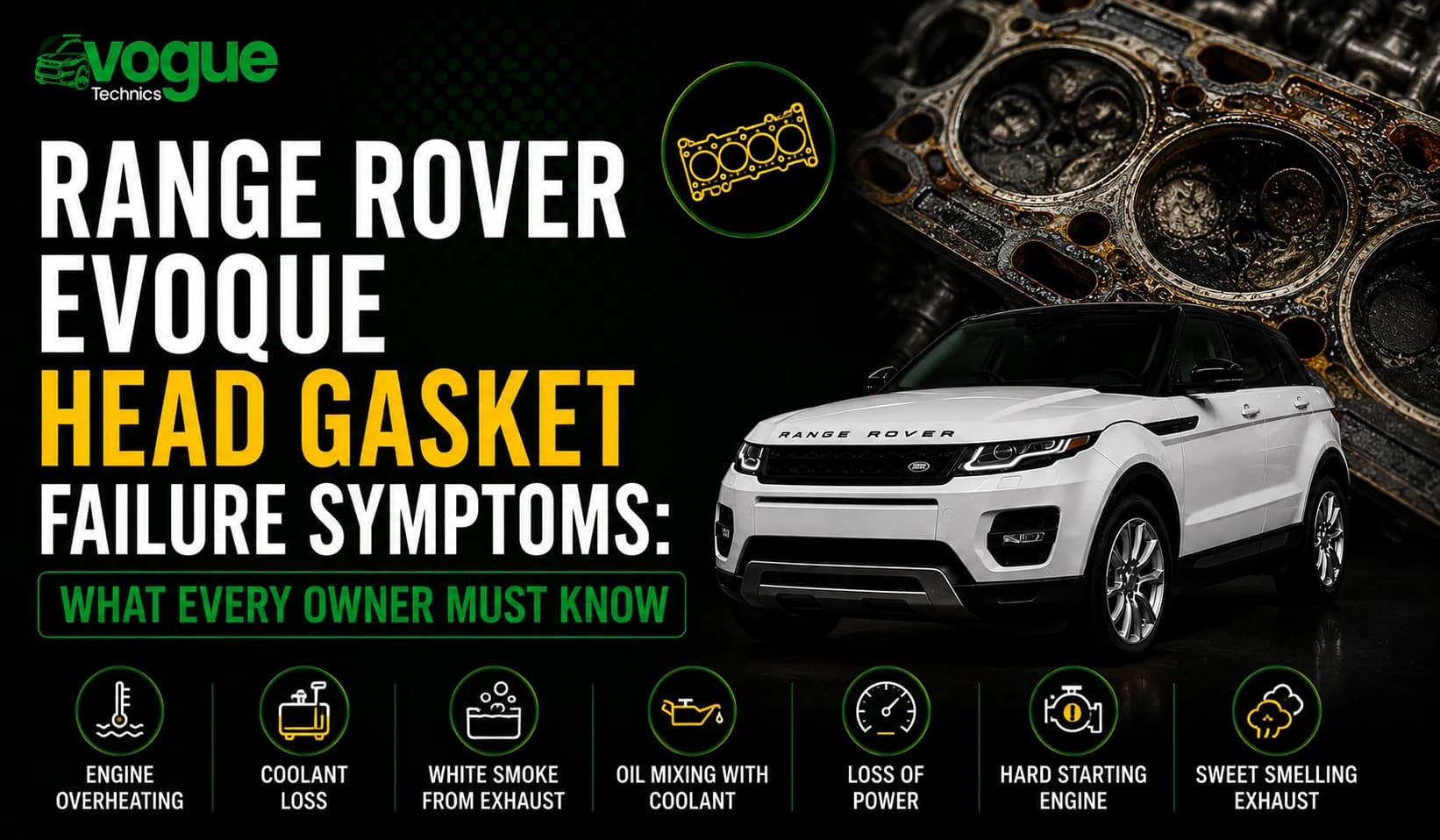
Head gasket failure is one of the most serious and costly problems a Range Rover Evoque owner can face. Key warning signs include persistent white exhaust smoke, unexplained coolant loss, milky engine oil, and repeated overheating, even after a thermostat replacement. Catching these symptoms early can mean the difference between a £800 repair and a £6,000 engine rebuild. This guide covers every major symptom, diagnosis method, and repair option to help you act before the damage becomes irreversible
You noticed white smoke drifting from your exhaust. Your coolant warning light flickered on, yet there is no visible puddle under the car. Your temperature gauge is creeping higher than it should. Something is wrong and if you own a Range Rover Evoque, these are not signs to brush off or book in for a routine service.
Head gasket failure is one of the most serious and costly engine problems any Evoque owner can face. Caught early, it is a manageable repair. Left ignored, it leads to warped cylinder heads, contaminated engine oil, turbocharger damage, and in the worst cases, a complete engine rebuild.
This guide walks you through every major Range Rover Evoque head gasket failure symptom, explains what is happening inside your engine, and tells you exactly when to act before the damage becomes irreversible.
What Is a Head Gasket and Why Does It Matter in the Range Rover Evoque?
Before diving into symptoms, it helps to understand what the head gasket actually does, because once you understand its role, the warning signs start to make complete sense.
The Role of the Head Gasket in the Evoque's Engine
The head gasket sits between the engine block and the cylinder head. Its job is to seal the combustion chamber so that fuel ignites correctly, while simultaneously keeping coolant passages and oil galleries completely separate from one another.
Think of it as the engine's most critical internal seal. It holds back enormous pressure from combustion gases, operates under extreme heat cycles every time you drive, and prevents three completely incompatible fluids, fuel gases, coolant, and engine oil, from ever mixing together.
When it fails, those boundaries break down. Coolant leaks into combustion chambers. Oil becomes contaminated. Combustion gases enter the cooling system. And the engine begins to destroy itself from the inside out.
Why the Evoque's Ingenium Engine Is Particularly Vulnerable
The Range Rover Evoque, particularly models from 2012 through to the mid-generation facelift, uses engines derived from the Ford EcoBoost platform and later the Jaguar Land Rover Ingenium family. Both engine families use aluminium cylinder heads mated to an engine block and aluminium is far more sensitive to heat stress than cast iron.
Aluminium expands and contracts rapidly during temperature changes. Every overheating event, even a mild one, puts enormous stress on the gasket sealing surface. Over time, that stress causes micro-failures in the gasket material and once the seal starts to go, it rarely recovers on its own.
How Turbocharging Increases Thermal Stress on the Head Gasket
The Evoque's turbocharged engine produces significantly more heat than a naturally aspirated equivalent. The turbocharger forces compressed, heated air into the combustion chamber, raising cylinder temperatures and pressures well beyond what the engine experiences at idle.
Under motorway driving, repeated hard acceleration, or towing, this thermal load becomes sustained. If the cooling system is even slightly compromised, a partially blocked radiator, a slow coolant leak, a failing water pump, the head gasket is the first component to suffer the consequences.
Common Design Factors Behind Evoque Head Gasket Failures
Several real-world factors contribute to higher-than-average head gasket failure rates in the Evoque:
- Cooling system neglect: infrequent coolant flushes allow acidity to build up, degrading the gasket material from within
- Thermostat failure: a stuck thermostat causes localised overheating that goes undetected until the gasket has already been damaged
- Water pump wear: reduced coolant circulation creates hot spots around the cylinder head
- Previous overheating events: even a single significant overheat can weaken the gasket seal permanently
- High mileage without maintenance: gasket materials degrade naturally over time, especially under turbo heat stress
Understanding these factors matters because many Evoque owners replace individual components, a thermostat here, a coolant flush there, without addressing the underlying gasket damage already present.
Range Rover Evoque Head Gasket Failure Symptoms You Should Never Ignore

This is the section that matters most. These are the symptoms Evoque owners report most frequently and the ones that demand immediate professional attention.
White Smoke Coming From the Exhaust
White or blue-tinged smoke from the exhaust on a warm day is one of the clearest indicators of head gasket failure. When coolant breaches the combustion chamber, it burns alongside the fuel and exits through the exhaust as thick, sweet-smelling white smoke.
This is distinct from the thin white vapour you see on cold mornings, which is simply condensation burning off. Head gasket smoke is persistent, heavy, and often accompanied by a sweet or antifreeze-like smell.
How to Tell the Difference Between Steam and a Blown Gasket
Observation | Cold Morning Condensation | Head Gasket Failure |
| When it appears | Only on cold start | Continues after engine warms up |
| Smoke thickness | Thin and light | Thick and persistent |
| Smell | No noticeable smell | Sweet, chemical, or burnt antifreeze smell |
| Duration | Disappears within minutes | Sustained throughout driving |
| Coolant level | Normal | Dropping over time |
If the smoke persists well after the engine has reached operating temperature, treat it as a head gasket symptom until proven otherwise.
Coolant Loss With No Visible External Leak
This is arguably the most confusing symptom for Evoque owners. Your coolant warning light comes on. You check the reservoir, it is low. But there is no puddle under the car. No wet hoses. No obvious leak anywhere.
The coolant is not disappearing. It is going somewhere internal, being burned inside the combustion chamber or leaking past the gasket into the engine oil. Coolant that disappears without explanation is a serious red flag, not a minor top-up issue.
Why Your Evoque Keeps Losing Coolant Without a Trace
When the head gasket develops a small internal breach, coolant seeps into the cylinder bore during engine shutdown. On the next start, that coolant burns away, producing the white exhaust smoke described above and the cycle repeats with every drive.
Because there is no external evidence of a leak, many owners top up the coolant repeatedly without seeking diagnosis. This delays the repair while the internal damage compounds.
Milky or Contaminated Engine Oil
Pull out your Evoque's oil dipstick and examine the oil on the tip carefully. Healthy engine oil is amber to dark brown in colour, with a consistent texture. If the oil appears milky, creamy, or has a frothy, light-brown appearance, coolant is mixing with your engine oil.
This is one of the most damaging consequences of head gasket failure. Engine oil contaminated with coolant loses its lubricating properties almost entirely. Metal components that rely on a clean oil film for protection begin to wear rapidly. Bearings, camshafts, and cylinder walls are all at risk.
What Coolant Mixing With Oil Means for Your Engine
When coolant enters the oil system, the two fluids emulsify, creating a milky sludge that circulates through the engine. This sludge:
- Clogs oil passages: restricting flow to critical components
- Degrades bearing surfaces: accelerating wear on crankshaft and connecting rod bearings
- Reduces oil pressure: creating low-pressure warnings and potential engine seizure risk
- Contaminates the oil cooler: spreading the problem beyond just the engine block
The moment you see milky oil on the dipstick, stop driving the vehicle. Continued use risks catastrophic internal engine damage that goes far beyond a head gasket repair.
Engine Overheating Repeatedly or After Short Drives
An Evoque that repeatedly overheats, even after the thermostat has been replaced or the coolant refilled, is showing a classic head gasket failure pattern. The cooling system cannot maintain correct temperature because combustion gases are entering the coolant passages, creating air pockets that disrupt normal coolant circulation.
These air pockets prevent coolant from reaching certain areas of the cylinder head, causing localised hot spots. The temperature gauge rises. The engine management system may log warning codes. And the cycle repeats on the next drive.
Why Replacing the Thermostat Does Not Always Fix Overheating
Many garages, particularly those without Land Rover-specific experience, replace the thermostat as a first response to Evoque overheating. In some cases, a failed thermostat is indeed the cause. But if overheating continues after thermostat replacement, the head gasket must be investigated.
A new thermostat cannot compensate for combustion gases in the coolant system. If a hydrocarbon test confirms exhaust gas contamination in the coolant, no amount of component swapping will resolve the overheating.
Rough Idle, Misfiring, and Loss of Engine Power
Head gasket failure does not only affect the cooling system. When the gasket fails between two cylinders, or allows combustion gases to escape into the coolant jacket, cylinder compression drops significantly. The result is an engine that misfires, idles roughly, and feels noticeably underpowered, especially under acceleration.
Evoque owners often describe this as the car feeling "flat", struggling to pull at motorway speeds, or shuddering at idle after a period of overheating.
How Head Gasket Failure Causes Cylinder Compression Loss
Each cylinder in the Evoque's engine relies on a perfect seal to build compression before ignition. When the head gasket fails at a cylinder bore, pressure escapes into adjacent cylinders or coolant passages. Compression drops. The fuel-air mixture ignites inconsistently. The engine misfires and loses power output.
A compression test and cylinder leak-down test will confirm this. If two adjacent cylinders show unusually low compression, a head gasket breach between them is the most likely explanation.
Coolant Bubbling in the Reservoir Tank
Open your Evoque's coolant reservoir cap carefully and only when the engine is completely cold. If you notice bubbling, gurgling, or foaming in the coolant, combustion gases are entering the cooling system through a failed head gasket.
Under normal conditions, coolant circulates smoothly with no gas present. Bubbling coolant means combustion pressure is finding its way into coolant passages, a definitive sign of internal gasket failure.
What Combustion Gases in the Coolant System Actually Mean
When the head gasket fails at a point adjacent to a coolant passage, high-pressure combustion gases force their way into the cooling system every time the engine fires. This pressurises the coolant reservoir abnormally, causes bubbling, and eventually forces coolant out through the pressure cap.
This is why some Evoque owners notice coolant loss alongside an overflowing or pressurised reservoir, two symptoms that together point directly toward combustion gas ingress.
How to Diagnose a Head Gasket Failure on Your Range Rover Evoque
Recognising the symptoms is the first step. Confirming the diagnosis requires either a careful visual inspection or more reliably, professional diagnostic testing.
Warning Signs Visible Without Any Tools
Before any specialist testing, the following checks can be carried out at home:
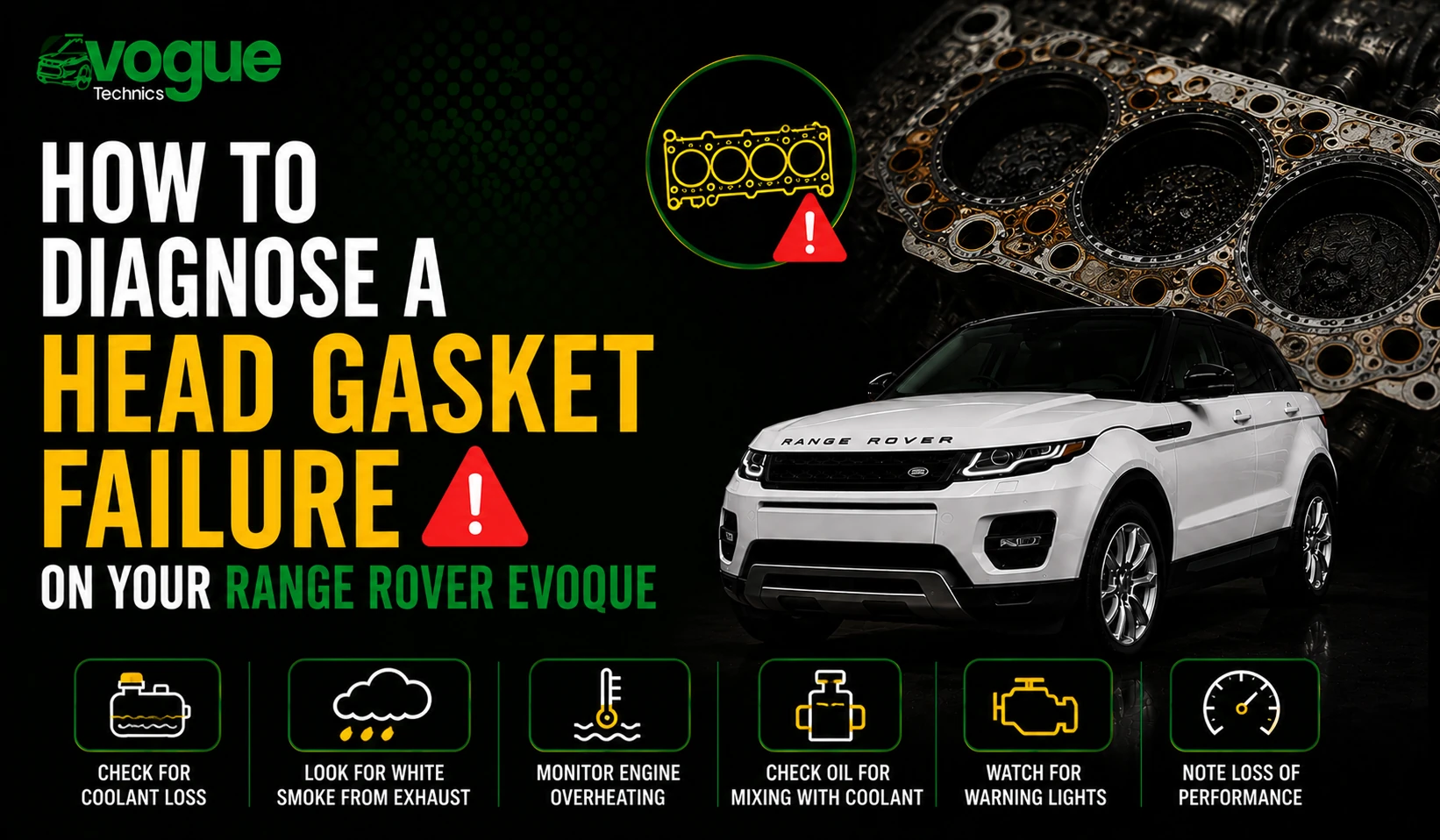
- Check the oil dipstick for milky or frothy oil
- Inspect the coolant reservoir for brown discolouration, oily film on the surface, or bubbling
- Observe the exhaust on a warm day for persistent white or sweet-smelling smoke
- Check the coolant level weekly to track unexplained losses
- Look under the oil filler cap for creamy deposits, a strong indicator of coolant contamination
None of these checks individually confirms a blown head gasket. But two or more occurring together significantly raises the probability.
Professional Diagnostic Tests Used by Land Rover Specialists
For a definitive diagnosis, a specialist workshop will use a combination of the following tests:
Compression Test and Cylinder Leak-Down Test Explained
A compression test measures the pressure each cylinder builds during the compression stroke. Low compression in one or more cylinders, particularly adjacent ones, points toward head gasket failure or a cracked cylinder head.
A cylinder leak-down test goes further by introducing pressurised air into each cylinder and measuring how quickly it escapes. Air escaping into the coolant system or adjacent cylinder confirms a gasket breach at that location.
Hydrocarbon (Combustion Gas) Test on the Coolant System
This is one of the most reliable non-invasive tests available. A hydrocarbon tester, also called a combustion leak detector, uses a chemical fluid that changes colour when exposed to exhaust gases. The tester is held over the coolant reservoir while the engine runs.
A colour change from blue to yellow confirms the presence of combustion gases in the coolant, definitive evidence of head gasket failure in the Evoque.
Coolant Pressure Test to Detect Internal Leaks
A coolant pressure tester pressurises the cooling system to its normal operating pressure and monitors for pressure loss. A system that cannot hold pressure, with no external leaks present, indicates an internal breach, most commonly at the head gasket.
This test is particularly useful for identifying slow or early-stage gasket failures before catastrophic symptoms develop.
Can You Still Drive a Range Rover Evoque With a Blown Head Gasket?
The straightforward answer is: technically yes, but practically no, and it is a decision that risks turning a £1,500 repair into a £5,000 engine rebuild.
Risks of Continued Driving and Long-Term Engine Damage
Driving an Evoque with a confirmed or suspected blown head gasket exposes the engine to escalating damage with every mile:
- Coolant starvation can cause the engine to overheat severely, warping the aluminium cylinder head
- Oil contamination accelerates bearing wear and risks complete lubrication failure
- Turbocharger damage from insufficient cooling can add significant cost to the repair
- Cracked cylinder head may result from sustained overheating, requiring full cylinder head replacement
- Engine seizure in extreme cases where oil pressure collapses entirely
The cost difference between early intervention and delayed repair is substantial. A head gasket replaced before warping occurs is a fraction of the cost of a full engine rebuild.
Range Rover Evoque Head Gasket Repair — Costs, Options, and Expert Help in Essex

Once a head gasket failure is confirmed, the quality of the repair matters as much as the speed of it. This is not a job for a general garage with no Land Rover experience.
How Much Does Evoque Head Gasket Replacement Cost in the UK?
Head gasket replacement on the Range Rover Evoque typically falls within the following ranges depending on the extent of damage found:
Repair Type | Approximate UK Cost | When Required |
| Head Gasket Replacement (gasket only) | £800 – £1,200 | Early-stage failure, no warping |
| Head Gasket + Cylinder Head Skim | £1,200 – £1,800 | Minor warping detected on cylinder head |
| Full Cylinder Head Replacement | £1,800 – £2,800 | Severe warping or cracking |
| Engine Rebuild (worst case) | £3,500 – £6,000+ | Extensive internal damage from continued driving |
These figures reflect specialist Labour rates and OEM or quality replacement parts in the UK market. Main dealer costs will typically sit at the higher end of each range.
Cylinder Head Resurfacing vs Full Engine Rebuild — Which Do You Need?
If the head gasket is caught before significant overheating has warped the cylinder head, resurfacing (skimming) the head is usually sufficient. The machinist restores the gasket sealing surface to a flat, smooth finish, and a new OEM head gasket is fitted.
If the cylinder head has cracked, common when an Evoque has been driven repeatedly while overheating, full cylinder head replacement becomes necessary. In cases where internal engine damage extends to bearings, pistons, or the block itself, a complete engine rebuild is the most cost-effective long-term solution.
Why Choosing a Land Rover Specialist Matters Over a General Garage
The Evoque's Ingenium and EcoBoost-derived engines have specific torque sequences, clearance tolerances, and cooling system bleed procedures that general mechanics may not follow correctly. An incorrectly fitted head gasket on an aluminium engine is likely to fail again within a short period.
A Land Rover specialist brings:
- Familiarity with Evoque-specific overheating patterns and failure points
- Access to OEM or equivalent quality gasket sets
- Correct tooling for cylinder head removal and torque procedures
- Experience identifying secondary damage that a non-specialist might miss
- Proper cooling system bleed procedures to prevent air locks post-repair
Saving money at a general garage and returning six months later with the same problem is not saving money at all.
Vogue Technics Engine Rebuild — Evoque Head Gasket Experts in Grays, Essex
At Vogue Technics Engine Rebuild, based in Grays, Essex, we specialise exclusively in Land Rover and Range Rover engine repairs. The Range Rover Evoque is one of the most common vehicles in our workshop — and head gasket failure is one of the most frequent jobs we carry out on this model.
We understand the specific vulnerabilities of the Evoque's engine architecture. We know where the cooling system fails first, how to diagnose accurately before removing a single bolt, and how to carry out a repair that lasts.
Our clients come to us from across Essex, London, and the wider South East because they want the job done right, by specialists who work on these engines every single day.
What to Expect From Our Evoque Engine Diagnostic and Repair Process
When you bring your Range Rover Evoque to Vogue Technics, here is what happens:
- Full engine diagnostic: OBD2 scan, compression test, hydrocarbon test, and coolant pressure test
- Honest assessment: we tell you exactly what has failed, what is at risk, and what the repair requires
- Transparent quote: no hidden costs, no upselling, no surprises
- Quality repair: OEM-grade head gasket sets, correct cylinder head procedures, full cooling system inspection
- Post-repair testing: we road-test and re-test before the vehicle is returned to you
- Aftercare advice: guidance on coolant maintenance and early warning signs to monitor going forward
Book Your Range Rover Evoque Engine Diagnostic Today
If your Evoque is showing any of the symptoms described in this article, persistent white smoke, unexplained coolant loss, milky oil, repeated overheating, or rough idle, do not wait until the damage becomes irreversible.
Contact Vogue Technics Engine Rebuild in Grays, Essex today. Our team of Land Rover engine specialists will diagnose the problem accurately, give you a clear and honest repair quote, and get your Evoque running correctly again.
Visit us at voguetechnicsenginerebuild.co.uk or call to book your diagnostic appointment. Early diagnosis saves engines and money.
Frequently Asked Questions
What are the first signs of head gasket failure in a Range Rover Evoque?
The earliest signs are usually unexplained coolant loss without any visible external leak, a slight sweet smell from the engine bay, and white exhaust smoke that persists after the engine warms up. Some owners also notice a very slight rough idle before more obvious symptoms develop.
Can I drive my Evoque if I suspect the head gasket has failed?
It is strongly advisable not to. Continued driving with a failing head gasket accelerates internal engine damage significantly. Every mile driven while overheating risks warping the aluminium cylinder head, contaminating the engine oil, and damaging the turbocharger, all of which add considerably to the repair cost.
Why does my Range Rover Evoque keep overheating even after a thermostat replacement?
If overheating persists after thermostat replacement, the head gasket is the most likely cause. Combustion gases entering the cooling system create air pockets that prevent proper coolant circulation, a problem no thermostat replacement can
resolve. A hydrocarbon test on the coolant will confirm or rule out gasket failure.
How much does it cost to replace a head gasket on a Range Rover Evoque in the UK?
Depending on the extent of damage, costs range from approximately £800 for a straightforward gasket replacement to £2,800 or more if the cylinder head requires replacement. Leaving the problem too long can push costs toward a full engine rebuild, which starts at £3,500 upwards.
What does milky oil mean on my Evoque's dipstick?
Milky or creamy oil is a clear sign that coolant has mixed with the engine oil, almost always the result of a head gasket failure. Stop driving the vehicle immediately and seek specialist diagnosis. Continued use with contaminated oil risks severe internal engine damage.
How long does a head gasket replacement take on the Evoque?
A straightforward head gasket replacement typically takes one to two days at a specialist workshop. If the cylinder head requires skimming or replacement, the timeline extends to two to four days depending on parts availability and the extent of additional damage found.
Is the Range Rover Evoque known for head gasket problems?
The Evoque, particularly earlier models with the Ford EcoBoost-derived 2.0-litre engine, has a documented history of cooling system vulnerabilities that can lead to head gasket failure when left unaddressed. Regular coolant maintenance, thermostat checks, and early diagnosis significantly reduce the risk.
Conclusion
Head gasket failure in the Range Rover Evoque is serious, but it is not a death sentence for your engine if you act promptly. The symptoms are distinctive: white exhaust smoke, vanishing coolant, milky oil, repeated overheating, rough idle, and bubbling coolant. Each one is your engine communicating that something is critically wrong.
The longer these warnings are ignored, the more severe and expensive, the damage becomes. An aluminium cylinder head that warps, or an engine that seizes due to oil contamination, turns a manageable repair into a major rebuild.
If your Evoque is showing any of these symptoms, the right move is a professional diagnosis from a specialist who knows these engines inside and out.
Vogue Technics Engine Rebuild in Grays, Essex is ready to help. Visit voguetechnicsenginerebuild.co.uk and book your diagnostic today.