
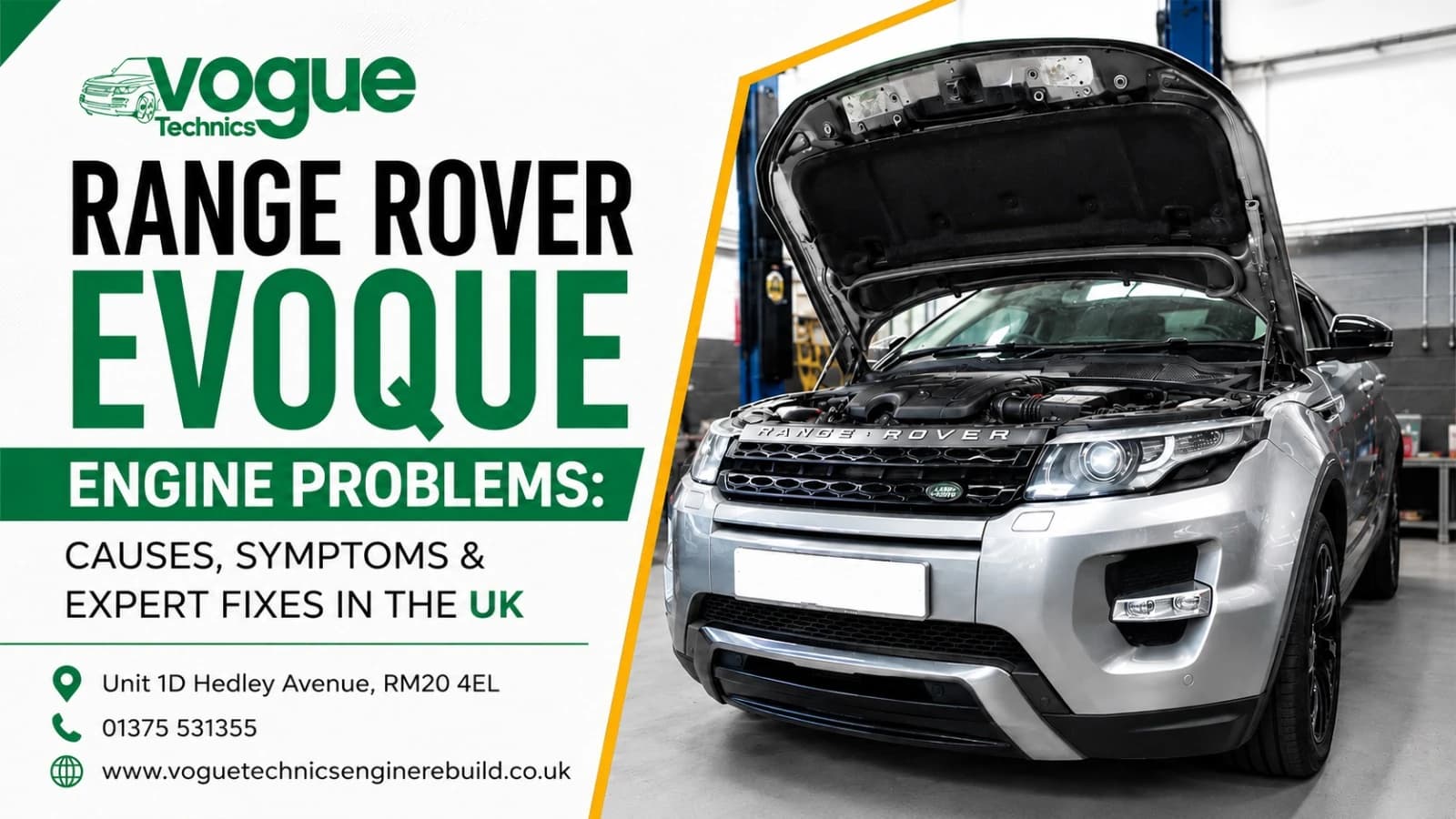
Range Rover Evoque Engine Problems: Causes, Symptoms & Expert Fixes in the UK
The most common Range Rover Evoque engine problems include timing chain wear on the 2.2 TD4 diesel, DPF blockage, EGR valve failure, turbocharger failure, and oil consumption issues on petrol models. Early symptoms include cold-start rattling, engine warning lights, loss of power, and excessive smoke from the exhaust. The 2013–2015 diesel Evoques carry the highest fault risk, particularly when service history is incomplete or incorrect oil grades have been used. Most faults are repairable by a specialist — but early diagnosis is critical, as ignored symptoms frequently escalate into full engine reconditioning or replacement.
You love your Range Rover Evoque. The raised ride height, the premium interior, the way it turns heads on the A13 through Grays. But lately, something feels off. Maybe there's a rattle on cold starts. Maybe the engine warning light decided to ruin your morning commute. Or perhaps power has quietly disappeared, and you're wondering whether your Evoque is heading toward a very expensive conversation with a mechanic.
You're not alone and more importantly, you're not out of options.
The Range Rover Evoque (L538 and the newer L551) has earned genuine fans across the UK, but it also carries a well-documented history of engine-related issues that Land Rover and Jaguar Land Rover owners know all too well. Whether you're running the 2.2L TD4 diesel, the Ford 2.0L EcoBoost Si4, or the later Ingenium AJ200D or AJ200P unit, each engine family comes with its own set of quirks, weaknesses, and — if ignored — costly failure points.
This guide is written from the front line of engine reconditioning work. At Vogue Technics Engine Rebuild, based in Grays, Essex, we've stripped, inspected, rebuilt, and returned to the road more Evoque engines than most main dealers have ever seen up close. What follows is honest, specialist-level knowledge, the kind that helps you make the right decision before a minor fault becomes a major rebuild.
What Are the Most Common Range Rover Evoque Engine Problems?
Before throwing money at diagnostics or trusting a generic garage's opinion, it pays to understand exactly what you're dealing with. Evoque engine problems broadly fall into two camps — diesel-specific faults and petrol-specific faults and they each demand a different approach.
Range Rover Evoque 2.2 TD4 Diesel Engine Problems — What Owners Report Most
The 2.2L TD4 diesel engine was fitted to early Evoques from 2011 through to around 2015. It's a capable unit, reasonably torquey, and decent on fuel but it has a handful of recurring faults that show up with frustrating regularity, particularly on higher-mileage examples and vehicles that have seen a lot of short urban trips.
If you're searching for Range Rover Evoque 2.2 engine problems, there are three fault areas that consistently top the list.
Timing Chain Wear & Failure — The Silent Engine Killer
This is arguably the most serious mechanical fault found on the 2.2 TD4. The timing chain and tensioner assembly on this engine is known to stretch prematurely, particularly on vehicles that haven't had regular oil changes using the correct specification oil.
The warning signs are easy to miss until they aren't:
- A rattling or clattering noise on cold startup that disappears after a few minutes of running
- The engine management light illuminating with fault codes related to cam or crank timing
- A rough, hesitant idle that worsens in colder weather
- In severe cases, the engine will simply refuse to start, or will start and immediately cut out
Timing chain wear is a progressive fault. In early stages, a chain and tensioner replacement by a competent specialist will resolve it completely. Leave it too long, and you're looking at bent valves, damaged camshafts, and in worst cases, terminal engine damage that makes a full Evoque engine rebuild the only sensible path forward.
The honest truth: many owners first notice the cold-start rattle and dismiss it as "just how it sounds." By the time they act, the damage has already progressed. If you hear that rattle — even once, book a diagnostic immediately.
DPF Blockage & EGR Valve Failure in Diesel Evoques
These two faults are almost inseparable in the diesel Evoque world, and together they cause more engine management light illuminations and failed MOTs than almost anything else on this platform.
The Diesel Particulate Filter (DPF) traps soot from combustion. It's designed to self-clean through a process called regeneration, which requires the engine to reach a sustained high temperature, something that doesn't happen on short stop-start journeys. If your Evoque mostly covers school runs or short commutes, the DPF will block faster than the system can clear it.
Symptoms of DPF blockage include:
- Noticeably reduced power, particularly under acceleration
- Excessive black or grey smoke from the exhaust
- A strong smell of fuel in the cabin or exhaust
- The engine malfunction light combined with a DPF warning symbol on the dash
The EGR valve (Exhaust Gas Recirculation) recirculates a portion of exhaust gases back into the intake manifold to reduce NOx emissions. Over time, it accumulates carbon deposits, sticks open or closed, and causes rough idle, stalling, and loss of power, all common Range Rover Evoque faults reported by diesel owners.
A clogged EGR combined with a blocked DPF can trigger cascading fault codes that, without specialist diagnosis, often lead to unnecessary parts replacement and wasted money.
Turbocharger Failure — Why Boost Pressure Drops Suddenly
Turbocharger failure is another headline fault on the TD4 diesel. The turbo on this engine is particularly susceptible to oil starvation damage, often caused by infrequent oil changes, using the wrong oil grade, or the early signs of oil system contamination going undetected.
You'll typically notice:
- A distinct whistling or whining sound under acceleration that wasn't there before
- Turbo lag a delay in power delivery that feels like the engine is hesitating before boosting
- Blue or white smoke from the exhaust under hard acceleration
- Oil pooling around the turbo housing or inlet tract
Turbocharger replacement alone can run into several hundred pounds. But if the underlying cause, typically oil quality or a failing oil feed, isn't addressed at the same time, the replacement turbo will fail just as quickly as the original.
Range Rover Evoque 2.0 Ingenium & EcoBoost Petrol Engine Problems
The petrol side of the Evoque story involves two distinct engine families. Earlier models used the Ford 2.0L EcoBoost Si4, a turbocharged four-cylinder unit shared with various Ford platforms. From 2015 onwards, Land Rover introduced their own Ingenium AJ200P petrol engine as part of a broader shift toward in-house powertrains.
Both are capable engines. Both have their documented weaknesses.
Oil Consumption & Piston Ring Wear in High-Mileage Evoques
One of the most widely discussed Range Rover Evoque 2.0 engine problems, particularly on the EcoBoost and early Ingenium units, is excessive oil consumption. Some owners report needing to top up oil between services, which on a modern premium SUV should simply not be happening.
The culprit is typically piston ring wear or, in some cases, oil starvation caused by extended service intervals. When piston rings lose their seal, oil bypasses into the combustion chamber, burns off, and disappears from the sump without any obvious external leak.
Signs to watch for:
- Oil level dropping noticeably between services
- Light blue smoke from the exhaust, particularly on startup or during deceleration
- A slight burning smell with no visible leak under the car
- Carbon buildup and intake valve deposits causing rough idle
Left unaddressed, this progresses toward cylinder head damage, crankshaft bearing failure, and ultimately engine oil starvation, one of the leading causes of total engine failure in the Evoque petrol range.
Engine Misfires, Ignition Coil & Spark Plug Failures
Engine misfires are a frequently reported complaint on the 2.0 petrol Evoque. The causes range from straightforward to complex, but the most common starting points are worn spark plugs and failing ignition coils.
Symptoms are hard to ignore once they start:
- A rough, shaking idle that feels like the engine is running on fewer cylinders
- Hesitation or stumbling under acceleration
- The check engine light illuminating, often with a flashing pattern indicating an active misfire
- Noticeably worse fuel economy
Most spark plug and coil failures are maintenance-related, these components have a finite service life, and many Evoque owners push well beyond recommended replacement intervals. A full ignition service using OEM parts resolves the issue completely in most cases. Where misfires persist after ignition servicing, the investigation typically moves toward fuel injector faults, which are covered later in the diagnostic process.
Coolant Leaks, Thermostat Failure & Overheating Risk
Coolant leaks and thermostat failure are among the more dangerous faults on any engine, and the Evoque petrol is not immune. The thermostat regulates engine temperature; when it fails in the closed position, the engine overheats. When it fails open, the engine never reaches operating temperature, causing poor fuel economy and accelerated wear.
Watch for:
- Temperature gauge climbing higher than normal, especially in traffic
- Overheating warnings on the dashboard
- A sweet, slightly sickly smell from the engine bay, a classic sign of a coolant leak
- White steam or white smoke from the exhaust (not just condensation on a cold morning)
- Coolant level dropping in the reservoir without any visible external leak
Head gasket failure is the worst-case outcome of persistent overheating. On the Evoque, a blown head gasket typically requires either a comprehensive cylinder head rebuild or full engine replacement, depending on how long the overheating has been occurring. This is not a fault to leave and monitor.
Which Range Rover Evoque Years & Models Have the Most Engine Issues?

Not all Evoques are created equal. Knowing which model years carry the highest risk helps you make a smarter buying decision, and if you already own one of the more problematic years, it helps you know exactly what to watch for.
2013–2015 Range Rover Evoque (L538) — Early Generation Engine Faults
The 2013 Range Rover Evoque sits at the top of the fault frequency list in most owner forums and reliability surveys. This generation used the 2.2L TD4 diesel in the majority of UK-spec cars, and many of the timing chain, DPF, and EGR problems detailed above were at their worst in this era.
Why the 2013 Evoque 2.2 SD4 Has the Highest Fault Reports
The 2.2 SD4 variant, the higher-output version of the TD4 diesel, produced 190bhp and was a popular choice. Unfortunately, it also produced the longest list of reported faults. The combination of a complex DPF system, a timing chain known to stretch on irregular servicing schedules, and a turbocharger sensitive to oil quality created a perfect storm for reliability issues.
If you're buying a used 2013 or 2014 Evoque diesel, a full service history with oil changes at no more than 10,000-mile intervals is non-negotiable. Without that paper trail, assume the worst and price it accordingly.
2016–2018 Range Rover Evoque — Transition Period Engine Problems
The 2016 facelift brought significant changes, including the introduction of Land Rover's own Ingenium engine family to replace the outgoing Ford-derived and Peugeot-shared units. In theory, this was progress. In practice, early Ingenium engines had their own teething issues.
2016 & 2017 Evoque Ingenium Engine Teething Issues
The 2016 and 2017 Range Rover Evoque engine problems most commonly reported relate to the early AJ200D Ingenium diesel and include oil leaks from various gaskets and seals, unexpected engine stalling, and a higher-than-expected rate of engine management light illuminations in the first 30,000–50,000 miles.
Early software calibration issues with the ECU and engine management system contributed to some owners experiencing rough idle and hesitation that responded to software updates rather than mechanical work, underlining the importance of proper specialist diagnostics rather than guesswork.
2018 Evoque Engine Warning Light & Management Faults
The 2018 Range Rover Evoque engine problems are somewhat less severe mechanically, but ECU-related faults and sensor failures, particularly around the fuel system and emissions management, continued to generate complaints. AdBlue system faults also appeared more frequently on 2018 diesel models, sometimes triggering warnings that prevent the vehicle from starting after a set number of warning cycles.
Range Rover Evoque Years to Avoid & Years to Buy With Confidence
Based on fault frequency, owner reports, and our own experience reconditioning these engines in Essex, here's a straightforward guide:
Years to approach with caution:
- 2013 — 2014 (2.2 TD4 / SD4 diesel): Highest risk of timing chain and DPF issues
- 2016 — 2017 (early Ingenium diesel): ECU teething problems and oil seal failures
- 2018 (diesel): AdBlue and engine management sensor faults
More reliable years:
- 2015 (petrol EcoBoost, well-serviced): Generally solid if service history is clean
- 2019 onwards (L551 generation): Refined Ingenium engines with most early issues resolved
- Any year with full documented service history using correct oil specification and genuine filters
What the What Car? Reliability Survey Says About Evoque Dependability
The What Car? Reliability Survey has consistently placed the Range Rover Evoque in the lower half of reliability rankings within the compact SUV segment. Engine and gearbox issues account for a significant proportion of the reported problems, with electrical faults close behind. This is not a vehicle that forgives neglected servicing and those reliability statistics reflect exactly that.
The takeaway is clear: a well-maintained Evoque can be a genuinely rewarding ownership experience. A poorly maintained one will cost you significantly.
Should You Repair, Rebuild or Replace Your Evoque Engine?

This is the question most Evoque owners eventually face and it's also the question where bad advice costs the most money. The answer depends on several factors, and getting it right requires honest assessment rather than a rushed decision.
How to Tell When an Evoque Engine Repair Is No Longer Worth It
Not every engine fault justifies a full rebuild or replacement. Minor issues, a faulty sensor, a worn spark plug, a sticking EGR valve, are straightforward repairs that any competent specialist can handle efficiently and affordably.
The calculation changes when the fault is deep, mechanical, and progressive.
Warning Signs That Point Toward Engine Rebuild or Full Replacement
These are the symptoms that suggest a repair alone won't solve the underlying problem:
- Persistent knocking or deep rumbling from the bottom end, this typically indicates crankshaft bearing failure or oil starvation damage, neither of which can be patched over
- Metal shavings or debris found in the engine oil during a service, a clear sign of internal mechanical wear that has already progressed significantly
- Compression loss across multiple cylinders confirmed by a compression test, this points to serious piston, ring, or valve train damage
- White smoke from the exhaust combined with coolant loss the classic head gasket failure signature, which if left long enough contaminates the entire engine oil system
- Hydrolocked engine caused by coolant or water entering the combustion chamber, this bends con rods and destroys pistons in a single event
- Oil starvation seizure when an engine runs dry, bearing surfaces are destroyed within minutes
When two or more of these signs are present, a targeted repair will not deliver a reliable, long-term result. At that point, the conversation moves to rebuild or replacement.
Reconditioned vs Used vs Remanufactured — Which Engine Option Is Right?
This is a decision that confuses a lot of Evoque owners, so here's a clear breakdown:
Option | What It Means | Typical Cost | Reliability |
| Used Engine | Sourced from a salvage vehicle, unknown history | Lowest upfront | Variable — high risk |
| Reconditioned Engine | Your existing unit stripped, measured, and rebuilt to spec | Mid-range | High — known quality |
| Remanufactured Engine | Fully rebuilt to OEM tolerances with new components | Higher | Highest — closest to new |
At Vogue Technics, we specialise in Evoque engine reconditioning, taking your existing unit, inspecting every component to engineering tolerances, replacing everything that falls outside specification with OEM or OEM-equivalent parts, and returning an engine that performs as it should. This approach preserves your vehicle's original specification while delivering reliability that a used engine simply cannot guarantee.
A reconditioned engine warranty is also something to look for, any reputable specialist should stand behind their work with documented coverage.
What Does a Range Rover Evoque Engine Rebuild Actually Cost in the UK?
Cost is always a central concern, and we believe in being transparent rather than vague.
Evoque engine rebuild costs in the UK typically vary based on the engine type, the extent of damage, and the parts required. As a general guide:
- Partial rebuild (timing chain, head gasket, seals and gaskets): From around £1,200–£2,500
- Full engine reconditioning (complete strip, measure, rebuild): From around £2,500–£4,500 depending on the unit
- Engine replacement with reconditioned unit: From around £2,000–£4,000 fitted, depending on specification
These figures are meaningfully lower than main dealer pricing for equivalent work — and unlike a main dealer, a specialist reconditioning workshop is working specifically on your engine type, not following a generic labour rate card.
Factors That Affect Evoque Engine Reconditioning Costs in Essex & Nationwide
Several variables influence the final cost of an Evoque engine rebuild:
- Severity of internal damage: a seized or hydrolocked engine requires significantly more remedial work than a worn but intact unit
- Engine variant: the 2.2 TD4 and the Ingenium units have different parts availability and complexity levels
- Parts specification: OEM parts carry a higher cost than pattern alternatives, but deliver better longevity and preserve warranty validity
- Labour time: some faults require ancillary components (turbo, injectors, water pump) to be addressed simultaneously, which adds time but saves money versus returning for separate repairs
- Location: workshop rates vary across the UK; as an independent specialist in Grays, Essex, Vogue Technics offers significantly better value than main dealer labour rates without compromising on quality
Why Choose Vogue Technics for Your Range Rover Evoque Engine Rebuild in Essex?

There's no shortage of garages in Essex willing to look at your Evoque. What's rarer is a workshop with the specific tooling, technical knowledge, and hands-on experience to actually rebuild its engine properly, the first time.
Specialist Evoque Engine Reconditioning — Not a Generic Garage
At Vogue Technics Engine Rebuild, we don't service everything on four wheels. We focus specifically on engine reconditioning and rebuild work, which means every member of our team understands the mechanical detail of units like the Ingenium AJ200D, the 2.2 TD4, and the Ford EcoBoost Si4 at a level that a general service garage simply doesn't reach.
When your Evoque engine comes into our workshop, it doesn't get a visual inspection and a quote. It gets stripped to bare components, measured with precision tooling, and assessed against OEM engineering tolerances. Every finding is documented. Every recommendation is explained in plain language, without pressure.
OEM Parts, RAC Approved Standards & Warranty-Backed Workmanship
We use OEM parts or OEM-specification equivalents across all rebuild work. This matters because pattern parts, while cheaper upfront, frequently fall short of the tolerances required for a reliable, long-lasting rebuild. We don't cut corners on parts, because the cost of a comeback is higher for everyone.
Our work is carried out to RAC approved workshop standards, and all engine rebuild work comes with documented warranty coverage. You're not taking a gamble, you're investing in a known, accountable result.
Serving Grays, Essex & Surrounding Areas — Local Specialist, National Reputation
We're based in Grays, Essex, which makes us easily accessible for owners across Thurrock, Basildon, Chelmsford, Dartford, and across the wider South East. We also receive vehicles from further afield — from the Midlands, the North West, and Scotland because specialist Evoque engine reconditioning work at this level is not something you find on every high street.
If you'd prefer not to drive a potentially compromised engine to us, we can discuss collection and delivery options. Your Evoque's engine health matters more than the logistics of getting it here.
FAQs — Range Rover Evoque Engine Problems Answered by Specialists
What are the most common problems with a Range Rover Evoque?
The most frequently reported issues across the Evoque range include timing chain stretch on the 2.2 TD4 diesel, DPF blockage and EGR valve failure on diesel variants, turbocharger failure, oil consumption and piston ring wear on petrol models, engine misfires, coolant leaks, and thermostat failure. Electrical and engine management faults are also commonly reported, particularly on 2016–2018 models during the Ingenium transition period.
What is the problem with the 2.0L Ingenium engine?
The early Ingenium AJ200 units, both petrol and diesel, experienced a range of issues including oil leaks from gaskets and seals, ECU calibration faults that caused rough idle and stalling, and in some cases, premature timing chain wear. Later software updates and revised service procedures addressed several of these issues, but early examples with high mileage and incomplete service history remain at elevated risk.
Which Range Rover Evoque engine is the most reliable?
Generally speaking, the 2.0L Ingenium petrol (AJ200P) in post-2018 specification, well-maintained with regular oil changes, is considered the most robust of the Evoque engine options. The 2.2 TD4 diesel, while capable, requires meticulous maintenance to avoid its known failure points. The Ford EcoBoost Si4 petrol is reasonably reliable but can suffer from oil consumption on higher-mileage examples.
How long does a Range Rover Evoque engine last?
A properly maintained Evoque engine, with oil changes at the correct intervals using the right specification oil, and with issues addressed promptly rather than deferred, can realistically cover 150,000 miles or more. The engines that fail prematurely almost always share a common history of irregular servicing, incorrect oil, or early warning signs that were ignored.
Is it worth rebuilding a Range Rover Evoque engine?
In most cases, yes especially when the vehicle is otherwise in good condition and the engine fault is mechanical rather than catastrophic. A professional engine reconditioning by a specialist restores the unit to a known, reliable standard, typically at a fraction of the cost of a main dealer replacement, and often with warranty coverage that gives you genuine peace of mind.
Final Thoughts: Don't Let an Evoque Engine Problem Define Your Ownership Experience
The Range Rover Evoque is a genuinely accomplished compact luxury SUV. Its engine problems, real as they are,not a reason to abandon the vehicle. They are a reason to be informed, to act early when symptoms appear, and to work with specialists who actually understand what they're dealing with.
If your Evoque is showing any of the symptoms described in this guide, whether it's a timing chain rattle, an engine warning light, a loss of power, or something less obvious that's just not sitting right, don't leave it and hope it resolves itself. These faults don't improve with time.
At Vogue Technics Engine Rebuild in Grays, Essex, we offer honest, specialist-level diagnostics and engine reconditioning for Range Rover Evoque owners across the UK. No guesswork. No unnecessary upselling. Just accurate diagnosis, quality rebuild work, and engines that go back into vehicles and stay there.
Get in touch with the team at Vogue Technics today, visit voguetechnicsenginerebuild.co.uk or call us to discuss your Evoque's symptoms with someone who genuinely knows this engine.