
Range Rover Evoque Turbo Replacement Cost in the UK: What Shapes the Price and Your Options
Your Evoque has started whistling like a kettle, there is a haze of blue smoke when you pull away, or the dash has flashed a warning and dropped the car into limp mode. Now the question is the one that matters most: what is this going to cost? The honest answer is that there is no single figure for every car.
Your Evoque has started whistling like a kettle, there is a haze of blue smoke when you pull away, or the dash has flashed a warning and dropped the car into limp mode. Now the question is the one that matters most: what is this going to cost?
The honest answer is that there is no single figure for every car. The Range Rover Evoque turbo replacement cost depends on your engine, the type of turbocharger fitted, the condition of the oil system around it and the labour involved. Two Evoques with the same symptom can need very different jobs.
At VogueTechnicsEngineRebuild.co.uk, we repair, rebuild and replace turbochargers on Land Rover and Range Rover models, with supply and fit available and collection or delivery across the UK. Send us your registration and your symptoms and request your fitted Evoque turbo quote today. If you want to understand what drives the price first, read on.
How Much Does Range Rover Evoque Turbo Replacement Cost in the UK, and Why Do Quotes Differ?
If you have been collecting quotes, you have probably noticed they do not line up. One is for the turbo unit alone. Another is for a fitted job. A third covers a rebuild of your existing turbo. They look like the same service, but they are not, and that is why comparing headline numbers misleads so many owners.
A fair comparison starts with knowing exactly what each quote includes. A figure that covers only the part leaves labour, pipes, oil and diagnostics for later. A figure that looks higher may simply include everything that a proper job needs.
What Is Included in an Evoque Turbo Replacement Quote, and What Affects the Price?
When we prepare a fitted quote, we break it into the same elements every time, so you can see where each part of the bill comes from:
- The turbocharger unit. New, reconditioned or used, each reflecting different levels of work and warranty.
- Labour and removal. Access to the turbo on the Evoque takes time, and the work varies between engines.
- Gaskets and fitting components. Mounting gaskets, clips and seals should be renewed, not reused.
- Oil feed and return pipes. These carry lubrication to the turbo and back. A blocked or damaged pipe is a common reason for failure.
- Engine oil and filter. Fresh oil is essential when a new turbo goes on.
- Intercooler inspection and cleaning. After a failure, oil and debris can end up in the intercooler and intake.
- Diagnostic charges. Confirming the real fault before any parts are ordered.
- VAT and warranty. Both should be clear on the quote.
Several things move the total up or down. Engine type and turbo specification matter most. The choice between a new, reconditioned or used unit matters too. The condition of the actuator and wastegate, the state of the oil pipes, and any extra repairs the inspection uncovers all play a part.
We do not publish a generic number, because a generic number ignores all of this. We quote against your registration so the figure reflects your car, not an average.
Here is a scenario worth knowing. An owner books a replacement after being quoted for a turbo unit only. When the car is inspected, the oil feed pipe is partly blocked and the intercooler holds oil. Fitting the new turbo alone would have meant a repeat failure. The fitted quote looked higher than the parts-only one, but it was the only one that actually fixed the problem.
Is the Cost Different for the 2.2 TD4 and SD4 Than the 2.0 Ingenium Diesel?
Yes, and it is one of the biggest reasons quotes vary. The Evoque has been built in two generations with different diesel engines, and they do not share the same turbocharger or the same labour.
Engine | Generation | What differs | What we verify |
| 2.2 TD4 and SD4 diesel | First generation, L538 | Older design with its own turbo specification, access and oil system layout | Engine code, production date, turbo part number |
| 2.0 Ingenium diesel (D150, D180, D240) | Second generation, L551, and later first-generation cars | Newer engine family, with different turbo, actuator and pipe arrangements | Engine code, power version, turbo part number |
| 2.0 petrol Ingenium | Both generations | Also turbocharged, but a different system from the diesels | Engine code and vehicle specification |
Never assume every Evoque takes the same turbo. Two cars with the same badge can need different units depending on the engine code, build date and power version.
Send us your registration and we will confirm your engine and turbo specification before anything is ordered. That one check prevents wrong parts and wasted days.
What Are the Signs of Turbo Failure on a Range Rover Evoque, and What Causes It?
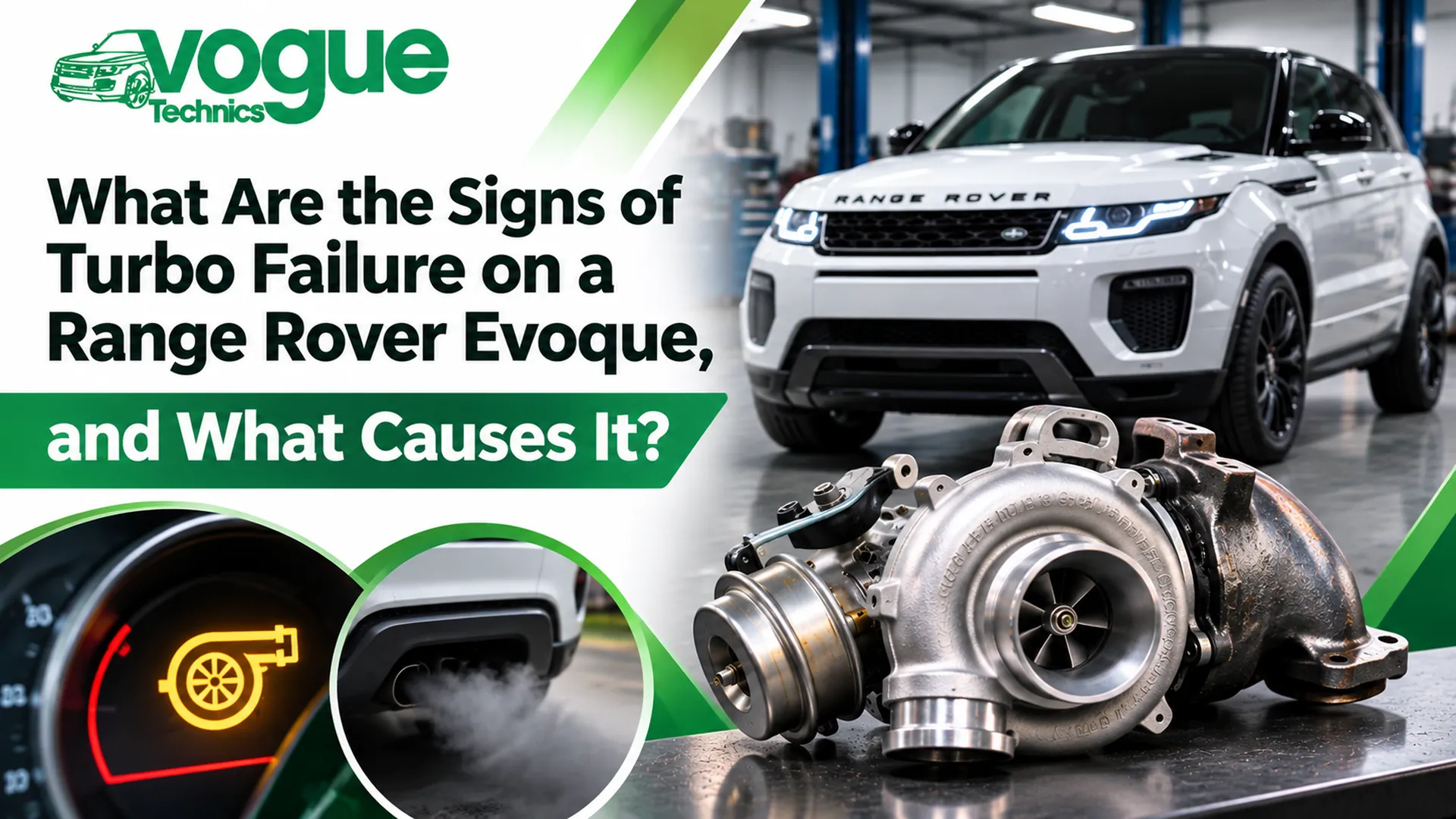
Turbos rarely fail without warning. Most give signs for days or weeks first. Catching them early can mean a smaller repair, and ignoring them can mean engine damage.
Why Is My Evoque Whistling, Smoking Blue or Losing Power?
The table below links common symptoms to their possible causes. These are possibilities, not diagnoses. Only an inspection can confirm what is wrong with your car.
Symptom | Possible cause | What to do next |
| Whistling or siren-like noise | Worn turbo bearings, damaged compressor wheel or a boost leak | Have it inspected promptly. Avoid hard driving. |
| Blue exhaust smoke | Oil passing through failed turbo seals | Check the oil level and book an inspection. |
| Loss of power and acceleration | Turbo fault, actuator fault, boost leak or blocked DPF | Read fault codes and test boost pressure. |
| Limp mode | Underboost or overboost condition, actuator or sensor fault | Get a diagnostic scan before the problem escalates. |
| Engine management light | Boost pressure or turbo control fault | Read the stored codes. |
| Increased oil consumption | Turbo oil leakage or internal engine wear | Inspect the turbo and oil system. |
A boost leak or a faulty actuator can feel exactly like a failing turbo. That is why diagnosis comes first. Replacing a turbo that was never the problem is an expensive way to find out.
Some symptoms are urgent. A loud, rising whistle, heavy blue smoke or a sudden loss of power means it is time to stop. Driving on can push oil into the intake, spread debris through the system and, in the worst cases, damage the engine itself.
What Causes an Evoque Turbo to Fail, and Why Can a New One Fail Again?
A turbo spins at very high speed on a thin film of oil. Anything that interrupts that oil supply or contaminates it can destroy the bearings quickly. The most common causes include:
- Oil starvation. The turbo does not receive enough oil, so the shaft and bearings wear rapidly.
- Blocked or damaged oil feed pipes. A restricted pipe starves the turbo, and a loose or leaking pipe loses oil.
- Contaminated or degraded oil. Dirty oil and overdue changes wear bearings and seals.
- Bearing and shaft wear. The natural result of long use, often hastened by poor lubrication.
- DPF and exhaust problems. A blocked filter raises exhaust pressure and temperature, which stresses the turbo.
- Actuator and boost control faults. These cause incorrect boost and can mimic or contribute to failure.
This is also why a replacement turbo can fail again. If the original cause is still there, a blocked oil line, contaminated oil or an exhaust restriction, the new unit meets exactly the same fate. Replacing a turbo without finding and fixing the cause is the most common reason for a repeat failure.
You should also know that some Range Rover Evoque models have been subject to a recall involving the turbocharger oil feed pipe. Whether your car is affected depends on its build, so check your registration or VIN on the official DVSA vehicle recall checker, and ask us to look at the oil feed pipe during any turbo work.
If your Evoque is showing these signs, send us your symptoms and registration and we will tell you plainly what we think is happening.
Can an Evoque Turbo Be Repaired, or Should You Replace It?
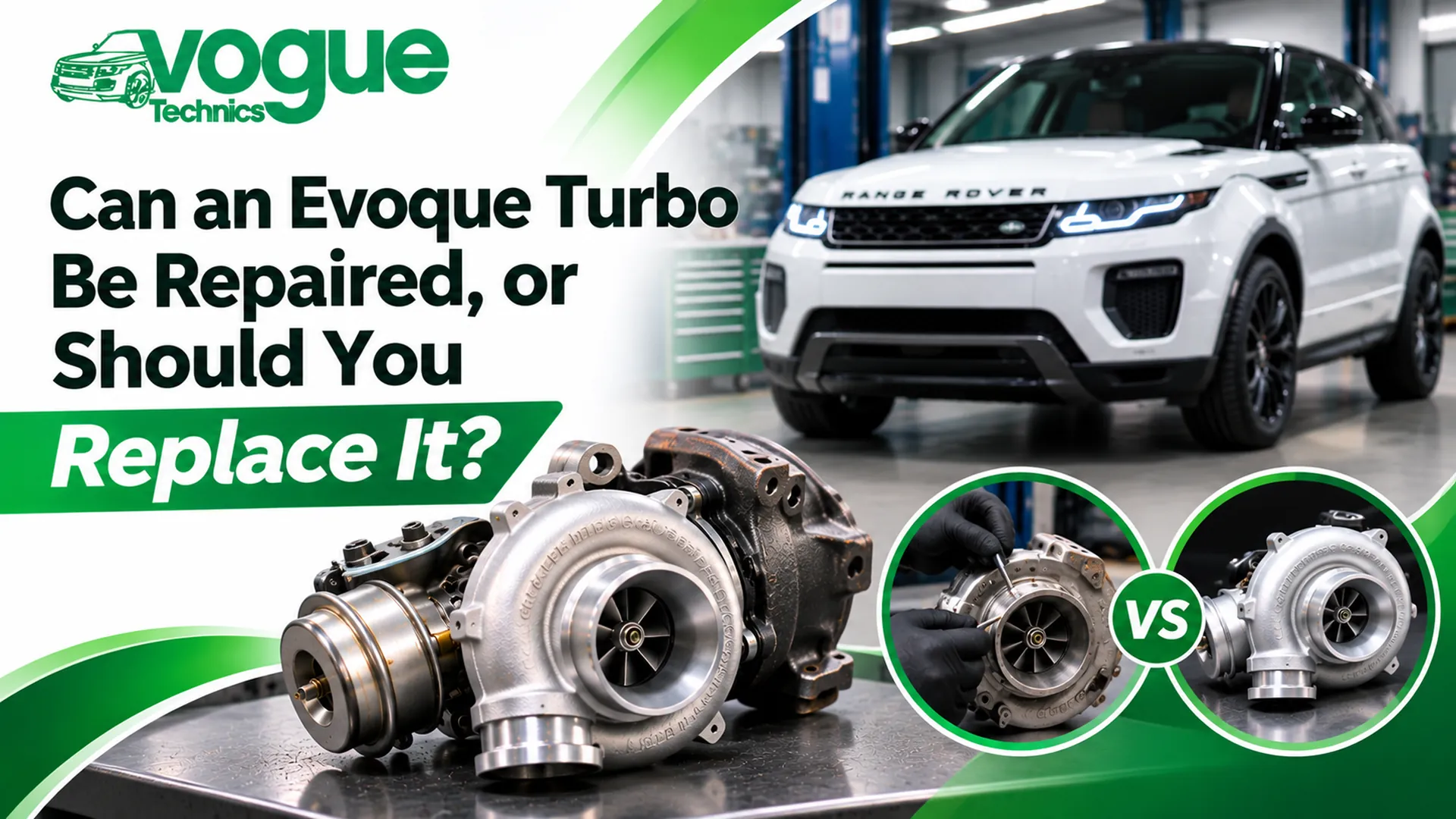
Sometimes a repair is enough. Sometimes it is not. The right answer depends on what has failed, how far the damage has spread and what the car is worth to you.
A faulty actuator or a sticking wastegate does not automatically mean the whole turbo needs replacing. Where the turbo itself is sound, testing and repairing the actuator can be a sensible and economical fix. A turbo with worn bearings, a damaged compressor wheel or a damaged turbine wheel is a different matter. At that point, a rebuild or a replacement unit is the realistic route.
Is a Reconditioned Evoque Turbo Better Than a New or Used One?
Not always. Each option has a place, and the best choice depends on the car, your budget and how long you plan to keep it.
Factor | New OEM turbo | Reconditioned turbo | Used turbo |
| Condition | Brand new, built to manufacturer specification | Stripped, inspected, worn parts renewed and balanced | Taken from a donor vehicle |
| Parts renewed | All new | Worn components replaced | Usually none |
| Warranty | Confirmed on your quote | Confirmed on your quote | Confirmed on your quote |
| Expected reliability | Highest | Strong when properly rebuilt and tested | Depends on history and mileage |
| Best suited to | Cars you plan to keep for the long term | Most owners wanting good value and reliability | Short-term ownership or lower-value cars |
A reconditioned turbo from a specialist who balances and tests every unit is a strong choice for most owners. A new unit suits someone who wants the longest possible life. A used unit carries more unknowns, so ask what is known about its history.
Whichever you choose, ask what is included, what warranty applies and whether the unit has been matched to your engine code and part number. A supplier who cannot answer clearly is not one to trust with a turbo.
Is It Safe to Drive an Evoque With a Failing Turbo, and What Gets Checked During Replacement?
Short answer: it is risky. A failing turbo can lose oil, send debris into the intake and starve itself of lubrication. Continued driving can turn a turbo repair into a much larger engine problem. If you notice a loud whistle, heavy smoke or a sharp loss of power, stop and get the car checked.
A proper replacement is more than swapping one part for another. Here is how it runs when we do the job:
- Diagnostic scan and boost checks. We read the fault codes, test boost pressure and confirm the turbo is the cause.
- Turbo removal. The failed unit comes out, and we inspect it for the cause of failure.
- Oil feed and return pipe checks. We look for blockages, damage and contamination.
- Intercooler and intake inspection. Oil and debris are cleaned out so they cannot damage the new turbo.
- Oil system flush. Contaminated oil is removed from the system, because dirty oil is a leading cause of repeat failure.
- Fitting the replacement. The new or reconditioned turbo goes on with fresh gaskets and seals.
- Oil and filter change. Clean oil and a new filter protect the new unit from the start.
- Boost pressure check and road test. We confirm the turbo is delivering the correct boost before the car goes back to you.
Skipping the oil system and intercooler checks is a false economy. It saves a little time today and risks the whole job tomorrow.
How Do You Get a Fitted Evoque Turbo Quote From a Land Rover Specialist?
Getting a quote should be quick and clear. Here is how it works with us, from your first message to the road test.
How Do I Get an Evoque Turbo Replacement Quote Today?
It takes only a few minutes:
- Send your registration and symptoms. Use our quote form, call us or send an email. Tell us the engine if you know it and what you have noticed, such as the noise, smoke or warning lights.
- Receive your options. We confirm your engine and turbo specification, and set out itemised choices covering repair, reconditioned or new units, with supply and fit details.
- Book collection, delivery or fitting. Choose what suits you, and we arrange the rest, with nationwide collection and delivery available.
Ready to get your Evoque back to full power? Request your Evoque turbo replacement quote now, ask about repair or reconditioned options and speak to a specialist who knows these engines.
What Warranty Applies, and Why Choose a Land Rover Specialist?
Every turbo we supply and fit comes with a warranty, and the coverage, exclusions and claim process are set out clearly on your quote. You will know where you stand before you agree to anything.
A general parts seller lists thousands of turbos. A specialist knows which one fits your car. We work on Land Rover and Range Rover engines, so we understand how the 2.2 TD4 and SD4 differ from the 2.0 Ingenium, where the oil system traps are and what a car needs for a repair to last. That shows in the details:
- Engine code matching before anything is ordered.
- Honest advice on repair, reconditioned or new, including the modest option when it suits you better.
- Evidence of our findings before you approve work, so you see what we see.
- Oil system care, because a clean oil system protects the new turbo.
- Clear warranty terms that explain coverage and exclusions.
How Can You Prevent Future Evoque Turbo Problems?
Once your turbo is sorted, a few habits protect it:
- Use the correct oil specification for your engine, and do not stretch service intervals.
- Change the oil and filter on time. Clean oil is what keeps a turbo alive.
- Look after the DPF. Regular longer drives help it clear, and a blocked filter stresses the turbo.
- Act on warning signs early. A whistle, smoke or a new warning light deserves a prompt check.
- Check your recall status using your registration or VIN on the official DVSA checker.
If you want help with any of this, ask us for a turbo and oil system check and we will tell you what we find.
Frequently Asked Questions About Evoque Turbo Replacement
How much does a Range Rover Evoque turbo replacement cost in the UK?
It depends on your engine, the type of turbo you choose, the condition of the oil system and the labour involved. We quote against your registration so the figure reflects your car, and the quote itemises each element.
Does the quote include labour?
Our fitted quotes include removal, fitting and the checks needed for a proper job. Your quote sets out exactly what is covered, so nothing is left unclear.
Can a Range Rover Evoque turbo be repaired?
Sometimes. A faulty actuator or wastegate can often be repaired without replacing the whole turbo. Worn bearings or damaged wheels usually mean a rebuild or replacement.
Is a reconditioned Evoque turbo worth it?
For most owners, yes. A properly rebuilt, balanced and tested unit with warranty cover offers strong reliability. A new unit suits those who want the longest possible life.
How long does turbo replacement take?
It depends on the engine, parts availability and what the inspection finds. We give you a realistic timeline when we confirm your quote.
Can I drive my Evoque with a failing turbo?
It is not advisable. A failing turbo can lose oil, send debris into the intake and damage the engine. Stop and get the car checked if you notice a loud whistle, heavy smoke or sudden power loss.
Why did my new turbo fail?
Usually because the original cause was never fixed. Oil starvation, blocked oil pipes, contaminated oil or exhaust restrictions can destroy a new unit just as quickly as the old one.
Do all Evoque diesels use the same turbo?
No. The 2.2 TD4 and SD4 and the 2.0 Ingenium diesel use different turbos, and even within one engine the unit can vary by build and power version. We verify your engine code and part number first.
Why is my Range Rover Evoque making a whistling noise?
Common causes include worn turbo bearings, a damaged compressor wheel or a boost leak. A diagnostic check shows which applies.
Can a faulty turbo cause limp mode?
Yes. An underboost or overboost condition, or an actuator fault, can trigger limp mode. Reading the fault codes is the first step.
Should the oil pipes be replaced with the turbo?
Often, yes. The oil feed and return pipes should always be inspected, and renewed where they are blocked, damaged or doubtful. Fitting a new turbo to a poor oil supply risks a repeat failure.
Is the Evoque turbo oil feed pipe covered by a recall?
Some Evoque models have been subject to a recall involving this pipe. Check your registration or VIN on the official DVSA recall checker to see whether yours is affected.
Get Your Evoque Turbo Sorted Properly
Whether you need a diagnosis, an actuator repair, a reconditioned turbo or a new unit, the next step is simple. Send us your registration and your symptoms, and we will confirm your engine and turbo specification, explain your options and prepare an itemised, fitted quote for your car.
Contact VogueTechnicsEngineRebuild.co.uk today to request your quote, ask about warranty cover and arrange nationwide collection or delivery.