

Range Rover Evoque Turbocharger Failure Signs: What Every Owner Must Know
Is your Range Rover Evoque losing power, triggering a "Restricted Performance" warning, or showing a P0299 fault code? These are early signs of turbocharger failure and ignoring them can escalate a £800 repair into a £6,000+ engine rebuild. This guide covers every warning sign, root cause, and repair option for Evoque turbo problems across the 2.0 Ingenium and 2.2 SD4 engine variants. Know what to look for before the damage becomes catastrophic.
You're cruising down the motorway, and suddenly your Range Rover Evoque feels sluggish. The acceleration is flat, there's an odd whistling sound coming from the engine bay, and the dashboard flashes a "Restricted Performance" warning. Sound familiar?
These aren't random glitches. These are your Evoque's way of telling you the turbocharger is in serious trouble and ignoring them could turn a fixable repair into a full engine rebuild.
At Vogue Technics Engine Rebuild, based in Grays, Essex, we've diagnosed and repaired hundreds of Range Rover Evoque turbocharger failures across the UK. In this guide, we break down every warning sign, root cause, and repair option, so you can make the right call before the damage becomes catastrophic.
What Are the Early Warning Signs of Turbocharger Failure in a Range Rover Evoque?
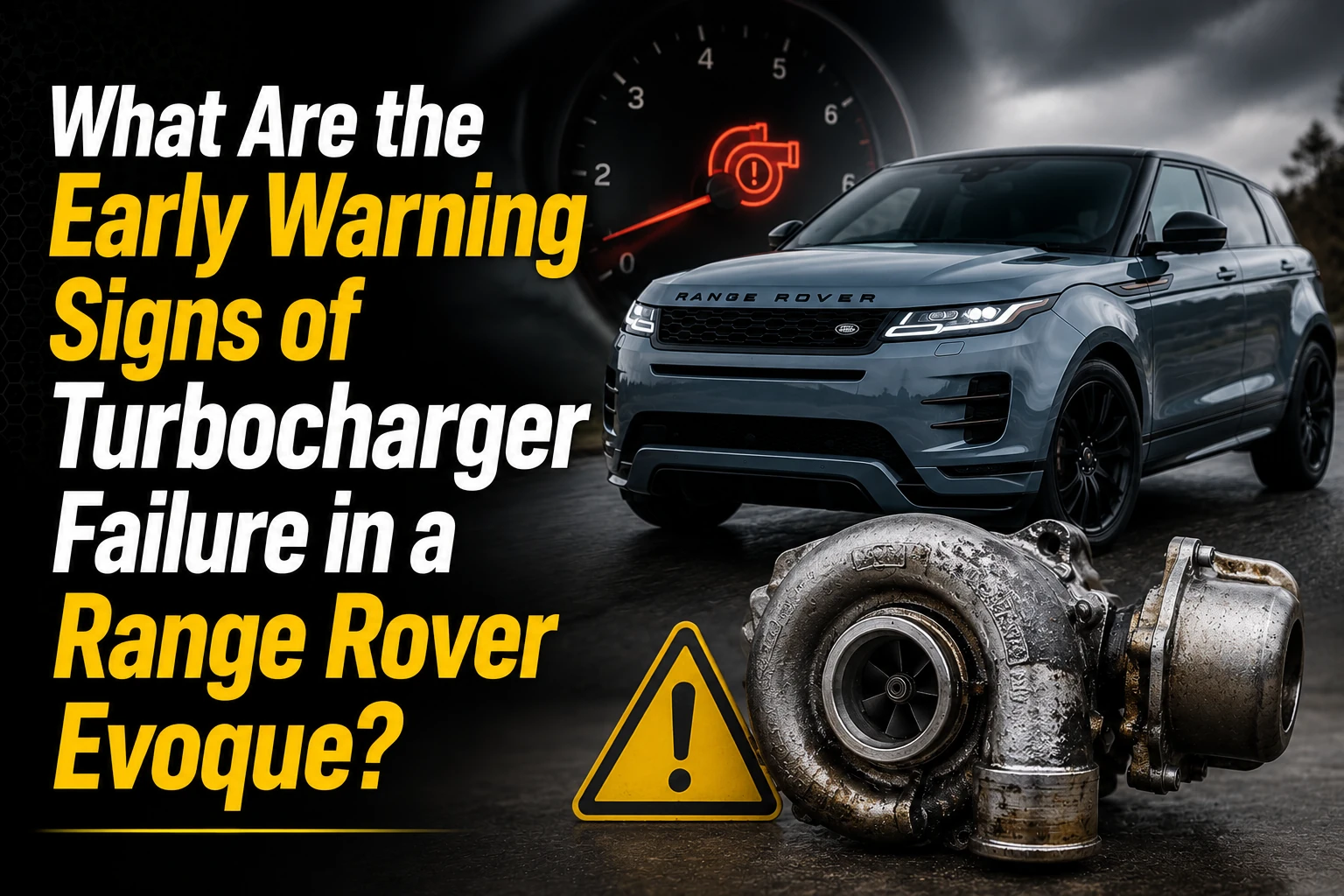
Turbocharger problems rarely happen overnight. There's almost always a build-up of symptoms that owners either overlook or mistake for something less serious. The earlier you catch these signs, the cheaper and simpler the fix.
Here are the most critical early warning signs that your Evoque's turbocharger is beginning to fail.
Why Is My Range Rover Evoque Losing Power Under Acceleration?
A noticeable loss of power, especially under hard acceleration or at motorway speeds, is the single most common symptom of a failing turbocharger. The turbo's entire job is to force compressed air into the engine to boost combustion power. When it starts to fail, boost pressure drops and your engine performs as though it's underpowered.
You may notice:
- Flat or sluggish acceleration, particularly above 2,000 RPM
- Turbo lag that feels more pronounced than usual
- Hesitation when pulling out at junctions or overtaking
- The car struggling on inclines where it previously had no issues
This symptom is especially common in the 2.0 Ingenium diesel and 2.2 SD4 engine variants found in 2012–2018 Evoques. Many owners describe it as "the car just doesn't pull like it used to" — a deceptively casual phrase that actually points to a serious underboost condition.
If left unaddressed, the engine management system will intervene and put the car into limp-home mode to prevent further mechanical damage.
What Does Restricted Performance Warning Mean on an Evoque?
When your Evoque's dashboard displays a "Restricted Performance" warning, it means the ECU has detected an abnormal condition, often tied to insufficient boost pressure and has deliberately limited engine output to protect critical components.
This is not a minor inconvenience. It is the engine management system waving a red flag.
Common triggers for the Restricted Performance warning include:
- Turbocharger underboost (the turbo isn't producing enough pressure)
- Faulty turbo vane actuator preventing proper boost control
- Wastegate failure causing unregulated exhaust flow
- Boost pressure sensor fault sending incorrect readings to the ECU
- Vacuum leaks in the intake system reducing effective boost
Many Evoque owners make the mistake of resetting this warning with an OBD reader and continuing to drive. Without addressing the root cause, the warning will return, usually alongside worsening damage.
How Does P0299 Underboost Code Relate to Turbo Failure on an Evoque?
If your diagnostic scanner flags a P0299 fault code, it's confirming exactly what the Restricted Performance warning was suggesting: the turbocharger is not producing the boost pressure the ECU expects.
The P0299 code, formally defined as "Turbocharger/Supercharger Underboost Condition", is one of the most frequently recorded fault codes on Range Rover Evoque models, particularly the 2016, 2017, and 2018 variants.
Other turbo-related fault codes worth knowing:
Fault Code | Meaning |
| P0299 | Turbocharger underboost condition |
| P0234 | Turbocharger overboost condition |
| P2563 | Turbocharger boost control position sensor |
| P132B | Turbocharger vane position fault |
| P0087 | Fuel rail pressure too low (can mimic turbo symptoms) |
A P0299 alone doesn't confirm the turbo is physically damaged, it could also point to a blocked oil feed line, a faulty boost metering valve, or a DPF restriction affecting exhaust backpressure. A proper diagnostic is always required before parts are replaced.
What Does Turbo Whistle or Siren Noise Mean on a Range Rover Evoque?
Not all turbocharger noises are the same, and the type of noise your Evoque makes tells a very specific story about what's going wrong internally.
A high-pitched whistle during acceleration is sometimes completely normal, it's simply the sound of the turbo spooling up under load. However, when that whistle becomes:
- A loud, persistent siren-like noise
- A metallic screeching or grinding sound
- A rattling from the turbo housing at idle or under load
...you are almost certainly dealing with worn or damaged turbo bearings, a damaged compressor wheel, or debris ingestion into the turbo intake.
Bearing wear is particularly common in Evoques that have suffered oil starvation, either through infrequent oil changes, extended service intervals, or a blocked oil feed pipe. Once the bearings degrade, the turbine shaft develops play, the compressor wheel can contact the housing, and catastrophic failure follows rapidly.
If your Evoque is making an unusual siren noise under acceleration, stop driving and book a diagnostic immediately. Continuing to drive risks destroying not just the turbocharger but the entire engine.
What Causes Blue or Black Smoke From a Range Rover Evoque Exhaust?
Exhaust smoke colour is one of the most reliable diagnostic indicators a mechanic or an attentive owner, can use.
Blue smoke from the exhaust on a Range Rover Evoque almost always indicates that engine oil is being burned inside the combustion chamber. In the context of turbocharger failure, this typically means the turbo oil seals have failed, allowing oil to pass from the bearing housing into the intake or exhaust stream, where it burns off visibly.
Black smoke during acceleration points to a rich fuel mixture, too much fuel relative to air, which can occur when the turbocharger is not delivering adequate boost pressure, causing the ECU to compensate incorrectly with additional fuelling.
Here's a quick reference guide:
Smoke Colour | Most Likely Cause | Turbo-Related? |
| Blue smoke | Burning engine oil — turbo seal failure | Yes — high probability |
| Black smoke | Rich fuelling — underboost condition | Yes — likely |
| White smoke | Coolant burn or cold start condensation | Possible — check coolant |
Blue smoke on start-up that clears after a few minutes is a particularly telling sign of overnight oil drain-back into the turbo, a classic symptom of deteriorating turbo seals on higher-mileage Evoques.
What Causes Turbocharger Failure in a Range Rover Evoque?

Understanding what causes turbo failure is just as important as recognising the symptoms. In our experience at Vogue Technics, the vast majority of Evoque turbocharger failures are not random mechanical events, they are the direct result of identifiable, often preventable causes.
How Does Oil Starvation Damage the Evoque Turbocharger?
Oil starvation is the single leading cause of premature turbocharger failure across all Range Rover Evoque variants, regardless of engine type or model year.
The turbocharger operates at extremely high speeds, often exceeding 150,000 RPM and at temperatures that can reach several hundred degrees Celsius. The only thing standing between smooth operation and catastrophic bearing failure is a constant, pressurised supply of clean engine oil.
When oil supply is interrupted or contaminated, bearing surfaces begin to wear at an accelerated rate. The damage sequence is fast and largely irreversible once it begins.
Common causes of oil starvation in an Evoque turbocharger include:
- Infrequent oil changes allowing oil to degrade, thicken, and lose its lubricating properties
- Low oil level due to consumption or a slow leak going unnoticed
- Blocked oil feed pipe restricting flow to the turbo bearing housing
- Clogged oil filter screen within the turbo itself
- Extended cold starts where the car is revved hard before the oil has properly circulated
The fix sounds straightforward, keep your oil fresh and at the correct level but many owners are unaware of how quickly an Evoque's 2.0 Ingenium engine can consume oil, particularly in higher-mileage examples. Regular checks between services are strongly recommended.
How a Blocked Oil Feed Line Leads to Turbo Bearing Failure
The oil feed line is a small but critically important component that delivers pressurised oil directly to the turbocharger's central bearing housing. On the Range Rover Evoque, this line is known to develop partial blockages over time, particularly in vehicles where oil change intervals have been extended beyond manufacturer recommendations.
When the feed line becomes partially or fully blocked:
- Oil flow to the turbo bearings is restricted
- Bearing surfaces begin to run dry under high-speed, high-temperature conditions
- Metal-to-metal contact accelerates wear on the turbine shaft and bearing housing
- The compressor wheel develops shaft play and can contact the housing walls
- Metallic debris enters the oil circuit, threatening engine-wide damage
By the time a driver notices the symptoms, noise, smoke, power loss, the bearing damage is usually already severe. This is why early diagnostic intervention is so valuable.
Can a Blocked DPF Cause Turbocharger Failure on an Evoque?
This is a question we hear regularly at our Essex workshop, and the answer is: yes, indirectly but significantly.
The Diesel Particulate Filter (DPF) captures soot from the exhaust gases. When it becomes blocked — through repeated short journeys that prevent proper regeneration, it creates excessive exhaust backpressure in the system.
This backpressure directly affects the turbocharger in two important ways:
- It reduces the efficiency of the turbine wheel, forcing the turbo to work harder to maintain boost pressure
- It can cause exhaust gases to be forced back past the turbo oil seals, accelerating seal degradation and leading to the oil leaks and blue smoke described above
A blocked DPF is also known to trigger the P0299 underboost code and the Restricted Performance warning, symptoms that are frequently misdiagnosed as a primary turbocharger fault when the DPF is actually the root cause.
If your Evoque has a history of short urban journeys and has never had a DPF service or forced regeneration, this should be investigated alongside any turbocharger diagnosis.
Does the 2.0 Ingenium or 2.2 SD4 Engine Have More Turbo Problems?
Both engines have known turbocharger vulnerabilities, but they present differently — and understanding which engine your Evoque has will help you know what to look for.
Engine | Common Turbo Issues | Affected Years |
| 2.2 SD4 (Duratorq) | Turbo vane actuator failure, variable geometry turbo sticking, carbon buildup on vanes | 2011–2015 |
| 2.0 Ingenium Diesel | Oil starvation, bearing wear, oil feed line blockage, DPF interaction | 2015–2019 |
| 2.0 Si4 Petrol | Less common but turbo seal failure and boost leaks reported | 2011–2019 |
The 2.2 SD4 turbocharger uses a Variable Geometry Turbocharger (VGT) with moveable vanes. Carbon buildup on these vanes, again, typically a result of short journeys and DPF regeneration failure, causes the vanes to stick, disrupting boost control and triggering fault codes.
The 2.0 Ingenium diesel, introduced in 2015, showed early promise but has developed a reputation for oil consumption issues that directly feed into premature turbocharger wear. Owners of 2016–2019 Evoques with this engine should be particularly vigilant about oil levels and service intervals.
Can You Still Drive a Range Rover Evoque With a Failing Turbocharger?

This is the question every Evoque owner asks when the warning lights appear. The honest answer is: technically yes, practically no, and financially, it's a very bad idea.
A turbocharger in early-stage failure may still allow the car to drive in a reduced capacity. But every mile driven with a failing turbo increases the risk of:
- Metal debris from the turbo entering the engine oil circuit
- Complete turbo seizure causing sudden power loss at speed, a serious safety risk
- Contaminated oil reaching crankshaft bearings and causing engine-wide damage
- A repair bill that was £800–£1,500 becoming a £4,000–£8,000 engine rebuild
The moment you notice consistent power loss, unusual noises, exhaust smoke, or a Restricted Performance warning, treat it as urgent. Book a diagnostic, not a future service appointment.
What Happens If You Ignore Turbo Failure Signs on Your Evoque?
Ignoring the early warning signs of turbocharger failure is one of the most costly mistakes an Evoque owner can make. Here's a realistic progression of what happens if symptoms are left unaddressed:
Stage 1: Early symptoms: Power loss, occasional whistle, P0299 code. Turbo repair or actuator replacement may suffice. Cost: relatively low.
Stage 2: Progressive damage: Persistent Restricted Performance warning, blue or black smoke, increased oil consumption. Full turbocharger replacement likely required.
Stage 3: Critical failure: Turbo seizes, metal debris enters oil system, engine management light illuminates permanently, limp mode becomes permanent. Engine may require partial or full rebuild.
Stage 4: Catastrophic: Engine seizure. At this point, even a specialist rebuild may not be viable, and engine replacement becomes the only option.
The difference between Stage 1 and Stage 4 is often just a matter of weeks and the difference in repair cost can be thousands of pounds.
How Limp Mode Protects Your Evoque Engine — And Why It's a Final Warning
Limp mode, formally known as limp-home mode, is a protective state triggered by the ECU when it detects a critical fault that could cause serious engine damage. In the context of turbocharger failure, limp mode typically limits the engine to a fraction of its normal power output and restricts RPM to reduce stress on failing components.
It is not a temporary glitch. It is the ECU telling you, in the clearest possible terms, that something is seriously wrong.
Common symptoms when an Evoque enters limp mode:
- Engine limited to around 20–30 mph maximum speed
- Severe loss of power even at light throttle
- Gear changes feel erratic or the gearbox holds low gears
- Dashboard warnings illuminate including the engine management light
If your Evoque enters limp mode, pull over safely when possible, allow the engine to cool, and arrange recovery or a very short, low-speed drive to a specialist. Do not attempt a long journey.
How Long Does a Range Rover Evoque Turbocharger Last?
Under ideal conditions, regular servicing, clean oil, proper warm-up and cool-down habits, a Range Rover Evoque turbocharger should last the lifetime of the vehicle, or at minimum 100,000–150,000 miles.
In real-world UK driving conditions, however, many Evoques see turbocharger issues well before 80,000 miles, particularly when:
- Oil changes are performed at extended intervals
- The car is used predominantly for short urban journeys
- DPF regeneration cycles are regularly interrupted
- The engine is switched off immediately after hard driving without a cool-down period
The cool-down point is worth emphasising. After high-speed or hard driving, the turbocharger remains extremely hot even after the engine stops. Oil circulation ceases the moment the engine is off, and residual heat can bake the remaining oil in the bearing housing into a thick, damaging sludge. Allowing the engine to idle for 1–2 minutes before switching off significantly extends turbo life.
Evoque Turbocharger Repair, Rebuild or Replacement — Which Option Is Right for You?
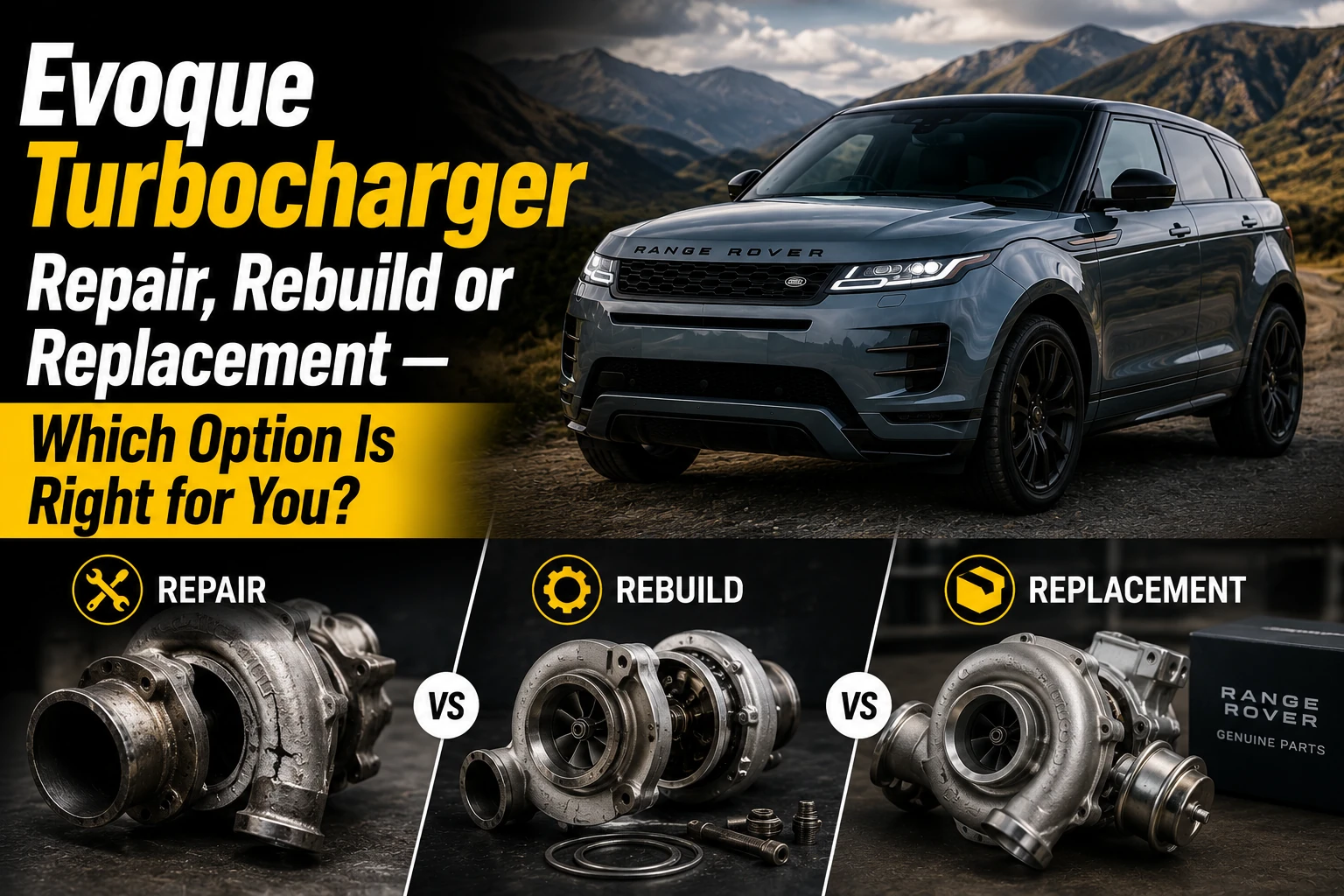
Once turbocharger failure is confirmed, you'll face a decision: repair, rebuild, or replace? Each option has its merits, and the right choice depends on the extent of the damage, the age of the vehicle, and your budget.
How Much Does Range Rover Evoque Turbo Replacement Cost in the UK?
Turbocharger replacement costs for a Range Rover Evoque in the UK vary depending on the engine variant, the type of turbocharger used, and the labour involved.
As a general guide based on current UK market rates:
Option | Approximate Cost (Parts + Labour) |
| Turbo actuator repair/replacement | £300 – £600 |
| Reconditioned turbocharger supply and fit | £700 – £1,200 |
| OEM new turbocharger supply and fit | £1,200 – £2,000 |
| Full turbo rebuild (specialist) | £500 – £900 |
| Engine rebuild (if turbo damage is extensive) | £2,500 – £6,000+ |
These figures are indicative. A proper diagnosis at a specialist workshop like Vogue Technics will give you a precise, transparent quote based on your specific vehicle, mileage, and the actual extent of the damage.
OEM vs Aftermarket Turbocharger for Range Rover Evoque — What's the Difference?
This is a decision many Evoque owners face, and it's worth understanding the genuine differences before committing.
OEM (Original Equipment Manufacturer) Turbochargers:
- Manufactured to Jaguar Land Rover's exact specifications
- Guaranteed fitment and performance compatibility
- Full warranty coverage (typically 12–24 months)
- Higher upfront cost but greater long-term reliability
- Recommended for newer Evoques or vehicles with lower mileage
Aftermarket Turbochargers:
- Produced by third-party manufacturers to varying quality standards
- Lower upfront cost, can be significantly cheaper than OEM
- Quality varies enormously between brands, some are excellent, others are not
- Suitable for older, higher-mileage Evoques where a lower-cost solution makes financial sense
- Always source from a reputable supplier with a warranty
Reconditioned (Remanufactured) Turbochargers:
- Original turbocharger cores rebuilt to OEM specification
- Often the best value-for-money option
- Quality depends entirely on the remanufacturer's standards
- At Vogue Technics, we only fit reconditioned units from verified, approved suppliers
Our recommendation: for any Evoque under 100,000 miles, always opt for OEM or a high-quality reconditioned unit. False economy on a turbocharger replacement costs far more in the long run.
Why Choose Vogue Technics for Your Evoque Turbocharger Diagnosis in Grays, Essex?
At Vogue Technics Engine Rebuild, we specialise exclusively in Land Rover and Range Rover engines. This isn't a general garage that sees the occasional Evoque between Ford Fiestas, this is a dedicated Land Rover specialist workshop with deep, model-specific knowledge of the Range Rover Evoque across all engine variants and model years.
Here's what sets us apart:
- Specialist diagnostic equipment calibrated for Jaguar Land Rover vehicles, not generic OBD readers
- Transparent, detailed fault reports before any work is authorised
- Full engine rebuild capability, meaning if turbo damage has affected the wider engine, we can handle the entire scope of repair in-house
- Competitive, honest pricing with no hidden charges
- Convenient location in Grays, Essex, easily accessible from across London, Kent, and the wider South East
Whether you're dealing with a P0299 fault code, a Restricted Performance warning, or you just know something doesn't feel right with your Evoque's performance, we'd rather you came to us early, when the repair is manageable, than late, when it isn't.
Book a Turbocharger Diagnostic for Your Range Rover Evoque Today
Don't wait for the symptoms to get worse. If your Range Rover Evoque is showing any of the warning signs covered in this guide, the smartest move you can make right now is booking a professional diagnostic.
Visit us at: Vogue Technics Engine Rebuild, Grays, Essex Website: voguetechnicsenginerebuild.co.uk
A diagnostic appointment takes a matter of hours and gives you a complete, honest picture of your turbocharger's condition and your options. Whether the fix is a simple actuator repair or a full turbocharger replacement, we'll give you the facts and let you make an informed decision.
Your Evoque is built to last. Let's make sure it does.
Frequently Asked Questions
What are the first signs of turbo failure on a Range Rover Evoque?
The earliest signs are typically a noticeable loss of power under acceleration, a Restricted Performance warning on the dashboard, and an unusual whistling or siren noise from the engine bay. A P0299 underboost fault code is often recorded alongside these symptoms. Catching these signs early is critical — early-stage turbo issues are significantly cheaper to resolve than advanced failures.
What does P0299 mean on a Range Rover Evoque?
P0299 is a diagnostic fault code indicating a turbocharger underboost condition — meaning the turbocharger is not generating the level of boost pressure the ECU expects. It can be caused by a failing turbocharger, a blocked oil feed line, a faulty boost pressure sensor, a DPF restriction, or a vacuum leak in the intake system. A proper diagnostic is needed to identify the exact cause.
Can a bad turbo damage the engine?
Yes, significantly. When a turbocharger fails, it can release metallic debris into the engine oil circuit, contaminating bearings, journals, and other critical components throughout the engine. Oil starvation caused by a blocked or damaged turbo can lead to crankshaft bearing failure and, in worst cases, complete engine seizure. This is why prompt diagnosis and repair is so important.
How do I know if my Evoque is in limp mode?
Limp mode typically presents as a sudden and severe reduction in engine power, an inability to exceed around 20–30 mph comfortably, erratic gear changes, and multiple warning lights on the dashboard, usually including the engine management light and a Restricted Performance message. The car will feel drastically underpowered even at light throttle inputs.
Is turbo replacement worth it on an older Evoque?
This depends on the overall condition of the vehicle and the extent of the turbo damage. In most cases, a quality reconditioned turbocharger fitted by a specialist offers excellent value on a well-maintained Evoque, even at higher mileages. The key is ensuring the root cause of the failure — whether oil starvation, DPF issues, or bearing wear, is also addressed, so the new turbo doesn't suffer the same fate. A specialist assessment will give you an honest answer for your specific vehicle.
For professional Range Rover Evoque turbocharger diagnosis and repair in Grays, Essex, visit voguetechnicsenginerebuild.co.uk or contact the Vogue Technics team directly.