

Range Rover Evoque Engine Code Identification Guide (All Years & Engine Variants)
Identifying your Range Rover Evoque's engine code is the single most important step before ordering parts, buying used, or planning a rebuild. This guide shows you exactly where to find your engine number, how to decode your VIN, and which engine sits in your specific model year, from the early 2.2 diesel and Si4 petrol to the 2.0 Ingenium family. You'll also learn which Ingenium engines to avoid, common faults by engine code, and your options if a replacement is on the cards.
You're standing over the engine bay, a parts supplier on the phone asking for your engine code, and you have no idea what to tell them. Or you're about to buy a used Evoque and the seller swears it's "the good engine" but you can't verify it. Either way, getting this wrong is expensive. Order the wrong replacement engine and you've wasted thousands. Misread your VIN and you'll fit parts that simply won't bolt up.
This Range Rover Evoque engine code identification guide fixes that. By the time you finish reading, you'll know exactly where to find your engine number, how to decode your VIN, which engine sits in your specific model year, and what your options are if that engine is on its way out.
We're Vogue Technics, an Evoque and Land Rover engine rebuild specialist based in Grays, Essex. We strip, inspect and rebuild these exact units every week.
How Do I Find My Range Rover Evoque Engine Code?

Before you can identify which engine you have, you need to physically locate the code stamped on it. Most owners look in the wrong place and give up. There are two reliable sources: the engine number stamped on the block itself, and the VIN (Vehicle Identification Number), which encodes engine information in its character sequence.
Where Is the Engine Number Located on a Range Rover Evoque?
The engine number is stamped directly into the engine block, and its position changed between generations.
Engine Number Location on First-Generation Evoque (L538)
On the 2011–2018 Evoque (L538), the engine number sits on a machined, flat surface on the front or side of the cylinder block, usually near the joint where the block meets the gearbox bell housing. On the early 2.2-litre diesel units you'll often find it low down on the front face — bring a torch and a rag, because it collects road grime fast. On the later 2.0-litre Ingenium diesel, it's typically stamped on the rear of the block near the transmission.
Engine Number Location on Second-Generation Evoque (L551)
On the 2019-onward Evoque (L551), the Ingenium engines carry their number on a stamped pad on the block, again toward the rear/gearbox side. The format is a letter-and-number string that ties directly back to the engine family. If the engine has been replaced at some point, this stamped number is your single source of truth, it overrides whatever the paperwork claims.
How to Decode Your Evoque VIN to Identify the Engine
If you can't get to the block, your VIN is the next best tool. Every Evoque VIN is 17 characters, and specific positions tell you the engine type, fuel, and emissions setup. A reputable VIN decoder or a main-dealer parts desk can translate it, but you can read the key digits yourself once you know where to look.
Where to Find the VIN and Chassis Number on Your Evoque
You'll find the Range Rover Evoque VIN number in several places:
- Base of the windscreen, driver's side, visible from outside through the glass.
- Driver's door B-pillar sticker, which doubles as the build plate.
- Under the bonnet on the slam panel or inner wing on some builds.
- V5C logbook, which lists the same chassis number.
Checking two of these against each other is a quick way to spot a vehicle that's had a swap or, worse, a cut-and-shut. Always cross-reference before buying.
VIN Character Breakdown — Which Digits Reveal the Engine
In a Land Rover VIN, the early World Manufacturer Identifier characters confirm it's a Jaguar Land Rover vehicle, while the Vehicle Descriptor Section (roughly characters 4–8) encodes the body, engine and transmission. One character in that block is the engine designator, this is what tells you whether you're looking at a TD4, SD4, eD4, Si4, or one of the newer D-series and P-series Ingenium units. The final characters form the unique serial number of your specific car.
Can You Identify Engine Type by Engine Number Alone?
Yes, and it's the most reliable method. The stamped engine number contains a prefix that maps to the engine family (for example, the Ingenium diesel family). Where a VIN tells you what the car left the factory with, the engine number tells you what's physically bolted in right now. On any Evoque that's had an engine replacement, those two can disagree. For buying, insuring, or ordering parts, trust the engine stamp first.
Range Rover Evoque Engine Codes Explained by Model Year (2011–2026)

This is where most guides stop at a bare list. We'll break it down by generation and year so you can match your exact car. The Evoque has run two distinct platforms, and the engine line-up shifted significantly when the Ingenium family arrived.
First-Generation Evoque Engine Codes (2011–2018)
The original L538 launched with Ford- and PSA-derived engines, then transitioned to Land Rover's own Ingenium units mid-life.
2012, 2013 & 2014 Evoque Engine Codes (TD4, SD4, eD4, Si4)
The 2012, 2013 and 2014 Evoque engines were dominated by the 2.2-litre diesel (engine code commonly seen as 224DT), offered in two states of tune:
- eD4 / TD4 (150 PS) the front-wheel-drive eD4 and the all-wheel-drive TD4 shared the 2.2 diesel block.
- SD4 (190 PS) the higher-output 2.2 diesel, AWD as standard.
On the petrol side, the Si4 used a 2.0-litre turbocharged petrol (around 240 PS), a Ford-based EcoBoost-derived unit. So if you're searching for the 2012, 2013 or 2014 Range Rover Evoque engine, you're almost certainly looking at the 2.2 diesel or the 2.0 Si4 petrol.
2015, 2016, 2017 & 2018 Evoque Engine Codes (Ingenium Transition)
This is the period buyers get caught out on. From around the 2015–2016 model year, Land Rover began replacing the 2.2 diesel with its new 2.0-litre Ingenium diesel (engine code 204DT, engine family AJ200D). Badges stayed familiar eD4, TD4, SD4 but the engine underneath changed.
That means a 2015 Evoque engine could be either the old 2.2 or the new 2.0 Ingenium, depending on build date. A 2016, 2017 or 2018 Range Rover Evoque engine is far more likely to be the 2.0 Ingenium diesel or the 2.0 petrol. This is exactly why you check the engine code rather than trusting the year alone.
Second-Generation Evoque Engine Codes (2019–Present)
The L551 went all-Ingenium, added mild-hybrid (MHEV) tech, and switched to power-output badging (the number is roughly the PS figure).
Evoque Diesel Engine Codes — D150, D165, D180, D200 (AJ200D)
The second-gen diesels run the 2.0-litre Ingenium diesel, evolving from the AJ200D into the updated AJ20D4:
- D150 entry diesel, ~150 PS.
- D165 mild-hybrid diesel, ~163–165 PS.
- D180 the popular mid-range ~180 PS unit.
- D200 top diesel, ~204 PS, mild-hybrid.
Evoque Petrol Engine Codes — P160, P200, P250 (AJ20D4 / AJ200P)
The petrols use the 2.0-litre Ingenium petrol (AJ200P, later AJ20P4):
- P160 / P200 lower and mid-output petrols.
- P250 the strong ~249 PS petrol, AWD.
- Higher P300 outputs appear on sportier and hybrid derivatives.
Which Evoque Has an Ingenium Engine?
Practically every Evoque built from 2015–2016 onward has an Ingenium engine, and every second-generation (2019+) Evoque is Ingenium. The clear dividers are: 2.2-litre badged engines are pre-Ingenium, while 2.0-litre diesel and petrol units from the mid-2010s onward are Ingenium. If your car carries a D- or P-number badge, it's Ingenium.
Evoque Engine Capacity, CC & Specifications at a Glance
Owners constantly ask about Evoque engine cc and capacity, so here's the quick comparison. Use it to sanity-check what your code is telling you.
Engine Code / Family | Fuel | Capacity (CC) | Badges | Generation |
| 224DT | Diesel | 2,179 cc (2.2L) | eD4, TD4, SD4 | L538 (2011–2015) |
| 204DT (AJ200D) | Diesel | 1,999 cc (2.0L) | eD4, TD4, SD4 | L538 (2015–2018) |
| Si4 (2.0 petrol) | Petrol | 1,999 cc (2.0L) | Si4 | L538 |
| AJ200D / AJ20D4 | Diesel | 1,999 cc (2.0L) | D150, D165, D180, D200 | L551 (2019+) |
| AJ200P / AJ20P4 | Petrol | 1,999 cc (2.0L) | P160, P200, P250, P300 | L551 (2019+) |
The headline takeaway: from the Ingenium era onward, the Evoque engine capacity is essentially 2.0 litres across the board, the difference is tuning, turbocharging and hybrid assistance, not displacement.
Engine Reliability, Common Faults & Which Ingenium Engine to Avoid

Identifying the code is only half the job. What that code means for reliability is what really matters when you're buying, keeping, or budgeting for repairs. Here's what we see come through the workshop.
Common Problems Linked to Each Evoque Engine Code
No engine family is fault-free, and certain issues cluster around specific units.
- 2.2 diesel (224DT): Generally robust mechanically, but timing components and turbo wear show up at higher mileages.
- Early 2.0 Ingenium diesel (204DT / AJ200D): This is the one with a reputation. Early builds are associated with timing chain stretch and tensioner issues, plus the usual DPF (diesel particulate filter) and AdBlue system headaches on short-journey cars.
- Ingenium petrol (AJ200P): Fewer chronic issues than the early diesel, though carbon build-up and the occasional cooling fault appear.
Timing Chain, DPF & AdBlue Issues by Engine Family
The timing chain concern on early Ingenium diesels is the headline risk. On these engines the chain sits at the rear of the block, so replacement is labour-intensive and ignoring early rattle can end in catastrophic damage. Add a DPF that struggles on stop-start urban driving and an AdBlue system that throws warnings, and short-trip owners feel the pain most. Regular motorway runs, correct-spec oil and on-time servicing genuinely reduce these failures.
Which Evoque Ingenium Engine Should You Avoid?
If you want the honest workshop answer: be most cautious with early (roughly 2015–2017) 2.0 Ingenium diesels that have a patchy service history and short-journey-only use. Those are the cars most likely to need timing chain and DPF work. The engine family isn't inherently bad — later revisions improved durability noticeably but a neglected early diesel is the one that bites. A well-maintained D180 or D200, or the petrol P250, tends to be a safer used buy. Service history beats model year every time.
Land Rover Fault Codes — Reading Engine Trouble Codes
When a warning light appears, an OBD-II scanner pulls the stored Land Rover fault codes from the ECU. Generic readers show standard P-codes, but Land Rover uses manufacturer-specific codes too, so a proper JLR-capable diagnostic tool reads far more detail. Matching a fault code to your specific engine code is how we pinpoint whether you're looking at a sensor, an injector, the turbocharger, or something internal. If you'd like help interpreting a code, our [Land Rover diagnostics service] can decode it properly.
Replacing or Rebuilding Your Range Rover Evoque Engine
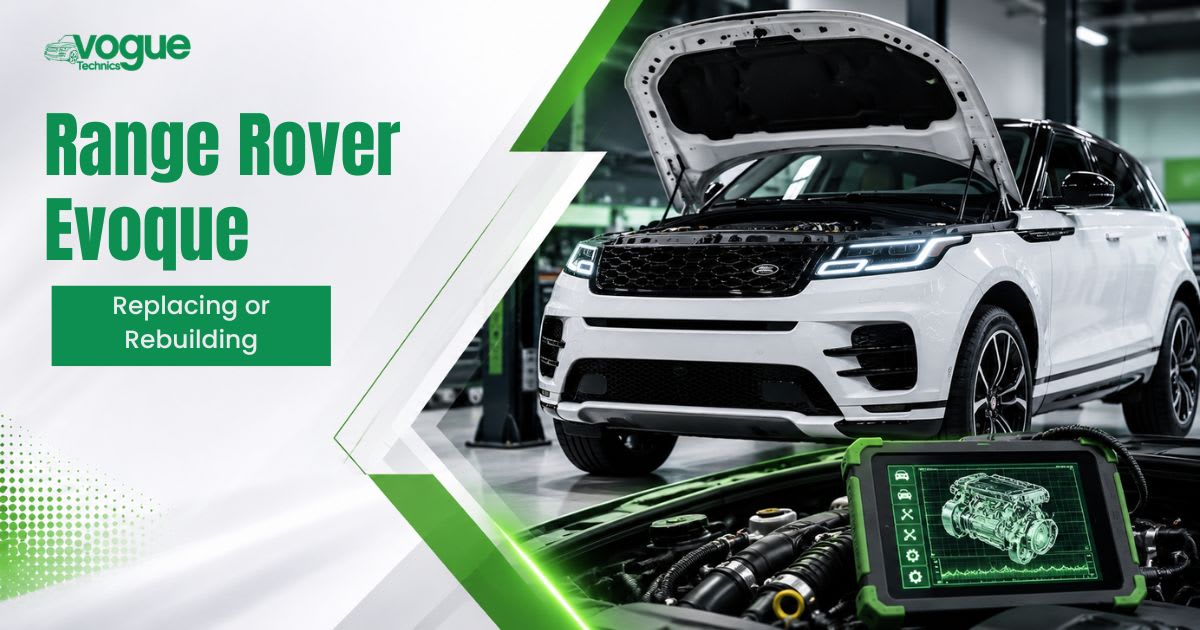
If your investigation has ended with bad news, this section is the practical one. Knowing your code now lets you source the correct replacement and choose the right route.
Reconditioned vs Remanufactured vs Used Evoque Engines
These three terms get used loosely, and the difference affects both cost and lifespan.
- Used engine: A second-hand unit pulled from a donor car. Cheapest upfront, but you inherit unknown wear and history.
- Reconditioned engine: Worn parts inspected and replaced as needed, then reassembled. A solid middle ground.
- Remanufactured engine: Stripped to the block and rebuilt to factory tolerances with new components throughout. The closest thing to new, and usually the longest-lasting.
For an early Ingenium diesel with a stretched timing chain, a remanufactured or properly rebuilt engine often makes more sense than gambling on a used unit with the same latent fault.
How to Check Engine Compatibility for a Replacement
This is where the engine code pays off. To confirm engine compatibility, match the engine family and code (not just "2.0 diesel"), the emissions standard (Euro 5 vs Euro 6 matters), the mild-hybrid status, and the transmission/drivetrain setup. Fitting a non-matching ECU or emissions configuration causes endless fault codes. Send us your engine number and VIN and we'll confirm the exact match before anything is ordered.
Evoque Engine Rebuild Cost & What Affects the Price
There's no single figure, because the Evoque engine rebuild cost depends on the engine family, the extent of damage, and whether ancillaries (turbocharger, injectors, DPF) need replacing too. A timing-chain-related rebuild on a 2.0 Ingenium diesel differs in price from a bottom-end failure. The honest approach is a strip-and-inspect, then a fixed quote, no guesswork, no surprise invoices.
Why Choose Vogue Technics for Your Evoque Engine Rebuild (Grays, Essex)
We specialise specifically in Range Rover Evoque and Land Rover engines, this isn't a sideline for us. From our workshop in Grays, Essex, we rebuild the exact Ingenium and pre-Ingenium units covered in this guide, using correct-spec parts and proper JLR diagnostics. You get a clear quote, work backed by warranty, and a team that knows the timing-chain and DPF quirks of these engines inside out.
Get a Free Evoque Engine Rebuild Quote
Send us your engine number and VIN, tell us the symptoms, and we'll identify your exact engine and give you a straight answer on whether a repair, recondition or full rebuild is the right call. Call Vogue Technics or request your free quote today and stop guessing about what's under the bonnet.
Frequently Asked Questions
What is the engine code for the Evoque?
It depends on the model year. Early L538 Evoques use the 2.2-litre diesel (224DT) and 2.0 Si4 petrol, while 2015-onward and all second-generation cars use the 2.0-litre Ingenium family 204DT/AJ200D/AJ20D4 diesels (D150–D200) and AJ200P/AJ20P4 petrols (P160–P300). Always confirm with the stamped engine number.
How do I identify engine type by engine number?
Locate the number stamped on the engine block, near the gearbox-to-block joint. The prefix maps to the engine family, which tells you the exact unit. This is more reliable than the VIN if the engine has ever been replaced.
Which Evoque has an Ingenium engine?
Most Evoques from the 2015–2016 model year onward, and every second-generation (2019+) Evoque. Any car wearing a D-number or P-number badge is Ingenium.
Which Ingenium engine should I avoid?
The early (roughly 2015–2017) 2.0 Ingenium diesels with poor service history and short-journey use are the highest-risk, mainly due to timing chain and DPF issues. A well-maintained later diesel or the P250 petrol is generally safer.
Where is the VIN on a Range Rover Evoque?
Check the base of the windscreen on the driver's side, the driver's door B-pillar sticker, and your V5C logbook. Cross-reference at least two before buying a used Evoque.
Can a VIN decoder tell me my engine?
Yes, the VIN's descriptor section encodes engine and fuel type. A VIN decoder or a JLR parts desk can confirm what the car left the factory with, though the physical engine stamp is the final word.
The Bottom Line
Your engine code is the single most useful piece of information about your Evoque, it unlocks the right parts, an honest reliability picture, and the correct replacement if it comes to that. Don't rely on the badge or the model year alone, especially across the 2015–2016 Ingenium changeover where two completely different engines wore the same badge.
Found your code and not liking what it's telling you? That's where we come in. Vogue Technics in Grays, Essex rebuilds these engines properly send us your engine number and VIN, and we'll tell you exactly what you're dealing with and the smartest way forward.