
Land Rover Engine Warranty After Rebuild: What's Covered, What Voids It & How to Claim (UK Guide)
A rebuilt Land Rover engine's warranty isn't the same as a new-car warranty, coverage, length, and terms are set entirely by the specialist who did the work. This guide breaks down how long these warranties typically last, what's actually covered versus excluded, and the common mistakes (like missed servicing or unauthorised repairs) that can void your claim. It also walks through the exact steps to take if your engine develops a fault, so you know what to do before you even pick up the phone.
Your Land Rover's engine has just been rebuilt, and now you're staring at a warranty document full of terms you don't fully understand. Or maybe worse, the engine has developed a fault, and you're trying to work out whether you're covered before you pick up the phone to the garage that did the work.
Either way, you're in the right place. A rebuilt engine warranty isn't the same as the warranty on a brand-new car, and most owners find that out the hard way, usually at the worst possible moment, standing next to a car that won't start.
This guide breaks down exactly what a Land Rover engine warranty after rebuild should cover, how long it typically lasts, what can void it, and what to do if something goes wrong. We'll also flag where suppliers cut corners, because not every "warranty" on the market means the same thing.
How Long Does a Land Rover Engine Rebuild Warranty Last?
There's no single legal standard that dictates how long an engine rebuild warranty must run. Unlike a new vehicle, which comes with a manufacturer warranty set by Jaguar Land Rover, a rebuilt or reconditioned engine's warranty is set entirely by the specialist who carried out the work.
That means warranty length varies significantly across the industry. In practice, you'll typically see offers ranging from as little as 3 months / 3,000 miles at the budget end, up to 12 months unlimited mileage from more established specialists, with some premium rebuilds extending to 24 months.
As a rule of thumb: the shorter the warranty, the more it should make you ask questions about the quality of the rebuild underneath it.
Standard Warranty Terms You Should Expect
A reputable Land Rover engine rebuild specialist should offer, at minimum:
- A minimum of 12 months warranty on the rebuilt engine, regardless of mileage driven
- Written documentation confirming exactly what was replaced, machined, or inspected during the rebuild
- Clear terms stating what triggers a valid claim versus what doesn't
- A named point of contact for warranty support, not just a call centre number
If a supplier can't provide clear written terms before you commit, treat that as a warning sign. Verbal promises about warranty coverage are effectively worthless if a dispute arises later.
Parts-Only vs Parts-and-Labour Warranty, Why the Difference Matters
This is one of the most commercially important distinctions in the entire warranty conversation, and it's the one most owners overlook until it costs them money.
Parts-only warranty means the specialist will replace a faulty component free of charge, but you pay for the labour to remove and refit it. On a Land Rover engine, labour alone can run into four figures, since accessing internal components often means stripping the engine bay significantly.
Parts-and-labour warranty covers both the component and the work needed to fix it. This is the standard you should be looking for, because it's the only version that actually protects your wallet if something fails.
Here's a realistic example: if a bearing fails six months after a rebuild under a parts-only warranty, you might get the bearing itself for free, but pay £800–£1,200 in labour to have the engine partially stripped down again. Under a parts-and-labour warranty, that same repair could cost you nothing beyond your excess, if one applies.
Always ask the specialist directly: "Is this parts-only, or parts and labour?" before you agree to anything.
Does Mileage Limit Your Engine Warranty?
Some warranties cap coverage at a specific mileage, for example, 12 months or 12,000 miles, whichever comes first. Others offer genuinely unlimited mileage for the warranty period.
If you drive high annual mileage, a time-limited but mileage-capped warranty could expire in coverage terms long before the 12-month mark. Always check both figures, not just the headline warranty length advertised.
What Does a Rebuilt Land Rover Engine Warranty Actually Cover?
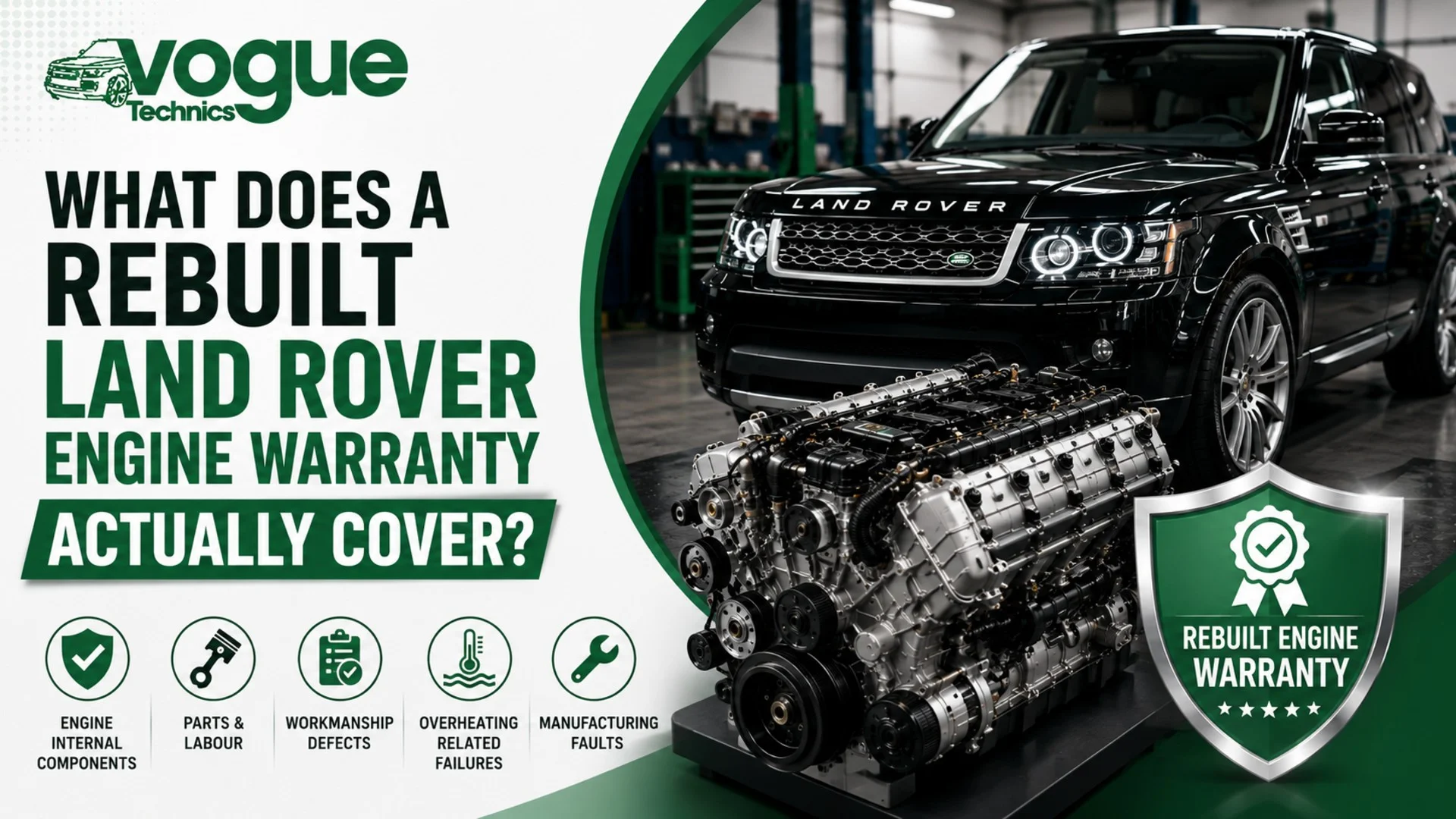
This is where owners get caught out most often. A warranty rarely covers "the whole engine" in the way people assume. It covers specific components under specific conditions, and understanding that distinction upfront prevents disappointment later.
Internal Components Covered
A properly structured rebuild warranty should cover the core internal components that were part of the rebuild itself, including:
- Pistons and piston rings, covered against manufacturing or workmanship defects
- Crankshaft and bearings (main and big-end), covered for premature internal failure
- Cylinder head and valves, covered where the fault relates to rebuild-related work
- Gaskets and seals, covered against failure caused by incorrect fitting
- Timing chain and tensioners, covered where these were part of the rebuild scope
- Oil pump and lubrication components, covered against workmanship-related failure
The key phrase across all of these is "workmanship or manufacturing defect." If a component fails because of how it was rebuilt or fitted, that's a legitimate warranty claim. If it fails because of something that happened after the rebuild, poor maintenance, contamination, driver error, that's a different conversation entirely.
What's Usually Excluded From an Engine Rebuild Warranty
Just as important as knowing what's covered is knowing what typically isn't. Most specialists exclude:
- Turbochargers, unless the turbo was specifically replaced or reconditioned as part of the job
- Injectors and fuel system components, treated as separate ancillary parts
- Sensors and electrical components, which sit outside the mechanical rebuild scope
- Cooling system parts not directly replaced during the rebuild
- Damage caused by overheating after the rebuild was completed
None of this means these exclusions are unfair. It simply reflects that the warranty covers the work actually carried out, not every component bolted to the engine. Ask for a written list of exactly what was replaced or inspected, and cross-reference it against the warranty terms before signing anything.
What Can Void Your Engine Rebuild Warranty
Warranty invalidation is the single biggest source of disputes between owners and engine specialists. Understanding these triggers in advance can save you thousands of pounds.
Incorrect Engine Oil or Missed Servicing
Using the wrong oil specification, or simply missing a scheduled service, is one of the fastest ways to void a rebuilt engine warranty. Most specialists require you to:
- Use the manufacturer-approved oil grade specified for your engine (TDV6, SDV6, and Ingenium engines each have different requirements)
- Keep dated, itemised service records
- Service the vehicle at the intervals stated in your warranty documentation, not just when convenient
If a claim is submitted and there's no service history to support it, the specialist has legitimate grounds to reject the claim outright.
Unauthorised Installation, Modifications or Remapping
If you have the engine installed by someone other than a qualified technician, or the specialist that carried out the rebuild, you risk invalidating the warranty entirely. Installation issues, incorrect torque settings, poor ECU coding, missed timing verification, are among the most common (and preventable) causes of post-rebuild failure.
Modifications and remapping carry the same risk. Altering the engine's tuning after a rebuild changes the stress placed on internal components, and most warranties explicitly exclude failures linked to remapping or performance modifications.
Quick checklist to protect your warranty:
- Keep every invoice, receipt, and service record
- Only use technicians authorised by your warranty provider
- Avoid remapping or performance modifications during the warranty period
- Report any unusual noise, smoke, or warning light immediately, don't wait
How to Make a Land Rover Engine Warranty Claim
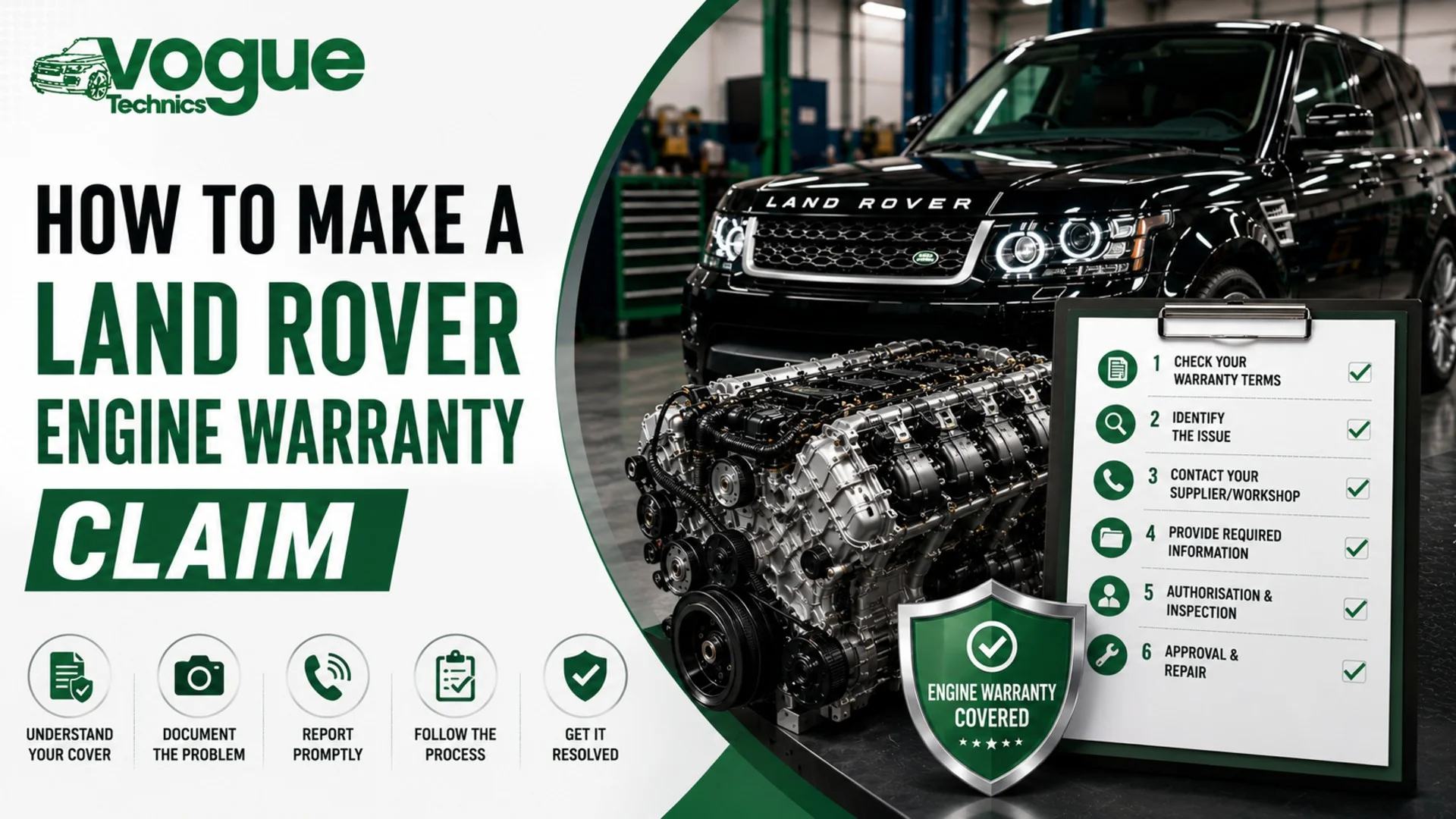
If something does go wrong, how you respond in the first 24 hours genuinely affects whether your claim succeeds.
Step-by-Step Claim Process
Step 1, Stop Driving and Document the Fault
Continuing to drive after noticing unusual noise, smoke, warning lights, or a loss of power is the single most common reason legitimate warranty claims get rejected. Specialists can often tell from the damage pattern whether a vehicle was driven after the fault first appeared, and doing so can be treated as contributing to further damage.
Pull over safely, note the time, mileage, and symptoms, and take photos or a short video if it's safe to do so.
Step 2, Contact Your Engine Specialist
Get in touch with the specialist who carried out the rebuild as soon as possible. Most warranty terms specify a notification window (often 24–48 hours), so delaying this call can weaken your position even if the fault itself is genuinely covered.
Step 3, Diagnostic Inspection & Claim Authorisation
The specialist will typically arrange a diagnostic inspection to determine the cause of failure. This is where your documentation matters most, service records, the original rebuild invoice, and any evidence of correct maintenance all support your case.
Once the cause is confirmed, the specialist will authorise (or decline) the claim, and outline the repair or replacement process.
What Happens If a Rebuilt Engine Fails Under Warranty?
A straightforward claim generally follows this path: fault reported → diagnostic inspection → cause identified → warranty authorised → repair or replacement carried out → engine tested (compression and leak-down testing, at minimum) → vehicle returned.
If the claim is disputed, ask for the rejection reason in writing. Legitimate specialists will explain their reasoning with reference to the specific warranty term that applies, not a vague generalisation. If you believe the rejection is unfair, you're entitled to ask for a second opinion or an independent inspection before accepting the decision.
Used vs Reconditioned vs Rebuilt, Which Comes With the Strongest Warranty?
Owners often assume "used," "reconditioned," and "rebuilt" mean roughly the same thing. They don't, and the warranty terms attached to each reflect real differences in quality and risk.
Engine Type | Typical Warranty | What It Actually Means |
| Used engine | Shortest (often 30–90 days) | Removed from a donor vehicle, tested but not stripped or rebuilt internally |
| Reconditioned engine | Medium (3–12 months) | Key wear components replaced; not fully stripped to bare block |
| Rebuilt engine | Longer (12 months+) | Fully stripped, machined, inspected, and rebuilt to OEM-spec tolerances |
| Remanufactured engine | Potentially longest | Rebuilt to original factory specification with full quality-control testing |
It's worth noting that warranty length alone doesn't guarantee quality. A longer warranty is meaningful only when it's backed by genuine rebuild methodology, proper machining, OEM-spec components, compression and leak-down testing, and full documentation. A 24-month warranty from a supplier who can't explain their rebuild process is worth less than a 12-month warranty from a specialist who can show you exactly what was done and why.
Get a Warranty-Backed Land Rover Engine Rebuild in Essex
If your Land Rover, Range Rover, or Discovery engine has failed, or you're comparing quotes before committing, it helps to work with a specialist who treats the warranty as a reflection of the rebuild quality, not a marketing line.
Our Rebuild Process & OEM-Spec Quality Standards
At Vogue Technics Engine Rebuild, every engine goes through a full strip-down, precision machining, and component inspection before reassembly. We work to OEM specification across Ingenium, TDV6, SDV6, and TDV8 engines, covering models including Discovery, Discovery Sport, Defender, Range Rover, Range Rover Sport, Evoque, and Velar.
Every rebuild is followed by compression testing and leak-down testing before the engine leaves our workshop, and every job comes with clear, written warranty documentation, no vague verbal promises.
Why Grays & Essex Customers Choose Vogue Technics
Local owners come to us because we're upfront about what's covered, what isn't, and why. We explain the rebuild process in plain terms, provide full documentation for your records, and stand behind our work with a genuine parts-and-labour warranty rather than a headline figure with hidden exclusions.
Get Your Free, No-Obligation Engine Rebuild Quote
If you're dealing with a failed engine, unusual noises, or you simply want to understand your options before your current engine gets worse, get in touch with our team based in Grays, Essex. We'll talk you through the rebuild process, what warranty coverage applies to your specific vehicle and engine type, and provide a clear, no-obligation quote.
Frequently Asked Questions
How long is the warranty on a rebuilt Land Rover engine? Warranty length varies by specialist, but a properly rebuilt Land Rover engine should typically carry a minimum of 12 months warranty, with some specialists offering longer terms depending on the rebuild scope and components covered.
What does a Land Rover engine rebuild warranty cover? It generally covers internal components directly involved in the rebuild, pistons, crankshaft, bearings, cylinder head, gaskets, and timing components, against manufacturing or workmanship defects. Ancillary parts like turbochargers, sensors, and injectors are often excluded unless specifically replaced.
Can a Land Rover engine warranty claim be rejected? Yes. Claims are commonly rejected due to missed servicing, incorrect engine oil, unauthorised installation or repairs, continued driving after a fault appeared, or modifications such as remapping. Keeping full documentation significantly reduces this risk.
Does mileage affect a rebuilt engine warranty? Some warranties are mileage-capped alongside the time period (for example, 12 months or 12,000 miles), while others offer unlimited mileage. Always confirm both figures before agreeing to the work.
Is a rebuilt engine better than a reconditioned or used engine? Generally, yes, in terms of longevity and warranty strength. A rebuilt engine is fully stripped, machined, and rebuilt to close tolerances, whereas a reconditioned engine typically has only key wear components replaced, and a used engine is untouched internally.
Does servicing affect my engine rebuild warranty? Yes. Missing scheduled services, or using incorrect oil specifications, is one of the most common reasons warranty claims are declined. Keep dated, itemised records throughout the warranty period.
A rebuilt engine warranty is only as good as the rebuild behind it. Understanding what's covered, what voids it, and how the claims process works puts you in a far stronger position, whether you're comparing quotes now or dealing with a fault after the fact.
If you're in Grays, Essex, or the wider surrounding area and want a straight answer on your engine, get in touch with Vogue Technics Engine Rebuild for a free, no-obligation quote and a warranty you can actually read and understand.