
Range Rover Sport Limp Mode Causes: Diagnosis, Repair & Cost Guide (Grays, Essex)
Range Rover Sport limp mode is your ECU's built-in safety response when it detects a fault that could damage the engine or transmission — not a random breakdown. This guide covers the most common causes, including turbo actuator failures, boost leaks, blocked DPFs, EGR faults, and sensor issues, along with how each is properly diagnosed using specialist Land Rover equipment. It also breaks down realistic repair cost ranges and explains why resetting the fault without fixing the root cause almost always backfires. Written by Land Rover specialists in Grays, Essex, it's a practical guide for any owner trying to understand — and fix — the problem the right way.
You're cruising down the A13, foot on the accelerator, and suddenly your Range Rover Sport feels like it's driving through treacle. The power drops. The gearbox holds onto low gears. An amber warning light stares back at you from the dash. That's limp mode and if it's just happened to you, you're probably wondering whether you're facing a £150 sensor or a £5,000 engine rebuild.
We get this call constantly at our workshop in Grays, Essex. It's one of the most common reasons Range Rover Sport owners across the region search for help, and honestly, it's one of the most misunderstood faults in modern Land Rover ownership. The good news: limp mode is rarely random, and it's almost never unfixable. It's your vehicle's ECU making a deliberate decision to protect the engine or transmission from further damage.
This guide breaks down exactly why Range Rover Sport limp mode causes happen, how a proper diagnosis actually works, what it costs to fix, and because we've rebuilt more Land Rover engines than we can count what we'd genuinely recommend if it were our own car.
What Is Limp Mode and Why Does It Happen?

Limp mode, sometimes called limp home mode or emergency operating mode, is a built-in safety response. When your Range Rover Sport's ECU (Engine Control Unit) detects a fault code that could risk engine or drivetrain damage, it deliberately restricts engine power, limits RPM, and often locks the transmission into a higher gear. It's not the car breaking down, it's the car protecting itself.
Think of it like a circuit breaker in your house. Something's gone wrong upstream, and rather than let the whole system burn out, it trips a safety switch. Limp mode is your Range Rover version of that switch.
What Does Limp Mode Feel Like When Driving?
Most owners describe a similar pattern of symptoms:
- Sudden, noticeable power loss the car feels sluggish even with your foot flat on the accelerator
- Engine warning light or "reduced engine performance" message appearing on the instrument cluster
- The gearbox refusing to shift down, or getting stuck in one gear
- A rev limiter effect, where the engine won't climb past 2,500–3,000 RPM
- Reduced throttle response, almost like the accelerator pedal is disconnected from the engine
If several of these are happening at once, you're in limp mode, not just experiencing a one-off hesitation.
Is It Safe to Drive a Range Rover Sport in Limp Mode?
You can usually get home or to a garage safely, but you shouldn't treat it as business as usual. Limp mode caps your top speed and acceleration on purpose, which makes overtaking, joining motorways, and quick manoeuvres genuinely risky.
We'd always recommend driving cautiously, avoiding motorways where possible, and booking a diagnostic as soon as you can, ideally within a day or two.
Can Limp Mode Damage Your Engine If Left Untreated?
Limp mode itself doesn't damage your engine, that's literally its job, to prevent damage. But the underlying fault causing it absolutely can. A blocked DPF left unaddressed can lead to a full exhaust system failure. A failing turbo actuator ignored for months can eventually cause turbo failure and metal debris entering the intake. The mode is a symptom, not the disease.
Why Does Limp Mode Happen Intermittently or Disappear After Restarting?
This trips up a lot of owners. You restart the car, the warning light clears, and everything seems fine, so you assume it's fixed. It isn't.
Intermittent limp mode usually points to a sensor fault, a loose connector, or a boost leak that only presents under specific load or temperature conditions. The ECU clears the immediate trigger on restart, but the fault code is still logged, and the underlying issue is still there. It's only a matter of time before it reappears, often at a worse moment.
What Causes Range Rover Sport Limp Mode? (Full Breakdown)
Range Rover Sport limp mode causes fall into a handful of core categories. Below is the breakdown we use ourselves when triaging a vehicle, roughly ordered by how frequently we see each one on the ramp.
Turbocharger and Boost Pressure Faults
Turbo-related issues are among the most common range rover sport turbo problems we diagnose, particularly on the 3.0 TDV6 and 3.0 SDV6 diesel engines. When boost pressure drops below what the ECU expects, it assumes a turbo fault and triggers limp mode immediately.
Wastegate Actuator Failure
The turbo actuator controls how much boost pressure the turbocharger produces. On TDV6 and SDV6 engines especially, these actuators are known to stick or fail electronically over time. When the actuator can't hold accurate boost pressure, the ECU sees an implausible reading and cuts power as a precaution.
Split Boost Hose or Intercooler Leak
A cracked intercooler hose or perished boost pipe is a surprisingly common and surprisingly cheap, cause of limp mode. Air escapes before it reaches the engine, boost pressure drops, and the car derates. We've seen customers braced for a turbo replacement bill walk away having paid for a hose.
DPF and EGR Valve Problems
Diesel Range Rover Sports are particularly prone to emissions-system-related limp mode, especially on vehicles used mostly for short journeys.
Blocked DPF Symptoms
The Diesel Particulate Filter (DPF) traps soot from the exhaust. If it becomes blocked, often from repeated short trips that never let it regenerate properly back pressure builds in the exhaust system, and the ECU restricts power to protect the engine. You'll usually notice a burning smell, poor fuel economy, and a dashboard DPF warning before full limp mode kicks in.
Failed EGR Valve Symptoms
The EGR (Exhaust Gas Recirculation) valve reduces NOx emissions by recirculating a portion of exhaust gas back into the intake. When it sticks open or closed, it throws off the engine's air-fuel balance, often triggering rough idling, hesitation, and eventually limp mode.
Sensor Failures That Trigger Limp Mode
Modern Range Rover Sports rely on dozens of sensors feeding real-time data to the ECU. A single faulty sensor sending implausible readings is enough to trigger a protective shutdown, even if the actual component it's monitoring is fine.
Faulty MAF Sensor Symptoms
The Mass Air Flow (MAF) sensor measures how much air is entering the engine. A dirty or failing sensor sends inaccurate data, causing the ECU to miscalculate fuel delivery, leading to hesitation, rough running, and limp mode, particularly under acceleration.
Faulty MAP Sensor Symptoms
The Manifold Absolute Pressure (MAP) sensor works alongside boost pressure sensing. A faulty MAP sensor often mimics turbo fault symptoms almost exactly, which is exactly why proper diagnostic equipment, not guesswork, matters here.
Fuel Pressure and Injector Faults
Low fuel rail pressure, a failing high-pressure fuel pump, or a faulty injector can all starve the engine of consistent fuel delivery. The ECU interprets this as a potential engine protection issue and responds with limp mode, often accompanied by a rough idle or visible misfire.
Gearbox and Transmission-Related Limp Mode
Not every limp mode case is engine-related. Transmission Control Module (TCM) faults, worn torque converters, or gearbox sensor failures can trigger a parallel version of limp mode focused entirely on the drivetrain, usually presenting as the car refusing to shift out of a low gear regardless of engine RPM.
Quick reference table:
Symptom | Most Likely Cause | Typical Urgency |
| Power loss on acceleration only | Turbo actuator / boost leak | Medium |
| Power loss after motorway driving | DPF blockage | Medium-High |
| Rough idle + limp mode | MAF/MAP sensor or EGR | Low-Medium |
| Won't shift out of gear | TCM / gearbox sensor fault | Medium |
| Limp mode + burning smell | Blocked DPF | High |
| Intermittent, clears on restart | Sensor or wiring fault | Medium |
How Is Limp Mode Diagnosed on a Range Rover Sport?
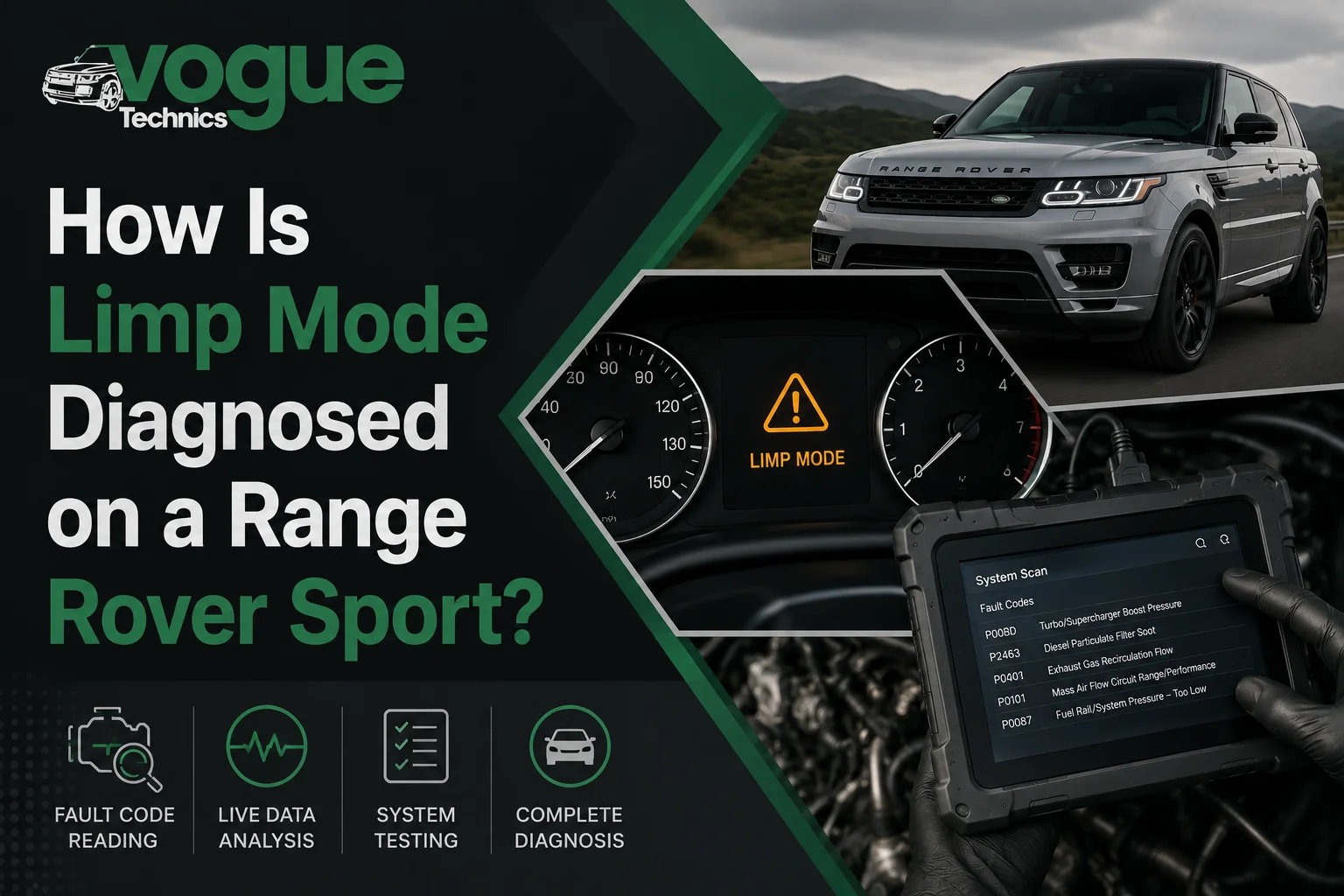
This is the step most owners skip and it's the single biggest reason people end up paying for parts they didn't need. Because so many limp mode causes produce near-identical symptoms, guessing based on symptoms alone is a genuine gamble.
Reading Fault Codes and Live Diagnostic Data
We start every limp mode job the same way: plugging in specialist Land Rover diagnostic equipment (not a generic high-street code reader) to pull stored fault codes and more importantly, live data. Fault codes tell you what the ECU flagged. Live data tells you why, by showing real-time sensor readings, boost pressure values, and fuel rail pressure as the engine runs.
Common Fault Codes Linked to Limp Mode
A few fault codes we see repeatedly on Range Rover Sport limp mode jobs:
- Boost pressure control codes: pointing toward turbo actuator or boost leak issues
- MAF/MAP circuit range codes: indicating sensor faults or wiring damage
- DPF differential pressure codes: signalling filter blockage
- EGR flow performance codes: indicating a sticking or failed EGR valve
- Fuel rail pressure codes: pointing to injector or high-pressure pump faults
A generic OBD-II reader can often pull a basic code, but it won't give you the manufacturer-specific detail or live data needed to confirm the actual root cause, which is exactly where a lot of misdiagnosis (and wasted money) happens.
Can You Reset Limp Mode Without Fixing the Cause?
Technically, yes, disconnecting the battery or clearing codes with a scanner will often reset limp mode temporarily. We'd strongly advise against treating this as a fix. The underlying fault is still there, the code will return, usually within a few miles, and you'll have lost the diagnostic trail that would've helped identify the real problem the first time.
TDV6 vs SDV6 vs Ingenium: Do Limp Mode Causes Differ by Engine?
Yes, meaningfully. The older 3.0 TDV6 is more prone to turbo actuator and EGR issues due to its age and mileage profile. The 3.0 SDV6 shares similar failure points but with more advanced sensor systems, meaning MAF/MAP faults are slightly more common. Newer Ingenium engines lean more toward software and sensor-related limp mode rather than mechanical turbo failures, reflecting their more electronically managed design. Knowing your exact engine variant significantly narrows down the likely cause before we even connect a scanner.
Limp Mode Repair Costs & Why Choose Voguetech Engine Rebuild

Cost is usually the first question after "what's wrong with it", and it's a fair one. Range Rover Sport repairs have a reputation for being expensive, but limp mode faults span a huge cost range, and most are far less dramatic than owners initially fear.
Typical Repair Costs by Fault Type
Fault | Typical Repair Range | Notes |
| Boost hose / intercooler pipe | Low | Often the cheapest realistic fix |
| MAF or MAP sensor replacement | Low-Medium | Straightforward once confirmed |
| Turbo actuator replacement/repair | Medium | Can sometimes be recalibrated, not always replaced |
| EGR valve replacement or clean | Medium | Cleaning is often viable before full replacement |
| DPF cleaning | Medium | Far cheaper than replacement |
| DPF replacement | High | Only when cleaning isn't viable |
| Injector or fuel pump repair | Medium-High | Depends on which injector(s) affected |
| Full turbocharger replacement | High | Reserved for genuine turbo failure, not actuator faults |
We deliberately avoid giving exact figures here because pricing genuinely depends on your specific engine, mileage, and which component has failed, and we'd rather quote you accurately after a proper diagnostic than guess and get it wrong.
Why Choose a Land Rover Specialist Over a Main Dealer
Main dealer diagnostics and labour rates on Range Rover Sports are notoriously high, and you're often paying for brand overhead rather than better expertise. As a dedicated Land Rover specialist based in Grays, Essex, our workshop focuses specifically on Range Rover and Land Rover engine diagnostics, repair, and full engine rebuilds, meaning our team sees these exact fault patterns week in, week out.
That specialism matters. We're not switching between five different manufacturers daily; we know the specific quirks of TDV6, SDV6, and Ingenium engines, which fault codes are genuinely urgent, and which components are worth repairing versus replacing outright.
Frequently Asked Questions About Range Rover Sport Limp Mode
How Much Does It Cost to Fix Limp Mode?
It depends entirely on the cause, a boost hose repair might cost a fraction of what a full turbo or DPF replacement would. This is exactly why a proper diagnostic first is so important; it prevents you paying for guesswork.
How Long Does a Limp Mode Repair Take?
Simple sensor or hose repairs can often be completed same-day. DPF, EGR, or turbo-related repairs typically take longer, particularly if parts need ordering. We'll always give you a realistic timeframe once we've confirmed the fault.
Can Low Battery Voltage Cause Limp Mode?
Yes. A weak or failing battery can cause voltage irregularities that affect sensor readings and ECU communication, sometimes triggering limp mode even when the engine itself is fine. It's one of the first things we check, precisely because it's cheap to rule out.
Can Bad Fuel Cause Limp Mode?
Contaminated or poor-quality diesel can affect fuel pressure and injector performance, which may trigger limp mode. It's less common than sensor or turbo faults but worth mentioning if you've recently filled up somewhere unfamiliar.
Does Limp Mode Damage the Engine Over Time?
Not directly, but ignoring the underlying fault that caused it can. A blocked DPF left unresolved, for example, can eventually cause more serious exhaust and engine damage.
Which Fault Codes Trigger Limp Mode Most Often?
Boost pressure control codes, MAF/MAP sensor circuit codes, and DPF differential pressure codes are among the most frequent triggers we see on Range Rover Sport diagnostics.
Book a Range Rover Sport Diagnostic in Grays, Essex
If your Range Rover Sport has gone into limp mode, the worst thing you can do is guess or worse, ignore it and hope it clears itself. Every day it runs with the underlying fault unresolved is a day closer to a bigger, more expensive repair.
At Voguetech Engine Rebuild in Grays, Essex, we specialise in exactly this kind of diagnosis and repair, from a simple sensor swap through to complete engine rebuilds when a fault has been left too long. We'll give you an honest diagnosis, a clear explanation of what's actually wrong, and a realistic cost before any work begins.
Get in touch with our team today to book a full diagnostic and stop guessing what's wrong with your Range Rover Sport.