
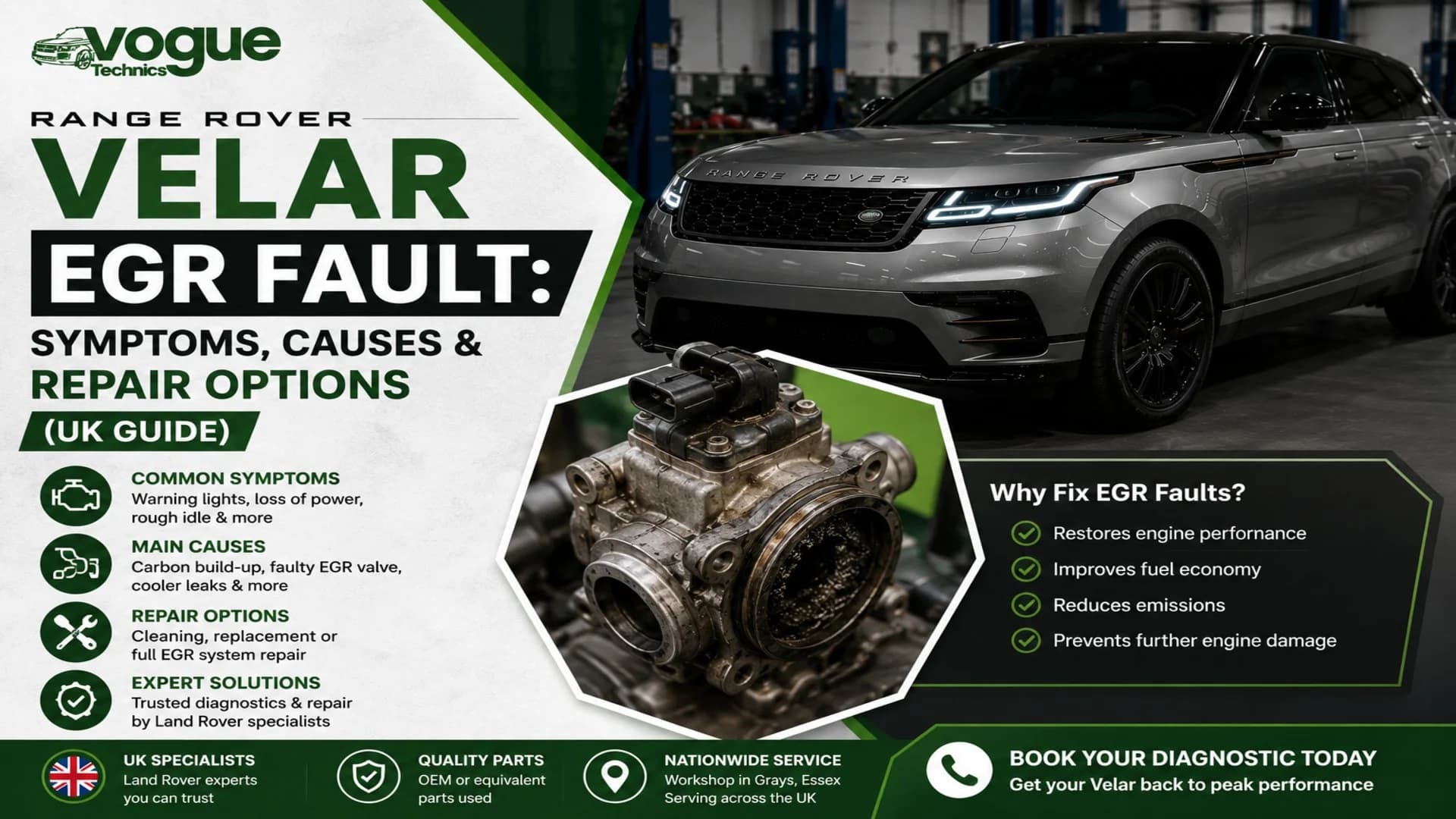
Range Rover Velar EGR Fault: Symptoms, Causes & Repair Options (UK Guide)
A Range Rover Velar EGR fault is one of the most common issues affecting the Ingenium diesel engine, often triggered by carbon build-up, a cracked cooler, or a faulty sensor. This guide breaks down the warning signs, fault codes, and diagnostic process, plus real UK repair costs for cleaning or replacement. It also features a genuine case study from a Velar D240 diagnosed at Voguetechnics in Grays, Essex, showing why proper live-data diagnostics matter more than just reading a fault code.
Your Velar's engine warning light just came on, and now it feels sluggish, hesitant, maybe even stuck in limp mode. If you've landed here searching for answers about a Range Rover Velar EGR fault, you're probably somewhere between mild concern and genuine frustration, and rightly so. The EGR system is one of the most common failure points on the Ingenium diesel engine, and ignoring it rarely ends well.
Here's the good news: an EGR fault is almost always diagnosable, explainable, and fixable, provided you understand what's actually going wrong under the bonnet rather than just clearing a code and hoping for the best. This guide walks through exactly that, from the mechanics of the system to real repair costs and a genuine case study from a Velar we worked on right here in Essex.
What Is a Range Rover Velar EGR Fault and What Causes It?
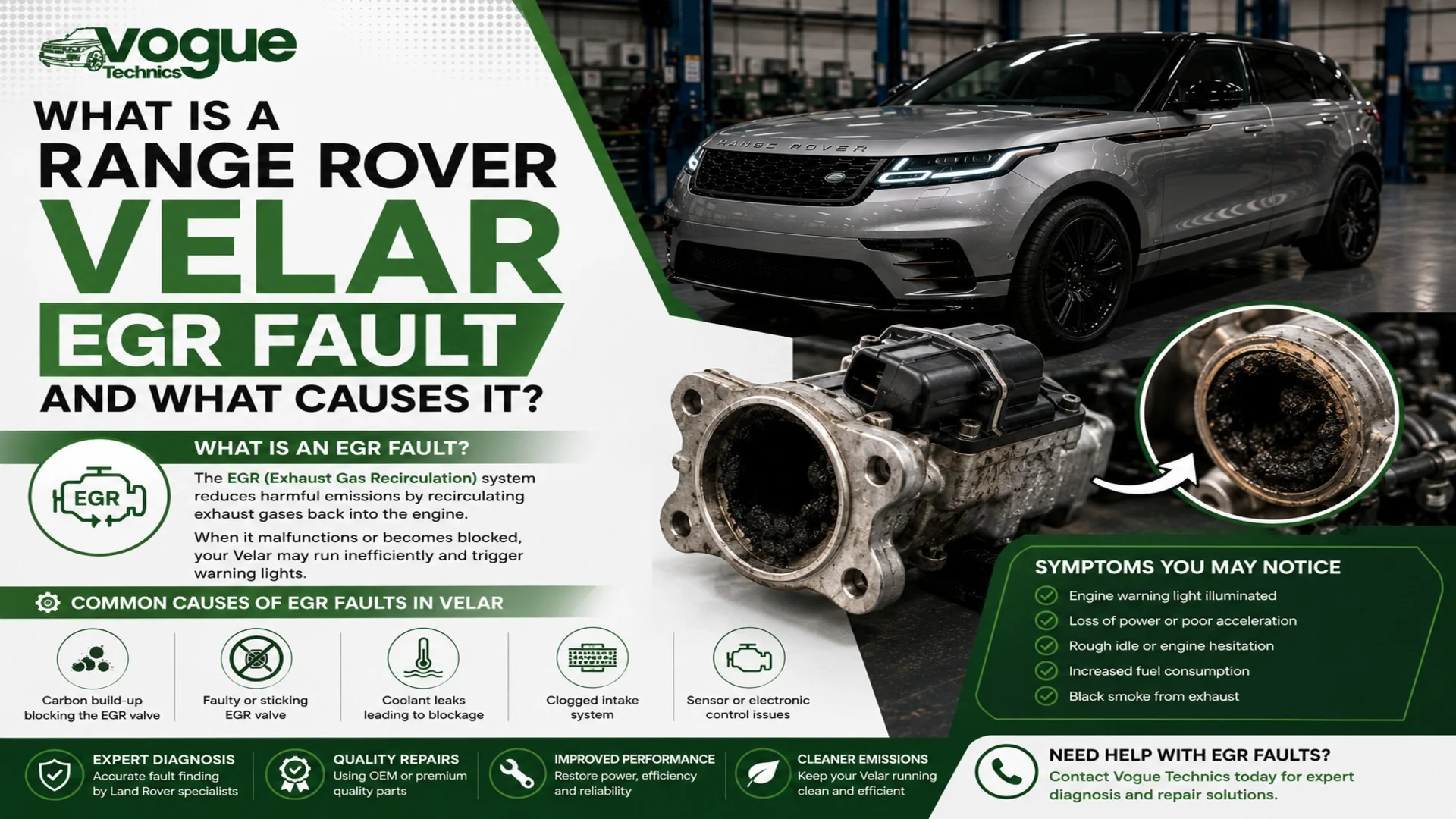
The EGR (Exhaust Gas Recirculation) system exists for one reason: to reduce NOx emissions by recirculating a portion of exhaust gas back into the intake, lowering combustion temperatures. It's a legal requirement on modern diesels, and the Velar's 2.0 Ingenium engine relies on it heavily to stay within emissions limits.
When people search for a "Velar EGR fault," they're usually dealing with one of a handful of underlying issues, not a single mysterious problem, but a specific mechanical or electronic failure within the system. Understanding the mechanism helps you (and your mechanic) diagnose it correctly the first time, rather than replacing parts on guesswork.
How the EGR System Works on the Ingenium Diesel Engine
The Ingenium engine uses a dual-loop EGR setup, meaning exhaust gas is recirculated through two separate paths depending on engine load and temperature. This dual system is more efficient than older single-loop designs, but it also means there are twice as many components that can fail, valves, coolers, sensors, and actuators across two circuits instead of one.
High-Pressure vs Low-Pressure EGR — What's the Difference?
This distinction matters more than most guides admit, and it's one of the biggest gaps in existing advice online.
Feature | High-Pressure (HP) EGR | Low-Pressure (LP) EGR |
| Gas source | Taken before the turbo, directly from the exhaust manifold | Taken after the diesel particulate filter (DPF) |
| Primary use | Low engine loads, cold starts, quick response | Higher loads, motorway driving, cruise conditions |
| Common failure | Carbon build-up, sticking valve | Cooler cracking, filter blockage |
| Typical symptom | Rough idle, hesitation at low revs | Reduced power at speed, fuel economy drop |
Most Velar owners experience HP EGR problems first, since it operates more frequently in typical UK stop-start driving. LP EGR issues tend to surface on cars used mostly for longer runs, where the low-pressure loop is doing more of the work.
Common Causes of EGR Failure
There are three recurring root causes behind the vast majority of EGR faults we see on the Velar.
Carbon Build-Up and Blocked EGR Valve Diesel engines naturally produce soot, and over thousands of short trips, that soot accumulates inside the EGR valve and its passages. Eventually the valve either sticks open, sticks closed, or can no longer move through its full range, triggering an "EGR insufficient flow" fault.
EGR Cooler Leaks and Coolant Loss The EGR cooler lowers the temperature of recirculated exhaust gas before it re-enters the intake. Constant heat cycling causes the metal to fatigue and eventually crack, allowing coolant to leak, sometimes into the exhaust system itself, which can produce white smoke and unexplained coolant loss.
Faulty EGR Position or Pressure Sensor Even a mechanically sound valve can trigger a fault if its position sensor sends inaccurate data to the PCM (Powertrain Control Module). This is a frequently misdiagnosed cause, owners replace the entire valve assembly when the sensor alone was at fault.
What Are the Warning Signs of an EGR Fault on a Velar?
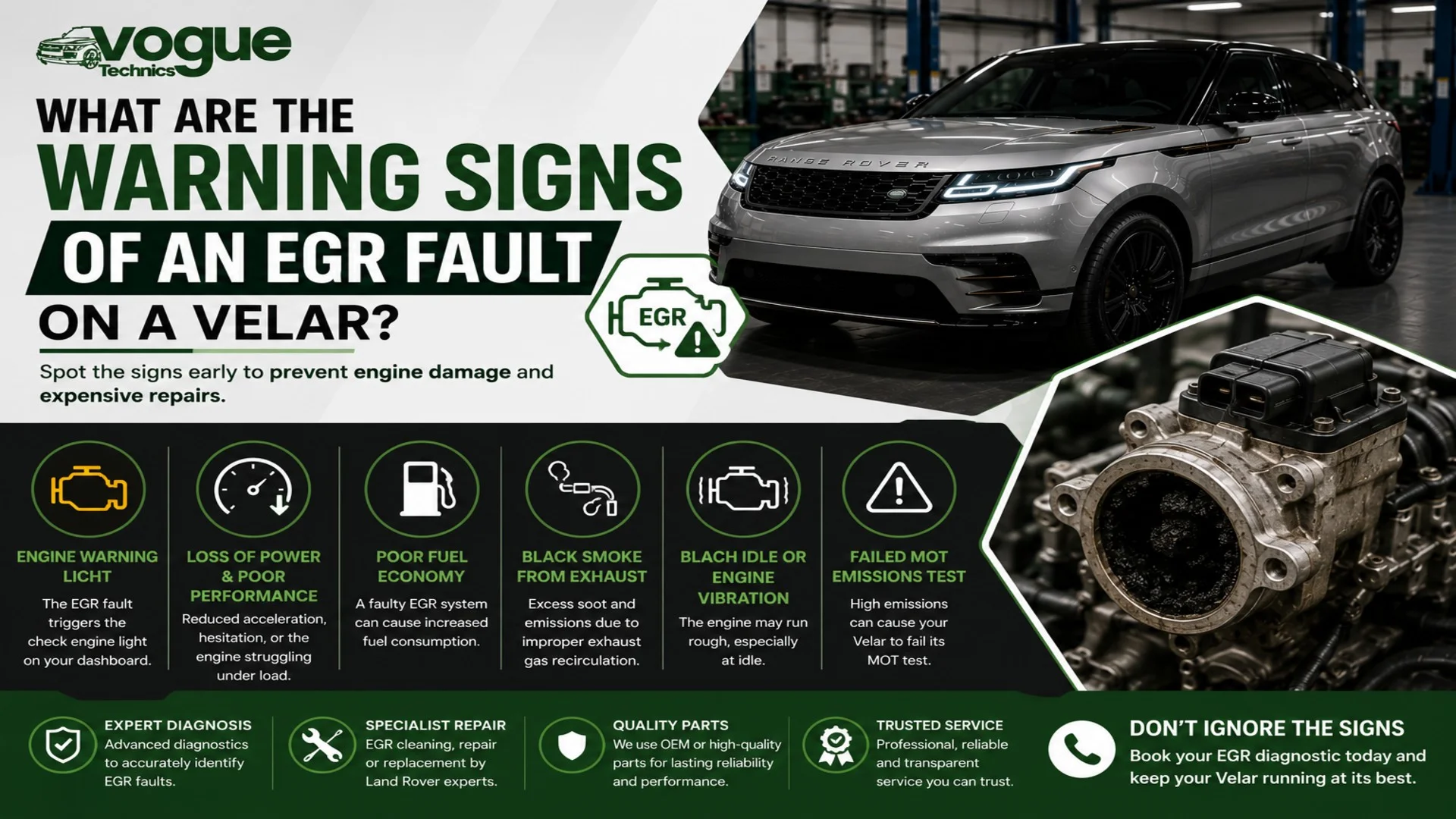
EGR faults rarely appear without warning. The car is usually telling you something well before it goes into limp mode, you just need to know what to listen for.
Dashboard Warning Lights and Fault Codes
The engine management light is the most obvious signal, but the specific fault code stored by the ECU tells you far more than the light alone.
Common EGR Fault Codes
- P0401: EGR insufficient flow detected, usually pointing to a blocked valve or clogged passages
- P049B: EGR cooler bypass performance issue, often linked to a stuck bypass valve
- P0402: EGR excessive flow detected, sometimes caused by a valve stuck open
- P0403: EGR circuit malfunction, typically an electrical or actuator fault rather than a mechanical blockage
A proper diagnostic scan should always pull live data alongside the stored code, reading the code alone tells you what triggered, not necessarily why.
Performance Symptoms to Watch For
Beyond the warning light, there are physical symptoms that consistently show up with EGR problems.
Rough Idle, Hesitation, and Loss of Power A blocked or stuck EGR valve disrupts the air-fuel mixture entering the cylinders, which shows up as an uneven idle or hesitation when you press the accelerator, particularly noticeable pulling away from a standstill.
Black Smoke, Coolant Loss, or Restricted Performance Message Excess exhaust gas re-entering the intake at the wrong time can cause incomplete combustion, producing visible black smoke. If you're also topping up coolant more often than usual with no visible external leak, an EGR cooler crack is a strong suspect. The Velar's "Restricted Performance" message often appears once the ECU decides it needs to protect the engine by limiting power.
Is It Safe to Drive With an EGR Fault?
Short answer: for a short distance, usually yes, but it's not something to put off. Driving with an EGR fault means the engine is running outside its intended emissions and combustion parameters, which can accelerate wear on the turbo, DPF, and injectors. If the car has dropped into limp mode, driving further than necessary to reach a garage isn't advisable, since limp mode exists specifically to prevent further damage.
How Do You Diagnose and Fix an EGR Fault on a Range Rover Velar?

This is where most online guides stop short, they'll tell you the symptoms and maybe the fault code, but not the actual diagnostic logic a competent technician follows.
Proper Diagnostic Process (Beyond Just Reading the Fault Code)
A fault code is a starting point, not a conclusion. At Voguetechnics, our diagnostic process on a Velar EGR complaint typically involves:
- Pulling stored and pending codes, not just the current active one
- Checking live sensor data while the engine runs through different load conditions
- Physically inspecting the EGR valve and cooler for carbon build-up or coolant staining
- Smoke testing the intake system to rule out unrelated vacuum leaks that can mimic EGR symptoms
- Confirming whether the fault is isolated to EGR or interacting with the DPF and NOx sensor systems
Live Diagnostic Data and Sensor Readings Watching EGR valve position against commanded position in real time reveals whether the valve is physically responding correctly. A valve that's commanded to open 40% but only reaches 15% points clearly to a mechanical restriction rather than an electrical fault, a distinction that changes the entire repair approach.
Cleaning vs Replacement — Which Does Your Velar Need?
This is one of the most common questions we get, and the honest answer is: it depends on the failure mode.
- Cleaning is appropriate when the valve is mechanically sound but restricted by carbon deposits, and the actuator motor still tests correctly.
- Replacement is necessary when the cooler has cracked, the actuator motor has failed electrically, or the valve housing itself is warped or damaged beyond effective cleaning.
Cleaning is cheaper and can extend the life of an otherwise healthy component, but it's a temporary fix if the underlying cause, usually short-trip driving that never lets the engine reach full operating temperature, isn't addressed as well.
EGR Valve & Cooler Replacement Cost in the UK
Costs vary depending on whether you're replacing the valve alone, the cooler alone, or both, and whether genuine Land Rover parts or quality aftermarket equivalents are used. As a general guide:
Repair Type | Typical UK Price Range |
| EGR valve cleaning | £150 – £250 |
| EGR valve replacement | £350 – £650 |
| EGR cooler replacement | £500 – £900 |
| Combined valve + cooler replacement | £800 – £1,300 |
These figures reflect parts and labour combined and will vary by garage, engine variant (D200, D240, D275, D300), and whether OEM or OEM-equivalent parts are specified. It's always worth getting a specific quote against your registration rather than relying on averages.
How EGR Faults Can Affect the DPF and Turbo Over Time
An EGR fault rarely stays isolated for long. Excess soot from a malfunctioning EGR system accelerates DPF clogging, since more unburned particulate ends up heading toward the filter. Similarly, a turbo that's constantly compensating for incorrect airflow due to EGR issues wears faster than it should. This is why a Velar that arrives with "just an EGR fault" sometimes leaves with a DPF regeneration recommended in the same visit, the two systems are mechanically linked, not separate problems.
Real Velar Owner Case Study & Why Choose Voguetechnics for EGR Repair

Case Study: Diagnosing and Resolving an EGR Fault for an Essex-Based Velar Owner
A Velar D240 came into our Grays workshop with the engine management light on and a noticeable hesitation on pull-away, along with a Restricted Performance message appearing intermittently on the motorway. The owner had already had a code read at a chain garage, which showed P0401 and led to a quote for a full EGR valve replacement.
Our diagnostic process told a different story. Live data showed the valve was reaching its commanded position correctly, but coolant temperature readings were inconsistent under load, pointing toward the EGR cooler rather than the valve itself. A physical inspection confirmed a hairline crack in the cooler housing, consistent with the coolant top-ups the owner mentioned almost as an afterthought.
Replacing the cooler alone resolved the fault, saved the owner from an unnecessary valve replacement, and got the car back to normal performance within a day. It's a good example of why a proper diagnostic process matters more than simply matching a fault code to a part.
When Repair Isn't Enough — Reconditioned Engine Options
In most cases, an EGR fault is a contained, fixable issue. But if it's gone unaddressed for a long time and contributed to broader engine damage, excessive soot ingestion, turbo failure, or damaged pistons from prolonged incorrect combustion, a full repair may no longer be the most cost-effective route. In those situations, we also supply and fit reconditioned engines for the Velar range, giving owners a warrantied alternative to a repair bill that keeps growing.
Book an EGR Diagnostic or Get a Free Quote — Grays, Essex
If your Velar is showing any of the symptoms covered here, the most useful next step is a proper diagnostic rather than guessing at parts. Our team in Grays, Essex works specifically on Land Rover and Jaguar Ingenium engines and can talk you through exact costs once we've seen the live data from your car.
Frequently Asked Questions
What is the most common cause of an EGR fault on a Range Rover Velar?
Carbon build-up inside the EGR valve is the most frequent cause, particularly on cars used mainly for short journeys where the engine rarely reaches sustained operating temperature.
Can a blocked DPF cause an EGR fault?
Yes. Since the low-pressure EGR loop draws gas from after the DPF, a heavily blocked filter can alter exhaust flow and trigger EGR-related fault codes even when the EGR valve itself is healthy.
Is it safe to drive with an EGR fault warning light on?
For a short distance, generally yes, but it's not advisable long-term. Continued driving with an active EGR fault can accelerate wear on the turbo and DPF and may push the ECU into limp mode.
How much does EGR valve replacement cost in the UK?
Expect to pay between £350 and £650 for valve replacement alone, or £800 to £1,300 if the cooler needs replacing at the same time, depending on parts choice and labour rates.
Can an EGR cooler leak coolant?
Yes. A cracked EGR cooler is one of the most common sources of unexplained coolant loss on the Ingenium engine, and it can sometimes route coolant into the exhaust system, producing white smoke.
Should I clean or replace my Velar's EGR valve?
Cleaning is suitable when the valve is mechanically sound but carbon-restricted. Replacement is necessary when the cooler is cracked, the actuator has failed, or the housing is physically damaged.
An EGR fault on your Velar is rarely as simple as "replace the part and move on" but it's also not something to be intimidated by once you understand what's actually happening in the system. Get a proper diagnostic done, ask what the live data actually showed rather than just the fault code, and you'll avoid paying for parts you don't need.
If you're in the Grays or wider Essex area and your Velar is showing any of the symptoms covered above, get in touch with Voguetechnics for a free, no-obligation quote, we'll tell you exactly what's wrong before we tell you what it costs to fix.