
Range Rover Sport Fault Codes: Common Causes, Meanings & Trusted Repairs in Essex
Range Rover Sport fault codes help identify engine, transmission, suspension, and electrical problems before they become major repairs. This guide explains common fault codes, their causes, diagnostic methods, and when professional assistance is required. It also covers warning lights, OBD scanners, and practical advice to keep your vehicle running reliably.
Your Range Rover Sport's dashboard just lit up, and now you're staring at a warning light with no idea what it actually means. Is it safe to drive? Is this a £50 fix or a £2,000 one? You're not alone, this is one of the most common moments of dread for Land Rover owners, and it's exactly why you're here.
Fault codes aren't random. Every one of them is your vehicle's onboard computer flagging a specific issue, somewhere between a genuinely minor sensor glitch and a fault that could leave you stuck in restricted performance mode on the M25. This guide breaks down what these codes mean, what's actually causing them, and when it's time to stop guessing and get a proper diagnostic.
What Do Range Rover Sport Fault Codes Actually Mean?
Every modern Range Rover Sport runs on a network of onboard computers, the ECU, PCM, TCM, and BCM, constantly monitoring engine performance, emissions, transmission behaviour, and electrical systems. When something falls outside expected parameters, the system logs a diagnostic trouble code (DTC) and, often, triggers a warning light on your dash.
These aren't Land Rover's invention. They follow the OBD-II (On-Board Diagnostics) standard used across most vehicles sold in Europe and the US since the early 2000s, alongside manufacturer-specific codes unique to Land Rover and Range Rover models. That's why a code like P0299 means the same thing on a Range Rover Sport as it does on plenty of other cars, but Land Rover also layers on its own codes for things like air suspension and Terrain Response, which are unique to these vehicles.
What Triggers the Check Engine Light on a Range Rover Sport?
The check engine light on a Range Rover Sport isn't one single warning, it's a catch-all indicator for dozens of possible triggers. Some of the most frequent causes include:
- Fuel system faults: low fuel rail pressure or injector issues, often triggering codes like P0087
- Turbocharger faults: underboost or overboost conditions (P0299, P0234)
- Sensor faults: MAP, MAF, or oxygen sensor readings that don't match expected values
- Emissions faults: DPF restriction or EGR valve problems
- Communication faults: CAN bus errors between control modules (U0001, U0155)
The tricky part is that the light itself doesn't tell you which of these it is. A range rover engine light can mean anything from "your fuel cap is loose" to "your turbo is failing", which is exactly why reading the actual stored code matters more than the light alone.
How Can I Read Range Rover Sport Fault Codes Myself?
If you want to check what's going on before booking anywhere, a basic OBD2 scanner will pull generic codes. But here's the honest truth: consumer-grade scanners often can't read Land Rover's manufacturer-specific codes, especially anything related to air suspension, transmission, or Terrain Response systems.
For a fuller picture, specialist tools like the Foxwell NT530, Autel MaxiCOM, or Land Rover-specific software like IIDTool and GAP Diagnostics are far more reliable. These can pull live data, freeze frame data (what the car was doing the moment the fault occurred), and manufacturer-specific codes that a cheap reader will simply miss or misreport.
A generic scanner is a useful first step. It is rarely the full story on a Range Rover Sport.
Common Range Rover Sport Faults & What They Point To

Not all fault codes carry equal weight. Some are safe to drive with for a short while; others demand you pull over. Understanding the category helps you judge urgency before you even see a mechanic.
Engine, Fuel & Turbo Fault Codes Explained
These are among the most commonly reported range rover sport faults, and they tend to show up as rough idling, hesitation on acceleration, or a noticeable drop in power.
Code | Meaning | Typical Symptom |
| P0087 | Fuel rail pressure too low | Hesitation, stalling, poor acceleration |
| P0299 | Turbo underboost | Sluggish power delivery, limp mode |
| P0234 | Turbo overboost | Warning light, reduced power |
| P0106 | MAP sensor fault | Rough idle, poor fuel economy |
| P0300 | Random/multiple misfire | Shaking, uneven engine sound |
A real-world example: a Range Rover Sport TDV6 owner reports intermittent power loss on motorway inclines. Nine times out of ten, that's a boost pressure issue, P0299, often linked to a failing turbo actuator rather than the turbo itself. Diagnosing which one it is (actuator vs. full turbo) is the difference between a £300 repair and a £1,500 one, which is exactly why code-reading without proper interpretation can lead to unnecessary "parts cannon" repairs, replacing parts on guesswork instead of confirmed diagnosis.
Gearbox, Transmission & Suspension Fault Codes
A range rover gearbox fault is one of the more anxiety-inducing warnings an owner can get, largely because transmission repairs have a reputation for being expensive. The reality is more nuanced.
Common triggers include:
- P0705 Transmission range sensor fault, often a wiring or sensor issue rather than internal gearbox damage
- Communication faults between the TCM and other modules, frequently mistaken for mechanical transmission failure
- Range Rover Sport suspension fault codes tied to the air suspension valve block, compressor, or height sensors
Why Do Range Rover Sport Gearboxes Throw Recurring Fault Codes?
Here's something most guides skip: a recurring land rover transmission fault is very often not the gearbox itself. In a significant number of cases we see, the root cause is a weak or ageing battery sending inconsistent voltage to the TCM, which then logs a fault that looks transmission-related but isn't.
This is a genuinely underreported issue. Before assuming your gearbox needs a rebuild, a proper diagnostic should rule out battery voltage and wiring harness faults first. It's a far cheaper problem to fix, and it's one we check as standard.
Should You Fix Range Rover Sport Fault Codes Yourself or Call a Specialist?

There's a point where DIY diagnosis stops being useful and starts being a false economy. Knowing where that line sits will save you time and money.
Can DIY OBD Scanners Actually Fix the Underlying Fault?
No, and this is worth being blunt about. A scanner reads and clears codes. It doesn't diagnose why the fault occurred, and clearing a code without fixing the cause almost always means the light comes back within days.
We regularly see owners who've cleared a code themselves, felt relieved for a week, then found the same range rover sport engine management light back on, sometimes accompanied by restricted performance, because the underlying fault was never actually resolved.
When a Fault Code Means It's Time to Book a Professional Diagnostic
Book a proper diagnostic if you notice any of the following:
- The same fault code returns after clearing it
- Multiple codes appear simultaneously (often a sign of a shared root cause, like a CAN bus or battery issue rather than several unrelated faults)
- You experience restricted performance or limp mode
- The vehicle shows physical symptoms, misfiring, sagging suspension, delayed gear changes, alongside the warning light
Land Rover and Range Rover vehicles are known for interconnected systems, meaning one weak component (a battery, a corroded earth point, a failing sensor) can trigger fault codes across multiple modules at once. Untangling that requires proper live data interpretation, not just a code lookup chart.
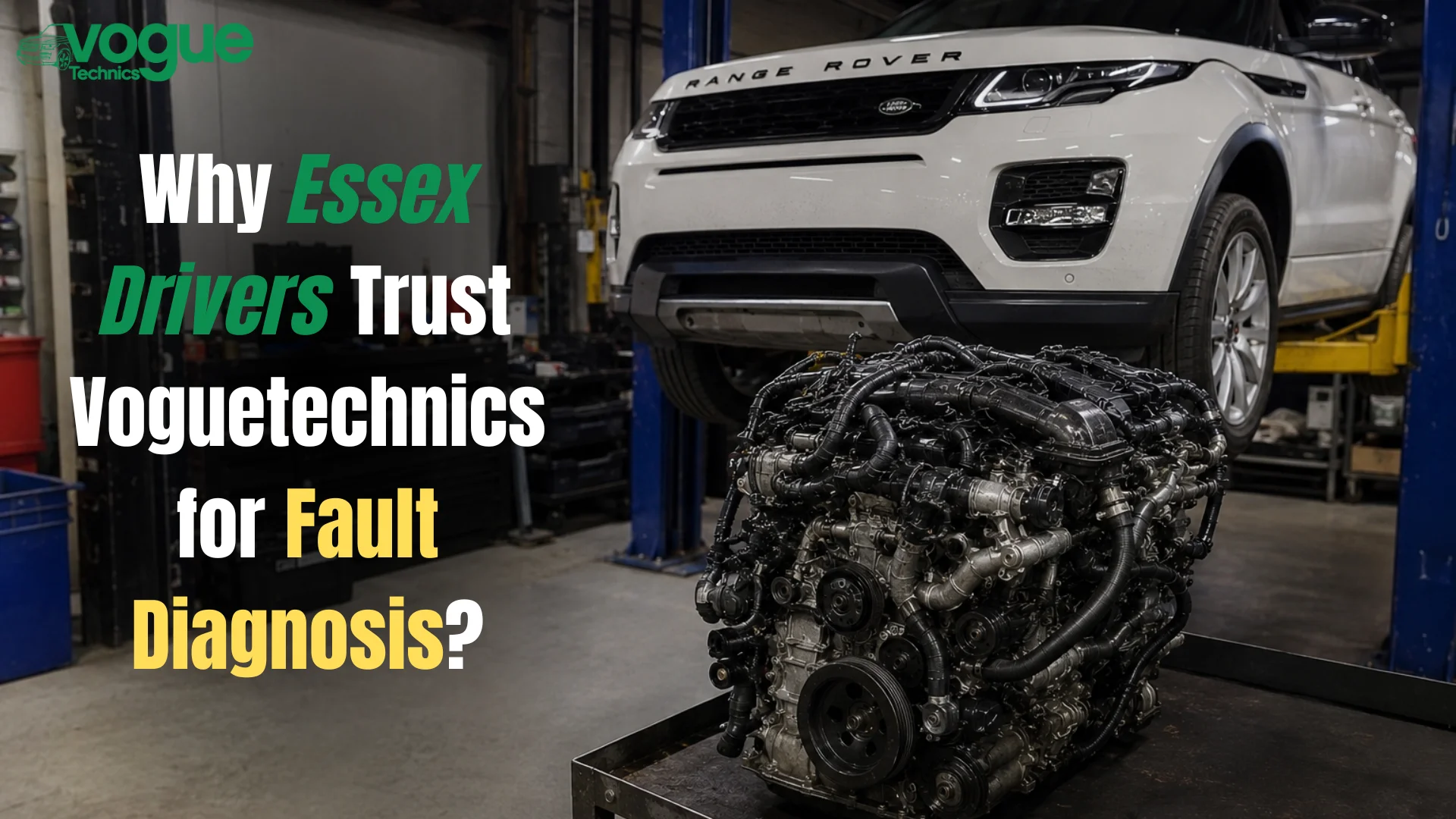
Why Essex Drivers Trust Voguetechnics for Range Rover & Land Rover Fault Diagnosis
Our Experience Diagnosing Range Rover & Land Rover Faults
At Voguetechnics, based in Grays, Essex, we work specifically with Land Rover and Range Rover vehicles, including the Sport, Evoque, Discovery, Discovery Sport, and Defender. We're not generalists running a basic code reader; we use manufacturer-level diagnostic tools to read live data, freeze frame data, and full fault histories, so we can tell you what's actually wrong, not just what the dashboard is guessing.
We've seen the same patterns repeat across hundreds of vehicles: gearbox faults that trace back to batteries, DPF codes that stem from short-journey driving habits, and suspension faults caused by a single failing height sensor rather than the whole valve block. That pattern recognition is what separates a genuine diagnostic from a parts-replacement guessing game.
Book a Diagnostic Check or Get a Repair Quote Today
If your Range Rover Sport, Evoque, or Discovery Sport has thrown a fault code, don't leave it guessing on your dashboard. A proper diagnostic takes the uncertainty out of the equation and gives you a clear, honest picture of what needs fixing, and what doesn't.
Get in touch with Voguetechnics in Grays, Essex, for an accurate diagnostic and a straightforward repair quote.
Frequently Asked Questions
What does it mean when my Range Rover Sport shows restricted performance? Restricted performance is a protective mode the ECU triggers when it detects a fault serious enough to risk further damage if the engine runs normally, commonly linked to turbo, fuel pressure, or emissions faults. It reduces power output until the underlying issue is diagnosed and fixed.
Can I drive with the engine warning light on?
It depends on the fault. A steady light usually means a lower-urgency issue, safe for short-term driving. A flashing light signals a more serious fault, often a misfire, and continuing to drive risks damaging the catalytic converter.
Why do multiple fault codes appear at the same time?
This is common on Range Rover Sport models because control modules communicate over a shared CAN bus network. A single weak point, often a battery, earth connection, or wiring fault, can cause several modules to log unrelated-looking codes simultaneously.
Can a weak battery cause false fault codes?
Yes, and it's more common than most owners realise. Inconsistent voltage can cause the TCM, BCM, or other modules to log faults that look mechanical but are actually electrical in origin.
How much does a Range Rover Sport diagnostic cost?
Costs vary depending on complexity, but a proper specialist diagnostic, using manufacturer-level tools rather than a basic code reader, is a small cost compared to replacing parts that were never actually faulty.
What's the difference between a generic OBD2 scanner and a Land Rover-specific diagnostic tool?
A generic scanner reads standard OBD-II codes, which cover many engine and emissions faults. Land Rover-specific tools like IIDTool or GAP Diagnostics also read manufacturer-specific codes covering air suspension, Terrain Response, and other systems unique to these vehicles.