
Range Rover Velar vs Jaguar F-Pace Engine Problems: Which Ingenium Engine Is More Reliable?
The Range Rover Velar and Jaguar F-Pace share more than a platform, they run the same Ingenium engines, which means they share the same reliability weak points too. This guide breaks down the timing chain, oil dilution, turbo, and DPF faults common to both models, plus which production years carry the highest risk. You'll also find real repair costs and clear guidance on when a repair is enough versus when a full rebuild makes more sense. Written by Ingenium specialists who diagnose and rebuild these exact engines daily in Essex.
If you're staring at a dashboard warning light on your Velar or F-Pace right now, you probably don't care about horsepower figures or infotainment specs. You want to know one thing: is this a minor hiccup, or the start of an expensive engine problem?
We get this question a lot at our workshop in Grays, Essex. Owners come in convinced their car is "just being temperamental," only to find out the fault is a well-documented issue affecting thousands of the same engine across two different badges. That's because the Range Rover Velar and Jaguar F-Pace aren't just stablemates under the Jaguar Land Rover umbrella — in many cases, they're running the exact same engine under a different bonnet.
This guide breaks down exactly what goes wrong, why it happens, which model years are riskier than others, and what it actually costs to put right. No dealership sales pitch, no vague "book a service" advice — just the reliability picture as we see it from the workshop floor.
Do the Range Rover Velar and Jaguar F-Pace Share the Same Engine?
Yes, largely — and this is the single most important thing to understand before comparing reliability between the two.
Both the Velar and F-Pace sit on Jaguar Land Rover's shared platform strategy, and both draw from the same Ingenium engine family. JLR developed Ingenium as a modular, in-house engine architecture to replace older Ford-derived units, and it's been fitted across the Range Rover, Jaguar, and Land Rover ranges since around 2015.
What this means practically: if you're comparing engine problems between these two SUVs, you're often comparing the same fault wearing two different badges. A timing chain issue on a Velar diesel is frequently the same mechanical weakness found on an F-Pace running the equivalent unit. This is one of the biggest gaps in most comparison content online — reviewers talk about styling and infotainment differences while glossing over the fact that the engines underneath are mechanically related.
The Shared Ingenium Engine Platform Explained
Ingenium engines come in three main configurations across these two models:
- 2.0-litre four-cylinder petrol: used in lower and mid-range trims of both cars
- 2.0-litre four-cylinder diesel: the volume seller for company car drivers and high-mileage owners
- 3.0-litre inline-six petrol (mild hybrid): introduced later, replacing the older supercharged V6 in many trims
The F-Pace additionally offered the AJ126 supercharged V6 and, on the SVR, the AJ133 supercharged V8, engines with a different lineage to Ingenium and their own separate reliability profile, covered further down.
Petrol vs Diesel Ingenium Variants — What's the Difference?
Buyers frequently ask us whether the petrol or diesel Ingenium is the "safer" choice. The honest answer is that both have had issues, but the nature of those issues differs.
P250, P300 and P400 Petrol Engines
The petrol range spans the P250, P300, and P400 badges (with the P400 referring to the 3.0-litre inline-six mild hybrid in later Velars and F-Paces). Petrol Ingenium units are generally less prone to the timing chain failures that plague the diesels, but they carry their own weak point: oil dilution, where unburned fuel seeps past the piston rings and mixes with engine oil during short journeys or cold starts. Over time, this thins the oil, reduces lubrication, and accelerates wear on the timing chain and bearings.
D180 and D200 Diesel Engines
The D180 and D200 diesel variants are torquey and efficient on paper, but they're the engines most associated with timing chain tensioner wear in early production years. We also see a steady stream of diesel-specific issues: DPF regeneration problems on short-journey use, EGR valve clogging, and AdBlue/SCR system faults that trigger limp mode. If you're a low-mileage, mostly-urban driver, a diesel Ingenium is arguably not the engine suited to your driving pattern, DPFs need sustained motorway running to regenerate properly.
Common Range Rover Velar Engine Problems Owners Report
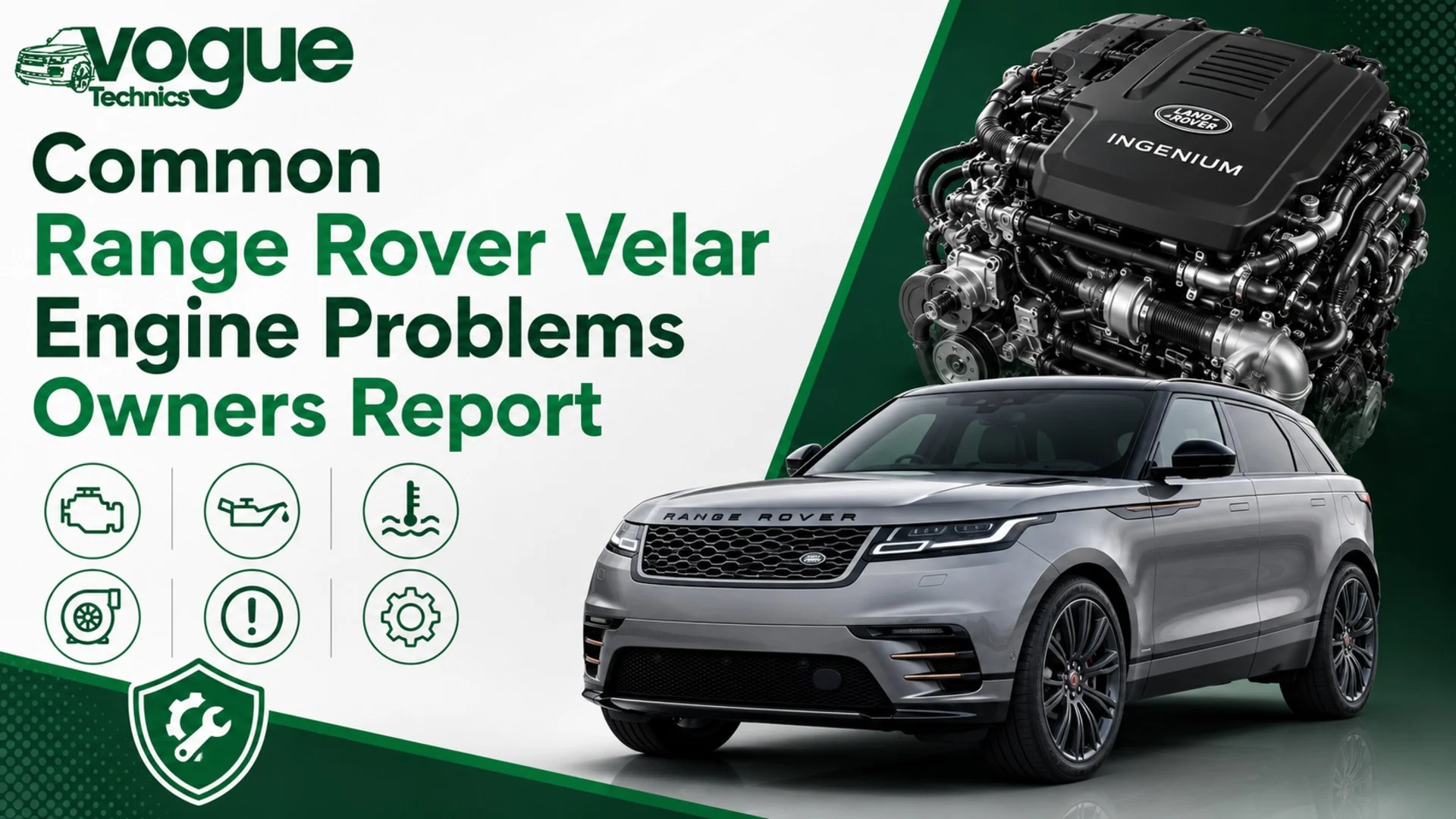
The Velar launched in 2017 as Land Rover's design-led mid-size SUV, and while it's a genuinely impressive car to drive, its early production years brought a cluster of engine issues that are now well documented among owners and specialists alike.
Timing Chain and Tensioner Wear
This is the fault we see most often on Velars that come through our doors. The timing chain tensioner can wear prematurely, allowing the chain to develop slack. Left unaddressed, this leads to a rattling noise on cold start, often mistaken for a "normal diesel clatter" by owners unfamiliar with the sound, that gradually worsens. In more advanced cases, a stretched or slipped timing chain can cause the engine to lose correct valve timing entirely, which risks serious internal damage.
A real-world example we see often: A Velar D180 comes in with an intermittent rattle on start-up that disappears after a few seconds. The owner has been told by a general garage that "it's nothing to worry about." In reality, that rattle is frequently the earliest audible sign of timing chain tensioner wear, and catching it at this stage is the difference between a tensioner replacement and a full engine rebuild.
Oil Dilution and High Oil Consumption
Petrol Velars, particularly the P250 and P300, are prone to oil dilution from fuel contamination. Symptoms include the oil level rising rather than falling between changes (a red flag many owners misread as a good sign), a fuel smell from the dipstick, and reduced oil viscosity that shows up on an oil analysis. If left unmonitored, diluted oil accelerates wear across the entire engine, not just the timing components.
Coolant Leaks and Water Pump Failures
Coolant system faults are another recurring theme. Common culprits include:
- Thermostat housing cracks — often plastic-bodied and prone to failure with age and heat cycling
- Water pump seal degradation — leading to slow coolant loss that's easy to miss until the temperature gauge spikes
- Coolant reservoir cracking — a smaller but still common leak point
Each of these looks minor in isolation, but a slow coolant leak that goes unnoticed can lead to overheating, and overheating on an aluminium Ingenium block risks head gasket damage, a far more expensive repair than the original fault.
Which Velar Model Years Are Most Affected?
Based on the patterns we see in the workshop, early production Velars, broadly 2017 to 2019, carry the highest concentration of timing chain and coolant-related faults. JLR made running changes to the tensioner design and cooling components across the production run, so later cars (2020 onward) tend to show fewer of these specific issues, though they're not immune, especially once mileage climbs past 60,000-70,000 miles.
Common Jaguar F-Pace Engine Problems Owners Report
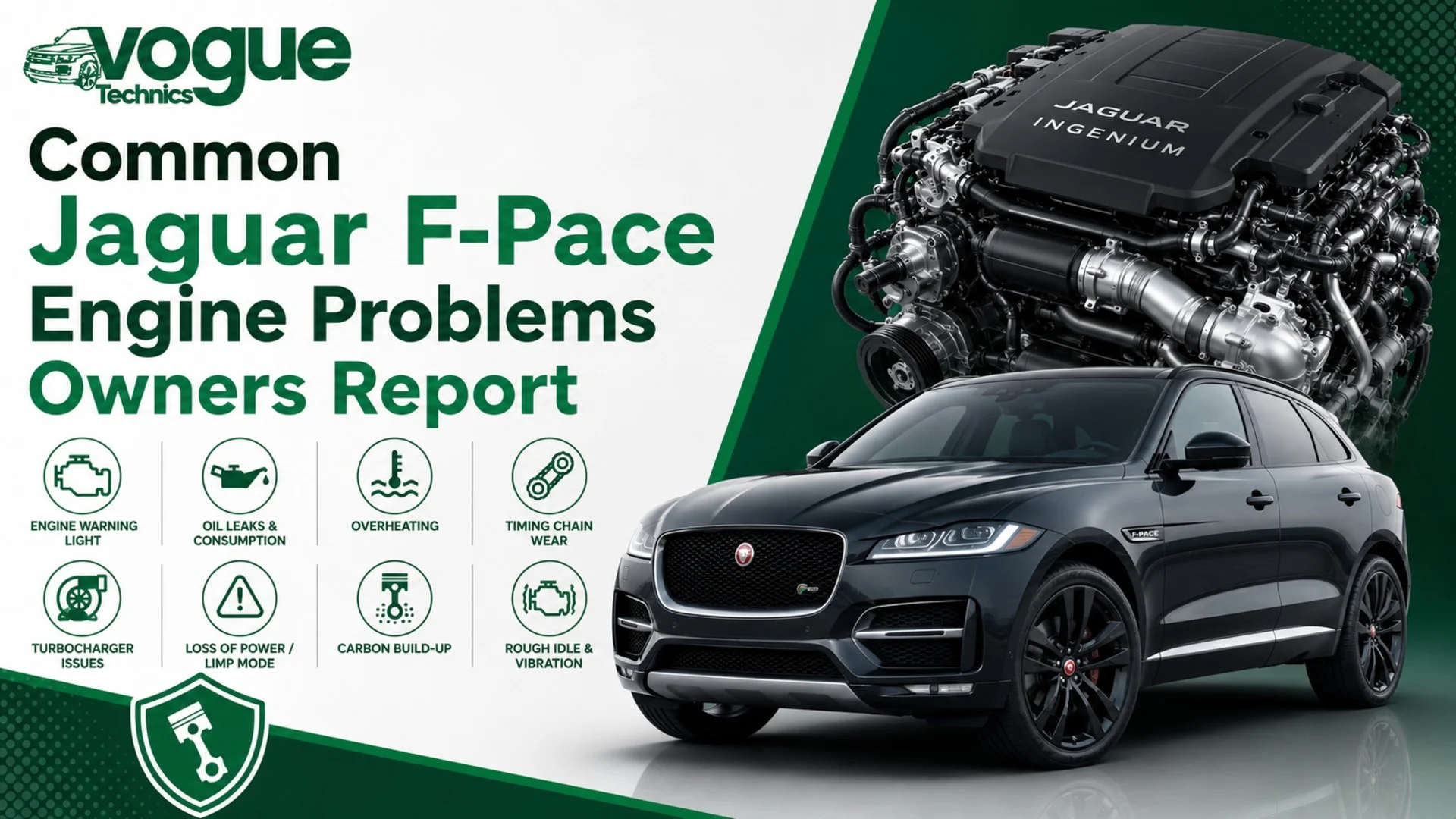
The F-Pace has been on sale since 2016, giving it a longer track record than the Velar and, correspondingly, a longer list of documented engine faults across its lifecycle.
Turbocharger and EGR Valve Failures
Turbo issues on the four-cylinder Ingenium F-Pace typically present as a loss of power, a whistling or whining noise under acceleration, or a check engine light triggered by boost pressure faults. EGR valve failures are a close relative of this problem, a clogged or stuck EGR valve disrupts airflow and can throw the engine into limp mode, particularly on diesel models used mainly for short trips.
DPF Regeneration and AdBlue System Faults
Diesel F-Pace owners frequently report DPF warning lights, especially on cars used predominantly for school runs and short urban journeys rather than sustained motorway driving. The diesel particulate filter needs a proper regeneration cycle, essentially a sustained high-temperature run, to burn off trapped soot. Without it, the filter clogs, performance drops, and fuel economy suffers.
AdBlue and SCR (selective catalytic reduction) system faults are also common on later diesel F-Paces. A failing NOx sensor or a blocked SCR injector can trigger a countdown warning and, eventually, a refusal to restart, a problem that catches a lot of owners off guard.
AJ126 and AJ133 (V6/V8) Reliability
The supercharged AJ126 V6 and AJ133 V8 engines, used in higher-performance F-Pace variants including the SVR, are a different beast entirely to the four-cylinder Ingenium units. They're generally robust mechanically but come with higher running costs by design, supercharger service intervals, more complex cooling requirements, and higher-spec oil requirements all add up. Reliability-wise, the AJ133 V8 has a good reputation for durability when properly maintained, but neglecting service intervals on these engines tends to produce more expensive failures than on the smaller Ingenium units, simply because there's more engine to go wrong.
Known Engine Faults on Early F-Pace Models (2018 Onward)
2018-model-year F-Pace diesels, in particular, show up frequently in specialist forums and owner groups for timing chain concerns, echoing the same Ingenium weakness found in the Velar. If you're looking at a used Jaguar F-Pace 2018 model, a timing chain and tensioner inspection should be non-negotiable before purchase, regardless of what the service history says.
Which Is More Reliable — and What Should You Do About It?

This is the question everyone actually wants answered, so let's be direct about it.
Velar vs F-Pace Reliability at a Glance
Factor | Range Rover Velar | Jaguar F-Pace |
| Shared Ingenium engines | Yes (P250, P300, P400, D180, D200) | Yes (same variants) |
| Main petrol issue | Oil dilution | Oil dilution, turbo wear |
| Main diesel issue | Timing chain tensioner wear | Timing chain, DPF/EGR faults |
| Higher-performance engines | Not offered | AJ126 V6, AJ133 V8 |
| Riskiest model years | 2017–2019 | 2016–2018 |
| On-sale since | 2017 | 2016 |
Because the two cars share so much engine hardware, there isn't a clear "winner" in reliability terms once you compare like-for-like engine variants. The F-Pace has a slightly longer track record simply because it launched a year earlier, which means more documented cases and, arguably, more mature fixes from JLR by the time later model years arrived. The Velar's early cars, on the other hand, benefited less from those running changes.
In short: the reliability question isn't really "Velar vs F-Pace", it's "which specific engine variant, and which specific production year." A well-maintained 2020 F-Pace P300 and a well-maintained 2020 Velar P300 will have essentially the same reliability profile, because it's the same engine.
Maintenance and Repair Costs Compared
Both models sit in the premium SUV bracket, and repair costs reflect that. As a rough guide:
- Timing chain tensioner replacement: a moderate repair if caught early, significantly more expensive if the chain has already caused internal damage
- DPF cleaning or replacement: cleaning is comparatively affordable; full replacement is a much bigger outlay
- Turbocharger replacement: a mid-to-high cost repair depending on whether it's a reconditioned or new unit
- Full engine rebuild: the most expensive outcome, typically only necessary when a fault has been ignored for an extended period
This is exactly why we push the message we do: catching these issues early is dramatically cheaper than waiting for a warning light to become a breakdown.
When to Repair vs When to Rebuild Your Engine
Not every fault needs a full rebuild, and not every rattle is terminal, but knowing the difference matters. As a general rule:
- If the issue is isolated (a single sensor, a cracked housing, a worn tensioner) and caught early, a targeted repair is usually sufficient
- If there's evidence of metal contamination in the oil, persistent overheating history, or a chain that has already jumped time, a rebuild is often the more cost-effective long-term option compared to repeated partial repairs
- If the engine has covered high mileage with a patchy service history, a pre-purchase inspection before you buy is far cheaper than discovering the problem afterward
Warning Signs You Need a Professional Engine Health Check
Don't wait for the warning light. Book a diagnostic if you notice any of the following:
- A rattling or chattering noise on cold start that fades after a few seconds
- Oil level rising, or a fuel smell on the dipstick
- Coolant needing regular topping up with no visible external leak
- Reduced power, hesitation, or a whining turbo noise under load
- Repeated DPF or AdBlue warnings, especially on short-journey use
Book an Engine Diagnostic or Rebuild Quote in Grays, Essex
If any of this sounds familiar, it's worth getting ahead of it rather than waiting for a breakdown. At Voguetechnics Engine Rebuild, based in Grays, Essex, we specialise in Jaguar and Land Rover engine diagnostics, repairs, and full engine rebuilds, including Ingenium, AJ126, and AJ133 units. We can assess your Velar or F-Pace, tell you honestly whether you're looking at a repair or a rebuild, and give you a clear, no-pressure quote before any work starts.
Frequently Asked Questions
Which is more reliable, the Range Rover Velar or Jaguar F-Pace? Because both share the same Ingenium engine range, reliability comes down to the specific engine and model year rather than the badge on the bonnet. Later production years (2020 onward) of both cars tend to be more reliable than early examples.
Do the Velar and F-Pace really use the same engine? Yes, in most variants. Both draw from JLR's Ingenium engine family for their petrol and diesel four-cylinder options. The F-Pace additionally offers the AJ126 V6 and AJ133 V8, which the Velar doesn't.
What is the most common Range Rover Velar engine problem? Timing chain tensioner wear on diesel models and oil dilution on petrol models are the two most frequently reported issues.
What is the most common Jaguar F-Pace engine problem? Timing chain wear on early diesels, along with turbocharger, EGR, and DPF-related faults, particularly on cars used mainly for short journeys.
How long do Ingenium engines last? With proper maintenance and prompt attention to early warning signs like timing chain rattle or oil dilution, Ingenium engines can comfortably cover well over 100,000 miles. Neglected maintenance significantly shortens that lifespan.
Is it worth buying a used Jaguar F-Pace or Range Rover Velar from 2018? It can be, but a pre-purchase inspection focused specifically on the timing chain, coolant system, and turbo is strongly recommended for cars from this earlier production window.
Should I repair or rebuild my Velar or F-Pace engine? It depends on how far the fault has progressed. Isolated, early-caught issues are usually repairable. Widespread wear, metal contamination in the oil, or a history of overheating typically point toward a rebuild being the more sensible long-term option.
The Bottom Line
The Range Rover Velar and Jaguar F-Pace are excellent cars to drive, but they share more than showroom appeal, they share an engine family with well-documented weak points. Timing chains, oil dilution, coolant leaks, turbo wear, and DPF issues aren't rare exceptions; they're patterns we see consistently across both models, especially in early production years.
The good news is that almost every one of these problems is manageable if you catch it early. A rattling cold start or a rising oil level isn't something to shrug off, it's your engine telling you exactly what it needs.
If you own a Velar or F-Pace and something doesn't feel quite right, don't wait for it to get worse. Get in touch with Voguetechnics Engine Rebuild in Grays, Essex, for an honest assessment and a straightforward quote, before a manageable repair turns into a full engine rebuild.