
Range Rover Velar Turbo Failure: Symptoms, Causes, Cost & Trusted Repair in Essex
Range Rover Velar turbo failure often starts with subtle warning signs, a faint whistle, blue smoke, or a sudden loss of power, long before it becomes a costly engine problem. This guide breaks down the real causes behind Ingenium turbo issues, from oil starvation to actuator faults and DPF/EGR complications, and explains what UK repair costs typically look like. It also outlines how Voguetechnics Engine Rebuild in Grays, Essex diagnoses and fixes these faults properly, addressing root causes rather than just swapping parts. Catching the symptoms early can mean the difference between a simple turbo repair and a full engine rebuild.
Your Velar just lost power on the motorway slip road. There's a faint whistle under acceleration that wasn't there last month. Maybe a puff of blue smoke followed you out of the driveway this morning. If any of that sounds familiar, you're not imagining things and you're not alone.
Range Rover Velar turbo failure is one of the most common (and most expensive) issues we see walk through our doors at Voguetechnics Engine Rebuild in Grays, Essex. The good news: turbo problems almost always give warning signs before they cause catastrophic engine damage. The better news: if you catch it early, repair costs are far more manageable than most owners expect.
This guide walks you through exactly what causes turbo failure on the Velar's Ingenium engines, how to spot the symptoms before they get worse, what replacement actually costs in the UK, and how to choose a repair path that won't leave you back in the same position six months later.
What Causes Range Rover Velar Turbo Failure?
Turbochargers don't usually fail out of nowhere. They fail because something in the surrounding system — oil supply, boost control, or an interconnected engine component, has been quietly degrading for a while. Understanding the root cause matters because it determines whether you need a simple turbo swap or something more involved.
Oil Starvation and Contaminated Oil
The turbo's internal shaft spins at speeds well over 100,000 RPM, riding on a thin film of oil rather than solid bearings. That oil film is everything. When it's compromised, the turbo doesn't just wear out slowly, it can seize within minutes.
Two things usually cause this on the Velar's Ingenium engines:
- Oil starvation: a blocked or restricted oil feed pipe stops enough lubricant reaching the turbo bearings, often triggered by sludge build-up from extended service intervals.
- Oil contamination: metallic debris or degraded, sludgy oil gets pumped through the turbo's tight tolerances, scoring the bearings and shaft over time.
Both are largely preventable. Sticking to manufacturer-recommended oil grades and not stretching service intervals is the single biggest thing a Velar owner can do to protect the turbo long-term.
Turbo Actuator and Boost Control Faults
The electronic turbo actuator controls how much boost pressure the turbo generates by adjusting the variable geometry vanes or wastegate position. When this actuator sticks, loses calibration, or fails electrically, you'll typically notice one of two extremes:
- Underboost: sluggish acceleration, reduced power, and the car feeling noticeably flat, especially under load.
- Overboost: the ECU pulling power back defensively, sometimes triggering limp mode as a protective measure.
This is a genuinely common failure point on Ingenium-engined Velars (P250, P300, D180, D200, D240, D300), and it's often mistaken for a "dying turbo" when actually the turbo itself is mechanically fine, it's the actuator or boost control wiring causing the fault.
Timing Chain, DPF & EGR-Related Turbo Damage
This is the part most repair guides skip entirely, and it's exactly where things get expensive if missed.
- Timing chain wear changes oil pump timing and pressure delivery, which can starve the turbo of consistent lubrication even when the oil itself is fine.
- A clogged Diesel Particulate Filter (DPF) increases backpressure in the exhaust system, forcing the turbo to work harder against resistance it was never designed to fight, accelerating bearing wear.
- A faulty EGR valve can allow exhaust soot and carbon deposits to travel back through the intake system, contaminating the compressor side of the turbo and the intercooler along with it.
In our experience rebuilding these engines, a turbo replacement done without addressing an underlying DPF or EGR fault is one of the most common reasons owners find themselves back in a workshop within a year. It's a connected system, treating the turbo in isolation rarely fixes the actual problem.
How Do You Know Your Velar Turbo Is Failing?
Most Velar owners describe the same handful of warning signs before things get serious. Catching these early is the difference between a straightforward repair and a full engine rebuild.
Turbo Whistling, Whining or Boost Loss
A high-pitched whistle or whine under acceleration, often described as sounding like a small jet engine, is usually one of the earliest audible signs of turbo wear. It typically points to:
- A developing boost leak somewhere in the charge air piping
- Early-stage bearing wear allowing slight shaft play
- A cracked or loose intercooler hose fitting
If you're also feeling a delay before power kicks in (turbo lag that's noticeably worse than usual), or the car simply doesn't pull like it used to, boost pressure is likely dropping below spec.
Blue Smoke, Limp Mode & Power Loss
Blue smoke from the exhaust, particularly on acceleration or after idling, is a strong indicator that oil is being drawn into the combustion chamber past worn turbo seals. This is not something to drive through, it signals the turbo is already mechanically compromised.
Alongside smoke, watch for:
- Limp mode activation the ECU deliberately limiting engine power to protect the drivetrain, often accompanied by a dashboard warning
- Noticeable power loss under acceleration, especially uphill or when overtaking
- Poor fuel economy as the engine compensates for reduced boost efficiency
Common Fault Codes You Shouldn't Ignore
If your Velar throws the check engine light, a diagnostic scan will usually reveal turbo-specific fault codes relating to boost pressure deviation, actuator position errors, or turbocharger underboost/overboost conditions. These codes don't always mean the turbo itself has failed, but they always mean something in the boost control system needs proper diagnosis before you keep driving normally.
Real-world example: We recently diagnosed a 2019 Velar D240 that came in with intermittent limp mode and a faint whistle the owner had noticed for a few weeks. A full diagnostic traced it to early bearing wear combined with a partially blocked oil feed pipe, not full turbo failure, but close to it. Because it was caught in time, we replaced the turbo and flushed the oil system rather than facing a full engine rebuild, which would have been a significantly larger bill.
Turbo Replacement vs Repair: Cost, Process & What's Included
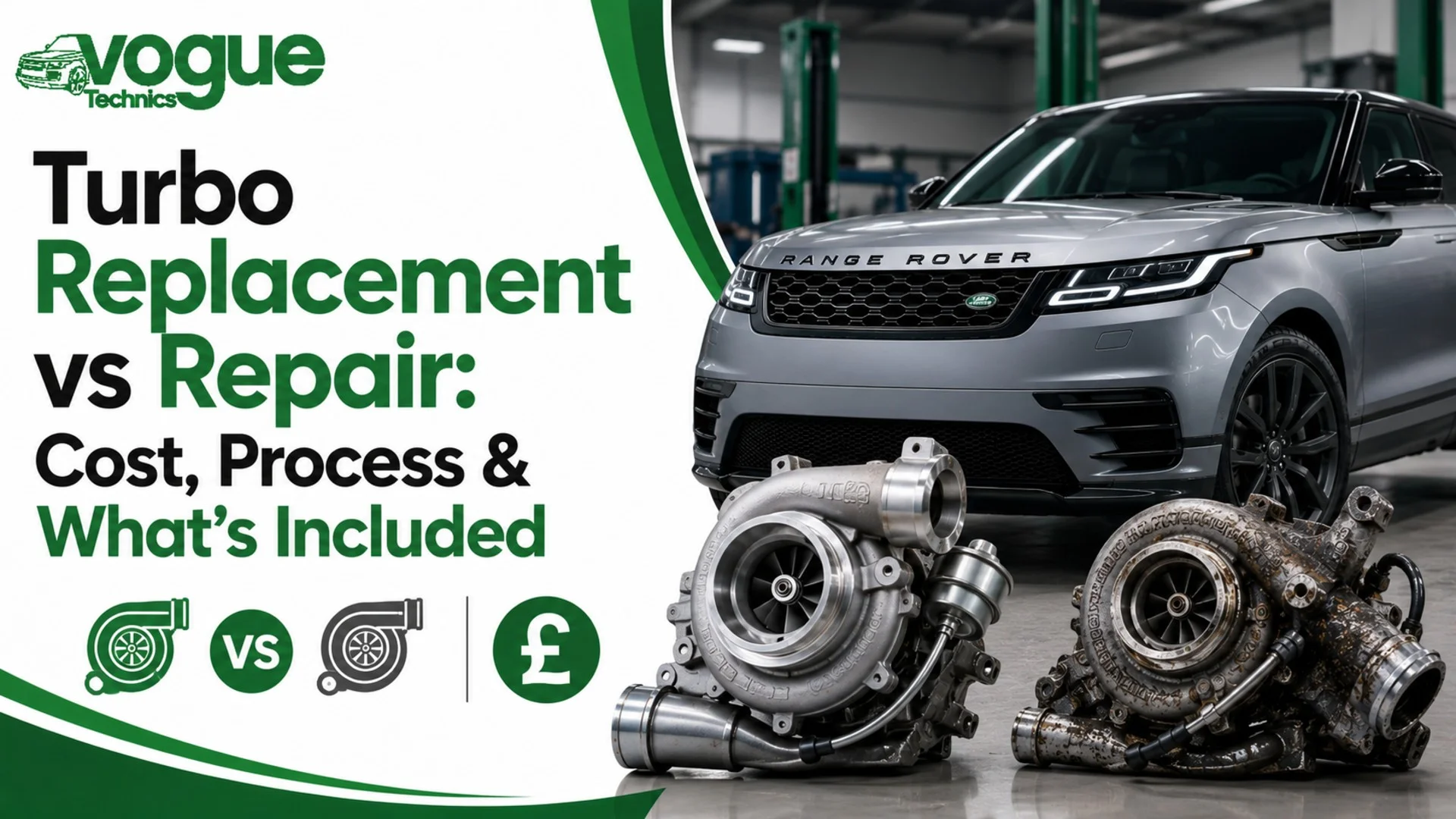
Once a turbo failure is confirmed, the next question is almost always the same: repair, replace, or rebuild — and what will it actually cost?
Range Rover Velar Turbo Replacement Cost (UK)
Costs vary depending on engine variant, whether you choose a genuine, remanufactured, or aftermarket unit, and whether any related components (oil lines, intercooler, actuator) need attention alongside the turbo itself. As a general guide:
Repair Type | Typical Scope | Relative Cost |
| Turbo actuator replacement/recalibration | Electronic component only, turbo mechanically sound | Lowest |
| Reconditioned turbo replacement | Rebuilt unit, tested to OEM spec | Moderate |
| Genuine OEM turbo replacement | Brand-new manufacturer unit | Higher |
| Turbo replacement + oil system flush/oil lines | Addresses root cause, not just symptom | Moderate–Higher |
| Full engine rebuild | Required if oil starvation caused internal engine damage | Highest |
Dealership pricing for genuine parts and labour tends to sit well above independent specialist pricing for equivalent, properly sourced parts and workmanship. Always ask for a written quote breaking down parts, labour, and any additional diagnostics before committing.
Genuine vs Reconditioned Turbochargers — Which Is Worth It?
This is one of the most common questions we get asked, and honestly, the answer depends on your situation:
- Genuine OEM turbochargers offer exact factory specification and typically come with the longest warranty backing, but at a higher upfront cost.
- Quality reconditioned turbochargers, properly tested and sourced from a reputable rebuilder, can offer excellent reliability at a lower cost — but quality varies significantly between suppliers, so provenance matters.
- Cheap aftermarket units are where we see the most repeat failures. If a quote seems unusually low, it's worth asking exactly what part and warranty is included.
Our Turbo Replacement Process at Voguetechnics
When a Velar comes in for turbo work, we don't just swap the part and send it out the door. Our process typically includes:
- Full diagnostic scan to confirm the fault is genuinely turbo-related and not a boost leak, actuator fault, or sensor issue
- Inspection of oil feed and return lines, since replacing a turbo without checking these is one of the most common causes of early repeat failure
- Intercooler inspection for oil contamination, particularly if the failure involved a seized bearing or damaged compressor wheel
- Fitting the correct turbo for your specific engine variant and running the appropriate break-in procedure
Post-Repair ECU Adaptation & Quality Checks
After a turbo replacement, the ECU often needs to relearn boost control parameters for the new unit, a step that's frequently skipped by rushed repairs. We carry out post-repair ECU adaptation and a full road test to confirm boost pressure, throttle response, and fault code clearance are all correct before the car goes back to you. Skipping this step is a common reason owners report symptoms returning within weeks of a "completed" repair elsewhere.
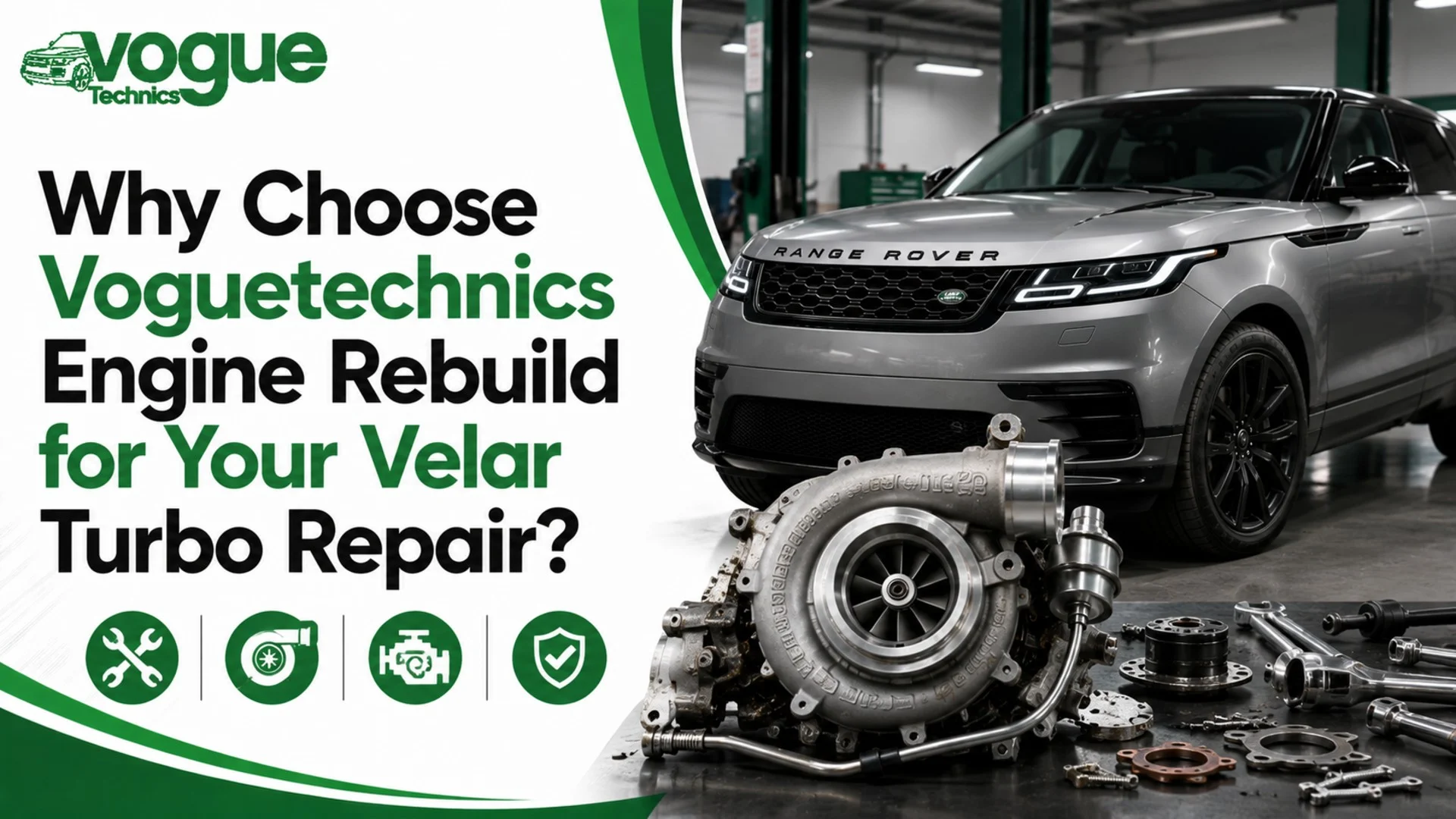
Why Choose Voguetechnics Engine Rebuild for Your Velar Turbo Repair?
Land Rover & Range Rover Specialists Based in Grays, Essex
We work specifically on Land Rover and Range Rover vehicles, including the Velar, Evoque, Range Rover Sport, and Discovery Sport, giving us hands-on familiarity with the Ingenium engine family's specific failure patterns. Being based in Grays, Essex means local owners get specialist-level diagnosis and repair without the dealership premium or the long wait times that often come with manufacturer service centres.
If you're searching for a Range Rover specialist, Land Rover mechanic, or turbo repair service near you in Essex, our workshop handles everything from initial diagnostics through to full turbo replacement, oil system servicing, and engine rebuilds where necessary.
Frequently Asked Questions
What causes Range Rover Velar turbo failure?
The most common causes are oil starvation or contamination reaching the turbo bearings, a failing electronic turbo actuator, and secondary damage from related issues like a blocked DPF, faulty EGR valve, or worn timing chain affecting oil delivery.
How much does turbo replacement cost?
Cost depends on whether you need actuator repair, a reconditioned turbo, or a full genuine OEM replacement, plus whether related components like oil lines need addressing. Independent specialists typically offer significantly better value than dealership pricing for equivalent quality work.
Can I drive with a failing turbo?
It's not advisable. A failing turbo can quickly worsen, and in cases involving oil starvation, continuing to drive risks sending metallic debris through the engine's oil system, turning a turbo repair into a full engine rebuild.
Does turbo failure damage the engine?
It can, particularly if the failure involves a seized bearing or damaged compressor wheel. Debris and oil contamination can spread into the intercooler and intake system, and in severe cases, into the engine itself.
Should the intercooler be cleaned after turbo failure?
Yes. If a turbo has failed mechanically, oil or debris frequently ends up inside the intercooler. Skipping this inspection is a common reason replacement turbos fail again shortly after installation.
Can timing chain problems damage the turbo?
Indirectly, yes. Timing chain wear can affect oil pump timing and pressure, reducing consistent oil delivery to the turbo bearings even when the oil itself is in good condition.
How long does turbo replacement take?
A straightforward turbo replacement typically takes a day, though this can extend if oil lines, the intercooler, or ECU adaptation work are required, or if diagnostics reveal additional related faults.
Book a Turbo Diagnostic or Repair Today
If your Velar is showing any of the warning signs covered above, whistling, smoke, limp mode, or reduced power, the smartest move is a proper diagnostic before the problem escalates. Get in touch with Voguetechnics Engine Rebuild in Grays, Essex for an honest assessment and a clear, itemised quote, so you know exactly what you're paying for and why. Catching turbo failure early is almost always cheaper than waiting for it to take the engine down with it.