

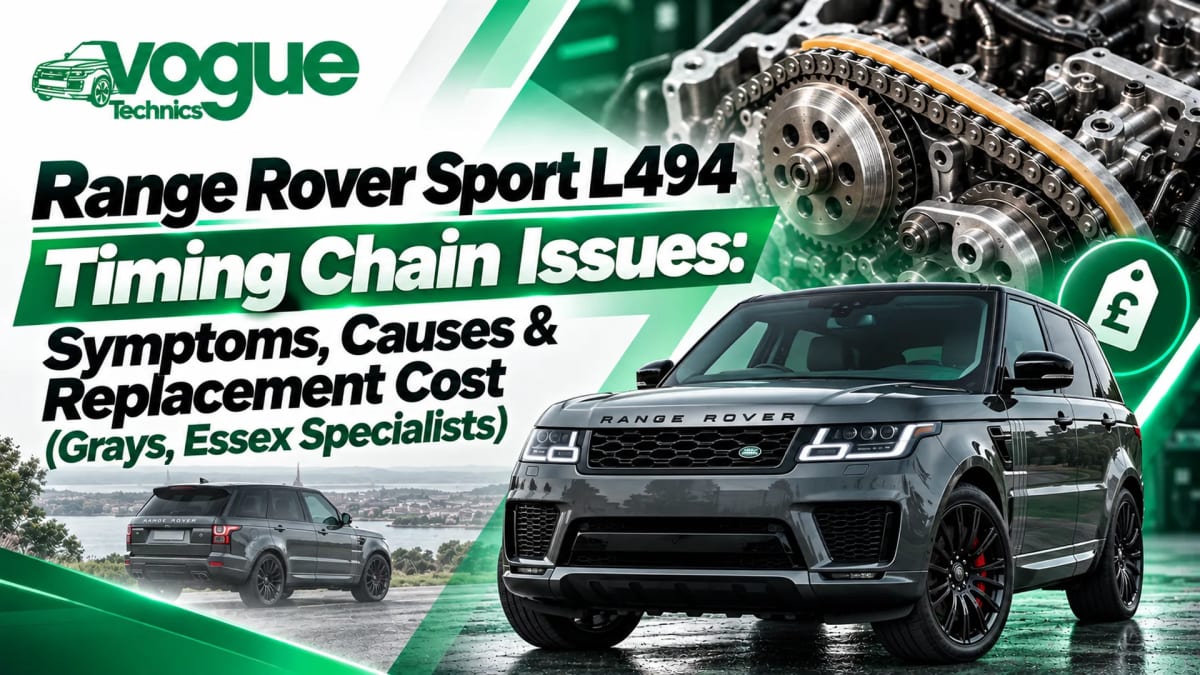
Range Rover Sport L494 Timing Chain Issues: Symptoms, Causes & Replacement Cost (Grays, Essex Specialists)
This guide breaks down what really causes timing chain issues across every Range Rover Sport L494 engine, from the 2.0 Ingenium to the 5.0 V8. It explains how to recognise the classic cold-start rattle, decode fault codes like P0016–P0341, and avoid confusing it with supercharger or turbo noise. It also walks through what a proper diagnosis and replacement job involves, plus realistic cost expectations (£2,000–£4,000) from L494 specialists in Grays, Essex.
That metallic rattle you hear when you start your Range Rover Sport on a cold morning isn't your imagination, and it isn't "just how these engines sound." If you're reading this, chances are you've already Googled the noise, found a dozen forum threads full of conflicting advice, and you're still not sure whether you're looking at a £300 fix or a £4,000 engine rebuild.
We've stripped down more L494 engines than we can count on the ramps at Vogue Technics in Grays, Essex, and the timing chain is one of the most common, and most misunderstood, faults we see walk through the door. This guide covers exactly what causes timing chain issues on the Range Rover Sport L494, how to tell if that's really what you're hearing, what the fault codes mean, and what genuine replacement work actually costs, engine by engine.
What Causes Timing Chain Issues on the Range Rover Sport L494?
The L494 (built 2013 onwards) was fitted with a wide spread of engines over its production run, from the 2.0-litre Ingenium four-cylinder right up to the 5.0-litre supercharged V8. Every one of them uses a timing chain rather than a belt, and every one of them can suffer chain-related wear, but not for identical reasons or at the same mileage.
A timing chain's job is simple: keep the camshafts and crankshaft perfectly synchronised so the valves open and close at exactly the right moment. When the chain stretches, the guides wear, or the hydraulic tensioner loses its ability to keep tension, that synchronisation starts to slip. Left unchecked, it doesn't just cause a noise, it can lead to a jumped chain, bent valves, and a wrecked engine.
Which L494 Engines Are Most Affected by Timing Chain Wear?
Not all L494 engines fail for the same reason. Here's how the main variants compare:
Engine | Main Timing Concern | Typical Trigger | Common Symptoms |
| 2.0 Ingenium (204DTD) | Chain stretch, guide wear | Oil dilution from DPF regeneration | Cold-start rattle, rough idle |
| 3.0 TDV6 | Chain, tensioner & phaser wear | Extended oil change intervals | Light-throttle rattle |
| 3.0 SDV6 (306DT) | Chain, tensioner & phaser wear | Low oil pressure, poor maintenance | Cold-start/light-throttle rattle |
| 4.4 SDV8 | Rear timing chain system wear | Oil quality, mileage | Rattle, timing-related fault codes |
| 5.0 V8 (AJ133) | Guide, tensioner & chain wear | High mileage, oil starvation | Cold-start rattle, often confused with supercharger noise |
2.0 Ingenium Timing Chain Problems
The Ingenium diesel has a particular relationship with oil dilution. During DPF regeneration, unburnt fuel can find its way into the engine oil, thinning it out and reducing the lubrication the timing chain and tensioner rely on. Over time, that accelerates chain stretch and guide wear, which is why we always check oil condition alongside the mechanical inspection on these engines.
3.0 TDV6 & SDV6 Timing Chain Problems
Both the TDV6 and SDV6 use a broadly similar timing arrangement, and both are sensitive to oil change intervals being stretched beyond the manufacturer's recommendation. We regularly see chain and tensioner wear on vehicles that have otherwise been well looked after but had one or two service intervals pushed back.
4.4 SDV8 Timing Chain Problems
The SDV8's timing chain sits at the rear of the engine, which makes it a more labour-intensive job to access. This is one of the reasons SDV8 owners sometimes get quoted eye-watering prices elsewhere, the parts aren't necessarily expensive, but the access time is.
5.0 V8 Timing Chain Problems
On the supercharged 5.0 V8, genuine timing chain wear is often mistaken for something else entirely, more on that below, because getting this distinction right can save you hundreds of pounds in unnecessary diagnostic work.
What's Actually Causing the Chain to Wear? (Oil Dilution, Tensioner & Guide Failure)
Across every L494 engine, the underlying causes tend to fall into a short list:
- Chain stretch, the chain physically elongates over time and mileage, introducing slack into the timing system.
- Worn chain guides, the plastic or composite guides that keep the chain running true degrade and can shed debris into the oil.
- Hydraulic tensioner failure, the tensioner is designed to take up slack automatically; when it fails, the chain is free to rattle against the guides.
- Low or degraded oil pressure, insufficient pressure means the tensioner can't do its job properly, even if it's mechanically sound.
- Oil dilution, particularly relevant on the Ingenium diesel, where fuel contamination thins the oil and reduces lubrication.
- Extended oil change intervals, going beyond the recommended schedule accelerates every one of the issues above.
None of these causes are unique to Range Rover, but the L494's engine layout, combined with real-world driving patterns (lots of short journeys, frequent DPF regeneration, motorway-light usage), makes it more exposed than some rivals.
How Do You Know If Your L494 Timing Chain Is Failing?

This is the section most owners land on first, usually because they've heard a noise and want to know how worried to be.
What Does an L494 Timing Chain Rattle Sound Like on Cold Start?
The classic symptom is a metallic, rattling or "diesel-like" clatter that appears for the first few seconds after starting the engine from cold, then fades once oil pressure builds. If you only hear it on a cold morning and it disappears within a few seconds of the engine running, that pattern is a strong indicator of timing chain or tensioner wear.
Timing Chain Rattle vs Supercharger, Turbo & Injector Noise
This is where a lot of owners, and, frankly, a lot of garages, get it wrong. Several other noises on the L494 can sound deceptively similar to a timing chain rattle:
- Supercharger coupler noise (5.0 V8), a whining or rattling sound that's often mistaken for chain wear, but comes from a completely different component.
- Turbo noise (diesel models), a whistling or rushing sound under acceleration, distinct from the metallic rattle of a chain.
- Injector tick, a light, rhythmic tapping that's normal on diesel engines and shouldn't be confused with chain slap.
- Auxiliary belt noise, a squeal or chirp, usually more pronounced when damp, and unrelated to the timing system.
Because these noises can overlap to an untrained ear, a proper diagnosis needs to involve more than just listening at idle, which is exactly why we combine an audible assessment with fault code analysis and, where needed, a physical inspection before we tell any customer what they're actually dealing with.
Warning Lights, Rough Idle & Loss of Power, Is It the Timing Chain?
Beyond the noise itself, watch out for:
- An illuminated engine warning light, sometimes accompanied by reduced power mode
- A rough or unstable idle, particularly noticeable when the engine is cold
- Hesitation or a flat spot under acceleration
- Misfires, especially on multi-cylinder banks
- Harder-than-usual starting
- A noticeable increase in fuel consumption
Any one of these on its own could point to several different faults. But a rattle combined with one or more of these symptoms is a strong enough pattern that we'd recommend booking a diagnostic check rather than waiting to see if it gets worse, because with a timing chain, it usually does.
Timing Chain Fault Codes Explained (P0016, P0017, P0018, P0019, P0341)
If the fault has progressed far enough to affect cam or crankshaft correlation, your L494 may store one of the following diagnostic trouble codes:
Code | What It Means |
| P0016 | Crankshaft/camshaft correlation fault, Bank 1, Sensor A |
| P0017 | Crankshaft/camshaft correlation fault, Bank 1, Sensor B |
| P0018 | Crankshaft/camshaft correlation fault, Bank 2, Sensor A |
| P0019 | Crankshaft/camshaft correlation fault, Bank 2, Sensor B |
| P0341 | Camshaft position sensor performance fault |
It's worth noting that these codes don't automatically confirm a stretched timing chain. A failing camshaft or crankshaft position sensor can trigger identical codes without any mechanical timing chain wear at all. This is a genuine gap in a lot of online advice, pulling a code and assuming the worst can lead owners into paying for parts they don't need. The only reliable way to tell the difference is a proper correlation test alongside a physical inspection, which is standard procedure whenever one of these codes comes up on our diagnostic bench.
Can You Still Drive With a Timing Chain Rattle?
Short journeys at low speed, in theory, won't cause immediate failure. But we'd stop short of calling it "safe." A rattling chain is a chain that's already lost tension or worn guides, and every mile you drive on it increases the risk of the chain skipping a tooth on the sprocket. Once that happens, you're no longer looking at a chain replacement, you're looking at valve damage, piston contact, or in the worst cases, a full engine rebuild. If you've heard the rattle more than once, it's worth getting it looked at before your next long drive, not after.
Range Rover Sport L494 Timing Chain Replacement & Cost
How We Diagnose Timing Chain Faults at Vogue Technics
Before we quote anyone for a timing chain job, we go through a structured process rather than guessing from a noise alone:
- Full diagnostic scan to read and interpret any stored fault codes
- Cold-start assessment to listen for the characteristic rattle pattern
- Oil condition and level inspection, checking for dilution or contamination
- Camshaft-to-crankshaft correlation analysis
- Physical inspection of chain slack, guides and tensioner where access allows
- A clear, honest explanation of what we've found before any work is agreed
This matters because, as covered above, the symptoms of a genuine timing chain fault can overlap with sensor faults, supercharger noise, and normal diesel characteristics. Skipping straight to a replacement without proper diagnosis is how owners end up paying for work they didn't need.
What Happens During Timing Chain Replacement?
Once a timing chain fault is confirmed, the job typically involves:
- Removing the components necessary to access the timing cover (varies significantly by engine)
- Locking the engine at top dead centre to preserve correct timing
- Replacing the chain, guides, and tensioner as a full kit rather than individual parts
- Replacing VVT or cam phaser components where wear is found
- Resetting mechanical timing to manufacturer specification
- Carrying out a full oil and filter service
- Clearing fault codes and running a post-repair diagnostic scan
- A road test to confirm the fault is fully resolved
We always replace guides and tensioners alongside the chain itself. Fitting a new chain onto worn guides is a false economy, it simply means you're back in the workshop within a year or two.
How Much Does L494 Timing Chain Replacement Cost?
There's no single honest answer to "how much does it cost," because it genuinely depends on the engine and its condition. As a rough guide, specialist timing chain replacement on the L494 typically falls somewhere between £2,000 and £4,000, with the 3.0-litre SDV6/TDV6 and 5.0 V8 generally sitting at the higher end due to access complexity.
Why Cost Varies by Engine (Access, Removal & Parts)
Several factors influence the final price:
- Engine access, the 4.4 SDV8's rear-mounted timing chain, for example, requires considerably more labour than a more accessible front-mounted arrangement.
- Parts required, a full chain, guide and tensioner kit costs more than a tensioner alone, but is almost always the right call for a lasting repair.
- Secondary damage, if the fault has been left to run for a while, you may also need cam phaser or VVT components, adding to the total.
- Specialist labour rate, Land Rover-specific specialist knowledge, while not the cheapest option on paper, typically avoids the comebacks and repeat visits we see with less experienced garages.
We'll always give you a proper breakdown before we start, so you know exactly what you're paying for and why, not a vague "engine work" line on an invoice.
Preventing Timing Chain Failure & Booking a Specialist in Grays, Essex
How to Extend the Life of Your L494 Timing Chain
A timing chain will never last forever, but you can meaningfully extend its working life:
- Stick to the manufacturer's recommended oil change interval, or shorter if you do a lot of short journeys
- Use the correct oil specification for your engine, this isn't an area to cut corners on
- Let DPF regenerations complete fully rather than switching the engine off partway through
- Get any cold-start rattle checked early, rather than waiting for it to become a warning light
- Keep a full service history, which also protects your car's resale value
Why Choose Vogue Technics Engine Rebuild for Your Range Rover Sport
We're based in Grays, Essex, and we work on Range Rover and Land Rover engines day in, day out, not as one job among many general repairs, but as our specialism. That means when you bring in an L494 with a rattle, we're not guessing based on a forum thread; we're drawing on genuine hands-on experience with these exact engines, across the Ingenium, TDV6, SDV6, SDV8 and V8 range.
We give straight answers, itemised quotes, and we won't recommend a full replacement if the problem turns out to be something smaller. That's the kind of trust that keeps customers coming back for their next service, not just their timing chain repair.
Book Your Timing Chain Inspection Today
If your Range Rover Sport L494 is rattling on cold start, showing a warning light, or just doesn't feel right, don't wait for it to get worse. Get in touch with Vogue Technics Engine Rebuild in Grays, Essex, for a proper diagnostic check and an honest assessment of what's actually going on under the bonnet.
FAQs: Range Rover Sport L494 Timing Chain Issues
What are the symptoms of timing chain problems on a Range Rover Sport L494?
The most common signs are a metallic rattle on cold start, rough idle, an illuminated engine warning light, reduced power, hesitation under acceleration, and occasionally misfires. Symptoms often start subtly and worsen over time.
Why does my Range Rover Sport L494 rattle on cold start?
This is usually caused by a worn timing chain, degraded guides, or a failing hydraulic tensioner losing tension while oil pressure is still building after start-up. The rattle typically fades once the engine warms and oil pressure normalises.
Can a timing chain cause a check engine light?
Yes. If chain wear affects camshaft-to-crankshaft timing correlation, it can trigger codes such as P0016, P0017, P0018, P0019, or P0341. However, these same codes can also be caused by a faulty sensor, so a proper diagnostic check is essential before assuming the worst.
Can you drive with a timing chain rattle?
You can in the short term, but it's not something to ignore. A rattling chain has already lost tension or worn guides, and continuing to drive increases the risk of the chain jumping timing, which can cause serious internal engine damage.
How much does L494 timing chain replacement cost?
Specialist replacement typically ranges from around £2,000 to £4,000, depending on the engine, parts required, and labour access. The 3.0-litre and 5.0-litre V8 variants tend to sit toward the higher end due to increased complexity.
Does the engine need to be removed to replace the timing chain?
It depends on the engine and access to the timing cover. Some variants, like the 4.4 SDV8, have a rear-mounted chain that requires significantly more disassembly than others.
How can you tell a bad sensor from a genuine timing chain fault?
Fault codes alone can't confirm the difference, both a worn chain and a faulty camshaft or crankshaft sensor can trigger identical correlation codes. A proper diagnosis requires a correlation test combined with a physical inspection.