

Signs of a Blown Head Gasket in Your Land Rover (And What to Do Before It's Too Late)
A blown head gasket is one of the most common — and most misunderstood — faults affecting Land Rovers. This guide breaks down the real warning signs, from white exhaust smoke and unexplained coolant loss to milky oil and overheating, so you can catch the problem early. It also explains why Land Rover engines are especially prone to this issue and what your repair options look like once it's confirmed.
Your Land Rover is running hotter than usual. There's a strange white haze drifting from the exhaust. The coolant reservoir keeps emptying, and you can't find a single drop on the driveway. If any of that sounds familiar, you're probably already suspecting the worst, and honestly, your instincts might be right.
A blown head gasket is one of the most common (and most expensive) faults we see on Land Rovers at our workshop in Grays, Essex. It's also one of the most misunderstood. Some owners panic over a minor coolant top-up. Others keep driving for weeks with a genuinely failing gasket, not realising the damage building up underneath.
This guide walks you through exactly what a head gasket does, the real warning signs to watch for, why Land Rovers seem particularly prone to this fault, and what your options are once you've confirmed the problem. No jargon for the sake of it, just what you actually need to know before your engine pays the price.
What Is a Head Gasket and Why Do Land Rovers Suffer From It?
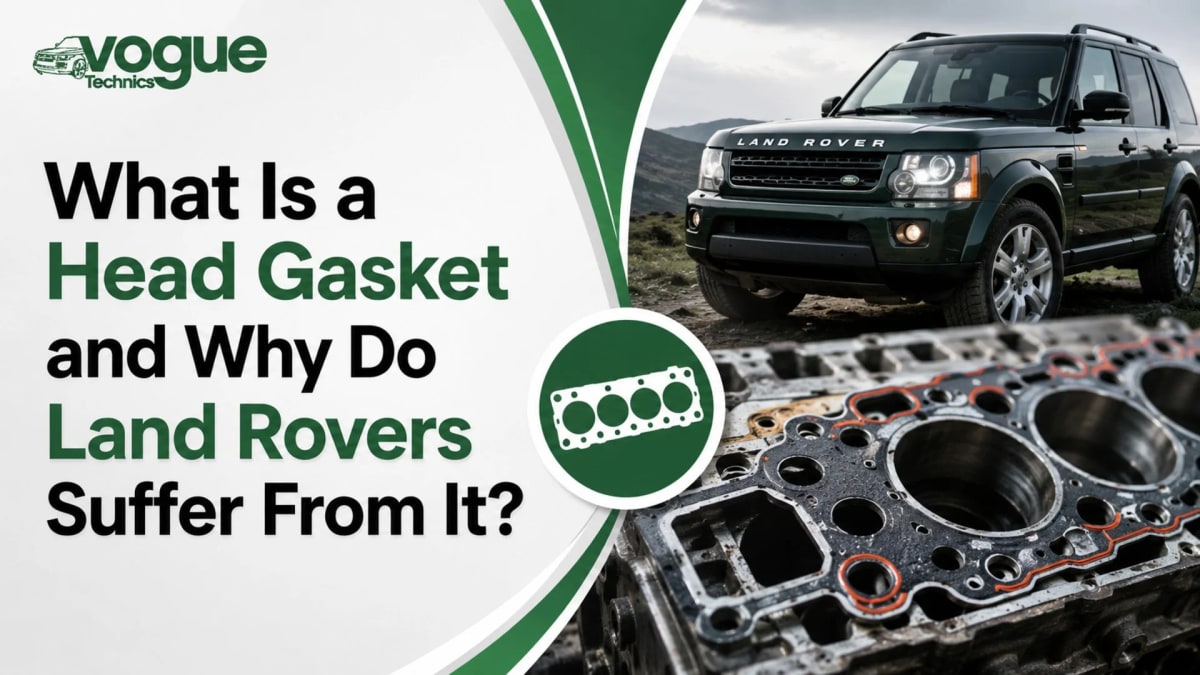
Before you can spot the warning signs, it helps to understand what you're actually dealing with.
How does a head gasket work in a Land Rover engine?
The head gasket sits between the cylinder head and the engine block, two of the most critical components in your engine. Its job sounds simple: seal that junction so combustion pressure, engine oil, and engine coolant all stay exactly where they're supposed to be.
In practice, that gasket is doing a lot of heavy lifting. It has to withstand extreme heat, constant pressure changes from combustion, and the physical clamping force of the head bolts, all while keeping three separate systems (oil, coolant, and combustion gases) completely isolated from one another.
When it fails, even a small breach in that seal lets things cross over that were never meant to mix. Coolant can leak into the combustion chamber. Oil can find its way into the cooling system. Combustion gases can pressurise the cooling system itself. Once that barrier is compromised, problems escalate fast.
Why are Land Rover engines more prone to head gasket failure than other brands?
This is where a lot of owners get frustrated, because it's not always about how the car has been driven or maintained. Several Land Rover engine families have known design characteristics that make them more vulnerable:
- Aluminium cylinder heads paired with different expansion rates, aluminium heats and expands differently to the engine block beneath it, putting extra stress on the gasket during heat cycles.
- Tight tolerances in engines like the AJ-V8 and TDV6, leave less margin for error if the cooling system underperforms even slightly.
- Turbocharged and supercharged variants (including the 3.0 SDV6 and 5.0 Supercharged units), run at higher combustion pressures, which puts additional load on the head gasket seal.
- The 2.0 Ingenium engine, while more modern, has had documented cases of gasket-related coolant loss, often linked to specific production batches.
None of this means every Land Rover will develop this fault. But it does explain why head gasket failure shows up so consistently across the range, from the Discovery Sport to the Range Rover Evoque to the Defender, regardless of how carefully the vehicle has been looked after.
How Do You Know If Your Land Rover's Head Gasket Is Blown?

This is the part you're really here for. Head gasket failure rarely announces itself with one dramatic symptom, it usually builds gradually, and catching it early can be the difference between a gasket replacement and a full engine rebuild.
Here's what to actually watch for.
Is white smoke from the exhaust a sign of a blown head gasket?
Yes, and it's one of the clearest indicators. When coolant leaks into the combustion chamber and burns alongside fuel, it produces a distinctive thick white smoke, often with a faintly sweet smell (that's the antifreeze burning).
It's worth knowing the difference:
- White smoke that's thin and disappears quickly in cold weather is usually just condensation, completely normal, especially on a cold morning start.
- White smoke that's dense, persistent, and smells sweet is a strong sign coolant is entering the engine's combustion process. This isn't something that resolves on its own.
If you notice the smoke gets worse under acceleration or after the engine has been running for a while, that's a further red flag pointing toward gasket failure rather than a simple condensation issue.
Why is my Land Rover losing coolant with no visible leak?
This one catches a lot of owners off guard. You top up the coolant, check under the car, check the hoses, check the radiator, and there's nothing. No puddle, no stain, no obvious external leak.
That's because the coolant isn't leaking onto your driveway. It's leaking internally, either into the combustion chamber, where it burns off as exhaust vapour, or into the engine oil, where it mixes and contaminates the lubricant.
If you're topping up coolant more than once every few weeks and can't trace an external source, that's a strong signal something inside the engine is compromised.
Why is my Land Rover overheating at idle or on the motorway?
A failing head gasket disrupts the sealed pressure of your cooling system. Combustion gases can leak into the coolant passages, creating pockets of pressure and air that interfere with proper circulation. The result is an engine that struggles to maintain a stable temperature.
Some owners notice overheating specifically at idle, when coolant flow relies more heavily on the water pump and less on airflow. Others notice it more on the motorway, where sustained high revs put more thermal load on the system. Either pattern can point to the same underlying issue.
If your temperature gauge is creeping toward the red, or your engine warning light has come on with an overheating alert, treat it as urgent. Continuing to drive on an overheating engine is one of the fastest ways to turn a repairable gasket fault into a cracked cylinder head or warped block.
Can coolant mixing with engine oil confirm head gasket failure?
This is one of the most reliable diagnostic signs there is. When coolant contaminates engine oil, it creates a distinctive milky, mayonnaise-like residue, usually visible:
- On the underside of the oil filler cap
- On the dipstick
- Within the oil itself, which may appear cloudy or frothy rather than clear amber
This mixing doesn't just indicate a head gasket problem, it actively damages your engine further. Oil contaminated with coolant loses its ability to lubricate properly, which accelerates wear on bearings, camshafts, and other internal components. If you spot this, it's not a "monitor it" situation. It's a "get it looked at now" situation.
Is bubbling in the coolant expansion tank a warning sign?
Yes, and it's often one of the earliest signs, even before overheating becomes obvious. If you open the expansion tank (only ever when the engine is cold) and see bubbling or fizzing in the coolant, that typically means combustion gases are escaping into the cooling system through a compromised gasket seal.
This pressurises the cooling system beyond its normal range, which can cause coolant to be pushed out through the overflow, gradually lowering your coolant level even without an external leak, tying directly back to the coolant loss issue mentioned above.
What Causes Head Gasket Failure in Land Rovers?

Understanding why this happens helps you prevent it from recurring, especially after a repair.
Can engine overheating cause a head gasket to blow?
Absolutely, and it's one of the most common causes we see. When an engine overheats, the cylinder head and block expand unevenly. That uneven expansion puts the head gasket under stress it wasn't designed to handle, and repeated overheating events weaken the seal until it eventually fails.
This creates a frustrating cycle: overheating can cause gasket failure, and gasket failure causes further overheating. It's why acting quickly at the first sign of an overheating engine matters so much.
Does wear and tear alone lead to gasket failure?
Sometimes, yes. Head gaskets are wear items, and after tens of thousands of miles of heat cycling, expansion, and contraction, the material naturally degrades. This is more common in older Land Rovers or those with higher mileage, where the gasket has simply reached the end of its practical lifespan.
Regular servicing won't necessarily prevent this entirely, but it does help you catch early signs before they turn into a full failure.
Is Land Rover engine design part of the problem?
In several cases, yes. As mentioned earlier, certain Land Rover engines have known design characteristics, tight tolerances, aluminium-to-block heat expansion differences, and high-pressure turbocharged or supercharged configurations, that make head gasket failure more likely compared to some other manufacturers.
This is worth knowing not to place blame, but because it changes how you should approach maintenance. If you own a model with a known history of this issue, proactive cooling system checks matter more than they might on a vehicle with no such pattern.
What Should You Do Next? Diagnosis, Repair Costs & Getting It Fixed Right

Spotting the signs is only half the job. Here's what actually happens next, and how to make sure it's handled properly.
Can you still drive a Land Rover with a blown head gasket?
Technically, for a very short distance, in an emergency, but we wouldn't recommend it, and here's why. Once a head gasket has failed, continuing to drive risks:
- Overheating damage to the cylinder head or engine block, potentially cracking or warping either
- Coolant contamination of the engine oil, accelerating internal wear
- Complete loss of coolant, leading to catastrophic overheating and possible engine seizure
What starts as a gasket replacement can quickly become a full engine rebuild or replacement if you keep driving on it. If you're experiencing any of the symptoms above, the safest move is to stop driving and arrange a proper diagnosis as soon as possible.
How is a blown head gasket professionally diagnosed?
A good workshop won't just take a guess based on symptoms, they'll confirm it properly using a combination of tests:
Diagnostic Method | What It Checks |
| Compression test | Measures pressure in each cylinder; low or uneven readings can indicate a gasket leak |
| Leak-down test | Pressurises the cylinder to pinpoint exactly where compression is escaping |
| Coolant pressure test | Checks whether the cooling system holds pressure correctly, or whether it's leaking internally |
| Combustion/exhaust gas test | Detects combustion gases present in the coolant, a clear sign of gasket breach |
| Visual oil and coolant inspection | Checks for milky oil residue or contaminated coolant |
This kind of thorough diagnostic process matters, because a misdiagnosis (say, mistaking a bad thermostat or a failing water pump for a head gasket issue) can mean paying for the wrong repair entirely. A proper diagnosis rules out related causes like a cracked radiator hose, faulty cooling fan relay, or failing thermostat housing before confirming the gasket itself is at fault.
How much does head gasket replacement cost on a Land Rover?
Costs vary depending on the model, engine type, and the extent of any secondary damage, but here's a general picture of what's typically involved:
- Straightforward gasket replacement (caught early, no further engine damage), this is the more affordable end of the repair
- Gasket replacement with cylinder head resurfacing (required if the head has warped from overheating), a noticeably higher cost due to the additional machining work
- Full engine rebuild or replacement (if overheating has caused block cracking or serious internal damage), the most expensive outcome, and the one you're trying to avoid by catching symptoms early
This is exactly why early diagnosis matters so much financially. The gap between "we replaced the gasket" and "we had to rebuild the engine" is often several times the cost, and it's almost always driven by how long the fault was left unaddressed.
Why choose Vogue Technics Engine Rebuild for diagnosis and repair in Grays, Essex?
We specialise in exactly this kind of work. Our team handles Land Rover head gasket diagnosis, repair, and, where necessary, full engine rebuilds, using proper diagnostic testing rather than guesswork.
If you're anywhere near Grays, Essex, and you're seeing any combination of the symptoms above, overheating, white smoke, unexplained coolant loss, or milky oil, we'd rather you bring it in for a proper diagnostic check now than wait until the damage spreads. Catching a head gasket issue early is almost always the difference between a manageable repair bill and a much bigger one.
Frequently Asked Questions
What are the signs of a blown head gasket? The most common signs include white smoke from the exhaust, unexplained coolant loss with no visible leak, engine overheating, milky residue in the engine oil, and bubbling in the coolant expansion tank. Rough idling, engine misfires, and reduced power can also occur as compression is lost.
Can you drive with a blown head gasket? You can, technically, for a very short distance, but it's not advisable. Continuing to drive risks turning a repairable gasket issue into serious engine damage, including a cracked cylinder head or warped engine block.
What causes a blown head gasket? The most common causes are engine overheating, general wear and tear over time, and in some Land Rover models, design factors like tight engine tolerances or high combustion pressures from turbocharged and supercharged units.
Will a blown head gasket cause overheating? Yes. A failing gasket disrupts the cooling system's sealed pressure, allowing combustion gases to enter the coolant and interfere with proper circulation, which commonly leads to overheating.
Can coolant disappear without any visible leaks? Yes. If a head gasket has failed internally, coolant can leak into the combustion chamber or engine oil rather than out of the vehicle, which means there's no external puddle or stain to find, even though coolant levels keep dropping.
Is a blown head gasket repairable? In most cases, yes, provided it's caught before secondary damage (like a warped cylinder head or cracked block) occurs. That's why early diagnosis is so important.
How much does head gasket replacement cost? Costs depend on the engine, model, and whether any additional damage (like head resurfacing) is needed. A straightforward replacement caught early is significantly cheaper than a repair that also requires addressing overheating damage.
Don't Wait for a Small Problem to Become a Major One
Head gasket failure rarely happens overnight. It builds gradually, a bit of coolant loss here, a slightly higher temperature gauge reading there, until one day the symptoms are impossible to ignore. The good news is that if you've noticed any of the warning signs covered in this guide, you're already ahead of the curve simply by paying attention.
The next step is getting a proper diagnosis before the fault has a chance to spread further into your engine. If you're in or around Grays, Essex, and something doesn't feel right with your Land Rover's cooling system, get in touch with our team at Vogue Technics Engine Rebuild. We'll run the proper diagnostic checks, give you a clear picture of what's actually going on, and talk you through your options, honestly and without the upsell.