
Velar Ingenium 2.0 vs 3.0 Six-Cylinder Reliability: Which Range Rover Velar Engine Should You Trust?
This guide breaks down the real reliability differences between the Range Rover Velar's 2.0 four-cylinder and 3.0 inline-six Ingenium engines, covering their common failure points, engine codes, and typical repair costs. It explains why the 2.0 Ingenium is prone to timing chain and oil dilution issues, while the 3.0 six-cylinder's added turbo and mild-hybrid complexity brings its own risks. The article also covers running costs, high-mileage ownership tips, and when a reconditioned engine replacement makes more sense than repair.
Your Range Rover Velar has just thrown up a warning light on the motorway, or maybe you're sat in a dealer's forecourt trying to decide between a four-cylinder diesel and the six-cylinder petrol. Either way, you've landed here because you need a straight answer: is the 2.0 Ingenium actually less reliable than the 3.0 inline-six, or is that just internet folklore?
We've pulled apart the real-world failure patterns, the engine codes, the running costs, and the mileage where problems tend to surface , so you can make a decision based on evidence, not forum panic. Whether you're buying used, weighing up a repair bill, or trying to work out if your current engine is worth saving, this guide covers it end to end.
Velar 2.0 vs 3.0 Ingenium , Engine Specs, Codes and Key Differences
Before you can judge reliability, you need to know exactly which engine you're dealing with. Land Rover Range Rover Velar has been sold with a confusing spread of engine codes since 2017, and JLR (Jaguar Land Rover) hasn't made it easy to tell them apart from a badge alone.
The Ingenium family covers everything from a modest four-cylinder diesel to a genuinely potent inline-six petrol, and the gap between the weakest and strongest variant is bigger than most buyers realise.
What Power, Torque and Fuel Economy Does Each Velar Engine Offer?
The Range Rover Velar engine options split broadly into two families: the 2.0-litre four-cylinder Ingenium (diesel and petrol) and the 3.0-litre Ingenium inline-six (diesel and petrol, both mild-hybrid).
Here's how they stack up:
Engine | Fuel | Power | 0-60mph | Real-world mpg |
| D200 | 2.0 Diesel | 201bhp | 8.4s | 38-42mpg |
| D240 | 2.0 Diesel | 237bhp | 7.3s | 36-40mpg |
| P250 | 2.0 Petrol | 247bhp | 6.5s | 26-30mpg |
| P340 | 2.0 Petrol | 296bhp | 6.1s | 25-28mpg |
| D300 | 3.0 Diesel | 296bhp | 6.5s | 33-37mpg |
| P400 | 3.0 Petrol | 395bhp | 5.2s | 22-26mpg |
The four-cylinder cars are lighter on fuel and cheaper to insure. The six-cylinder cars pull harder, tow better, and feel noticeably smoother at motorway speeds , but that refinement comes with a heavier servicing bill and a more complex mild-hybrid system to keep healthy.
Ingenium Engine Codes Explained , D200, D240, D300, P250, P340, P400
If you're buying a used Velar, the engine code on the V5 or the build plate tells you far more than the badge on the tailgate. Here's the quick decode:
- D200 / D240 – 2.0-litre four-cylinder diesel (AJ20D4). Entry and mid-tier diesel, no six-cylinder complexity.
- D300 – 3.0-litre inline-six diesel (AJ20D6). Mild-hybrid, more torque, more moving parts.
- P250 / P340 – 2.0-litre four-cylinder petrol (AJ20P4). Lighter, punchier for its size, less common in the UK market.
- P400 – 3.0-litre inline-six petrol (AJ20P6). The performance flagship, also mild-hybrid with a 48V system.
Knowing this code matters practically. If you're calling around for parts, diagnostics, or an engine replacement quote, quoting the correct AJ20 code (rather than just "2.0 diesel") gets you an accurate price the first time.
Which Velar Trim Comes With the 2.0 Four-Cylinder or 3.0 Inline-Six?
Land Rover shuffled engine availability by trim and model year, which is part of why so many owners aren't sure what's actually under the bonnet. As a general rule:
- Entry-level and mid-spec Velars (S, R-Dynamic S) were most commonly fitted with the D200, D240, or P250.
- Higher trims (R-Dynamic HSE, First Edition, SVAutobiography) leaned toward the D300 and P400.
- Facelifted Velars from 2020 onward standardised the mild-hybrid system across the six-cylinder range, and later extended 48V assistance to the four-cylinder diesels too.
If your logbook or dealer listing doesn't specify, the engine code is stamped on the vehicle identification plate , worth checking before you commit to any repair quote based on assumption.
Which Ingenium Engine Is More Reliable , 2.0 Four-Cylinder or 3.0 Inline-Six?
This is the question that actually brought most people to this page, so let's answer it directly: neither engine is bulletproof, but they fail in different ways, at different mileages, for different reasons.
The 2.0 Ingenium has a well-documented history of timing chain and oil dilution issues, particularly on pre-2020 diesel units. The 3.0 inline-six is mechanically newer and generally more robust, but its added complexity , turbocharging, cooling circuits, and the 48V mild-hybrid system , introduces its own failure points that the simpler four-cylinder doesn't have.
Range Rover Velar reliability, in other words, isn't a single number. It depends on which engine, which model year, and how the car was serviced.
Common Problems With the 2.0 Ingenium Diesel and Petrol
The 2.0 Ingenium built its reputation , fairly or not , on a cluster of recurring faults that JLR has since addressed through software and hardware revisions, but which still affect a meaningful number of cars on UK roads.
Timing Chain Stretch and Tensioner Failure
Early 2.0 Ingenium diesels (roughly 2017-2019) were prone to timing chain stretch, often preceded by a rattling noise on cold start. Left unaddressed, chain stretch can throw the timing out enough to cause valve-to-piston contact , a catastrophic engine failure that usually means a full rebuild or replacement rather than a repair.
If you notice a rattle in the first few seconds after starting a cold Velar, that's not something to wait out. Book a diagnostic scan promptly.
Oil Dilution and Oil Starvation Symptoms
The other well-known 2.0 Ingenium issue is oil dilution , diesel fuel finding its way into the engine oil during frequent short journeys or repeated DPF regeneration cycles. Diluted oil loses viscosity, which accelerates wear on bearings and, in worse cases, leads to oil starvation at the top end of the engine.
Watch for:
- Oil level appearing to rise between services (a strong warning sign, not a bonus)
- A persistent diesel smell from the dipstick
- Engine management or oil pressure warning lights after motorway runs following mostly urban driving
Regular oil analysis and shorter service intervals for high-urban-mileage cars go a long way toward catching this early.
Common Problems With the 3.0 Inline-Six Ingenium
The 3.0 Ingenium inline-six is a more modern design and, mile for mile, tends to be the more dependable engine , but "more reliable" doesn't mean "trouble-free."
Turbocharger and Cooling System Failures
The 3.0 six-cylinder relies on either a single or twin-turbo setup depending on the tune (D300 vs P400), and turbo oil feed issues can develop if servicing slips or low-quality oil is used. Coolant leaks around the thermostat housing are also a recurring theme reported by independent Land Rover specialists, sometimes triggering overheating warnings well before any serious damage occurs , which is actually the best-case scenario, since it gives you time to act.
MHEV / 48V Belt Starter Generator Faults
Every 3.0 Ingenium in the Velar range uses mild-hybrid assistance (MHEV) via a Belt Starter Generator and a 48V lithium-ion battery. When this system develops a fault, you'll typically see it as a loss of the stop-start function, a rough idle-restart, or an ECU software warning rather than a total breakdown , but the repair cost for BSG or 48V battery issues can be significant, and it's a component the four-cylinder diesel simply doesn't have to worry about.
Does Reliability Improve by Model Year?
Yes, meaningfully. JLR issued several ECU software updates and hardware revisions to the 2.0 Ingenium's timing chain tensioner and oil dilution management between 2018 and 2021. Cars built from 2020 onward, particularly post-facelift models, show a noticeably lower rate of the classic Ingenium complaints in owner forums and specialist workshop data.
If you're comparing two used Velars of similar mileage, a 2021-plus build date is generally a safer bet than an early 2017-2018 car, regardless of which engine you're looking at.
Running Costs, Repair Bills and High-Mileage Ownership
Reliability isn't only about whether an engine fails , it's about what it costs you along the way, and whether it's still worth owning once the odometer creeps past six figures.
Fuel Economy and Real-World Running Costs , 2.0 vs 3.0 Compared
The 2.0 diesel Ingenium remains the cheapest Velar to run day to day. Real-world owners typically report high 30s to low 40s mpg on a well-maintained D200 or D240, alongside lower road tax and insurance banding.
The 3.0 six-cylinder costs more to feed and more to service , expect a meaningful drop in fuel economy, particularly on the P400 petrol, plus higher parts costs for anything involving the turbo, cooling system, or MHEV components. For most private buyers doing mixed motorway and city driving, the 2.0 diesel remains the more economical long-term choice; for those regularly towing or covering big motorway miles, the 3.0's extra torque and refinement often justify the higher running cost.
Typical Repair, Rebuild and Replacement Costs for Each Engine
Repair costs vary enormously depending on whether you're looking at a straightforward fix or a full engine replacement. As a rough UK guide:
- Timing chain replacement (2.0 Ingenium): a labour-intensive job due to engine layout, often running into four figures at a franchise dealer, less through an independent specialist.
- Turbocharger replacement (3.0 six-cylinder): typically more expensive than the four-cylinder equivalent due to part cost and access.
- Full engine replacement: by far the largest single cost, and where reconditioned or supply-and-fit engine services become the far more economical route compared to a brand-new unit from a main dealer.
If your Velar has already suffered a catastrophic engine failure , bent valves from chain failure, or a seized bottom end from oil starvation , repair often isn't cost-effective. That's the point where a reconditioned engine replacement becomes the sensible option rather than throwing money at a doomed unit.
Is the Velar Still Reliable Past 100,000 Miles?
Both engines can comfortably clear 100,000 miles with proper care , but "proper care" is doing a lot of work in that sentence. High-mileage Velar ownership success stories almost always share the same pattern: consistent service intervals, quality synthetic low SAPS oil, and prompt attention to early warning signs rather than waiting for a warning light to become a limp mode event.
Preventative Maintenance Checklist for High-Mileage Ingenium Owners
If you're planning to keep your Velar well past 100k miles, build these into your routine:
- Shorter oil change intervals than the standard schedule if your driving is mostly short urban trips, to counter oil dilution risk
- Regular oil analysis for high-mileage cars, particularly on the 2.0 diesel, to catch dilution or wear metal contamination before it becomes expensive
- Coolant system checks every service on the 3.0 six-cylinder, given its more complex cooling circuit
- A specialist diagnostic scan at the first sign of any dashboard warning, rather than continuing to drive and hoping it clears itself
- DPF regeneration awareness , letting the diesel complete full regeneration cycles rather than repeatedly interrupting short journeys
None of this guarantees a fault-free engine, but it significantly shifts the odds in your favour, and it's the same advice independent Land Rover specialists give paying customers every week.
Need a Velar Engine Replacement? Talk to Voguetechnics Engine Rebuild
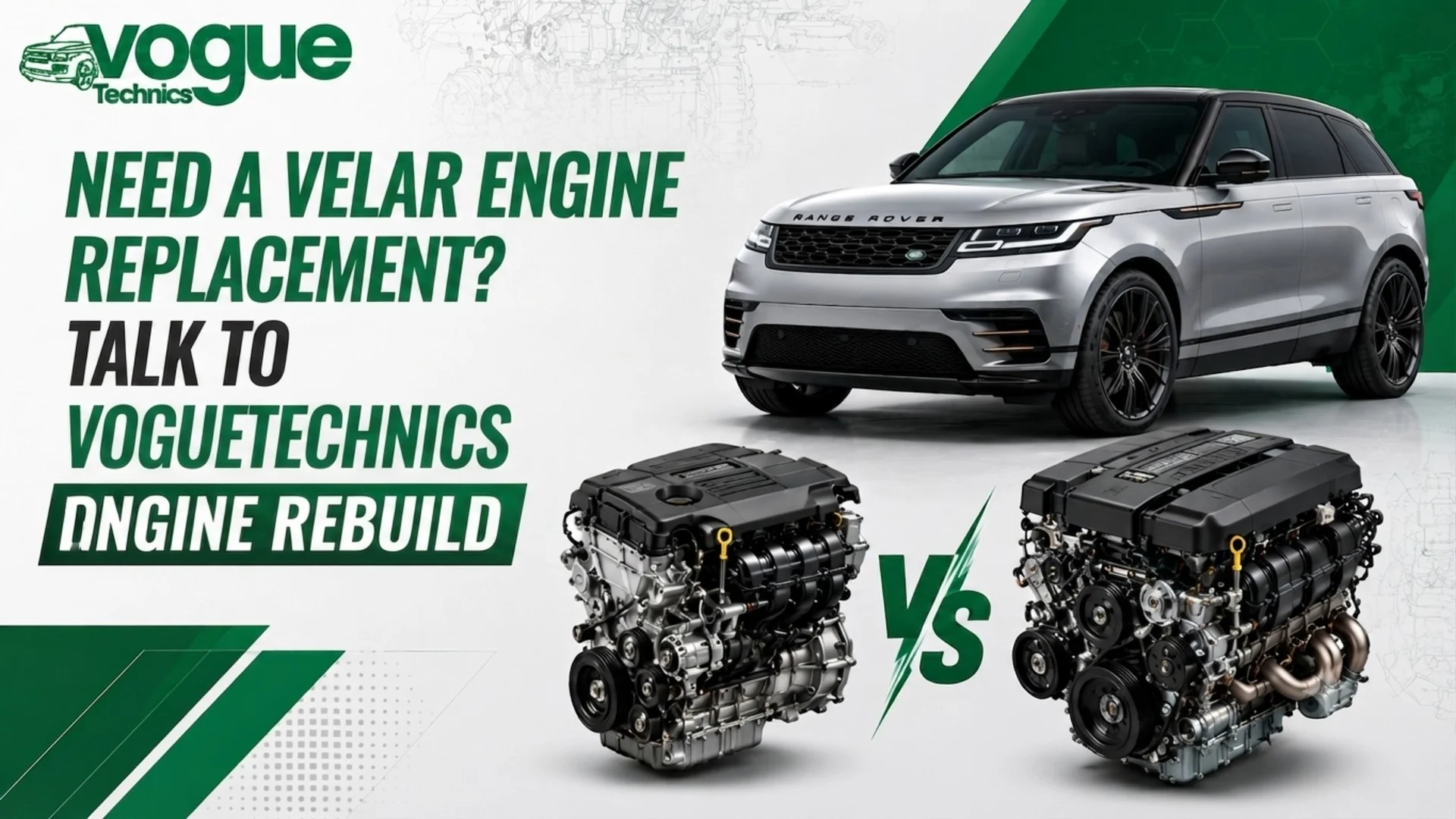
If you've read this far because your own Velar is already showing symptoms , a rattling cold start, a warning light that won't clear, or a diagnostic report confirming a failed timing chain or turbo , the practical question shifts from "which engine is more reliable" to "what's my best next step."
Reconditioned vs Used Velar Engine , Which Should You Choose?
Both options can get your Velar back on the road, but they carry different risk profiles:
- Used engines are pulled from another vehicle, usually cheaper upfront, but come with unknown service history and no guarantee against the same issue recurring , particularly relevant if you're replacing a chain-stretched 2.0 Ingenium with another engine of unknown mileage and maintenance record.
- Reconditioned engines are stripped, inspected, and rebuilt with worn components replaced, including the very timing chain and tensioner assemblies that caused the original failure. They cost more than a used unit but come with a clearer warranty and far more predictable long-term reliability.
For an engine family with well-known failure points like the Ingenium, a reconditioned unit is generally the more defensible choice , you're not just replacing a broken engine, you're replacing it with one where the known weak points have already been addressed.
Why Choose Voguetechnics Engine Rebuild for Your Velar or F-Pace Engine
Based in Grays, Essex, Voguetechnics Engine Rebuild specialises in supply-and-fit reconditioned engines for Range Rover, Land Rover, and Jaguar vehicles , including the full Ingenium range fitted across the Velar, and the shared engine architecture in the Jaguar F-Pace.
Because the Ingenium platform is used across Land Rover, Jaguar, and Range Rover models, the parts knowledge and reconditioning process for a Velar D300 apply just as directly to a Jaguar F-Pace 3.0 diesel engine or an F-Pace 2.0 diesel , a genuine advantage when your specialist understands the whole engine family rather than one badge in isolation.
Supply-and-Fit Reconditioned Ingenium Engines Across the UK
Rather than sourcing a reconditioned engine yourself and finding somewhere to fit it, a supply-and-fit service handles both ends , sourcing the correct reconditioned unit for your exact AJ20 engine code, then fitting it, with logistics arranged for customers across the UK, not just those local to Essex.
Get a No-Obligation Engine Quote Today
If your Velar, F-Pace, or another JLR-engined vehicle has suffered engine failure, getting an accurate quote starts with your registration and engine code , not guesswork. A same-day quote lets you compare the real cost of reconditioning against repair or a full replacement, with no upfront charge just to find out where you stand.
Frequently Asked Questions
Is the 2.0 or 3.0 Ingenium More Reliable?
The 3.0 inline-six is generally the more mechanically robust engine, particularly post-2020, but it carries added complexity through its turbo, cooling system, and mild-hybrid components. The 2.0 Ingenium is simpler and cheaper to run but has a well-documented history of timing chain and oil dilution issues on earlier builds. Neither is immune to failure , the right choice depends on your budget, mileage, and how the specific car has been maintained.
How Much Does a Velar Engine Replacement Cost in the UK?
Costs vary by engine code, whether you choose a used or reconditioned unit, and labour rates in your area. A reconditioned engine supplied and fitted typically costs less than a brand-new unit from a main dealer, while offering far more reliability assurance than a used engine of unknown history. Getting a quote based on your specific engine code (D200, D240, D300, P250, P340, or P400) gives the most accurate figure.
Do I Need to Pay a Deposit Before Work Starts?
Reputable supply-and-fit engine specialists typically don't require an upfront deposit before assessing your vehicle and confirming the correct engine and price , always confirm this directly with the specialist you're speaking to before booking.
Can You Collect My Velar if I'm Outside Essex?
UK-wide collection is commonly available for engine replacement services, even when the workshop itself is based in a specific location like Grays, Essex. It's worth confirming collection logistics and any associated costs at the quote stage.
The Bottom Line on Velar Ingenium Reliability
There's no single "safe" engine in the Velar range , both the 2.0 four-cylinder and 3.0 inline-six Ingenium have known weak points, and both can also comfortably clear six-figure mileages when serviced properly. The 2.0 diesel's timing chain and oil dilution history is well documented, while the 3.0 six-cylinder's added turbo and mild-hybrid complexity brings its own, generally less catastrophic, failure modes.
If you're buying used, weigh model year heavily, ask for full service history, and don't skip a specialist diagnostic scan before you commit. If your engine has already failed, don't let repair costs on an aging unit spiral before considering whether a reconditioned replacement is the smarter long-term move.
Whichever position you're in, getting a straight, no-obligation quote costs you nothing and gives you the real numbers to decide with , get in touch with Voguetechnics Engine Rebuild in Grays, Essex today and find out exactly what your Velar or F-Pace engine replacement would involve.