
Range Rover Velar Head Gasket Replacement — Expert Diagnosis, Repair & Cost Guide
Range Rover Velar owners often miss the early warning signs of head gasket failure, unexplained coolant loss, milky oil, or a sweet smell from the engine bay, until it becomes a costly problem. This guide explains why Ingenium-engined Velars (AJ126/AJ133) are prone to gasket failure, how to diagnose it properly through compression and leak-down testing, and when a simple replacement is enough versus needing a full rebuild. Voguetechnics Engine Rebuild in Grays, Essex offers expert diagnostics and warrantied head gasket repairs tailored to each Velar variant.
Coolant disappearing with no puddle on your driveway. A heater that blows cold for no reason. A faint whiff of sweetness from the exhaust that wasn't there last month. If any of that sounds familiar, your Velar is probably trying to tell you something before it becomes a five-figure problem.
A blown head gasket rarely announces itself with a bang. It creeps in, a little coolant loss here, a slightly rough idle there, until one day the temperature needle pins itself in the red on the motorway. By then, what could have been a straightforward repair has often turned into a full engine rebuild.
At Voguetechnics Engine Rebuild, based in Grays, Essex, we see this pattern constantly with Range Rover Velar owners. This guide walks you through exactly what a head gasket does, why it fails on Ingenium-engined Velars specifically, how to spot the warning signs early, and what a proper repair actually involves, so you can make an informed decision instead of a panicked one.
What Is a Range Rover Velar Head Gasket and Why Does It Fail?
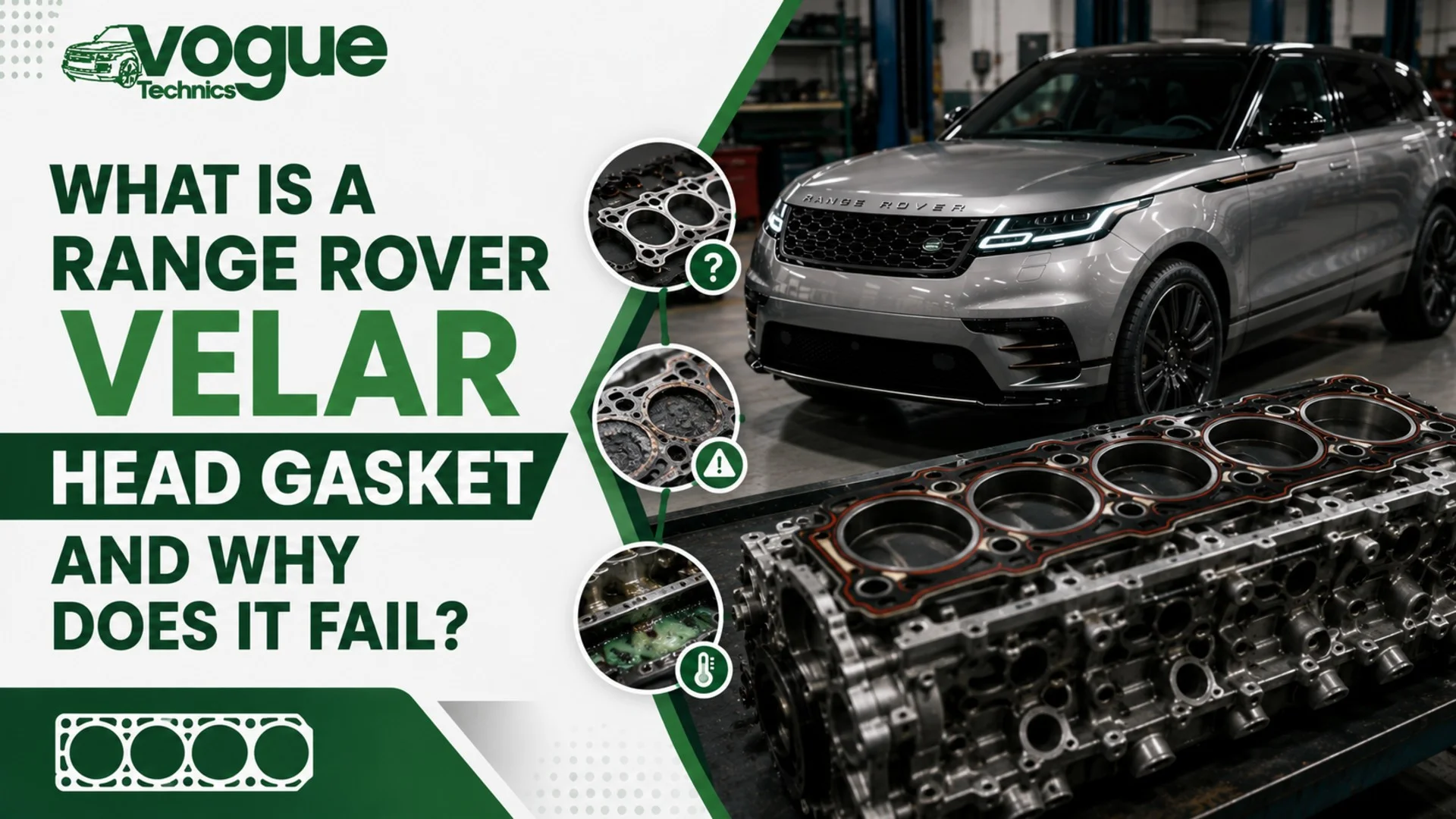
The head gasket sits between the cylinder head and the engine block. It's a thin, precisely engineered seal, but it does a genuinely difficult job: keeping coolant, engine oil, and combustion pressure completely separate from one another, all while sitting inches from temperatures exceeding 2,000°C. When it fails, those three systems start mixing, and that's when small problems become expensive ones.
Understanding the Head Gasket in Ingenium Engines (AJ126 & AJ133)
The Velar range uses Jaguar Land Rover's Ingenium engine family, predominantly the AJ126 (V6 petrol and diesel variants) and AJ133 (V8 petrol) units, depending on trim. These engines are compact, turbocharged, and run at higher operating pressures than older Land Rover units, which places extra demand on the gasket's sealing surfaces.
How the Head Gasket Seals Coolant, Oil & Combustion Pressure
A modern MLS gasket (multi-layer steel) uses several thin steel layers with coated sealing beads that compress precisely around each cylinder, coolant passage, and oil passage. Torque is applied to the head bolts in a specific torque sequence and torque angle, following OEM specifications, so the gasket clamps evenly. Get that sequence wrong or reuse stretched head bolts, and you're setting up a future failure even with a brand-new gasket.
Common Causes of Velar Head Gasket Failure
Head gaskets don't fail randomly. In our workshop, we consistently trace failures back to a handful of root causes.
- Overheating & cooling system faults: A failing water pump, a stuck thermostat, or a slow coolant leak from the expansion tank can push engine temperature beyond safe limits. Sustained overheating is, by far, the single biggest cause of head gasket failure we see.
- Warped or cracked cylinder heads: Aluminium cylinder heads expand and contract with heat. Repeated overheating cycles can cause micro-warping, which breaks the gasket's seal even if the gasket itself is otherwise intact.
- Age, mileage & manufacturing weak points: Some Ingenium engines have known coolant passage designs that are more prone to gradual seepage as the engine ages, particularly past 60,000–80,000 miles.
Does Head Gasket Failure Differ Across Velar Engine Variants?
This is one area most repair guides skip entirely, and it matters, because the diagnosis and repair approach isn't identical across the range.
P250, P300 & P340 Petrol Engines
These turbocharged four- and six-cylinder petrol variants run higher combustion pressures, which means the sealing beads around each cylinder bore take more punishment. We tend to see gasket failure here linked more closely to overheating events than to age alone.
D180, D200 & D240 Diesel Engines
Diesel variants generate higher compression and cylinder pressure by design. Head gasket failure on these engines is more frequently tied to coolant passage degradation and, in some cases, injector seal issues that get mistaken for gasket problems, which is exactly why proper diagnostic testing matters before any parts get ordered.
Signs and Symptoms of a Blown Head Gasket in Your Velar
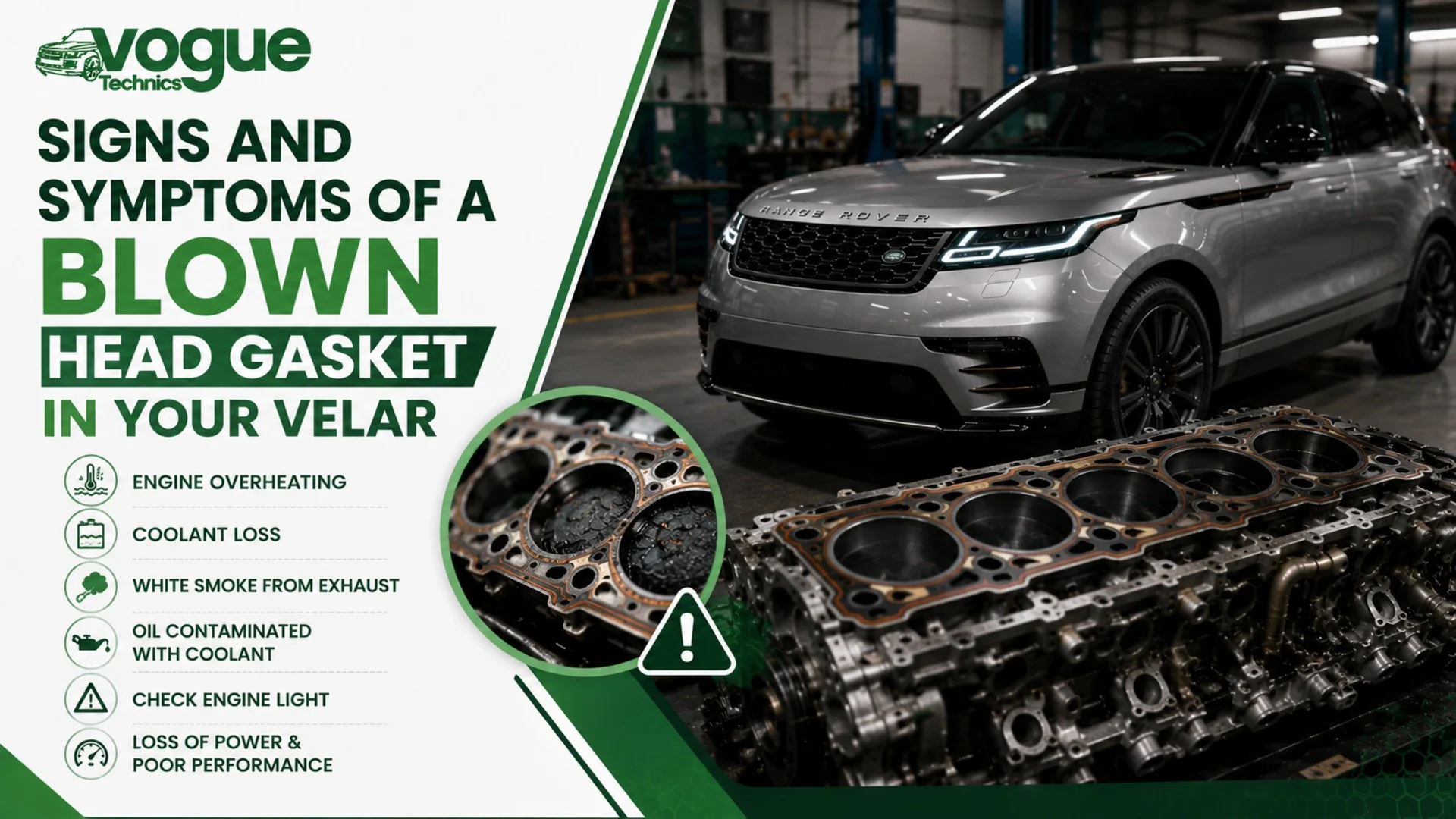
Catching a head gasket problem early is the difference between a repair bill and a rebuild bill. Here's what to watch for, in the order symptoms typically appear.
Early Warning Signs Before Total Failure
These are the symptoms owners most often dismiss, which is understandable, since none of them look dramatic on their own.
- Coolant loss with no visible leak: If you're topping up the coolant reservoir regularly but there's no puddle under the car and no obvious external leak, the coolant may be escaping internally, burning off in the combustion chamber or seeping into the oil.
- Milky or contaminated engine oil: Pull the dipstick or check under the oil filler cap. A pale, milkshake-like residue means coolant has mixed with your engine oil, a classic head gasket signature.
Advanced Symptoms You Shouldn't Ignore
Once the failure progresses, the symptoms become harder to miss, and more urgent to act on.
- White exhaust smoke & overheating: Thick white smoke from the exhaust, especially on startup, indicates coolant is burning in the combustion chamber. Combined with a rising temperature gauge, this is a strong indicator of active head gasket failure.
- Misfires, warning lights & compression loss: Coolant fouling a cylinder can cause rough running, misfires, and a Check Engine Light. A compression test or leak-down test at this stage will usually confirm reduced compression in the affected cylinder.
Can You Still Drive a Velar With a Blown Head Gasket?
Technically, for a very short distance, but you shouldn't. Continuing to drive risks coolant contamination spreading through the entire cooling system, warping the cylinder head further, and in worst cases, causing catastrophic engine damage through hydro-locking (where coolant enters a cylinder and stops a piston mid-stroke). If you're seeing any combination of the symptoms above, get the vehicle inspected before your next journey rather than after.
Our Range Rover Velar Head Gasket Replacement Process
A head gasket replacement isn't just "swap the gasket and reassemble." Done properly, it's a diagnostic-led process, and skipping steps is exactly how repeat failures happen.
Diagnostic Testing Before Any Repair Begins
Before we touch a spanner, we confirm the gasket is actually the problem, not a symptom of something else, like a failing water pump or a cracked expansion tank.
Compression Testing
We measure cylinder compression across all cylinders. A significantly lower reading in one or two cylinders, compared to the rest, points strongly toward a gasket breach at that location.
Leak-Down & Cooling System Pressure Testing
A leak-down test pressurises each cylinder and measures air escaping past the rings, valves, or head gasket, helping pinpoint exactly where the seal has failed. We also run a cooling system pressure test to check for internal coolant loss and rule out a separate radiator, water pump, or hose fault.
Step-by-Step Head Gasket Replacement
Once the diagnosis is confirmed, the physical repair follows a strict sequence to avoid introducing new problems.
Cylinder Head Removal & Inspection
The cylinder head is removed and thoroughly inspected for warping, cracks, and valve seat condition. This step alone often reveals issues an owner would never have known about — like an early-stage crack that hasn't yet caused symptoms.
Skimming & Resurfacing (When Required)
If the cylinder head has warped, even slightly, it needs CNC precision skimming to restore a perfectly flat sealing surface. Fitting a new gasket to a warped head is one of the most common reasons repairs fail within months. Not every repair needs skimming, but it's a step we never skip checking for.
MLS Gasket Fitting & Torque Sequence
We fit a new multi-layer steel (MLS) gasket matched to your specific Velar engine variant, along with new head bolts (torque-to-yield bolts should never be reused). Bolts are tightened following the exact OEM torque sequence and torque angle, in stages, to ensure even clamping pressure across the entire head.
Repair vs Engine Rebuild vs Engine Replacement — Which Do You Need?
This is the question most competitor pages skip entirely, and it's often the one that matters most to your wallet.
Situation | Recommended Option | Why |
| Gasket failure caught early, head undamaged | Head gasket replacement | Fastest, most cost-effective fix; addresses the root cause directly |
| Gasket failure plus warped or cracked head | Repair with head skimming/resurfacing | Restores sealing surface; avoids repeat failure |
| Prolonged overheating, internal engine damage (bearings, pistons) | Engine rebuild | Addresses damage beyond the gasket itself |
| Severe hydro-lock, block damage, or high-mileage engine with multiple faults | Engine replacement | More cost-effective long-term than repeated repairs |
If you're unsure which category your Velar falls into, that's exactly what the diagnostic stage is for, we won't recommend a rebuild when a repair will genuinely do the job, and we'll tell you plainly if it won't.
Velar Head Gasket Replacement Cost, Warranty & FAQs
How Much Does Velar Head Gasket Replacement Cost?
Cost varies depending on your engine variant, the extent of damage, and whether skimming or additional machining is needed. As a general guide, straightforward gasket replacements sit at the lower end, while jobs requiring head skimming, new head bolts, or additional cooling system components cost more.
Cost Factors by Engine Variant
- P250/P300 petrol variants: Typically lower labour time due to more accessible cylinder head layout
- P340/D240 higher-output variants: Slightly more involved due to additional turbo/cooling components requiring removal
- D180/D200 diesel variants: Comparable labour time, with cost driven mainly by whether skimming is required
Labour Hours & What Affects Pricing
Labour time typically depends on how much ancillary work is needed to access the cylinder head, intake components, turbo plumbing, and cooling hoses often need removing first. Get an accurate quote only after a proper inspection; ballpark figures without seeing the vehicle rarely hold up once the head comes off.
Warranty & Aftercare on Our Repairs
Every head gasket replacement we carry out is backed by a workshop warranty covering parts and labour. We also carry out a post-repair cooling system bleed and a follow-up check to confirm there's no residual air in the system, a step that, if skipped, is a common cause of early comeback issues.
Frequently Asked Questions
How long does a Velar head gasket replacement take?
Most straightforward replacements take between 1–3 working days, depending on parts availability and whether the cylinder head needs skimming. Diesel and higher-output petrol variants with more ancillary components can take slightly longer.
What are the early signs of head gasket failure?
Coolant loss with no visible external leak, milky residue on the oil dipstick, a sweet smell from the engine bay, and gradual overheating are the earliest indicators — often appearing weeks before more obvious symptoms like white smoke.
Do you use OEM or MLS gaskets for Velar repairs?
We fit multi-layer steel (MLS) gaskets matched to OEM specification for your specific engine variant, paired with new head bolts as standard.
Can a head gasket leak cause permanent engine damage?
Yes, if left unaddressed. Continued driving with a failing gasket can lead to cylinder head warping, bearing damage from coolant-diluted oil, and in severe cases, hydro-lock — turning a gasket repair into a full rebuild.
Is head skimming necessary for every repair?
No. Skimming is only needed if the cylinder head has warped or if surface imperfections are found during inspection. We check for this on every job rather than assuming it either way.
Book Your Velar Head Gasket Inspection in Grays, Essex
A head gasket problem doesn't get better with time, it gets more expensive. If your Velar is showing any of the warning signs covered here, the smartest move is a proper diagnostic inspection before the damage spreads beyond the gasket itself.
Voguetechnicsenginerebuild.co.uk specialises in Range Rover Velar engine diagnostics and head gasket replacement, right here in Grays, Essex. We'll test first, explain what we find in plain terms, and only recommend the repair your engine actually needs.
Get in touch today to book a diagnostic inspection or request a quote for your Velar's head gasket replacement.