
Range Rover Sport Timing Chain Problems: Symptoms, Real Costs & Expert Fixes (2026 UK Guide)
Range Rover Sport timing chain problems often start as a quiet cold-start rattle that owners ignore until it becomes a costly engine rebuild. This guide breaks down the real causes, the engines most at risk (5.0 V8 AJ133 and 2.0 Ingenium), the warning signs and fault codes to watch for, and honest 2026 UK repair costs. Most importantly, it shows how early action turns a £1,200 fix into avoided £9,000 damage, plus how to prevent failure altogether.
That faint rattle you hear in the first few seconds after a cold start? Don't talk yourself out of it. On the Range Rover Sport, that exact sound is the one most owners ignore until it turns a £1,200 job into a £9,000 engine rebuild. Range Rover Sport timing chain problems rarely announce themselves with drama. They creep in quietly, get blamed on "just a cold morning," and then one day the engine throws a restricted performance warning on the motorway.
If you've noticed a noise, seen a fault code, or you're simply trying to work out whether the Sport you're about to buy is a money pit, this guide gives you the straight answer mechanics actually give in the workshop, not the vague reassurance you get on forums. We'll cover what causes the failure, which engines are affected, what the warning signs really sound like, and what a proper repair costs in the UK in 2026.
What Causes Range Rover Sport Timing Chain Problems (and Which Engines Are Affected)?
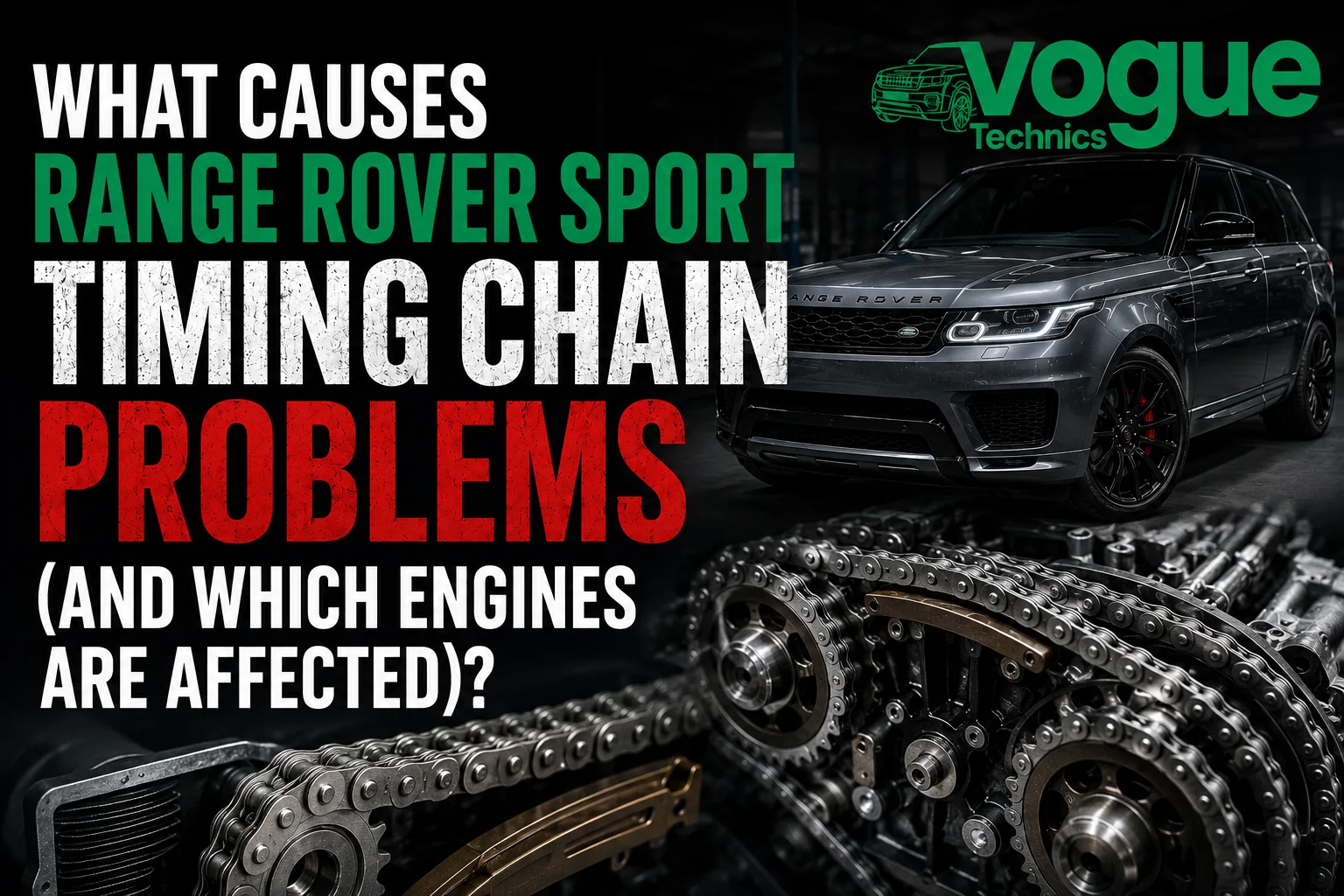
A timing chain has one job: keep the crankshaft and camshafts perfectly synchronised so the valves open and close at the exact moment the pistons need them to. When that synchronisation drifts, even slightly, the engine loses power, runs rough, and in the worst cases the valves and pistons collide. On an interference engine, which is what these are, that contact is catastrophic.
So why does a component designed to last the life of the engine fail early on these vehicles? It usually comes down to a chain of small problems (no pun intended) rather than one single fault.
What Causes Timing Chain Failure on the Range Rover Sport?
The root cause is almost always wear that was allowed to progress unchecked. Three failure points show up again and again on the workbench.
Chain Stretch and Excessive Wear
A timing chain doesn't stretch like elastic. The pins and rollers inside each link wear microscopically, and across hundreds of links that wear adds up to measurable slack. As the chain stretches, the camshaft timing falls out of correlation with the crankshaft. The engine management system notices the mismatch and logs a fault. Left long enough, the slack causes the chain to skip a tooth on a sprocket, and that's where serious internal damage begins.
Hydraulic Tensioner Failure
The hydraulic tensioner uses oil pressure to keep constant tension on the chain. When it fails, or when oil pressure drops at startup, the chain goes slack for a moment. That brief slack is exactly what produces the cold start rattle owners describe. A worn tensioner is often the real culprit behind a noise people assume is the chain itself, which is why correct diagnosis matters so much before any parts get ordered.
Guide Rail Wear and Oil Starvation
Plastic guide rails keep the chain running in a smooth path. Over time they wear, crack, or shatter, and fragments end up in the sump. Behind nearly all of this sits one preventable factor: oil starvation. Dirty or low engine oil, extended oil change intervals, and poor lubrication accelerate every other failure. Clean oil at the right pressure is genuinely the cheapest insurance you can buy for a Range Rover engine.
Which Range Rover & Land Rover Engines Have Timing Chain Issues?
Not every engine carries the same risk, and lumping them together is where a lot of online advice goes wrong. The two families owners ask about most are the supercharged V8 and the smaller Ingenium units.
5.0 V8 Supercharged (AJ133) Timing Chain Problems
The 5.0 V8 (the AJ133) is the engine the enthusiast crowd worries about most, and with good reason. Earlier builds of this range rover 5.0 timing chain setup are known for chain and tensioner wear, particularly on higher-mileage cars or those with patchy service histories. The supercharged version works hard, and that workload is unforgiving of neglected oil changes. When people search for a range rover 5.0 timing chain replacement or a range rover 5.0 timing chain kit, it's usually this engine driving the concern. The same rover v8 timing chain architecture appears across several Range Rover and Land Rover models, so the advice carries over.
Ingenium Petrol & Diesel Timing Chain Issues
The 2.0 Ingenium diesel and petrol engines (found in the later Range Rover Sport, Velar, Evoque and Discovery Sport) have their own reputation for ingenium timing chain problems. Here the failure mode often centres on chain stretch and tensioner wear at surprisingly low mileage, sometimes well under 60,000 miles on neglected examples. Diesel versions add their own complications with the DPF and EGR systems, but the timing chain concern is the one that ends engines. Land Rover Discovery Sport timing chain failures share the same Ingenium roots.
Range Rover Sport Years to Avoid (Quick Reference Table)
Use this as a starting filter, not gospel, a well-maintained example always beats a neglected "good" year.
Engine | Models / Era | Timing Chain Risk | What to Watch |
| 5.0 V8 S/C (AJ133) | Range Rover Sport ~2014–2016 | Moderate–High on early builds | Cold rattle, service history, oil condition |
| 2.0 Ingenium Petrol | ~2018 onward | Moderate | Stretch at lower mileage, missed oil changes |
| 2.0 Ingenium Diesel | ~2016 onward | Moderate–High | Rattle, P0016/P0017 codes, DPF history |
| 3.0 SDV6 / TDV6 | Across range | Lower (still inspect) | High-mileage wear, oil pressure |
If you're weighing up range rover sport common issues before buying, treat any unexplained startup noise as a reason to walk away or negotiate hard. (We go deeper on this in our [buying a used Range Rover Sport checklist].)
What Are the Warning Signs and How Are Timing Chain Problems Diagnosed?
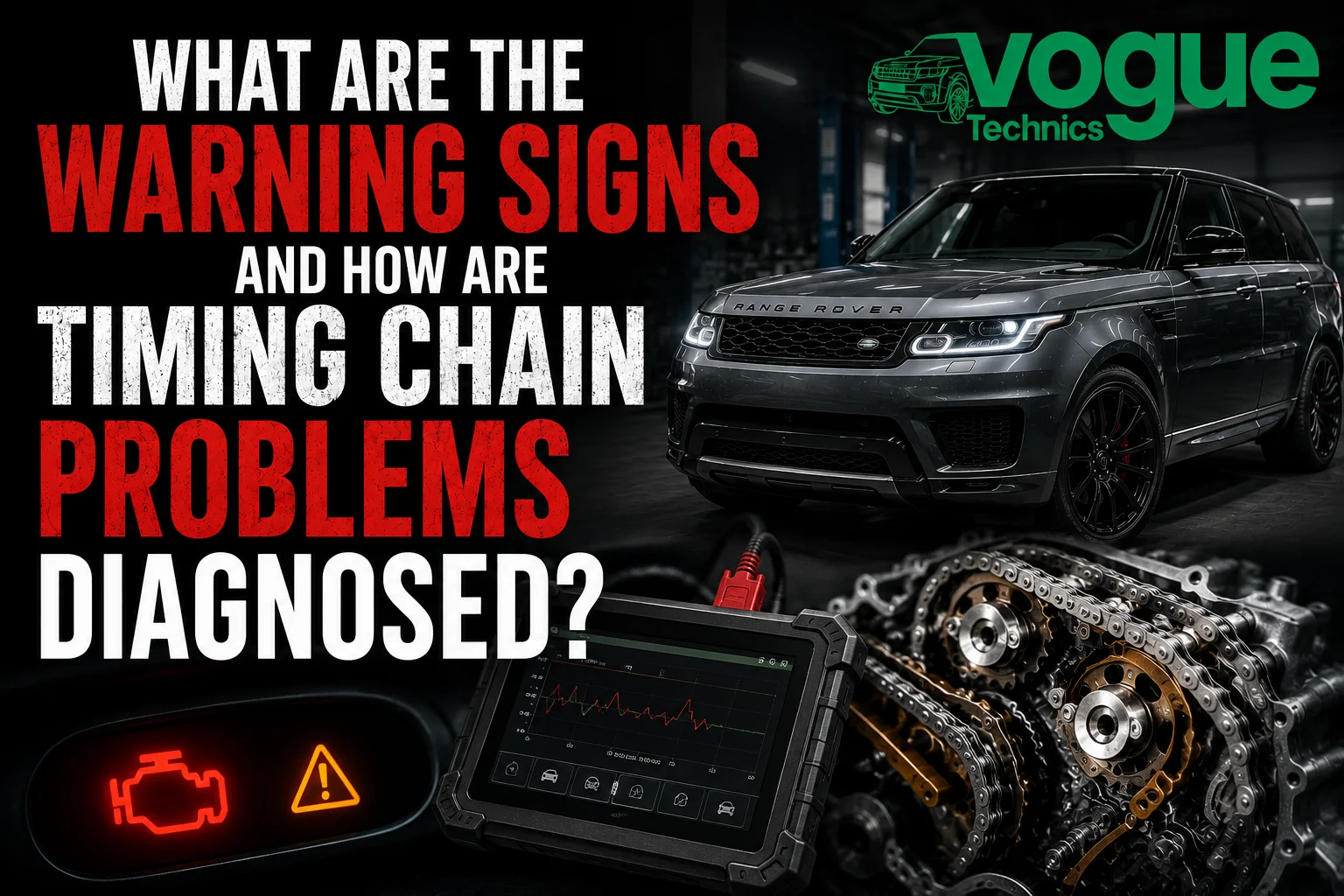
Catching this early is the entire game. The difference between a chain replacement and a full engine rebuild is often just a few hundred miles of driving on a noise the owner hoped would "sort itself out." It won't.
What Does a Range Rover Timing Chain Noise Sound Like?
People describe the range rover timing chain noise in fairly consistent ways: a metallic rattle, a light chattering, or a whirring that sits deeper than normal engine noise. The key detail is when it happens.
Cold Start Rattle Explained
The classic symptom is a rattle lasting one to three seconds immediately on a cold start, fading as oil pressure builds and the tensioner takes up the slack. Early on it's intermittent and easy to dismiss. As wear progresses, the rattle lasts longer, appears even when warm, and may be joined by a rougher idle. A short, repeatable cold-start rattle is the single most reliable early warning sign there is.
Restricted Performance Warning & Check Engine Light
When timing drifts far enough, the ECU steps in to protect the engine. You'll see a check engine light and often the dreaded "restricted performance" message, with the car dropping into a limited limp mode. Other red flags include misfires, hesitation under acceleration, and a noticeable loss of power. By this stage the problem is no longer subtle, and continued driving risks the valves.
How Do Mechanics Diagnose Timing Chain Issues?
A proper diagnosis is more than plugging in a scanner. In the workshop we typically:
- Read live and stored fault codes with a capable diagnostic scanner, not just a basic OBD reader.
- Check camshaft-to-crankshaft correlation to measure how far timing has actually drifted.
- Inspect the engine oil for metal shavings and check oil pressure, since lubrication is so often the underlying cause.
- Listen with the engine cold, because a warm engine can mask the very noise you're chasing.
That combination separates a stretched chain from a failing tensioner from an unrelated pulley noise, which matters because the fix and the cost are completely different.
Common Fault Codes — P0016, P0017, P0341, P0342 (Explained)
These four codes are the ones that point straight at timing. Here's what each one is actually telling you.
Code | Meaning | What It Suggests |
| P0016 | Crankshaft/camshaft correlation (Bank 1) | Timing drift — likely chain stretch or tensioner |
| P0017 | Crankshaft/camshaft correlation (Bank 2) | Same issue on the opposite bank |
| P0341 | Camshaft position sensor performance | Possible timing fault or sensor issue |
| P0342 | Camshaft position sensor low input | Sensor or wiring fault, sometimes timing-related |
Seeing P0016 or P0017 on a Range Rover Sport with a cold rattle is about as clear a signal as you'll get that the timing components need attention now.
Can You Drive With a Range Rover Timing Chain Rattle?
Short answer: you can, but you shouldn't, and not for long. A timing chain rattle means components are already worn and the chain may be close to skipping a tooth. If it jumps timing while you're driving, valves meet pistons and the repair bill multiplies several times over. Treat a confirmed timing chain rattle as a stop-driving-and-book-it situation, not a "next service" item.
How Much Does Range Rover Timing Chain Replacement Cost & What Does the Repair Involve?
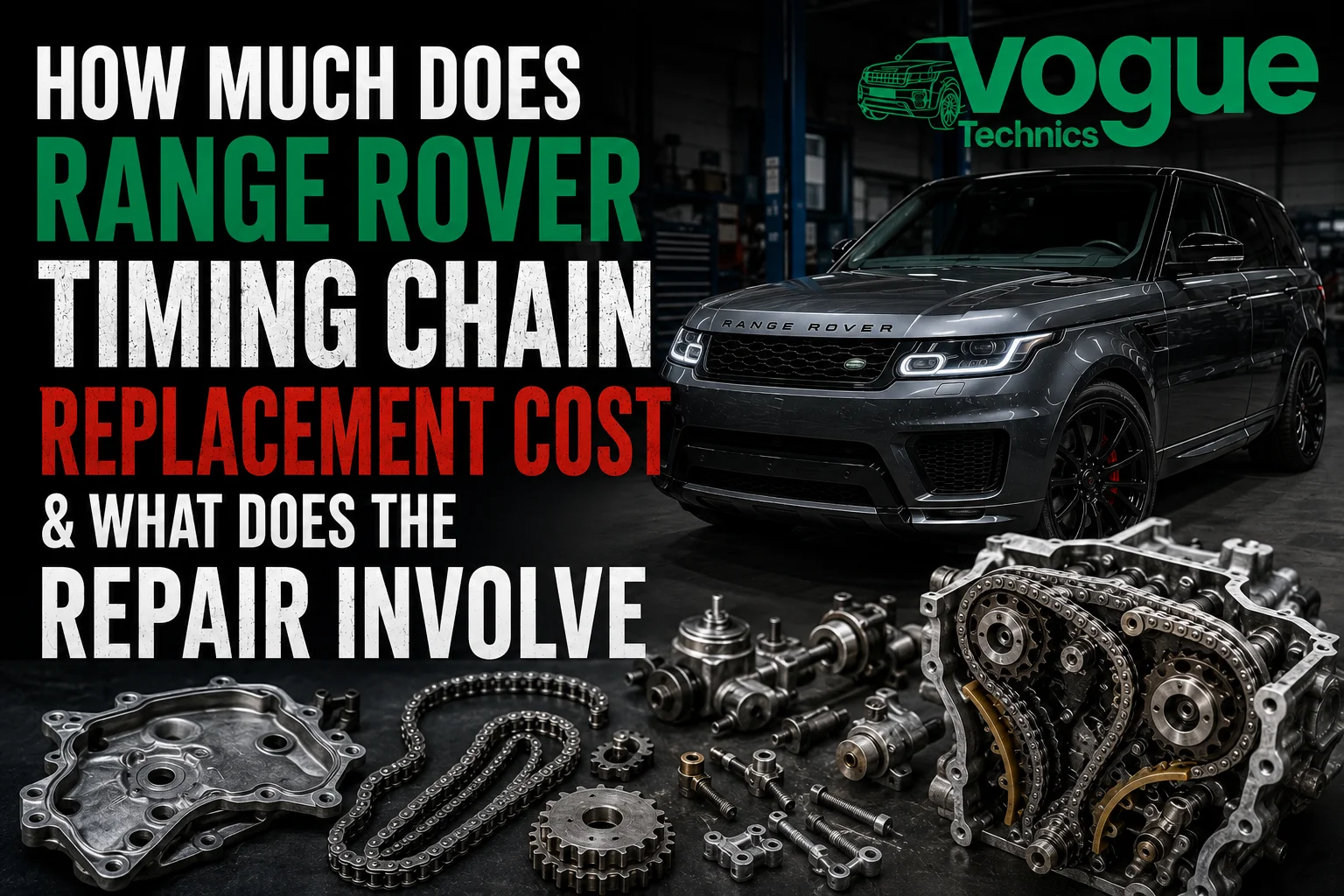
This is the question everyone really wants answered, so let's deal with it honestly rather than hiding behind "it depends." It does depend, but we can give you realistic UK figures.
How Much Does Range Rover Sport Timing Chain Replacement Cost in the UK?
A range rover sport timing chain replacement cost is driven mostly by labour, because reaching the chain is a deep, time-consuming job. Parts matter too, especially on the V8.
5.0 V8 vs Ingenium Replacement Cost Breakdown
These are typical independent-specialist ranges in 2026; dealer pricing usually runs higher.
Job | Typical UK Range (Indie Specialist) | Notes |
| Ingenium timing chain replacement | ~£900 – £1,800 | Varies with petrol/diesel and access |
| 5.0 V8 (AJ133) timing chain replacement | ~£2,000 – £4,000+ | More parts, more labour, supercharger access |
| Tensioner / guide-only repair | ~£600 – £1,200 | Only viable if caught early |
| Engine rebuild after chain failure | ~£6,000 – £10,000+ | What you pay if you ignore the warning |
The pattern is obvious: the range rover timing chain replacement cost is a fraction of what an engine rebuild costs. Early action isn't just safer, it's dramatically cheaper.
OEM vs Aftermarket Timing Chain Kits — Which Is Worth It?
A good range rover timing chain kit includes the chain, tensioner, guides and sprockets as a matched set. The OEM-versus-aftermarket question comes up constantly.
- OEM / genuine kits: exact fit, proven durability, best choice for an engine you intend to keep long-term.
- Quality aftermarket kits: reputable brands can be excellent value and perfectly reliable.
- Cheap budget kits: a false economy; a chain that stretches early puts you right back where you started, plus a second labour bill.
Our standing advice is simple: never fit a budget kit to an expensive engine. The labour to do this job twice dwarfs any saving on parts.
What Does a Timing Chain Replacement Actually Involve?
A range rover timing chain replacement is major surgery, not a bolt-on. In broad terms it involves removing ancillaries to reach the front of the engine, removing covers, locking the engine at top dead centre, replacing the chain along with the tensioner and guides as a complete set, re-timing everything precisely, and verifying camshaft-to-crankshaft correlation before the car goes back on the road. Getting the timing wrong by even one tooth means doing it all again, which is exactly why this is a job for a genuine range rover mechanic with the right tools, not a general garage learning on your car.
How Do You Prevent Timing Chain Failure?
The good news is that most failures are preventable. Prevention costs very little compared to the alternative.
Best Engine Oil & Service Intervals for Long Chain Life
- Use the correct specification oil for your engine and never skimp on quality — the chain, tensioner and guides all rely on it.
- Shorten the oil change interval. The factory "long life" intervals are widely considered too long for chain longevity; many specialists recommend roughly every 6,000–8,000 miles or annually.
- Don't ignore short cold rattles. Have them checked while they're cheap to fix.
- Keep a full service history. It protects the engine and your resale value, and it's the first thing a buyer should ask for.
Stick to those habits and a range rover sport timing chain can comfortably last the life of the car. Neglect them and you're rolling the dice. (See our full [preventive maintenance schedule] for engine-specific intervals.)
Range Rover Timing Chain Repair in Grays, Essex — Get an Expert Quote
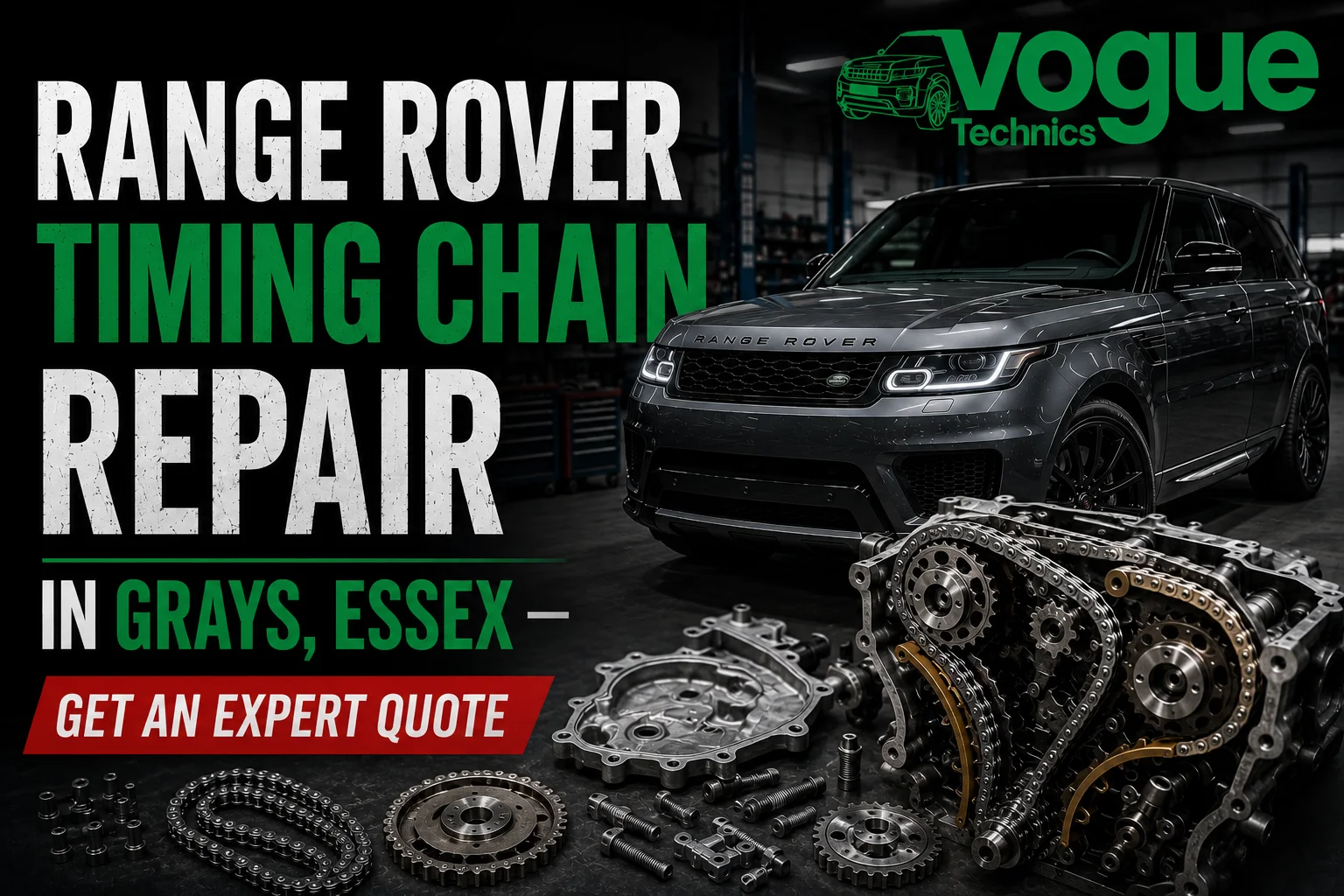
When you're dealing with something as serious as range rover engine problems, where you take the car matters as much as the parts you fit. A misdiagnosis here is expensive in both directions: replacing a chain that didn't need it, or missing one that did.
Why Choose Vogue Technics Engine Rebuild for Your Timing Chain Repair?
At voguetechnicsenginerebuild.co.uk, based in Grays, Essex, Range Rover and Land Rover engines are our core work, not a sideline. We diagnose properly before we quote, so you're paying to fix the actual fault rather than guessing.
Our Range Rover & Land Rover Engine Expertise
We work across the range, from the 5.0 V8 supercharged and rover v8 units to the Ingenium petrol and diesel engines and the SDV6/TDV6 family. Whether you need a straightforward timing chain replacement, a tensioner and guide repair caught early, or a full engine rebuild after a failure, we handle it in-house. That depth means we can tell you honestly whether you're looking at a quick fix or a bigger job, with no upsell.
Book a Timing Chain Inspection or Get a Free Quote
If your Range Rover Sport is rattling on cold starts, showing a restricted performance warning, or logging P0016/P0017, book a timing chain inspection today. We'll diagnose it accurately and give you a clear, written quote before any work begins. Catching it early is the single best decision you can make for your engine and your wallet, call us or request a quote online and we'll take it from there.
Frequently Asked Questions
How long does a Range Rover timing chain last?
A well-maintained chain can last 120,000 miles or more, but neglected examples (especially Ingenium engines on long oil intervals) have failed under 60,000. Maintenance history matters far more than the number on the odometer.
Is the timing chain covered under warranty or any recall?
It depends entirely on the car's age, mileage and warranty status, and there's no blanket Range Rover timing chain recall covering every affected model. Always check your specific vehicle's warranty terms and any outstanding service campaigns with Land Rover using your VIN.
Should I buy a used Range Rover Sport with high mileage?
You can, these are excellent vehicles but only with a full service history and ideally a pre-purchase inspection. Listen for a cold start rattle, scan for timing-related fault codes, and check the oil. A high-mileage Sport with proof of regular care is a safer bet than a low-mileage one with gaps in its history.
The bottom line: Range Rover Sport timing chain problems are serious, but they're also predictable and preventable. The owners who get caught out are almost always the ones who heard the rattle and hoped. The ones who keep their engines for years are the ones who acted on it. If something doesn't sound right, get it checked before it becomes a rebuild — the team at Vogue Technics Engine Rebuild in Grays, Essex is ready to help.