
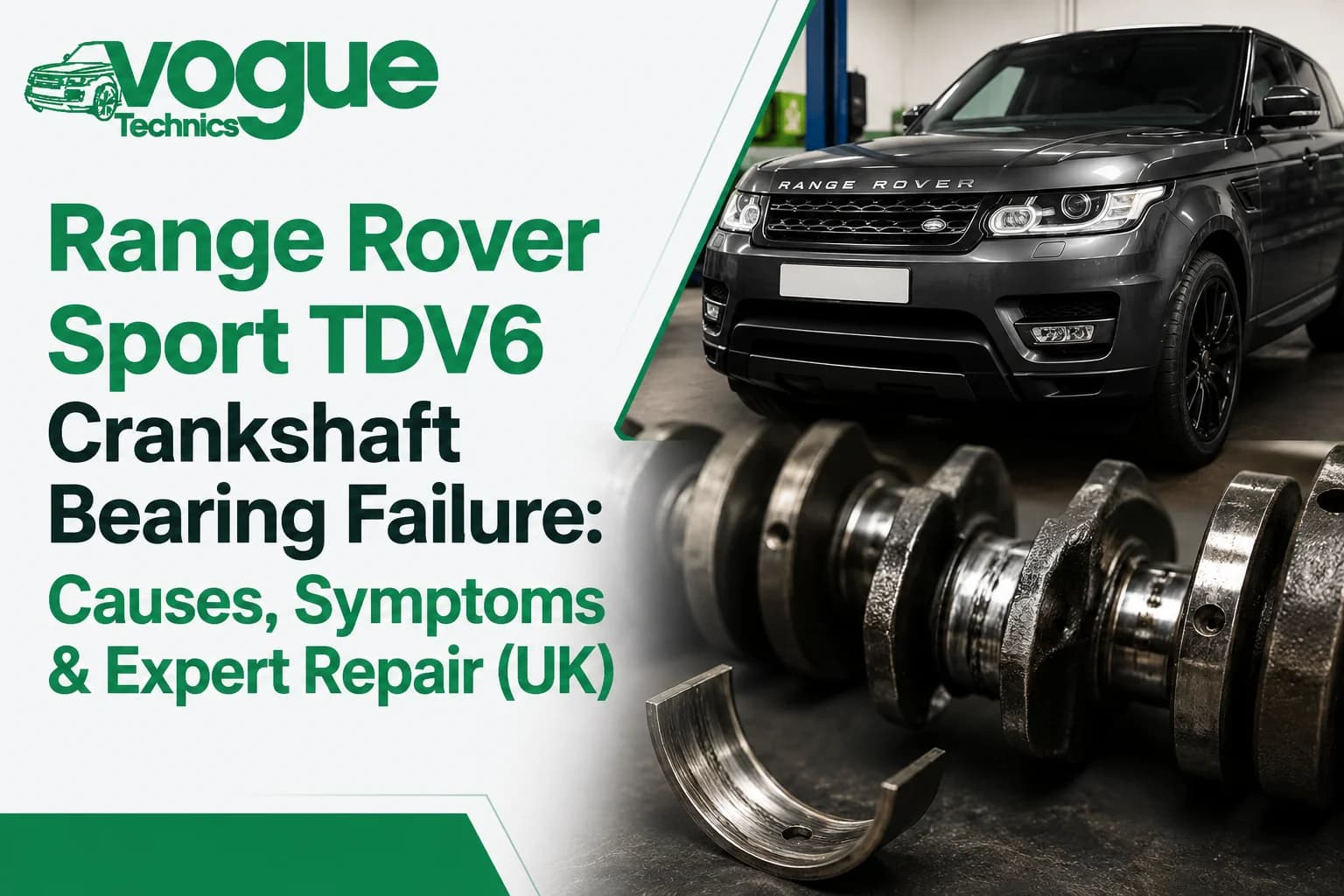
Range Rover Sport TDV6 Crankshaft Bearing Failure: Causes, Symptoms & Expert Repair (UK)
A deep, rhythmic knock from low in your Range Rover Sport's 3.0 TDV6 engine is often the first sign of crankshaft bearing failure, one of the most serious faults this 306DT/AJD-V6 engine can develop. This guide explains how the bottom end fails, the five warning signs you should never ignore, and why oil starvation is almost always the root cause. Caught early, it's frequently repairable for a fraction of a full engine replacement, but every mile driven on a knocking bottom end shrinks that window. Learn your realistic repair, rebuild, and replacement options and why stopping the engine now could save you thousands.
That deep, rhythmic knock from low in the engine, the one that gets louder when the oil's warm and quietens for a second when you blip the throttle is the sound most Range Rover Sport owners dread. If you've heard it and landed here, you already suspect what it might be. A Range Rover Sport TDV6 crankshaft bearing failure is one of the most serious problems this engine can develop, and unfortunately one of the most common on higher-mileage cars.
The good news: caught early, it's often repairable for a fraction of a full engine replacement. The bad news: every mile you drive on a knocking bottom end shortens that window. This guide explains exactly what's happening inside your engine, the warning signs that matter, why these bearings fail in the first place, and your realistic repair options, written from the perspective of a workshop that strips and rebuilds these engines week in, week out here in Grays, Essex.
What Is TDV6 Crankshaft Bearing Failure on the Range Rover Sport?
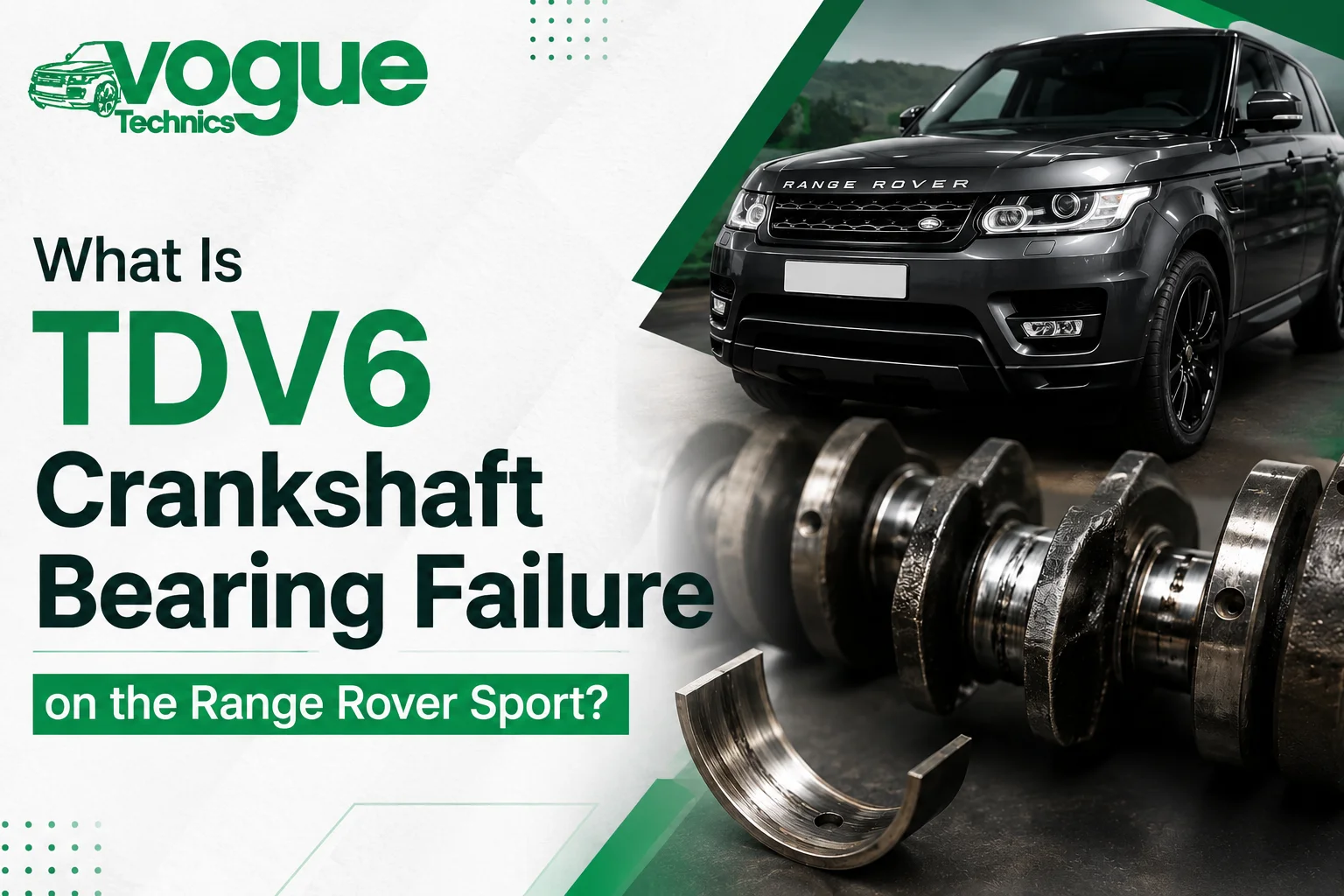
Your 3.0-litre engine spins a crankshaft that sits in the block on a set of main bearings, with the connecting rods attached to it via big-end bearings. These aren't solid lumps of metal, they're thin, replaceable bearing shells that ride on a microscopic film of pressurised oil. The crank never actually touches them in a healthy engine.
Crankshaft bearing failure is what happens when that oil film breaks down. Metal meets metal, the shells overheat, and the bearing "spins" in its housing, a spun bearing. From there it spirals quickly: clearances open up, oil pressure collapses, and in the worst cases the crankshaft itself can score, crack, or snap. That's the difference between a few hundred pounds of bearings and a four-figure rebuild.
How the 3.0 TDV6 (306DT / AJD-V6) Bottom End Actually Fails
The 3.0 TDV6, internally the 306DT, part of the Ford/PSA-developed AJD-V6 (Lion) family, is a strong, torquey engine, but its bottom end is sensitive to one thing above all: clean, well-pressurised oil reaching the bearings consistently.
When oil supply falters even briefly under load, the big-end and main bearing shells are the first to suffer. They wipe, the soft bearing material smears, debris circulates, and the damage compounds. By the time most owners hear a knock, the failure has usually been developing for a while.
Which Range Rover Sport Years & Engines Are Affected?
The 3.0 TDV6 and its later SDV6 twin-turbo sibling appear across a wide span of Range Rover Sport production, broadly from the late-2000s facelift cars through the L494 generation, spanning Euro 5 and Euro 6 emissions eras. Engines fitted to vehicles that tow heavily, do lots of short urban journeys, or have a patchy oil-change history tend to be most at risk.
It's worth being clear: not every TDV6 fails. Plenty cover huge mileages happily. Failures cluster around neglect, extended service intervals, and hard use, which is exactly why maintenance history matters so much when you're buying or keeping one.
Is It the Same Problem on the SDV6 and Discovery 4?
Yes, fundamentally the same engine architecture sits under the Land Rover Discovery 4, Range Rover, and several Jaguars (XF, XJ, F-PACE), so SDV6 crankshaft failure and Discovery 4 crankshaft failure present almost identically. The bearings, the lubrication system, and the failure mechanism are shared. If you own any 306DT/AJD-V6 vehicle, the symptoms and the fix in this guide apply to you too.
Quick Answer — Can You Still Drive It If a Bearing Has Gone?
No. If you're hearing genuine bottom-end knock or seeing a low oil pressure warning, stop driving and switch off. Every minute the engine runs on a failing bearing risks turning a repairable rebuild into a snapped crankshaft and a scrapped block. The single best thing you can do to protect your wallet is not start the engine again until it's been inspected.
What Are the Warning Signs of a Failing TDV6 Crankshaft Bearing?
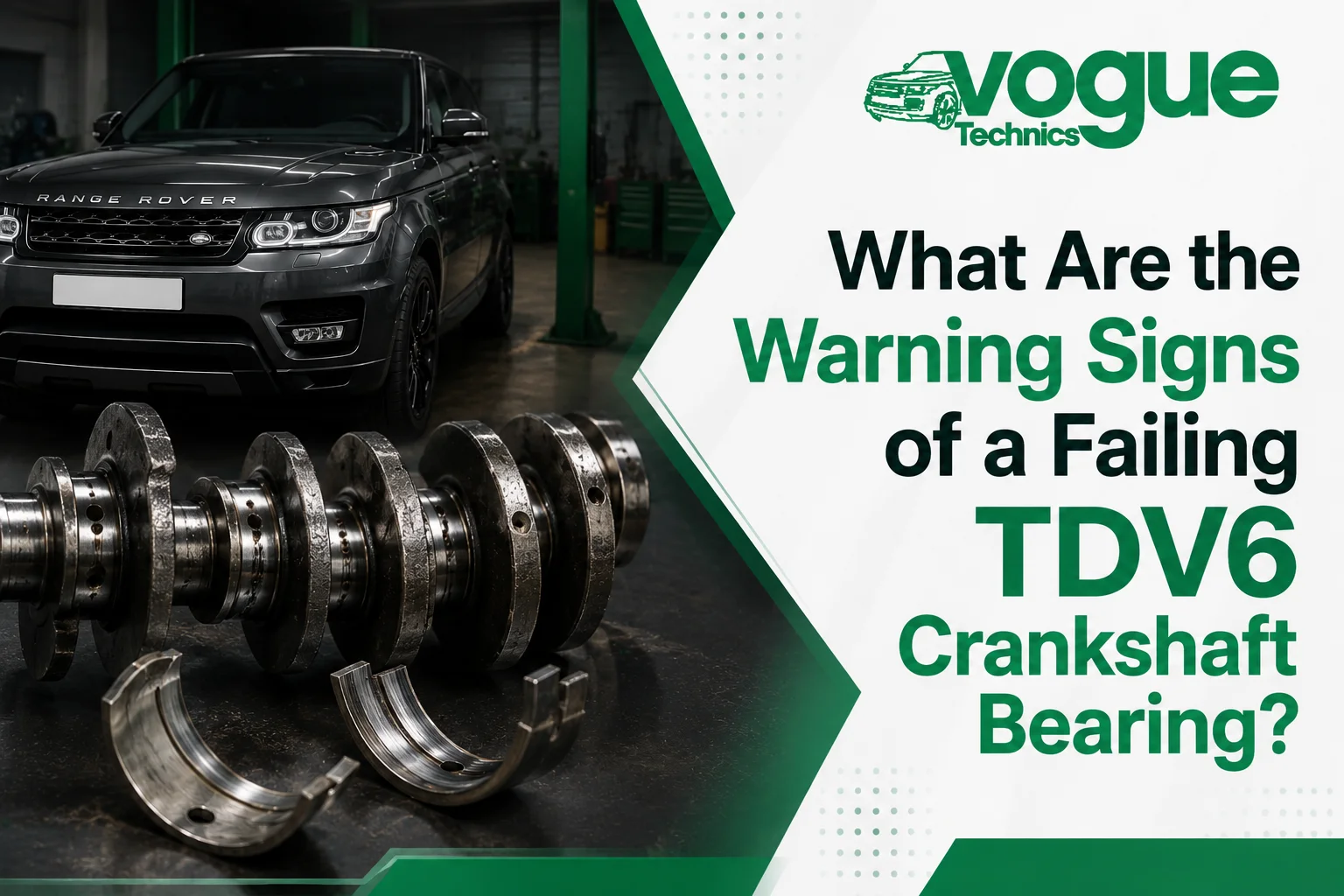
Most catastrophic failures give you a warning first. The trouble is that the early signs are easy to dismiss, a slightly noisier cold start, a flicker of the oil light, a faint vibration. Learning to read them is what saves engines.
What Does a Spun Bearing Sound Like? (Bottom-End Knock Explained)
A spun or failing bearing produces a distinctive bottom-end knock, a dull, metallic knock-knock-knock that:
- Comes from low in the engine, not the top, and feels like it's deep in the block
- Speeds up and slows down with engine RPM, because it's tied to crankshaft rotation
- Often gets worse as the oil warms and thins, which is the opposite of a harmless cold-start rattle
- Can momentarily change when you load or unload the engine
People describe it as a hollow tapping, a diesel "rod knock," or like a marble rattling in a tin. It is not the same as the lighter, faster top-end tick of injectors or a timing chain. If you can hear it from outside the car with the bonnet up, it's already serious.
Why Is My Low Oil Pressure Warning Light On?
The oil pressure warning exists precisely to catch this failure before it becomes terminal. As bearing clearances open up, oil pressure drops, pressure escapes through the worn gaps faster than the oil pump can maintain it.
A low oil pressure light, especially one that comes on at idle or when the engine is hot, should be treated as an emergency, not an inconvenience. Topping up the oil might quieten things briefly, but it doesn't fix worn bearings, it just masks the symptom while the damage continues.
Early Symptoms vs Catastrophic Failure — Know the Difference
Knowing where you are on the failure timeline changes everything. Here's the honest progression:
Stage | What you'll notice | What it means | Action |
| Early warning | Slightly noisier than usual, faint vibration, oil light flicker on hot idle | Bearing clearances opening, oil film marginal | Stop driving, get it inspected now |
| Developing | Clear knock under load, oil light on more often, metallic content in oil | Bearings wiping, debris circulating | Do not drive — recoverable if caught here |
| Catastrophic | Loud constant knock, sudden power loss, engine stalls or seizes | Spun bearing, possible crank/rod damage | Engine off immediately — recovery transport only |
The cars we rescue cheapest are the ones that come in at the first two stages. The expensive jobs are almost always the ones that were driven "just a few more miles."
The 5 Sounds and Signals You Should Never Ignore
If your Range Rover Sport, Discovery 4, or any TDV6/SDV6 does any of the following, book an inspection before you drive it again:
- A rhythmic knock from the bottom of the engine that tracks with RPM.
- The low oil pressure warning light appearing at idle or when hot.
- Metallic flakes, glitter, or a silver sheen on the dipstick or in drained oil.
- Unexplained vibration through the car that wasn't there before.
- A sudden drop in oil pressure or power, sometimes with a brief judder.
Any one of these on its own warrants a look. Two or more together is a near-certain bottom-end issue.
Why Do TDV6 Crankshaft Bearings Fail? (And How We Diagnose It)
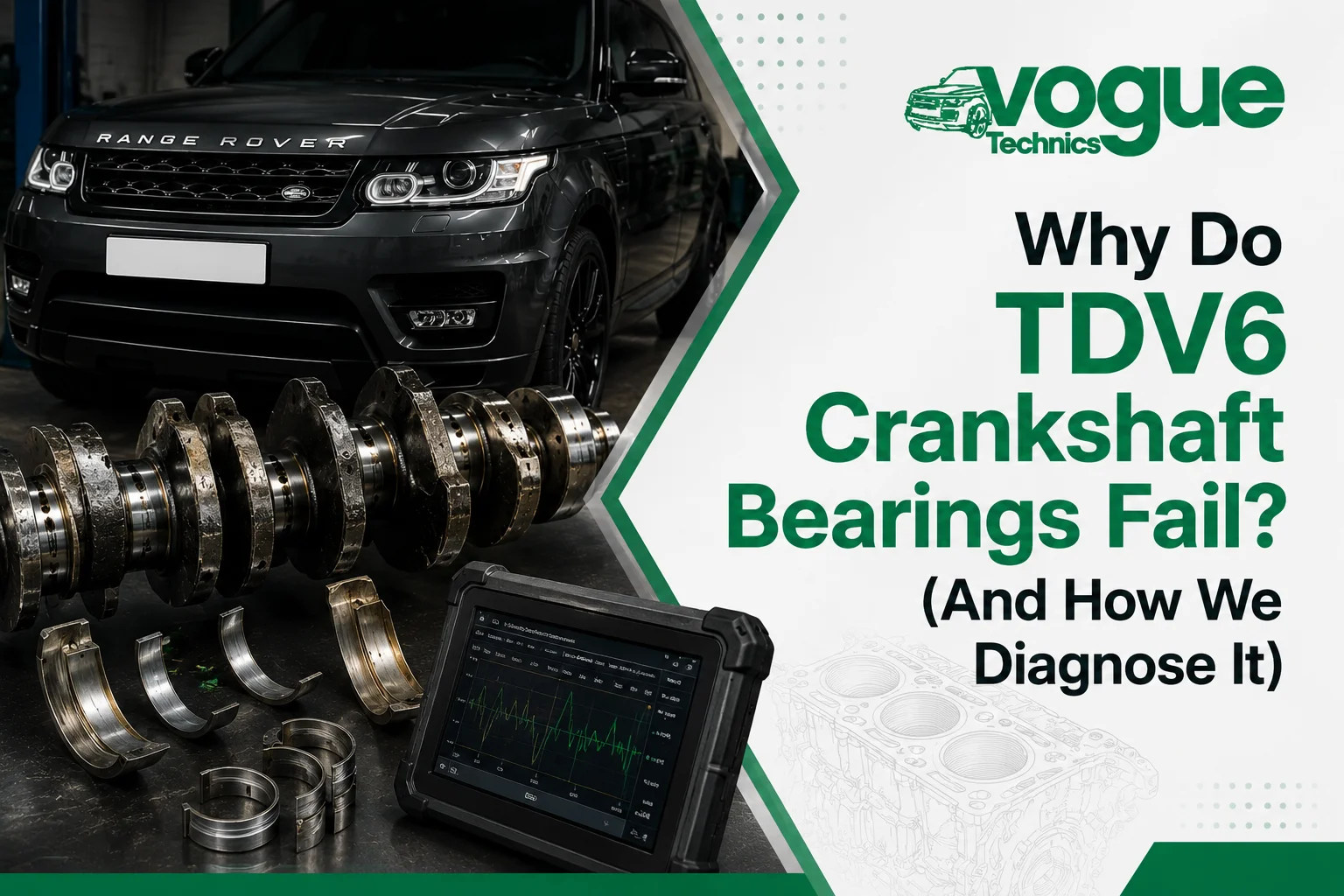
Understanding why these bearings fail isn't just academic, it tells you how to protect a freshly rebuilt engine so you're not back in the same position in two years.
Oil Starvation — The Number One Root Cause
Almost every TDV6 crankshaft bearing failure traces back to one thing: oil starvation. The bearings depend on a constant supply of clean oil at pressure, fed through the oil galleries from the oil pump and pickup. Anything that interrupts or contaminates that supply is a death sentence for the shells.
The usual culprits behind lubrication failure are:
- Extended or skipped oil changes, letting the oil degrade and sludge restrict the oil pickup/strainer
- The wrong oil specification or viscosity, so the protective film is too thin under load and heat
- Oil pump wear, reducing the pressure the system can generate
- Cold, short journeys that never get the oil fully up to temperature or burn off contaminants
- Sustained high load, particularly heavy towing, which raises bearing temperatures and demands more from the oil
Notice how many of those are preventable. That's the part owners have real control over.
How Oil Pump Wear and Towing Stress Accelerate Failure
Two factors deserve special mention because they quietly stack the odds. A tired oil pump can deliver "acceptable" pressure cold but fall short when the engine is hot and the oil is thin, exactly when the bearings need it most. And towing stress caravans, trailers, plants, keeps the bottom end under sustained high load, pushing bearing temperatures up and torsional stress through the crank. Combine a worn pump with regular heavy towing and a stretched service interval, and you have the classic failure recipe we see on the bench.
How We Confirm Bearing Failure Before Any Strip-Down
A knock isn't always a crank bearing, it can be a worn timing chain, a failing injector, or other top-end noise that's far cheaper to fix. So we never recommend pulling an engine apart on a hunch. Proper diagnosis protects you from paying for work you don't need.
Oil Pressure Testing, Oil Analysis & End-Float Inspection
Our diagnostic process confirms the problem before any major labour is committed:
- Mechanical oil pressure testing against the engine's specified figures, hot and cold, to confirm whether pressure has genuinely collapsed.
- Oil and filter analysis, cutting the filter open and checking drained oil for bearing material, metal flakes, and contamination, a clear fingerprint of bottom-end wear.
- Crankshaft end-float and play checks to detect movement and worn thrust faces.
- Audio and stethoscope diagnosis to pinpoint whether the noise is genuinely bottom-end or something else entirely.
Only once the evidence points clearly to the bearings do we recommend the strip-down. If you'd like to read more on telling these noises apart, see our guide to [TDV6 crankshaft failure symptoms] (internal link).
TDV6 Crankshaft Repair, Rebuild or Replacement — What Are Your Options & Costs?
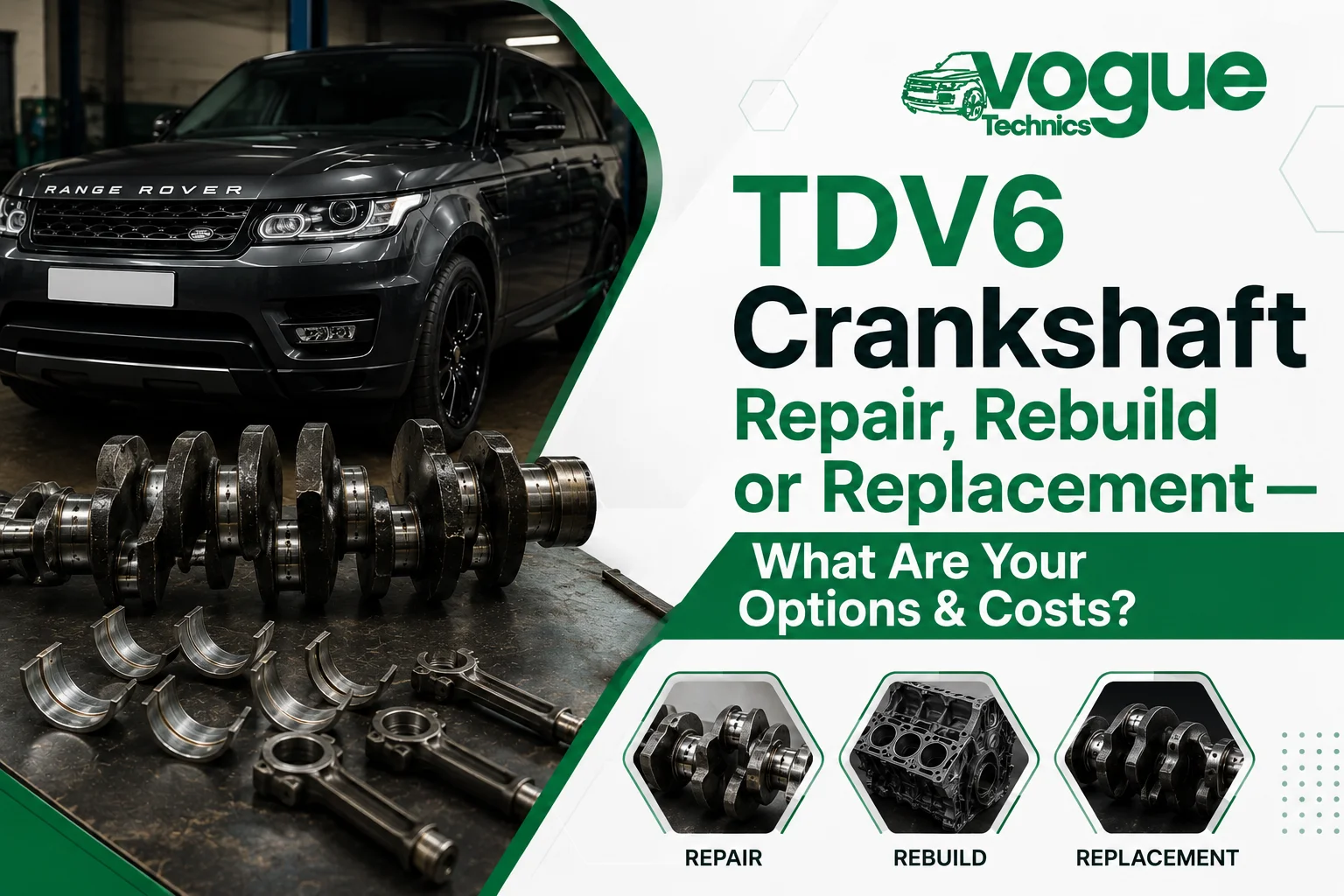
Once failure is confirmed, you have a decision to make. The right answer depends on how far the damage has spread, your budget, and how long you plan to keep the vehicle.
Engine Rebuild vs Replacement — Which Is Right for Your Range Rover Sport?
Broadly, you're choosing between three routes. Here's how they compare in plain terms:
Option | What's involved | Best when | Trade-offs |
| Crankshaft / bearing repair | Strip the bottom end, inspect and machine the crank, fit new bearing shells, rebuild | Caught early, crank still serviceable | Most cost-effective; depends on crank condition |
| Full engine rebuild | Bearings plus pistons, seals, and worn components refreshed | Higher mileage, more wear found on strip-down | More thorough and longer-lasting; higher cost |
| Replacement / reconditioned engine | Remanufactured or exchange engine fitted | Block or crank damaged beyond repair | Fastest turnaround; usually the priciest route |
The honest guidance we give every customer is the same: if the crankshaft has been caught before it scored or cracked, a repair or targeted rebuild almost always represents better value than a replacement engine. Replacement only becomes the sensible call when the strip-down reveals the block or crank is too far gone to save.
How Much Does TDV6 Crankshaft Bearing Repair Cost in the UK?
This is the question everyone wants answered, so here's a straight one. As a general UK market guide, bottom-end bearing work on a 3.0 TDV6/SDV6 typically runs from the mid-hundreds into the low thousands of pounds, while a full reconditioned or replacement engine, supplied and fitted, commonly lands in the multiple-thousand-pound range. The spread is wide because it hinges entirely on what the strip-down reveals, whether the crank can be saved, machined, and reused, or whether it's beyond economical repair.
(Confirm your own current pricing here, e.g. "[Crankshaft bearing repair from £X], [full TDV6 rebuild from £X], [reconditioned engine supplied & fitted from £X]" with a free, no-obligation inspection and written quote before any work begins.)
The key takeaway: a precise figure should always follow a proper inspection. Be cautious of anyone quoting a fixed price for crankshaft work without first seeing inside the engine.
What's Included: OEM-Spec Bearings, Machining & Warranty
A bottom-end rebuild is only as good as the parts and precision that go into it. A proper TDV6 crankshaft repair should include:
- OEM-specification bearing shells at the correct clearances, not generic budget parts
- Professional crankshaft assessment and machining where the journals need it, with measurement to factory tolerances
- New seals, gaskets, and any worn ancillaries found during the rebuild
- Fresh oil and filter to the correct specification, plus oil-system cleaning to remove the debris that caused the failure
- A meaningful parts-and-labour warranty, ours is [6 months / unlimited mileage — confirm] so you drive away protected
That last point matters. The cause of failure was lubrication; if the debris isn't cleaned out and the oil system isn't restored properly, even a perfect set of new bearings won't last.
Why Choose Vogue Technics for TDV6 Engine Rebuilds in Grays, Essex?
We specialise in exactly this engine. The 3.0 TDV6 and SDV6 bottom end isn't an occasional job for us, it's core work, and that focus is what lets us diagnose accurately and rebuild reliably rather than guessing. Based in Grays, Essex, we work on Range Rover Sport, Range Rover, Discovery 4, and Jaguar 3.0 diesels for customers across the local area and beyond.
What you can expect from voguetechnicsenginerebuild.co.uk:
- Specialist TDV6/SDV6 experience 25+ years focused on these engines (confirm)
- Honest, repair-first advice we'll save your existing engine where it's genuinely the better-value option
- In-house diagnostics and machining partnership for precise crank assessment
- A clear written quote after inspection, with no work started until you approve it
Nationwide Collection & Delivery + What Our Customers Say
A knocking engine shouldn't be driven, so we offer [nationwide collection and delivery — confirm coverage] to get your vehicle to us safely without risking further damage on the road.
Frequently Asked Questions About TDV6 Crankshaft Failure
Can a TDV6 crankshaft bearing failure be repaired, or do I need a new engine?
In many cases it can be repaired, provided it's caught before the crankshaft is badly scored or cracked. The deciding factor is the condition of the crank itself, which we confirm on inspection. Replacement is only necessary when the crank or block is beyond economical repair.
What does a spun bearing sound like on a TDV6?
A deep, rhythmic metallic knock from low in the engine that speeds up with RPM and often worsens as the oil warms. It's distinct from the lighter, faster tick of a timing chain or injector higher up the engine.
Is it safe to drive with a knocking bottom end?
No. Driving on a failing bearing risks turning a repairable job into a snapped crankshaft and a scrapped engine. Switch off and arrange inspection or recovery rather than driving it.
Which Range Rover Sport years are affected by TDV6/SDV6 crankshaft failure?
The issue spans 3.0 TDV6 and SDV6 models across the Euro 5 and Euro 6 eras. Risk is driven less by year and more by maintenance history, oil-change discipline, and how hard the vehicle has worked, towing and short-journey use raise the odds.
Can regular oil changes really prevent crankshaft failure?
They're the single most effective preventative measure. Frequent changes with the correct-specification oil keep the bearings properly lubricated and stop sludge restricting the oil pickup, directly addressing oil starvation, the number-one cause.
How long does a TDV6 crankshaft repair take?
Turnaround depends on parts, crank machining, and what the strip-down reveals, but a typical bottom-end rebuild is usually measured in days rather than weeks. We give a realistic timescale with your written quote.
Is the SDV6 the same as the TDV6 for this problem?
Yes, they share the same 306DT/AJD-V6 architecture and lubrication design, so the failure mechanism, symptoms, and repair are essentially identical.
Heard a Knock? Don't Drive It — Let's Look First
A TDV6 crankshaft bearing failure is far cheaper to fix the moment you notice it than the moment it ends in a snapped crank. If your Range Rover Sport, Discovery 4, or any 3.0 TDV6/SDV6 is knocking, flagging low oil pressure, or showing metal in the oil, the smartest move is to stop driving and get it properly diagnosed.
Call Vogue Technics Engine Rebuild in Grays, Essex on [phone number], or request a free inspection and written quote at voguetechnicsenginerebuild.co.uk. We'll tell you honestly whether it's a repair, a rebuild, or a replacement and we'll always try to save your engine first.