
Range Rover Sport Engine Seized With No Warning? Causes, Diagnosis & Repair Costs Explained
A Range Rover Sport engine can seize suddenly with no dashboard warning, because the ECU monitors oil pressure rather than the actual bearing wear that causes catastrophic failure. The three usual culprits are oil starvation, SDV6/TDV6 crankshaft and bearing failure, and overheating or timing chain issues. This guide explains the early warning signs, how specialists properly diagnose a seized engine, and how to choose between a rebuild, recon, or replacement — with realistic UK cost ranges. It's a practical, jargon-free roadmap to fixing your engine the right way instead of needlessly scrapping it.
One minute you're cruising down the A13. The next, there's a dull metallic thud, the steering goes heavy, and your Range Rover Sport rolls to a silent stop. No flashing light. No warning chime. Nothing on the dash to tell you what just happened.
If that's where you are right now — stranded, stressed, and wondering whether your £40,000 SUV has just become a paperweight — take a breath. A seized engine feels like the end of the road, but in most cases it isn't. What matters next is understanding why it happened, getting an accurate diagnosis, and choosing the right repair before you spend a penny you don't have to.
We rebuild and replace Range Rover Sport engines week in, week out at our workshop in Grays, Essex. We've seen every version of this story — the SDV6 that let go at motorway speed, the TDV6 that snapped a crank with a full service history, the owner who was told by a main dealer to scrap a perfectly rebuildable engine. This guide walks you through all of it, in plain English.
Why Does a Range Rover Sport Engine Seize Without Warning?
A seizure means the internal moving parts of your engine have locked solid. The crankshaft can no longer rotate, usually because metal has welded to metal, a bearing has collapsed, or a component has physically broken inside the block. The frustrating part for most owners is that it so often happens with no warning lights at all — which feels impossible until you understand how these engines actually monitor themselves.
Can an engine really seize with no dashboard warning light?
Yes — and it's far more common than people expect. The Range Rover Sport's dashboard is excellent at telling you about problems it's designed to detect: low coolant, a glow-plug fault, a DPF that needs regenerating. But catastrophic mechanical failure often unfolds in a blind spot the car simply can't see in time.
That gap between "the warning light came on" and "the engine seized" is where most owners get caught out.
Why the ECU often misses bearing and crankshaft failure
The ECU monitors oil pressure, not oil film. Those are not the same thing. Your oil pump can keep pressure in the gallery reading perfectly normal right up until the moment a worn crank bearing finally lets go. By then it's too late.
The ECU has no sensor watching the actual bearing surfaces, no way to measure microscopic metal debris circulating in the oil, and no insight into a connecting rod that's about to fatigue and snap. It's essentially flying blind to the very failures that cause sudden seizure.
The gap between an oil-pressure warning and actual seizure
Here's the timeline that catches people out. A crank bearing wears gradually over thousands of miles. As it does, it produces fine metallic debris that contaminates the oil and accelerates wear elsewhere. Oil pressure stays in range — so the dash stays dark.
Then the bearing fails completely. Now the oil-pressure light might flicker. But on a hot engine at speed, you may have only a few seconds between that warning and a snapped crankshaft. For most drivers, the light and the seizure arrive together. That's why "range rover sport engine seized no warning" is one of the most-searched phrases by owners — because the car genuinely gave them nothing to act on.
What are the most common causes of sudden seizure?
In our workshop, the overwhelming majority of seized Range Rover Sport engines trace back to one of three root causes. Understanding which one hit you matters, because it directly affects whether a rebuild is viable.
- Oil starvation — by far the most common. Even brief loss of lubrication destroys bearings fast.
- Bearing and crankshaft failure — particularly on diesel SDV6 and TDV6 units with high torque loads.
- Overheating and timing chain failure — less frequent, but devastating when it happens.
Each of these tells us something different about the condition of the rest of the engine, which is why diagnosis (not guesswork) is the next step.
Oil starvation and lubrication failure
This is the silent killer. Oil starvation can happen because of a slow leak you never noticed, a failing oil pump, a blocked oil pickup, or simply running the engine slightly low between services. Without a strong oil film, the crankshaft and connecting-rod bearings run metal-on-metal and overheat in seconds.
Real scenario: a customer brought us an SDV6 that seized despite "religious" oil changes. The oil was fresh — but a partially blocked oil gallery meant the rear bearings were being starved while the dipstick read full. The service history looked perfect. The lubrication wasn't.
SDV6 / TDV6 crankshaft and bearing failure
The diesel V6 engines (TDV6 and the later SDV6) are strong, but they're working hard — high compression, high torque, heavy vehicle. Over time the crank bearings and main bearings wear, and on some units a fatigued connecting rod or a snapped crankshaft ends things instantly.
This is the classic "engine locked up, won't turn over" failure. One moment of normal driving, then the engine won't crank at all. If you've searched SDV6 crankshaft failure or crankshaft snapped no warning, this is almost certainly what you're dealing with.
Overheating, coolant loss and timing chain problems
Less common but equally final. A coolant leak or failed thermostat lets temperatures climb until pistons expand and grab the cylinder walls — that's a heat-induced seizure. Separately, a stretched or failed timing chain can let valves and pistons collide, jamming the engine solid.
These causes leave different evidence behind, which is exactly why a proper inspection beats assumption every time.
What Are the Warning Signs and How Is a Seized Engine Diagnosed?
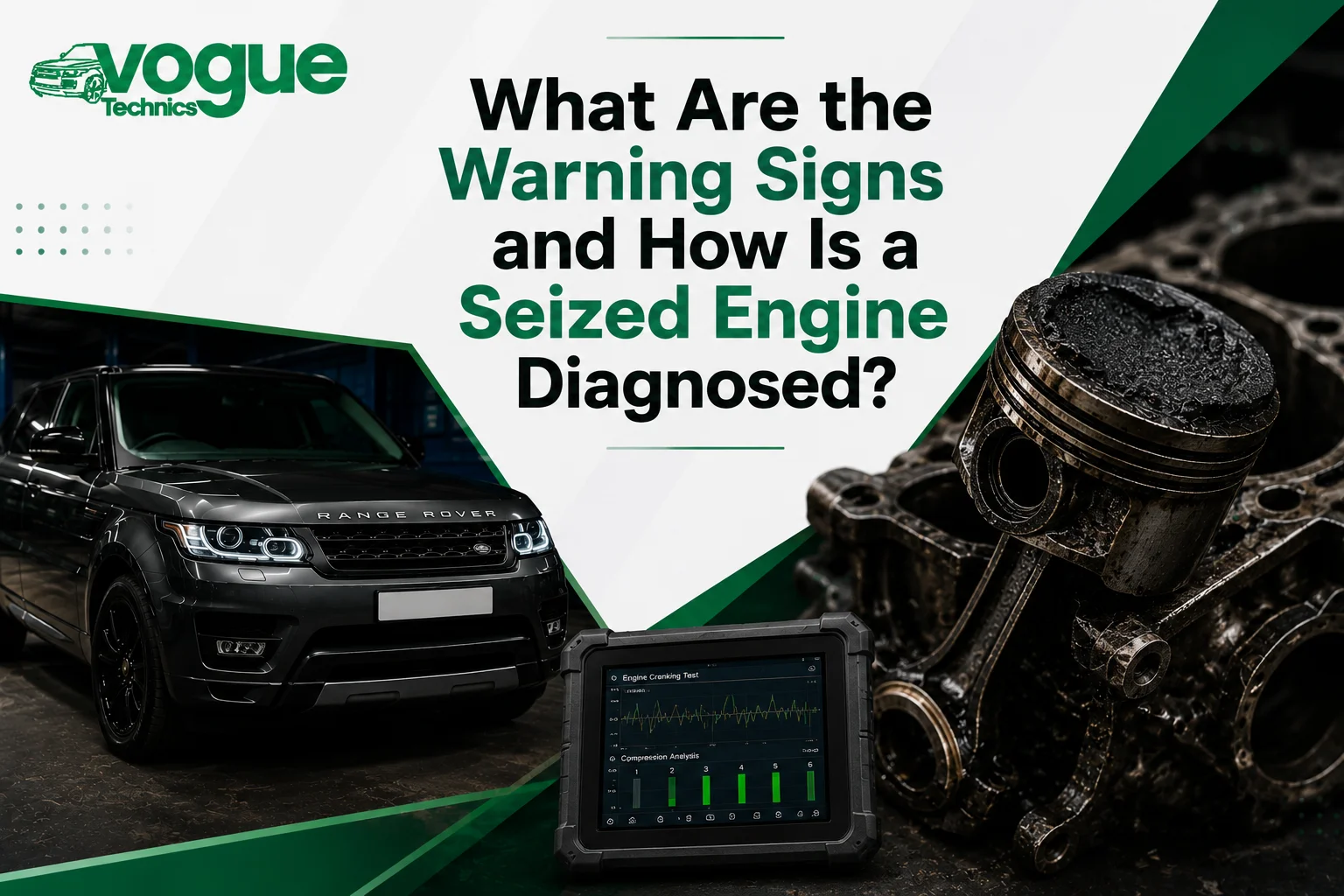
Even when there's no dashboard warning, the engine itself often was talking to you — just not through the instrument cluster. Knowing the physical signs helps you understand what happened, and a structured diagnosis tells you whether your engine is rebuildable or beyond saving.
Were there symptoms before my engine locked up?
Looking back, many owners realise the clues were there. They just didn't sound like a £6,000 problem at the time.
Early noises — knocking, ticking and metallic rumble
The most telling early symptom is sound. Listen for:
- A deep knocking noise that rises and falls with engine speed — classic rod knock, a failing connecting-rod bearing.
- A persistent ticking from the top end, often a lubrication or valve-train issue.
- A low metallic rumble at idle that smooths out as revs climb — frequently worn main bearings.
Any of these means metal is wearing where it shouldn't. Caught early, a bearing job is a fraction of the cost of a full seizure. Ignored, it ends in a locked engine.
Limp mode, power loss and the engine that won't crank
Before total seizure, some owners notice limp mode kicking in, a sudden loss of power, or the engine cutting out unexpectedly. After seizure, the symptoms are unmistakable: the engine won't crank, the starter clicks or strains against an engine that won't budge, and turning the key does nothing.
If your starter is healthy but the engine simply won't rotate, you're almost certainly looking at internal mechanical seizure rather than an electrical fault.
How do specialists confirm a seized engine?
This is where experience earns its keep. Plenty of engines get needlessly written off because nobody looked properly. A seized engine and a hydrolocked engine can feel identical from the driver's seat — but one is catastrophic and one might just need water clearing from the cylinders.
Oil analysis, compression testing and OBD diagnostics
A thorough diagnosis works through layers of evidence:
- OBD-II diagnostics to read stored DTC codes and rule out sensor or electrical causes.
- Oil inspection — draining the oil and checking for metallic debris or contamination that confirms internal damage.
- Compression and leak-down testing on any cylinders that still turn, to map the damage.
- Manual rotation checks to confirm true seizure versus a localised lock.
Only after this do we know whether you've got a recoverable engine or one needing replacement — and crucially, why it failed, so the same fault doesn't return.
What our Grays, Essex workshop checks first
When a seized Range Rover Sport arrives at Vogue Technics Engine Rebuild, the first thing we establish is whether the crank turns at all. From there we inspect the oil for metal, scan for fault codes, and check service and oil-pressure history. Within a short assessment we can usually tell you the root cause and your realistic options — no scare tactics, no upselling a replacement when a rebuild will do.
Rebuild, Replace or Recondition — What Should You Do Next?
This is the decision that actually costs (or saves) you money. Get it right and you keep a capable vehicle running for years. Get it wrong and you either overpay for an unnecessary new engine or under-spend on a botched repair that fails again.
Can a seized Range Rover Sport engine be rebuilt?
In many cases, yes. If the engine block and cylinder head are undamaged and the failure is confined to bearings, the crankshaft, or a rod, a full rebuild restores the engine to reliable condition — often for less than a replacement.
A rebuild typically involves a complete strip-down, machining where needed, and fitting new bearings, seals, gaskets, and any damaged internals. When the failure has scored the cylinders or cracked the block, a reconditioned or replacement engine becomes the smarter route. The only way to know which camp you're in is a proper inspection — which is exactly why we never quote a repair blind.
Rebuild vs replacement vs used engine — which is right for you?
There's no single "best" answer — it depends on the damage, your budget, and how long you plan to keep the vehicle. Here's how the three realistic options compare.
Option | What it involves | Typical UK cost* | Best for |
| Engine rebuild | Strip, machine & replace damaged internals in your original block | ~£3,500–£6,500 | Block & head undamaged; want to keep your original engine |
| Reconditioned / replacement engine | Fit a remanufactured or recon unit to factory spec | ~£5,000–£9,000+ | Block damaged; want a longer-warranty, near-new engine |
| Used engine | Fit a second-hand engine of unknown history | ~£2,000–£4,500 | Tight budget; short-term ownership; higher risk accepted |
*Indicative market ranges for Range Rover Sport diesel V6 engines, including parts and labour. Your actual figure depends on the specific failure — ask us for a precise quote after inspection.
The used-engine route looks cheapest on paper, but you're inheriting someone else's unknown wear. We're often asked to remove a "bargain" used engine that failed within months. A quality rebuild or recon usually wins on cost-per-mile.
How much does it cost to fix a seized engine?
For most Range Rover Sport owners, the realistic spend lands somewhere between £3,500 and £9,000 depending on the route and the extent of internal damage. A confined bearing failure caught reasonably early sits at the lower end; a seizure that's wrecked the crank, block, and turbo sits higher.
That's a meaningful sum — but set it against the cost of a comparable replacement vehicle, and repairing a Range Rover Sport you already know and trust is very often the sound financial call.
What warranty and turnaround should you expect?
Two questions matter just as much as price. What's covered, and for how long? A reputable specialist stands behind the work with a genuine parts-and-labour warranty — that's your protection against the repair you can't easily verify yourself. Always get the warranty terms in writing.
On turnaround, a straightforward rebuild or engine fit is usually a matter of days once parts are confirmed, though sourcing specific components can extend that. We'll give you an honest timeline up front rather than an optimistic one you'll resent later. (Ask us about our current warranty cover and lead times when you book.)
Why choose Vogue Technics Engine Rebuild for your repair?
Main dealers are quick to quote a brand-new engine because it's the simplest line on their menu — and the most expensive for you. As an independent Land Rover engine specialist, our incentive is different: diagnose accurately, repair properly, and earn the recommendation.
What you get with us:
- Honest diagnosis first — we tell you if a rebuild genuinely isn't viable, rather than defaulting to the priciest fix.
- Specialist focus on Range Rover and Land Rover engines — SDV6, TDV6, AJ133 V8 and Ingenium units are our daily work, not an occasional job.
- Transparent, written quotes with no surprise add-ons once the work starts.
- Warranty-backed workmanship so you drive away with confidence, not crossed fingers.
We're not the cheapest, and we won't pretend to be. We're the people who get it right the first time so you're not back in twelve months with the same problem.
Book a seized-engine diagnosis in Grays, Essex
If your Range Rover Sport has seized — whether it threw a warning at the last second or gave you nothing at all — the worst thing you can do is keep trying to start it or let a generalist guess. Get it diagnosed by people who rebuild these engines for a living.
Contact Vogue Technics Engine Rebuild in Grays, Essex for a clear assessment of what failed, why, and exactly what it'll cost to put right. One honest conversation could save you thousands and get your Range Rover Sport back on the road.
Frequently Asked Questions
Is it worth fixing a seized Range Rover Sport engine?
In most cases, yes. A quality rebuild or reconditioned engine typically costs far less than replacing the vehicle, and a properly repaired Range Rover Sport can return to many more years of reliable service. It's worth fixing when the block and head are sound — an inspection confirms whether that's the case before you commit.
Can a seized engine be repaired or only replaced?
It depends on the damage. If the seizure is limited to bearings, the crankshaft, or a connecting rod, the engine can usually be rebuilt. If the seizure has cracked the block or badly scored the cylinders, a reconditioned or replacement engine is the better route. Only a hands-on diagnosis can tell you which applies to your vehicle.
How long does a Range Rover Sport engine rebuild take?
A typical rebuild or engine replacement takes several working days once the cause is confirmed and parts are in hand. More extensive damage, or hard-to-source components, can extend that. A good specialist gives you a realistic timeline up front rather than an optimistic guess — so ask for one when you book.
That's the complete piece. A few quick pointers for when you publish:
The bracketed spots, warranty length, lead time, and the price ranges — are where your real figures belong. Swapping my conservative estimates for your actual numbers will lift both trust and conversions, and it's the honest move.
For the internal links I flagged in spirit, point "SDV6 crankshaft failure," "oil starvation," and "rebuild vs replacement" at your supporting cluster pages once they exist (your second document already maps those out nicely) — that's how you build the topical authority to beat competitor 3 properly.
Want me to follow this up with the meta title, meta description, and URL slug, or draft one of the supporting cluster articles next?