

Range Rover Evoque vs Discovery Sport Engine: A Rebuild Specialist's Honest Comparison
Wondering about the Range Rover Evoque vs Discovery Sport engine? The truth is they share the same JLR Ingenium engine family, so the real decision isn't the badge, it's the engine choice and service history. Written by Grays-based rebuild specialists, this honest guide breaks down the petrol, diesel, and P300e options, the faults they see most on the bench (timing chain wear, oil dilution, DPF issues), and how to pick the right engine for your driving so you avoid a costly rebuild.
If you're cross-shopping these two, you've probably already noticed something strange: every comparison page online argues about boot space, cupholders, and which one looks better on the school run. Almost none of them talk about the thing that will actually cost you money down the line the engine.
That's the part we deal with every week. At our workshop in Grays, Essex, the Evoque and Discovery Sport aren't lifestyle choices to us. They're cars that roll in on a low-loader because a timing chain let go, or an oil light came on and nobody acted fast enough. So this isn't a brochure rewrite. It's what we'd tell a mate who asked us, spanner in hand, "Which one should I actually buy and which engine won't bankrupt me?"
Let's get into it properly.
Do the Range Rover Evoque and Discovery Sport Share the Same Engine?
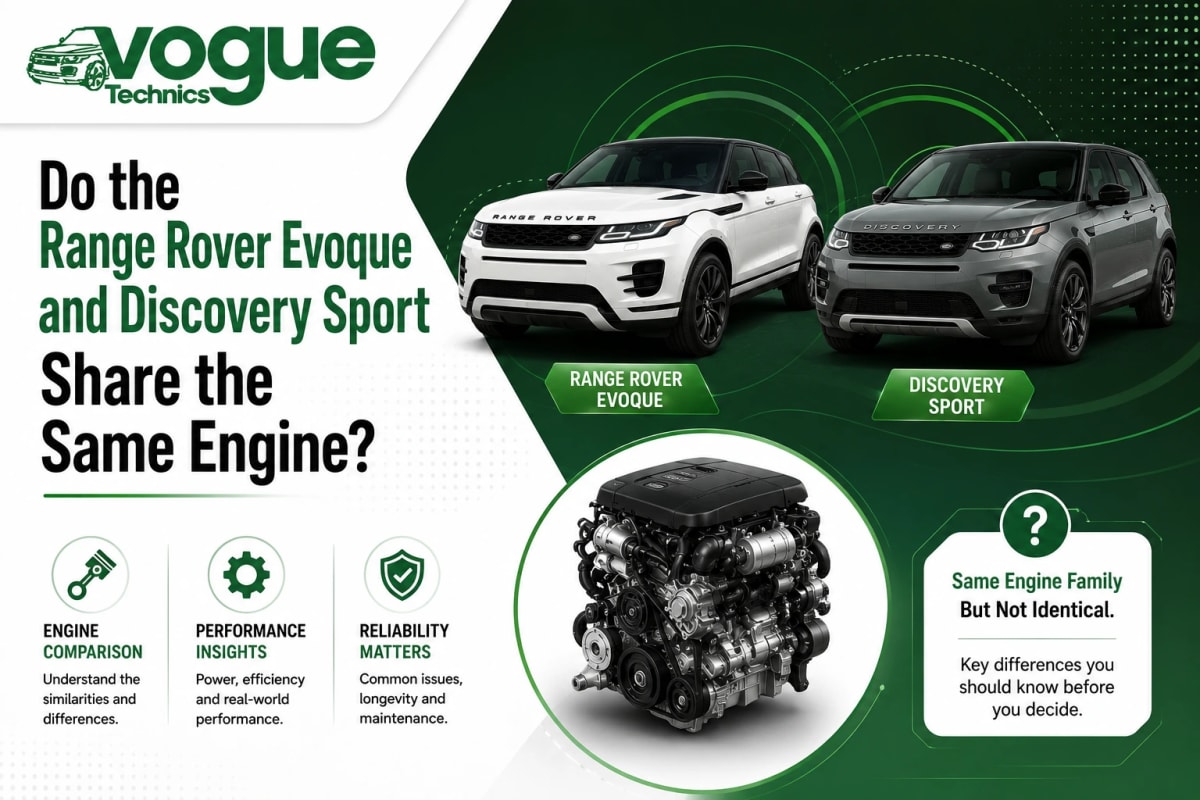
Here's the short version most dealer pages dance around: yes, they do. Both cars are built on Jaguar Land Rover's Premium Transverse Architecture, and both run the same family of Ingenium engines. So when people search Range Rover Evoque vs Discovery Sport engine expecting two wildly different powertrains, the reality is closer to two siblings wearing different outfits.
That single fact changes how you should shop. You're not really choosing between two engines, you're choosing the same engines wrapped in two different bodies with different weights, gearing, and intended jobs. The Evoque leans style and city polish; the Discovery Sport leans space and family practicality. Mechanically, the heart is shared.
Which Ingenium Petrol and Diesel Engines Come in Each Model?
Across recent model years, both cars draw from the same 2.0-litre Ingenium pool, plus the smaller hybrid unit. Here's the line-up in plain terms:
- Petrol (P-badged): P200 (around 200 hp), P250 (around 249 hp), and the punchier P300 (around 300 hp). These are turbocharged 2.0-litre four-cylinder units, most paired with the ZF 9-speed automatic and all-wheel drive.
- Diesel (D-badged): D150, D165, D180, and the stronger D200. All 2.0-litre turbo-diesels, all in the same Ingenium family. Earlier cars used the older TD4/SD4 badging for essentially the same hardware.
- Plug-in hybrid (P300e): This one's different a 1.5-litre three-cylinder Ingenium petrol engine paired with an electric motor and a small battery, giving a modest electric-only range for short commutes.
The practical takeaway: a P250 in an Evoque and a P250 in a Discovery Sport are the same engine. Reliability patterns, service needs, and common faults carry across both. So if you read about a fault on one forum thread for an Evoque, assume it's relevant to the Discovery Sport too.
Evoque vs Discovery Sport: How Do the Power and Torque Figures Compare?
Same engines, slightly different feel and that comes down to weight. The Discovery Sport is the heavier, taller car (it has to swallow that optional third row), so identical power moves it a touch less briskly than it does the lighter, lower Evoque.
Here's a rough head-to-head on the popular engines:
Engine | Type | Approx. Power | Approx. Torque | Best Suited To |
| D165 | 2.0 Diesel | ~163 hp | ~380 Nm | Motorway miles, towing |
| D200 | 2.0 Diesel | ~204 hp | ~430 Nm | Heavier loads, long-distance |
| P200 | 2.0 Petrol | ~200 hp | ~320 Nm | Town and light use |
| P250 | 2.0 Petrol | ~249 hp | ~365 Nm | Balanced everyday performance |
| P300e | 1.5 PHEV | ~309 hp combined | strong low-end | Short commutes, low tax |
Figures are approximate and vary by model year and spec always check the V5C and build data on the specific car you're viewing.
Notice the diesels' torque advantage. That's why, if you tow a caravan or a horsebox, the D200 diesel is the sensible pick in either body. The petrols feel keener around town but run out of pulling muscle when fully loaded.
Is the P300e Plug-In Hybrid the Same in Both Cars?
Effectively, yes. The P300e system three-cylinder petrol engine, electric motor, lithium-ion battery is shared across both the Evoque and the Discovery Sport. The numbers shift slightly because of weight and packaging, but the core technology is identical.
It's a clever bit of kit on paper, and the low company-car tax makes it tempting. But be honest with yourself about how you drive. If you can charge at home and your daily run is short, the P300e shines. If you mostly do long motorway stints, you're hauling a battery around for little benefit — and you'd be better served by a plain diesel. We've seen plenty of high-mileage PHEVs come in where the owner basically never plugged in. That defeats the point.
Which Engine Is More Reliable — Evoque or Discovery Sport?
This is the question that actually matters, and it's the one almost nobody answers honestly because dealers want to sell you the car, not warn you about it.
So here's our straight answer: reliability isn't really an Evoque-vs-Discovery-Sport question. It's an engine-choice and a service-history question. Since both cars share the Ingenium family, the same strengths and the same weaknesses show up in both. A well-maintained example of either can sail past 120,000 miles. A neglected one can leave you stranded at 60,000.
Below are the patterns we genuinely see on the bench, in order of how often they walk through our doors.
The Engine Problems We See Most Often on the Bench (And Why)
Before the list, one honest caveat: most of these faults trace back to deferred maintenance and short-journey driving, not to a fundamentally bad engine. The Ingenium is a capable unit when it's looked after. Abuse it and it bites.
The recurring issues:
- Timing chain wear the headline concern, especially on earlier diesel Ingenium engines. A stretched chain can jump timing and cause serious internal damage.
- Oil dilution on the diesels fuel seeping into the engine oil during DPF regeneration cycles, particularly on cars used only for short hops.
- DPF blockages diesel particulate filters that never get the long, hot run they need to regenerate, so they clog and trigger limp mode.
- EGR valve faults carbon build-up causing rough running, warning lights, and failed emissions tests.
- Turbocharger wear usually a symptom of poor oil maintenance rather than a weak turbo itself.
After that list, the thread tying it together is simple: oil and journey type. Clean oil, changed on time, and the occasional proper motorway run solve or prevent the majority of what we rebuild.
Why Does Oil Dilution Affect the Diesel Ingenium Engines?
Here's the mechanism, in plain English. Modern diesels squirt extra fuel to burn off soot trapped in the DPF that's "regeneration." On a long drive, the engine gets hot enough to complete that cycle cleanly. On short, stop-start trips, the cycle keeps getting interrupted, and some of that diesel slips past into the sump and mixes with the engine oil.
Diluted oil is thinner oil. Thinner oil protects bearings and the timing chain less well. Left unchecked over thousands of miles, that's a fast track to wear and it's exactly why a "city-only" diesel is often in worse mechanical shape than a higher-mileage motorway car.
The fix is behavioural, not just mechanical: if your driving is mostly short journeys, a diesel is the wrong engine for you. Buy the petrol or the P300e instead. We'd rather tell you that before you buy than rebuild your engine after.
Timing Chain Wear: What to Listen For Before It Fails
The timing chain is the single most important thing to check on any used Ingenium engine. When it goes, it doesn't go quietly it goes expensively.
Catch it early and you're looking at a manageable job. Miss it and the chain can skip, the valves can meet the pistons, and now you're rebuilding the whole engine. The difference between those two outcomes is often a few weeks of paying attention.
Early Warning Signs You Should Never Ignore
If a car you own or one you're about to buy does any of these, stop and get it inspected:
- A rattle from the engine on cold start-up, especially in the first few seconds before oil pressure builds.
- A whirring or chain-like noise that changes with engine speed.
- An engine management light linked to camshaft or crankshaft position correlation faults.
- Rough idle or a noticeable loss of smoothness that wasn't there before.
On a test drive, start the car cold yourself. A seller who's warmed it up before you arrive may be hiding exactly this. That cold start tells you more in five seconds than the rest of the drive combined.
Petrol vs Diesel: Which Engine Lasts Longer at High Mileage?
There's no universal winner there's a right answer for your usage. Match the engine to how you actually drive and either can last well. Mismatch them and you've bought a problem.
- Choose diesel (D165/D200) if you cover serious motorway mileage, tow, or do long, steady runs. Diesels thrive on heat and distance, that keeps the DPF clean and the oil healthy.
- Choose petrol (P200/P250) if you're mostly doing town driving, school runs, and short trips. No DPF headaches, no oil dilution worries.
- Choose the P300e only if you'll genuinely plug it in and your commute is short enough to run on electric most days.
The honest summary: a motorway diesel and a town petrol both routinely pass 130,000 miles in good health. A town diesel often doesn't not because the engine is bad, but because it was never the right tool for the job.
For a deeper breakdown of these faults, our [Ingenium engine problems guide] and [DPF regeneration explained] articles go further than we can here.
Should You Repair, Rebuild, or Replace a Failing Ingenium Engine?
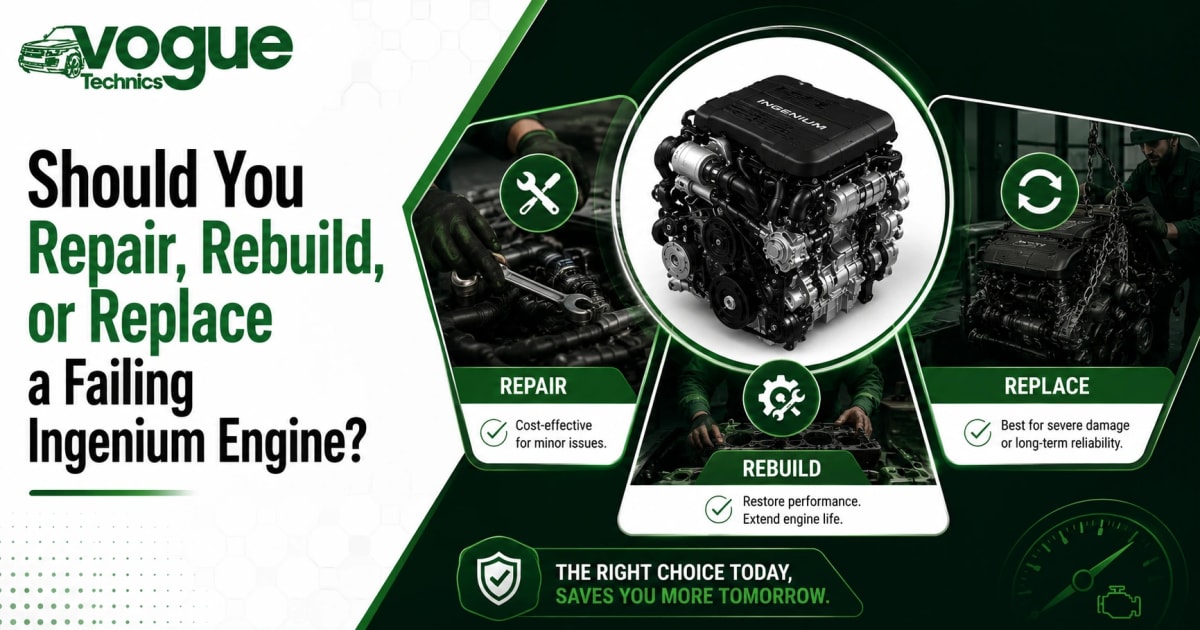
Say the worst has happened or you've found a great-value Evoque or Discovery Sport with a known engine fault and you're wondering whether it's a bargain or a money pit. This is where having a specialist in your corner pays for itself.
You've got three routes, and they're rarely as obvious as they seem.
How Much Does an Evoque or Discovery Sport Engine Rebuild Cost in the UK?
Cost depends entirely on what's actually failed, so anyone quoting a flat figure sight-unseen isn't being straight with you. As a realistic guide:
- A timing chain replacement, caught early, is a moderate job far cheaper than what follows if you ignore it.
- A full engine rebuild (reconditioning the block, replacing worn internals, new chain and seals) is a bigger investment but typically a fraction of the cost of a brand-new engine and it lets us put right the original weaknesses rather than just resetting the clock on them.
- A like-for-like used engine swap can look cheap up front but carries real risk (more on that below).
The smart move is a proper diagnostic first. A compression test, an oil analysis, and a chain inspection tell us whether you're facing a small job or a big one before you commit a penny.
Why a Rebuild Often Beats a Used Engine Swap
A used engine is a gamble dressed up as a saving. Here's the logic we walk customers through every week:
- A used Ingenium unit usually carries the exact same design weaknesses and you have no idea how the previous owner treated it.
- You're often buying someone else's deferred problem: an unknown oil-change history, a tired chain, a half-clogged DPF.
- A proper rebuild lets us upgrade and correct the known weak points, so the engine you drive away with is often better than factory in the areas that matter.
- A rebuild comes with our workmanship and warranty a breaker's used lump rarely does.
Put simply: a swap resets the mileage number but inherits the risk. A rebuild addresses the root cause. For an engine family with known timing chain and oil dilution patterns, that distinction is everything.
Trusted Range Rover Evoque & Discovery Sport Engine Rebuilds in Grays, Essex
This is what we do, day in and day out. Voguetechnicsenginerebuild.co.uk specialises in Ingenium engine diagnostics, repairs, and full rebuilds for the Range Rover Evoque and Land Rover Discovery Sport, right here in Grays, Essex serving owners across Thurrock, Essex, East London, and the surrounding areas.
If your car has a warning light, a worrying rattle, or you just want a pre-purchase engine inspection before you buy a used Evoque or Discovery Sport, that's exactly the kind of work we'd rather do before a breakdown than after.
Bring us the car, or send us the symptoms, and we'll give you the honest version repair, rebuild, or walk away. No upsell, no guesswork.
Frequently Asked Questions
Is the Evoque engine the same as the Discovery Sport engine?
Yes. Both use Jaguar Land Rover's Ingenium engine family on the same platform. A P250 petrol or D200 diesel is mechanically the same unit in either car, the main differences are weight, gearing, and how the power feels on the road.
Which engine is more reliable, the Evoque or the Discovery Sport?
Neither has an inherent reliability edge, because they share engines. Reliability comes down to which engine you pick and how it's been maintained. A serviced petrol used for town driving, or a diesel used for motorway miles, will both hold up well.
Are the Ingenium diesel engines reliable?
They can be, with the right driving and servicing. The common issues oil dilution, DPF clogging, timing chain wear are mostly linked to short-journey use and skipped oil changes rather than a flawed design.
Should I buy a petrol or diesel Evoque or Discovery Sport?
Match it to your mileage. High motorway mileage and towing favour the diesel. Mostly short, urban trips favour the petrol or the P300e plug-in hybrid. The wrong choice for your driving style is the single biggest cause of avoidable engine trouble.
Is the P300e plug-in hybrid worth buying?
Only if you'll actually charge it and your daily drive is short. Used that way, it's efficient and cheap to tax. If you rarely plug in or do long distances, a diesel makes more sense.
What mileage do these engines last to?
A well-maintained, correctly-chosen Ingenium engine routinely passes 120,000–140,000 miles. The key word is maintained service history matters more than the number on the clock.
The Bottom Line
The real answer to Range Rover Evoque vs Discovery Sport engine is that you're choosing the same heart in two different bodies. So stop agonising over which badge is "more reliable" and start asking the questions that actually protect your wallet: Which engine suits my driving? What's the service history? And has anyone checked that timing chain?
Get those right and either car can be a genuinely rewarding, long-lasting ownership experience. Get them wrong and you'll learn the Ingenium's weak points the hard way.
If you'd rather skip the hard way, whether you already own one of these cars or you're about to buy talk to the people who rebuild these engines for a living. Get in touch with voguetechnicsenginerebuild.co.uk in Grays, Essex for an honest diagnosis, a pre-purchase inspection, or a proper rebuild that fixes the cause, not just the symptom.