

Range Rover Evoque P0016 Fault Code Explained: Causes, Symptoms & Fix
The Range Rover Evoque P0016 fault code is one of the most serious and misunderstood engine codes on this platform. It signals a timing correlation error between the crankshaft and camshaft most commonly caused by a stretched timing chain, a faulty VVT solenoid, or low engine oil. Ignoring it can turn a £1,200 repair into a £5,000+ engine rebuild. This guide covers everything Evoque owners need to know: real causes, symptoms, accurate diagnosis, and honest UK repair costs.
If your Range Rover Evoque has thrown a P0016 fault code, you are not alone and you are right to take it seriously. This is one of the most misunderstood and frequently misdiagnosed engine codes on the Evoque, and ignoring it or guessing the fix can cost you thousands of pounds in avoidable engine damage.
Whether your check engine light came on out of nowhere, your Evoque is rattling on cold starts, or the code keeps returning even after repairs, this guide breaks everything down clearly. From what P0016 actually means, to what causes it on Land Rover's 2.0-litre engine, to how much it costs to fix in the UK, you will find honest, expert-level answers here.
What Is the P0016 Fault Code on a Range Rover Evoque?
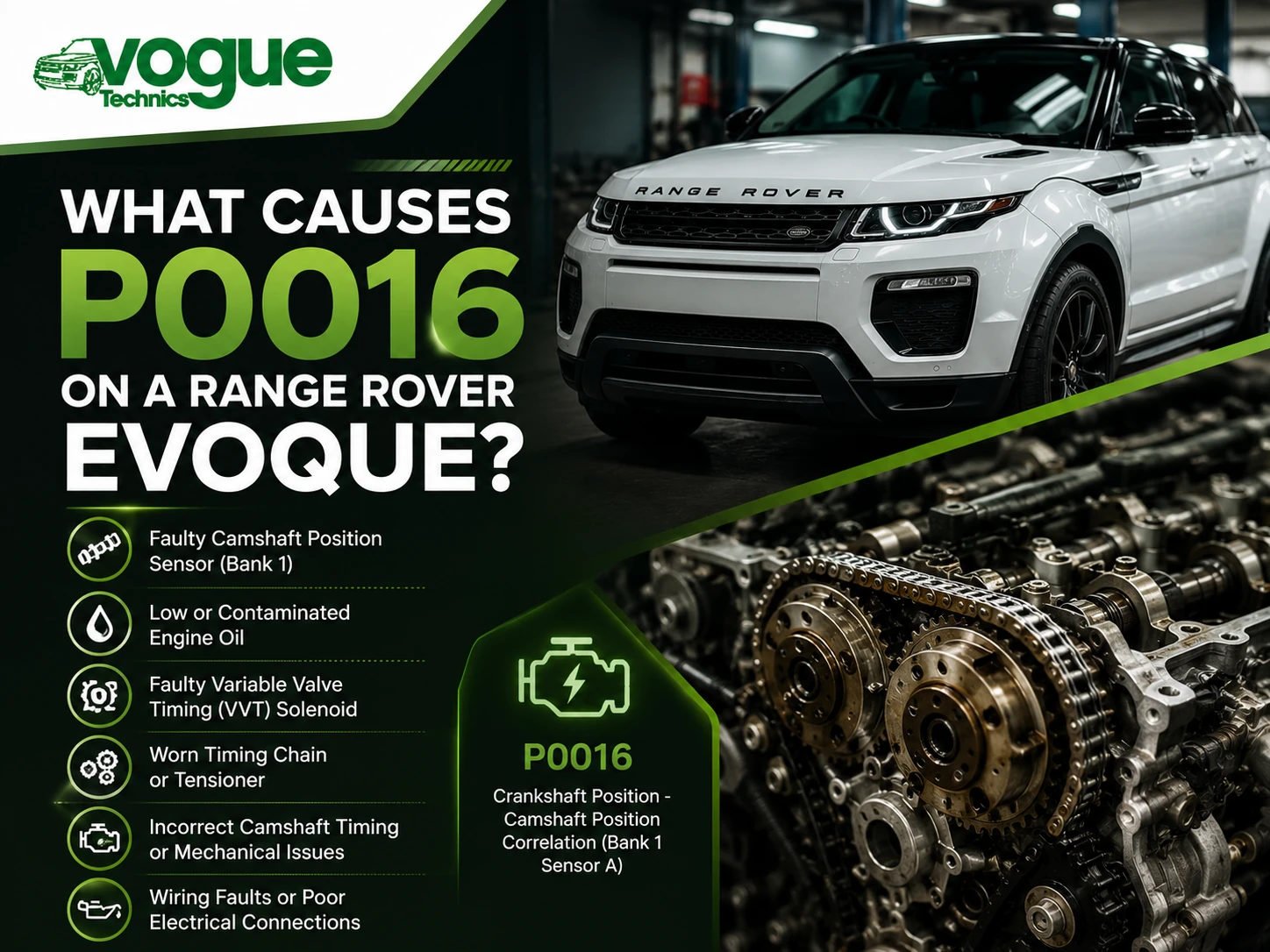
Before jumping to conclusions about timing chain replacements or sensor swaps, it helps to understand exactly what the ECU is telling you when P0016 is logged.
Technical Definition of P0016 (Bank 1 Sensor A)
P0016 is an OBD-II diagnostic trouble code that stands for "Crankshaft Position – Camshaft Position Correlation (Bank 1, Sensor A)."
In plain terms, the engine's ECU has detected that the crankshaft and the camshaft on Bank 1 are not rotating in the precise synchronisation they should be. The crankshaft position sensor and the camshaft position sensor are continuously feeding data to the ECM, and when those two signals fall out of the expected alignment window even slightly, P0016 is triggered.
It is not a sensor fault code in itself. It is a correlation fault, meaning the sensors may be perfectly fine but the mechanical timing relationship between the two shafts has drifted. That distinction matters enormously when diagnosing and fixing the issue.
How the Crankshaft and Camshaft Correlation System Works on the Evoque
The Range Rover Evoque uses a Variable Valve Timing (VVT) system, also known as variable camshaft timing, which adjusts the camshaft position in real time based on engine load, speed, and temperature. This optimises fuel economy, performance, and emissions simultaneously.
The VVT system relies on:
- The crankshaft position sensor: monitoring the crankshaft's rotational position via a reluctor ring
- The camshaft position sensor: tracking the camshaft's exact position relative to the crankshaft
- The VVT solenoid (oil control valve): directing pressurised engine oil to advance or retard the cam phaser
- The cam phaser (VVT actuator): physically adjusting camshaft timing in response to oil pressure commands
When all four components work in harmony and the timing chain holds its correct tension, the system runs flawlessly. When any element fails or when the timing chain stretches even a few degrees, the ECU logs P0016.
Why the Evoque's Engine Is Particularly Vulnerable to P0016
The Range Rover Evoque, particularly the 2.0-litre Si4 and the older 2.2 TD4 variants, has a well-documented history with timing chain wear. The Si4 petrol engine uses a relatively fine-pitch timing chain that is sensitive to:
- Infrequent oil changes: degraded oil loses its viscosity and fails to lubricate the chain guides properly
- Low oil level operation: even running slightly low reduces hydraulic pressure to the VVT actuator
- High mileage without chain inspection: chains are not a "fit and forget" component on these engines
This is not a design flaw exclusive to Land Rover, but the Evoque's engine architecture makes it particularly unforgiving when maintenance is deferred. Many P0016 cases we see at Vogue Technics in Grays, Essex trace back directly to oil service neglect rather than a sudden mechanical failure.
P0016 vs P0017 — What's the Difference and Can They Appear Together?
This causes genuine confusion among Evoque owners and even some independent garages.
P0016 relates to Bank 1, Intake Camshaft (Sensor A) correlation with the crankshaft. P0017 relates to Bank 1, Exhaust Camshaft (Sensor B) correlation with the crankshaft.
Code | Bank | Camshaft | Sensor |
| P0016 | Bank 1 | Intake (Sensor A) | Camshaft Position Sensor A |
| P0017 | Bank 1 | Exhaust (Sensor B) | Camshaft Position Sensor B |
Both codes appearing together almost always points to a mechanical timing issue, typically a stretched timing chain or a failed cam phaser, rather than individual sensor failures. If your scanner shows both P0016 and P0017 simultaneously, do not replace sensors and hope for the best. The root cause is almost certainly mechanical.
What Causes P0016 on a Range Rover Evoque?
There are several possible causes, ranging from a simple sensor replacement to a full timing chain overhaul. Understanding each one prevents unnecessary parts expenditure and repeat visits to the garage.
Stretched or Worn Timing Chain — The Most Common Culprit
On the Range Rover Evoque, a stretched timing chain is the leading cause of P0016, particularly on vehicles above 60,000 miles or those with an inconsistent service history.
The timing chain connects the crankshaft to the camshaft(s) and must maintain a precise length to keep valve timing accurate. Over time, the chain's pins and rollers wear, causing it to elongate slightly. Even a stretch of a few millimetres translates to several degrees of camshaft retardation, enough to trigger P0016.
Signs that the timing chain is the cause include:
- P0016 appearing alongside a rattling noise on cold start: the chain is slack before oil pressure builds
- The code returning shortly after being cleared: the underlying stretch remains
- Rough idle or hesitation on acceleration: timing is mechanically off, not just a sensor misread
- P0016 and P0017 logged together: both camshaft signals are affected, pointing to chain-level movement
A stretched chain cannot be "adjusted" or tensioned back to spec. Once the chain has worn beyond tolerance, replacement is the only lasting fix.
Failed VVT Solenoid or Cam Phaser
The VVT solenoid (also called the oil control valve) is responsible for directing engine oil to the cam phaser to advance or retard camshaft timing. When this solenoid becomes clogged with sludge, sticks in position, or fails electrically, the cam phaser receives incorrect oil pressure commands and the camshaft position drifts out of correlation with the crankshaft.
Similarly, a worn or seized cam phaser cannot respond accurately to the solenoid's commands, causing the ECU to detect a correlation error and log P0016.
Both of these components are directly affected by oil quality. Thick, degraded oil or sludge buildup is a common reason VVT solenoids fail prematurely on the Evoque. This is why an oil change is often the first diagnostic step, not as a definitive fix, but as a way to rule out oil-related causes before replacing hardware.
Faulty Camshaft or Crankshaft Position Sensor
While P0016 is a correlation fault rather than a sensor fault, a failing camshaft position sensor or crankshaft position sensor can produce intermittent or inaccurate signals that mimic a timing correlation issue.
A sensor fault is more likely the cause when:
- P0016 appears only intermittently rather than consistently
- No cold start rattle is present
- The timing chain is known to be recently replaced and correctly set
- Live data from a diagnostic tool shows erratic sensor readings at idle
Sensors are relatively inexpensive and straightforward to replace, making them worth testing before authorising more invasive work. However, replacing sensors without proper live-data diagnosis on a vehicle that actually has a stretched chain is a costly mistake that delays the real repair.
Can Low Engine Oil Level Trigger P0016?
Yes, and this is one of the most overlooked causes. The VVT system on the Evoque is hydraulically operated, meaning it depends entirely on adequate, pressurised engine oil to function correctly.
When the oil level drops below the minimum mark, oil pressure to the cam phaser drops. The phaser cannot hold or adjust the camshaft position accurately, and the ECU detects the resulting correlation error as P0016.
Before spending anything on diagnostics or parts, check the oil level. If it is low, top it up with the correct specification oil (check your Evoque's handbook, typically 5W-30 ACEA C3 for the Si4), clear the fault code, and monitor. If P0016 does not return, low oil was the trigger. If it returns, further investigation is needed.
Why Does P0016 Appear After a Timing Chain Replacement?
This is a question we hear regularly at Vogue Technics. If a timing chain has been replaced but P0016 persists or returns, the possible explanations are:
- Timing was set incorrectly during replacement: even one tooth off on installation causes a permanent correlation error
- The cam phaser or VVT solenoid was not replaced alongside the chain: these components are often worn and should be renewed as part of a full timing kit
- Old fault codes were not cleared properly: occasionally a stored code from before the repair is still present
- A secondary cause was missed: for instance, a faulty crankshaft sensor that was never diagnosed alongside the chain issue
A professional post-replacement diagnostic using live data is essential to confirm all timing values are within specification after the repair.
Cold Start Rattle and Its Direct Link to P0016
The infamous Evoque cold start rattle is directly related to the timing chain. When the chain is worn or the tensioner is weakening, there is momentary slack in the chain during the critical seconds between engine start and full oil pressure build-up.
This rattle is not just an annoying sound, it is a warning that the timing chain is under stress every time the engine starts from cold. Prolonged cold start rattling accelerates chain wear and increases the risk of the chain jumping a tooth on the sprocket, which causes immediate and severe valve timing disruption, potentially causing engine damage.
If your Evoque rattles on a cold start and has subsequently thrown a P0016 code, the two are almost certainly connected. Do not delay the diagnosis.
Symptoms, Risks and Real Diagnosis of P0016
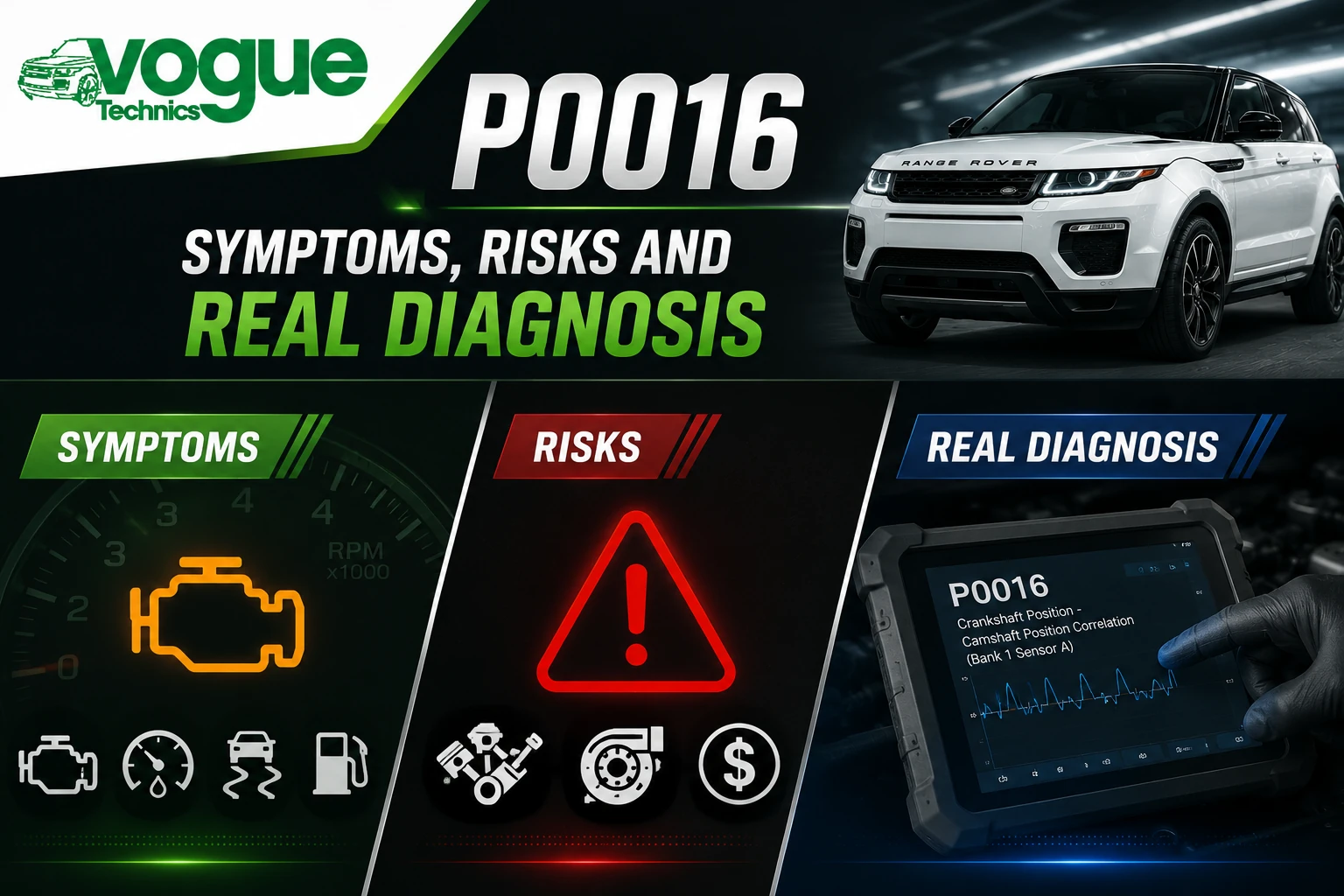
Understanding the symptoms and genuinely assessing the risk is what separates an informed owner from one who gets stranded or faces an engine rebuild bill that could have been avoided.
Common Symptoms of P0016 on the Range Rover Evoque
P0016 does not always present dramatically. In early stages, some owners barely notice anything beyond the check engine light. As the fault progresses, symptoms typically include:
- Illuminated check engine light (MIL) often the first and only early symptom
- Cold start rattle lasting two to five seconds after ignition
- Rough or unstable idle particularly noticeable when the engine is warm
- Reduced power or hesitation during acceleration, especially from low revs
- Poor fuel economy incorrect valve timing increases fuel consumption noticeably
- Engine misfire in more advanced cases where timing is significantly off
- Difficulty starting rare in early stages but possible if the chain has jumped a tooth
Not every P0016 case presents all these symptoms. A vehicle with a mildly stretched chain and a competent tensioner may show nothing beyond a logged fault code for weeks. That does not make it safe to ignore.
How Serious Is P0016 — Can You Still Drive Your Evoque?
Honestly, P0016 is a serious fault code that warrants prompt attention. It is not in the same category as a minor sensor glitch.
Here is a straightforward breakdown:
Situation | Risk Level | Recommendation |
| P0016 only, no symptoms | Moderate | Diagnose within 1–2 weeks |
| P0016 with cold start rattle | High | Book diagnostic immediately |
| P0016 with rough idle/misfire | High | Limit driving, diagnose urgently |
| P0016 with P0017 together | Very High | Do not drive until diagnosed |
| P0016 after chain replacement | Moderate–High | Return to garage immediately |
Short journeys in mild cases may be acceptable temporarily, but continued driving with a worn timing chain risks the chain jumping a tooth, an event that can bend valves, damage pistons, and turn a £1,200 chain job into a £5,000+ engine rebuild. That is not a risk worth taking.
What Happens If P0016 Is Left Ignored?
This is where many owners make a costly mistake. Because the Evoque continues to run, sometimes for weeks or months with P0016 logged, it is tempting to clear the code and hope it stays away.
The reality is:
- The timing chain continues to stretch and wear with every journey
- Cold start rattling causes repeated micro-damage to chain guides and tensioners
- The cam phaser operates under increasing stress without accurate positioning
- Eventually, the chain jumps a tooth, at which point the engine may stall, refuse to start, or suffer internal damage
We have seen Evoque engines at our workshop in Essex where the owner delayed a £1,000–£1,500 chain repair and ended up needing a full engine rebuild due to valve damage. The cost difference is not marginal, it is life-changing.
How to Accurately Diagnose P0016 — Step-by-Step
Accurate diagnosis prevents unnecessary parts replacement and ensures the real cause is identified the first time. Here is the professional approach:
Step 1: Check the oil level and condition Before connecting any diagnostic tool, check the dipstick. Low oil or very dark, degraded oil is a critical finding. Top up or change the oil as needed and clear the code.
Step 2: Read all stored fault codes Use a professional OBD-II scanner (not a basic code reader) to retrieve all stored and pending codes. Note whether P0016 appears alone or alongside P0017, P0011, P0012, or other VVT-related codes.
Step 3: Examine live data at idle Monitor camshaft and crankshaft position sensor readings in real time. Look for erratic signal patterns that suggest a failing sensor rather than a mechanical timing issue.
Step 4: Listen for cold start rattle Start the engine from fully cold and listen carefully for the first five seconds. A chain rattle that fades as oil pressure builds is strong mechanical evidence of chain wear.
Step 5: Inspect the VVT solenoid Remove and inspect the VVT solenoid for sludge, debris, or damage. Test its electrical resistance against specification.
Step 6: Assess timing chain wear Using timing tools specific to the Evoque's engine, check whether the timing marks align correctly. Any deviation beyond manufacturer tolerance confirms chain stretch or incorrect timing.
P0016 Repair Costs and Professional Fix in the UK

Now to the question most owners need answered: what is this going to cost, and who should do the work?
How Much Does It Cost to Fix P0016 on a Range Rover Evoque in the UK?
Costs vary depending on the root cause. Here is a realistic UK price guide based on current market rates:
Repair Required | Estimated UK Cost (Parts + Labour) |
| Engine oil change and VVT solenoid flush | £80 – £150 |
| Camshaft or crankshaft position sensor replacement | £120 – £250 |
| VVT solenoid replacement | £200 – £400 |
| Cam phaser (VVT actuator) replacement | £400 – £700 |
| Full timing chain kit replacement | £900 – £1,800 |
| Timing chain + cam phaser + VVT solenoid | £1,200 – £2,200 |
| Engine rebuild (if chain damage has occurred) | £3,500 – £6,000+ |
Main Land Rover dealers in the UK typically charge at the upper end of these ranges — and sometimes beyond — due to their labour rates and parts markups. A specialist independent with Land Rover engine expertise can deliver the same quality repair at significantly lower cost, using OEM-quality or genuine parts.
Timing Chain Replacement vs Sensor Replacement — Which Do You Need?
This is the critical decision point, and getting it wrong is expensive in both directions.
Replace sensors if:
- P0016 is intermittent rather than persistent
- No cold start rattle is present
- Live data shows irregular sensor signal patterns
- The timing chain has been recently replaced by a qualified specialist
- Oil level and quality are confirmed to be correct
Replace the timing chain if:
- Cold start rattle is present
- P0016 returns immediately after clearing
- P0016 and P0017 are both stored
- The vehicle has over 70,000 miles with no chain history
- Live data confirms cam timing is retarded beyond tolerance
Attempting a sensor replacement when the chain is the real cause will cost you sensor parts and labour — and you will still need the chain replacement shortly after. A thorough diagnostic first is always money well spent.
Why Choose a Specialist Over a Main Dealer for Evoque Engine Repairs?
Land Rover main dealers offer genuine parts and warranty cover on their work, that is legitimate value. However, for engine and timing system repairs on the Evoque, a specialist independent with demonstrable Land Rover engine experience often delivers:
- Lower total cost: typically 30–40% less than main dealer rates
- More diagnostic time: specialists are not working to flat-rate dealer timesheets
- Engine-specific expertise: a team that works on these engines daily understands their specific failure patterns
- Honest assessment: no upselling of unnecessary parts or services
The key is choosing the right specialist. Look for a workshop with verifiable Land Rover engine experience, clear fixed pricing, and the ability to show you the worn components when the job is complete.
Book Your Range Rover Evoque Diagnostic in Grays, Essex — Vogue Technics Engine Rebuild
At Vogue Technics Engine Rebuild, based in Grays, Essex, we specialise in Range Rover and Land Rover engine diagnostics and repairs. The P0016 fault code is something our engineers diagnose and resolve every week, we understand the Evoque's timing system in detail, and we know exactly where these faults originate.
Whether your Evoque needs a simple VVT solenoid service, a full timing chain replacement, or a comprehensive engine rebuild, we provide honest diagnostics, transparent pricing, and quality workmanship backed by real experience.
Visit us at voguetechnicsenginerebuild.co.uk to book your diagnostic or request a quote. We serve customers across Essex, London, and the surrounding areas and we will tell you exactly what your Evoque needs before any work begins.
Frequently Asked Questions
What does P0016 mean on a Range Rover Evoque? P0016 means the ECU has detected that the crankshaft and camshaft on Bank 1 are not correctly synchronised. It is a timing correlation fault that can be caused by a stretched timing chain, faulty VVT solenoid, worn cam phaser, or failing position sensors.
Can I drive my Range Rover Evoque with a P0016 code? Short journeys may be possible in mild cases, but driving with P0016 is not recommended, particularly if a cold start rattle is also present. A worn timing chain can jump a tooth without warning, causing serious internal engine damage.
Can low oil cause P0016 on an Evoque? Yes. The VVT system relies on hydraulic oil pressure to operate the cam phaser. Low oil level reduces that pressure and can cause the camshaft to lose positional accuracy, triggering P0016.
Why does P0016 keep coming back after being cleared? If P0016 returns shortly after clearing, the underlying mechanical or electrical fault has not been fixed. Common reasons include an unresolved stretched timing chain, a failing VVT solenoid, or a sensor that was not replaced.
How much does a timing chain replacement cost on a Range Rover Evoque in the UK? A full timing chain kit replacement on the Range Rover Evoque typically costs between £900 and £1,800 at an independent specialist in the UK, depending on the engine variant, parts specification, and whether additional components such as the cam phaser and VVT solenoid are replaced at the same time.
Does P0016 mean I need a new timing chain? Not always. P0016 can be caused by a faulty sensor, low oil, or a VVT solenoid issue. However, on higher-mileage Evoques, particularly those with a cold start rattle, a stretched timing chain is the most common cause and should be the primary suspect.
What is the difference between P0016 and P0017 on a Range Rover Evoque? P0016 relates to the intake camshaft correlation fault on Bank 1, while P0017 relates to the exhaust camshaft. Both codes appearing simultaneously strongly suggests a mechanical timing issue such as a stretched chain rather than individual sensor failures.
Conclusion
The Range Rover Evoque P0016 fault code is not something to clear and forget. It is the engine management system telling you that valve timing accuracy has been compromised and on an engine as sensitive to timing precision as the Evoque's, that matters.
The good news is that when P0016 is diagnosed correctly and addressed promptly, it is a very manageable repair. The real cost risk comes from delay, from cleared codes and hoped-for recoveries that allow a worn chain to stretch further, rattle harder, and eventually fail catastrophically.
If your Evoque has logged P0016, start with the basics: check the oil, read all fault codes properly, and listen for a cold start rattle. Then get it in front of a Land Rover engine specialist who can give you an honest diagnosis not a parts-swap guess.
At Vogue Technics Engine Rebuild in Grays, Essex, that is exactly what we do. Visit voguetechnicsenginerebuild.co.uk to book your diagnostic today.