

Land Rover Defender Timing Chain Replacement Interval: Complete UK Owner's Guide
Wondering when to replace your Land Rover Defender's timing chain? This guide breaks down why there's no fixed mileage rule, how the interval differs across the Ingenium diesel, petrol, and six-cylinder engines, and which warning signs (like cold-start rattle or fault codes) actually matter. It also covers what a proper replacement includes and what it costs in the UK, so Defender owners can make an informed decision instead of guessing.
That faint metallic rattle when you start your Defender on a cold morning isn't nothing. It might be nothing serious yet, but on the Ingenium-engined Defender, a cold-start rattle is one of the first things specialists check for, and it's exactly the kind of noise that gets more expensive the longer it's ignored.
If you've searched for the Land Rover Defender timing chain replacement interval, you've probably already noticed something frustrating: nobody gives you a straight mileage figure. Land Rover doesn't publish a fixed replacement number the way it does for cambelt-driven engines. That's not an oversight, it's how timing chains are meant to work. But it also means Defender owners are left guessing about when to actually act, and guessing with an engine component is never a great idea.
This guide clears that up. We'll walk through what Land Rover actually specifies, how the interval differs by engine, what symptoms actually matter, and what a proper replacement involves, so you're making a decision based on evidence, not anxiety.
Does the Land Rover Defender Have a Fixed Timing Chain Replacement Interval?
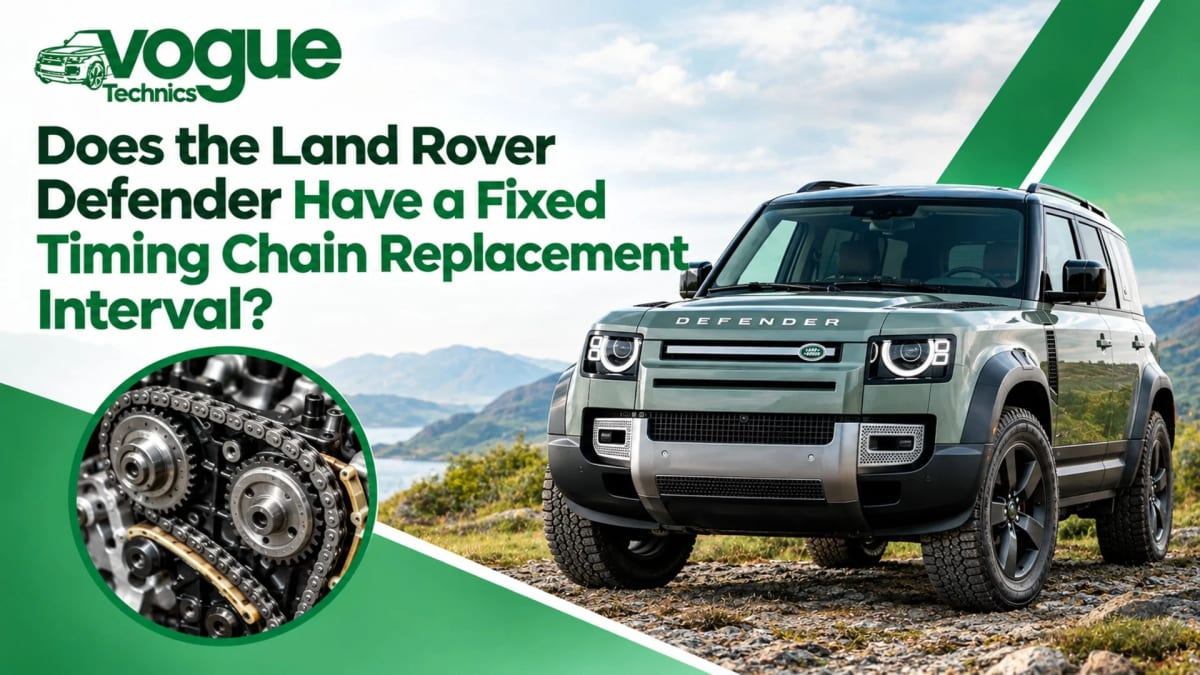
Short answer: no, not in the way you might expect.
Unlike a timing belt, which has a hard-and-fast "replace every X miles or Y years" rule, timing chains are designed to last far longer, often the lifetime of the engine. That's the whole point of using a chain instead of a belt. So Land Rover, like most manufacturers, doesn't list a scheduled timing chain replacement interval in the Defender's standard service plan.
That doesn't mean the chain is maintenance-free. It means replacement is condition-based rather than calendar-based.
What Land Rover Officially Recommends for Defender Timing Chains
Land Rover's official position is that the timing chain is designed to last the vehicle's service life under normal conditions, with no scheduled replacement built into routine maintenance. What Land Rover does specify tightly is the oil change interval and oil specification, and that detail matters more than most owners realise, because oil condition is the single biggest factor in chain longevity.
In other words: Land Rover isn't telling you to ignore the chain. It's telling you to protect it through correct servicing, and to treat any early warning signs as a reason to inspect it.
Why Mileage Alone Isn't a Reliable Guide
Two Defenders with identical mileage can have completely different chain conditions. One might have covered 80,000 motorway miles with regular oil changes and be in excellent shape. The other might have covered 60,000 miles of short urban trips, missed a service or two, and already be showing chain stretch.
This is exactly the gap that causes confusion across owner forums and specialist sites, some threads mention Defenders well past 150,000 miles on the original chain, while others report problems appearing under 60,000 miles. Both can be true at once, because mileage isn't the variable that matters most.
Inspection-Based vs. Time-Based Replacement
There are really three approaches to timing chain maintenance, and it helps to know which camp you're in:
- Preventive replacement, swapping the chain proactively, usually done by owners planning to keep a high-mileage Defender long-term or buyers who want peace of mind after purchase.
- Inspection-triggered replacement, the most common and most sensible approach, where the chain is assessed during routine servicing or when symptoms appear, and replaced only if wear is found.
- Failure-based replacement, replacing the chain only after it's already causing drivability problems, which is the most expensive and riskiest route since damage can spread beyond the chain itself.
Most specialists, ourselves included, recommend the middle option. It avoids unnecessary cost while catching problems before they become engine-threatening.
How Service History and Driving Style Change the Answer
If your Defender has a full, on-time service history using the correct low-SAPS oil, your risk profile is considerably lower. If it's done mostly short trips, has had extended service intervals, or has any gaps in its oil-change record, the chain deserves closer attention regardless of the odometer reading.
This is also a critical checkpoint if you're buying used, a used Defender's service book tells you far more about timing chain risk than its mileage does.
Defender Timing Chain Replacement Interval by Engine Type

Not every Defender engine has the same timing chain history, and treating them as identical is one of the more common mistakes we see in general advice online. The Ingenium four-cylinder diesel, in particular, has a documented pattern that the six-cylinder engines don't share in the same way.
Here's how the main Defender L663 engines compare:
Defender Engine | Timing Chain Type | Fixed Interval? | Main Concern | Inspection Trigger |
| 2.0 Ingenium Diesel (D200/D240/D250) | Primary + secondary chain | No universal fixed interval | Premature wear linked to oil dilution | Cold-start rattle, service gaps |
| 2.0 Ingenium Petrol (P300) | Chain-driven, engine-specific | No fixed interval | Tensioner and VCT wear | Noise, fault codes |
| 3.0 Ingenium Six-Cylinder (P400/D300) | Chain-driven | No universal fixed interval | Engine-specific wear pattern | Diagnostics, unusual noise |
Defender 2.0 Ingenium Diesel (D200 / D240 / D250)
This engine gets the most attention in timing chain discussions, and there's a genuine reason for that. The 2.0-litre Ingenium diesel has a known association with oil dilution, a process where unburned diesel fuel from DPF regeneration cycles ends up mixed into the engine oil. Diluted oil loses lubricating strength, and a chain running on thinner-than-intended oil wears faster than it should.
If your Defender is a D200, D240, or D250 and does a lot of short journeys, school runs, local errands, stop-start commuting, it's worth being more proactive about oil changes and chain checks than the standard interval alone would suggest.
Defender 2.0 Ingenium Petrol (P300)
The P300 shares the same broader engine family but doesn't carry the diesel's DPF-related oil dilution risk. Wear here tends to show up more in the tensioner and variable camshaft timing components than the chain itself failing outright. Symptoms are usually noise-led rather than oil-condition-led.
Defender 3.0 Ingenium Six-Cylinder (P400 / D300)
The six-cylinder engines are a genuinely different design context, and owner community discussions are usually careful to separate them from the 2.0-litre's history. That's the right instinct, problems reported on 2.0 diesel Defenders shouldn't be assumed to apply directly to a P400 or D300. These engines have their own wear patterns, and general internet advice that lumps "Defender timing chain problems" into one bucket often misleads six-cylinder owners into unnecessary worry, or worse, six-cylinder owners into ignoring symptoms that are actually relevant.
Which Defender Engine Is Most Prone to Early Timing Chain Wear?
Based on the pattern across specialist reports and forum evidence, the 2.0 Ingenium diesel shows up most frequently in early timing chain concerns, almost always tied to oil dilution rather than a chain design fault on its own. That's a useful distinction: it's often a maintenance and oil-quality issue wearing the chain prematurely, not the chain being inherently weak.
Warning Signs Your Defender Timing Chain Needs Attention

Symptoms rarely appear out of nowhere. There's usually a progression, and knowing where you are on that progression tells you how urgently to act.
Cold-Start Rattle: What It Means and How Urgent It Is
A brief metallic rattle for a second or two on a cold start, which disappears once oil pressure builds, is the earliest and most common warning sign. On its own, a short cold-start rattle doesn't mean imminent failure, but it does mean the chain or tensioner has some slack it shouldn't have, and it's worth getting checked rather than dismissed.
The pattern to watch for is progression: a rattle that lasts longer each week, starts happening when the engine is warm too, or is joined by rough idling or a warning light. That's when it moves from "worth checking" to "needs checking now."
Fault Codes and Diagnostic Indicators (P0016, P0017)
If your Defender throws a check engine light, a diagnostic scan may return codes P0016 or P0017. Both relate to a mismatch between camshaft and crankshaft position, essentially, the engine's computer detecting that the timing isn't lining up the way it should.
Camshaft and Crankshaft Correlation Errors Explained
Think of the camshaft and crankshaft as two dancers who need to move in exact sync. A stretched or slack timing chain lets that sync drift slightly. The engine's sensors pick up on this drift and log a correlation fault. It's not always catastrophic, but it's the engine telling you, in its own language, that the timing chain deserves immediate attention rather than a "we'll get to it" approach.
How Oil Dilution and DPF Regeneration Accelerate Chain Wear
This is one of the most misunderstood parts of Defender maintenance, and it's worth explaining properly.
Diesel particulate filters need periodic "regeneration", a process that burns off trapped soot. If regeneration cycles are frequently interrupted (which tends to happen with short journeys that never let the engine run long enough to complete the cycle), unburned fuel can find its way into the engine oil. Over time, this dilutes the oil, thinning it out and reducing its ability to lubricate and protect the timing chain and tensioner properly.
Why Short Journeys Are Harder on Your Timing Chain
If your Defender's daily routine is mostly five-minute trips to the shops or short school runs, it may rarely get the chance to complete a full regeneration cycle. Over months and years, that pattern quietly increases oil dilution risk, and with it, timing chain wear risk. Owners in this driving pattern benefit from slightly more frequent oil changes than the bare minimum interval, and from paying closer attention to any cold-start noise.
Timing Chain Replacement Cost, Process & Booking in Essex

Once inspection or diagnostics confirm the chain needs attention, it helps to know exactly what you're paying for and why.
What's Included in a Full Defender Timing Chain Replacement
A proper replacement isn't just swapping the chain itself. It typically includes:
- Primary and secondary timing chains, both replaced together rather than piecemeal, since mismatched wear between old and new components causes problems.
- Chain guides, these plastic-and-metal guides wear alongside the chain and are replaced as standard practice.
- Hydraulic tensioner, a worn tensioner is often part of the original problem, so it's replaced rather than reused.
- Sprockets, inspected and replaced if worn, since a new chain on worn sprockets won't last.
- Engine oil and filter, always replaced as part of the job, both to remove any contaminated oil and to give the new components a clean start.
- Post-repair timing verification, checking cam and crank timing is correctly set before the engine is run, and confirming no fault codes remain.
Skipping any of these to save money usually just moves the cost further down the road, since a new chain paired with a worn guide or tensioner won't deliver anywhere near the expected lifespan.
How Much Does Defender Timing Chain Replacement Cost in the UK?
Costs vary depending on engine type, labour required to access the timing system, and whether any secondary damage has occurred. As a general guide, straightforward chain and tensioner replacement on a 2.0 Ingenium tends to sit at the lower end of engine repair costs, while jobs complicated by delayed diagnosis, where correlation faults have been ignored and damage has spread, climb considerably higher.
This is really the core argument for early inspection. A timing chain caught at the "cold-start rattle" stage is a controlled, planned repair. A timing chain caught after a jumped tooth or valve contact is an entirely different scale of job.
Why Choose Voguetechnics Engine Rebuild for Your Defender
We work on Land Rover Defenders and their Ingenium engines regularly, which means we're not guessing at engine-specific wear patterns, we've seen how the 2.0 diesel's oil dilution issue actually presents, and how it differs from six-cylinder engine concerns. Based in Grays, Essex, we run full diagnostic checks before recommending any replacement, so you're never paying for parts your Defender doesn't actually need. Every timing chain job we carry out uses complete kits, chain, guides, tensioner, and sprockets together, because that's the only way to get the mileage back that a properly maintained Defender should deliver.
Book a Diagnostic Inspection in Grays, Essex
If your Defender has a cold-start rattle, a warning light, or you're simply due for a service and want the timing system checked as a precaution, get in touch with Voguetechnics Engine Rebuild in Grays, Essex. A proper inspection now is a fraction of the cost of a repair made necessary by ignoring the early signs.
Frequently Asked Questions
How long does a Defender timing chain actually last?
There's no single figure that applies to every Defender, because it depends heavily on engine type, oil-change history, and driving pattern. Well-maintained Defenders with regular oil changes and mostly longer journeys have gone well beyond 100,000 miles on original chains. Defenders with missed services or heavy short-trip use, particularly the 2.0 diesel, can show wear symptoms much earlier. The honest answer is: get it inspected rather than relying on a mileage number.
Can you drive a Defender with a timing chain rattle?
A brief cold-start rattle that clears quickly isn't usually an immediate emergency, but it shouldn't be ignored either. Driving for weeks or months with a known rattle, especially if it's getting longer or louder, risks the chain slipping and causing valve or piston damage, a dramatically more expensive repair. Book an inspection as soon as you notice a rattle, rather than waiting to see if it gets worse.
Does the engine need to come out to replace the chain?
On most Defender Ingenium engines, the timing chain sits at the rear or front of the engine depending on configuration, and access typically doesn't require full engine removal, though it is a labour-intensive job involving removal of various ancillary components. The exact process depends on the specific engine and, occasionally, the extent of any secondary damage.
Is preventive replacement worth it on a high-mileage Defender?
For owners planning to keep a high-mileage Defender for several more years, especially one bought used without a clear service history, preventive replacement can be a reasonable choice for peace of mind. For a Defender with a solid, documented service history and no symptoms, inspection-based monitoring is usually the more cost-effective route. It comes down to how much certainty you want versus how much history you already have.
The Bottom Line
There's no single mileage figure that tells every Defender owner when to replace their timing chain, and any page that gives you one flat number isn't being straight with you. What actually matters is your engine type, your service history, and whether you're seeing any of the warning signs we've covered here: cold-start rattle, fault codes, or a driving pattern heavy on short trips.
The good news is that this makes the decision manageable rather than mysterious. A quick inspection tells you far more than guessing ever will, and catching wear early keeps this a routine maintenance job instead of a major engine repair.
If you're hearing a rattle, seeing a warning light, or simply want the confidence of a professional check, Voguetechnics Engine Rebuild in Grays, Essex is ready to help. Get in touch to book a Defender timing chain inspection and find out exactly where your engine stands.