

Symptoms of Timing Chain Failure in Land Rover: Early Warning Signs & Expert Diagnosis
A rattling cold start, rough idle, or check engine light could be early warning signs of timing chain failure in your Land Rover. This guide breaks down the symptoms, most at-risk models like the Ingenium, SDV6, and TDV6, and how fault codes like P0016 confirm the issue. Catching it early can mean a simple chain replacement instead of a costly engine rebuild, Voguetechnics in Grays, Essex offers a free diagnostic to help you avoid that gamble.
Your Land Rover has just started rattling for a few seconds every morning before it settles down. You've told yourself it's nothing, maybe just the cold weather, maybe it'll go away on its own. It won't. That rattle is one of the clearest early symptoms of timing chain failure in Land Rover engines, and the gap between "I'll check it later" and "the engine needs a full rebuild" is often measured in weeks, not months.
We've worked on enough Ingenium, SDV6, and TDV6 engines at our workshop in Grays, Essex to know exactly how this story usually plays out. It rarely starts with a dramatic failure. It starts small, a noise, a hesitation, a flicker on the dash, and it's ignored because the car still drives fine. That's precisely why timing chain problems catch so many Land Rover owners off guard.
This guide walks through every stage of timing chain failure, from the first cold-start rattle to the fault codes a diagnostic scan will pick up, so you know exactly what you're dealing with and what to do next.
What Are the Early Symptoms of Timing Chain Failure in Land Rover Engines?

Timing chain wear doesn't happen overnight. It's a gradual process, and the engine usually gives you several warnings before things get serious. The trouble is, these early signs are easy to dismiss because the car often still runs normally in between.
Here's what typically shows up first, and what each symptom actually means mechanically.
Why Does My Land Rover Rattle on Cold Start?
This is, by far, the most common complaint we hear. The engine starts, there's a distinct metallic rattle for two to five seconds, and then it disappears as the engine warms up.
Here's why it happens. The timing chain tensioner relies on oil pressure to keep the chain tight against its guides. When the engine has been sitting overnight, oil drains back into the sump, leaving the tensioner temporarily starved. On startup, there's a brief window before oil pressure builds up, and if the chain, guides, or tensioner are already worn, that gap is enough for the chain to slap against its housing.
A healthy timing chain system shouldn't rattle at all, even on a cold start. If yours does, even briefly, that's chain stretch or a failing tensioner announcing itself early.
What Does a Bad Timing Chain Sound Like?
Owners describe it differently depending on how advanced the wear is, but the pattern is fairly consistent:
- Light metallic rattle, usually the first sign, lasting a few seconds on startup
- Persistent ticking or tapping, often mistaken for a lifter or tappet issue, but can indicate chain slap against the guides
- Grinding or knocking under load, a later-stage symptom suggesting the chain is skipping or guides have broken away
- Whining noise at idle, sometimes linked to a failing tensioner rather than the chain itself
If the noise is only present when cold and vanishes within seconds, it's early-stage. If it persists once the engine is warm, or gets louder under acceleration, the problem has progressed and needs immediate attention.
Engine Misfires, Rough Idle & Check Engine Light, What They Mean
Once chain stretch reaches a certain point, it starts affecting ignition timing and valve timing accuracy. The camshaft and crankshaft fall out of correct correlation, and the ECU notices before you do.
This typically shows up as:
- A rough, uneven idle that wasn't there before
- Occasional misfires, especially on cold starts or light acceleration
- Hesitation or a flat spot when pulling away
- The check engine light illuminating, often alongside a slight loss of power
A rough idle combined with a cold-start rattle is one of the strongest early indicators of timing chain wear we see in Ingenium diesel engines specifically. Taken together, these two symptoms rarely mean anything else.
Which Land Rover Models and Engines Are Most Prone to Timing Chain Problems?

Not every Land Rover engine has the same reputation here. Timing chain issues are heavily concentrated in a handful of engine families, and knowing which one sits under your bonnet tells you a lot about your actual risk level.
Ingenium, SDV6 & TDV6 Engine Timing Chain Issues Explained
The 2.0 Ingenium diesel is the engine most associated with timing chain complaints, and for good reason. Its chain sits at the rear of the engine rather than the front, a design choice that makes replacement significantly more labour-intensive, since the transmission often needs to come out to access it. Combined with known tensioner weaknesses in earlier production years, this engine tends to develop symptoms earlier than owners expect, sometimes well under 80,000 miles.
The SDV6 and TDV6 engines have a different profile. Timing chain wear here is less common but not unheard of, and it's usually linked to extended oil change intervals or use of incorrect oil specification rather than a design flaw. When it does occur, the guides tend to wear before the chain itself stretches significantly.
The AJ126 and AJ133 petrol engines, found in performance Range Rover and Jaguar-shared platforms, generally have a stronger track record but aren't entirely immune, particularly with high-mileage examples that have missed servicing.
Discovery, Defender, Evoque, Velar & Range Rover Sport, Model Risk Guide
Here's how the risk breaks down by model, based on the engines most commonly fitted:
Model | Common Engine(s) | Timing Chain Risk Level | Typical Onset Mileage |
| Discovery Sport | 2.0 Ingenium Diesel | High | 60,000–90,000 miles |
| Range Rover Evoque | 2.0 Ingenium Diesel/Petrol | High | 60,000–90,000 miles |
| Discovery 4/5 | SDV6, TDV6 | Moderate | 90,000–130,000 miles |
| Range Rover Velar | 2.0 Ingenium, AJ126 | Moderate–High | 70,000–100,000 miles |
| Range Rover Sport | SDV6, AJ133 | Moderate | 90,000–120,000 miles |
| Defender (new gen) | Ingenium (updated design) | Lower | Fewer reported cases to date |
These figures reflect patterns we see in workshop bookings, not manufacturer data, and individual results vary a great deal depending on service history, oil quality, and driving style. A well-maintained Ingenium engine can outlast these figures; a neglected one can fail sooner.
How Is a Timing Chain Failure Diagnosed and Confirmed?

A rattle alone isn't enough to confirm timing chain wear, plenty of other issues sound similar. Proper diagnosis combines a physical inspection with a diagnostic scan, and this is where an experienced technician earns their fee.
Common OBD Fault Codes for Timing Chain Faults (P0016, P0017, P0340, P0345)
When chain stretch affects cam and crank timing accuracy, the ECU logs specific correlation faults. The most common ones we see include:
- P0016 – Crankshaft/Camshaft Position Correlation (Bank 1, Sensor A), usually the first code to appear as the chain stretches
- P0017 – Crankshaft/Camshaft Position Correlation (Bank 1, Sensor B), often appears alongside P0016 on V-configuration engines
- P0340 – Camshaft Position Sensor Circuit Malfunction, can indicate a genuine sensor fault or a timing-related signal irregularity
- P0345 – Camshaft Position Sensor Circuit (Bank 2), relevant on engines with dual camshaft sensors
A scan tool reading one of these codes doesn't automatically confirm the chain is at fault, sensor faults can trigger similar codes. That's why we always follow up a fault code reading with a physical inspection: checking chain tension, examining guide wear, and in some cases using specialist timing tools to measure actual chain stretch against manufacturer tolerance.
Is It Safe to Keep Driving With a Bad Timing Chain?
Short answer: not for long, and definitely not once symptoms extend beyond a brief cold-start rattle.
Here's the real risk. As the chain stretches further, it can skip a tooth on the sprocket. On an interference engine, which most modern Land Rover engines are, that means the pistons and valves occupy the same space at the wrong moment. The result is bent valves at best, and a destroyed piston or cracked head at worst.
We've seen cars come in where the owner drove for another three or four months on a known rattle because the car "still drove fine." In more than one case, what would have been a £1,200–£1,800 chain replacement became a £4,000+ engine rebuild, because the chain finally skipped while the car was on the motorway.
What Happens If You Ignore a Timing Chain Rattle?
The progression generally follows this pattern:
- Intermittent cold-start rattle (early stage, repairable with straightforward chain kit replacement)
- Rattle persists longer, rough idle develops, check engine light appears (mid stage, still repairable, but guides and tensioner likely need replacing too)
- Misfires under load, noticeable power loss, engine warning escalates (late stage, internal wear likely, oil contamination possible)
- Chain skips or snaps, engine stalls, won't restart, or suffers catastrophic internal damage (failure stage, full engine rebuild or replacement needed)
The earlier you catch it, the cheaper and simpler the fix. That's not a sales line, it's just how chain wear physically progresses.
Land Rover Timing Chain Replacement, Cost, Process & Why Choose Voguetechnics
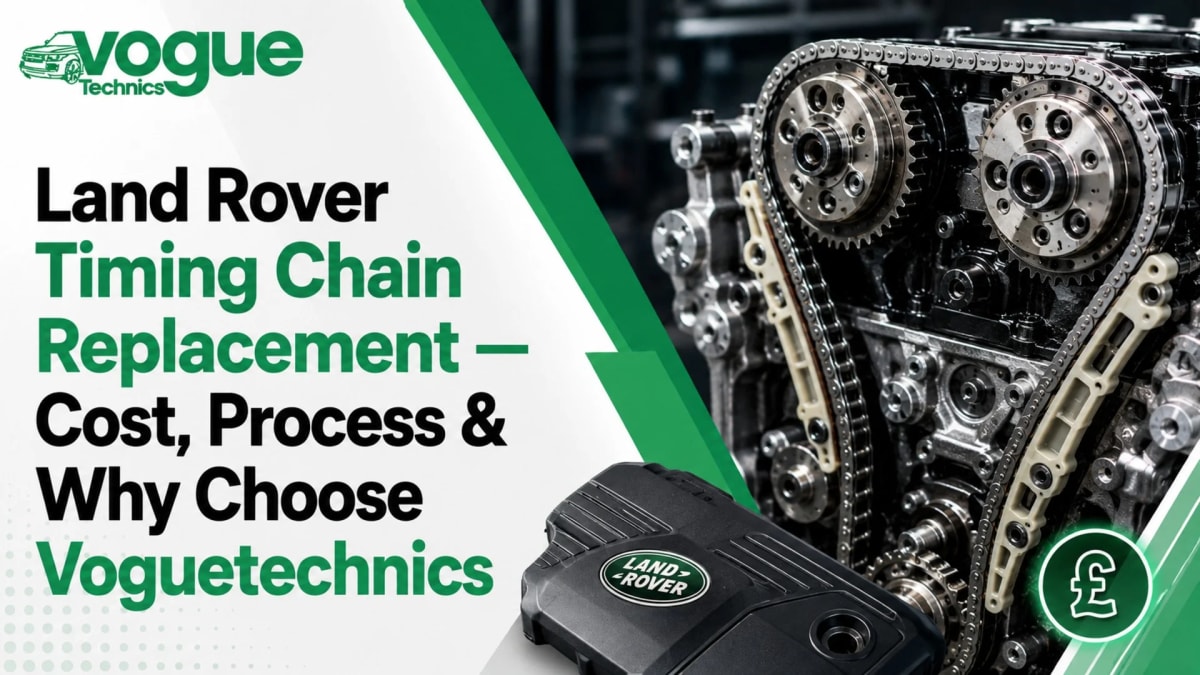
Once timing chain wear is confirmed, the only real fix is replacement. There's no additive, oil treatment, or tensioner adjustment that reverses a stretched chain, the metal has physically elongated and needs to come out.
How Much Does Timing Chain Replacement Cost in the UK?
Costs vary significantly depending on engine layout, and this is where the Ingenium's rear-mounted chain design becomes relevant again.
- Front-mounted chain engines (most SDV6, TDV6, older petrol units): typically £900–£1,600, since the chain is accessible without major disassembly
- Rear-mounted chain engines (2.0 Ingenium): typically £1,800–£3,000+, because the transmission often needs to be removed to access the chain housing
- Full engine rebuild (if failure caused internal damage): £3,500–£6,000+, depending on the extent of damage to pistons, valves, and the head
Prices also shift depending on whether guides, tensioners, and the oil pump chain are replaced alongside the main chain, which we'd always recommend doing together, since replacing one worn component while leaving another old one in place just delays the next failure.
OEM vs Aftermarket Timing Chain Kits, Which Is Better?
This is a genuine decision point, and the honest answer is: it depends on the engine.
OEM kits match Land Rover's original specification exactly, which matters most on the Ingenium engine where tolerances are tight and aftermarket variance has, in some cases, led to premature repeat failures.
Quality aftermarket kits (from established manufacturers, not budget unbranded parts) can offer solid reliability at a lower cost, particularly for SDV6 and TDV6 engines where the design is more forgiving.
What we don't recommend, on any engine, is the cheapest unbranded kit available online. We've replaced more than one budget chain within 18 months of fitting because the guide material wore through faster than the original.
Our Timing Chain Replacement Process at Voguetechnics Engine Rebuild
When a Land Rover comes into our Grays workshop with suspected timing chain wear, we follow a structured process rather than jumping straight to a quote:
- Diagnostic scan to pull any stored fault codes and check live cam/crank correlation data
- Physical inspection of chain tension, visible wear on guides, and tensioner condition
- Oil condition check, since contaminated or degraded oil accelerates chain and guide wear
- Transparent quote breaking down parts and labour before any work begins, including whether guides and tensioners need replacing alongside the chain
- Full replacement using OEM or manufacturer-grade parts appropriate to your specific engine
- Post-repair verification, rechecking timing accuracy and clearing fault codes before the car leaves
We've worked on Ingenium, SDV6, and TDV6 engines long enough to know where each one tends to fail first, which means less time spent diagnosing and more time spent fixing it correctly the first time.
Book a Free Timing Chain Diagnostic in Grays, Essex
If your Land Rover is rattling on startup, idling roughly, or has thrown a check engine light, it's worth getting it looked at before it becomes a bigger job. We offer a free initial diagnostic for timing chain concerns at our Grays, Essex workshop, no obligation, just a clear picture of what's actually going on under the bonnet.
Frequently Asked Questions
What are the symptoms of timing chain failure? The most common early symptoms are a brief metallic rattle on cold start, rough idle, occasional misfires, and a check engine light. As wear progresses, these symptoms become more persistent and are often joined by a noticeable loss of power.
Can a timing chain fail suddenly? It can, though it's usually the final stage of a longer wear process. A chain that's been stretching for months can eventually skip a tooth or snap without much additional warning, which is why early symptoms shouldn't be ignored.
How long does a timing chain last on a Land Rover? This varies significantly by engine. Some SDV6 and TDV6 units go well beyond 120,000 miles without issues, while the 2.0 Ingenium diesel commonly develops symptoms between 60,000 and 90,000 miles, particularly if servicing has been inconsistent.
Can you drive with a bad timing chain? Only briefly, and only with early-stage symptoms like an occasional cold-start rattle. Once misfires, persistent noise, or a check engine light appear, continuing to drive risks the chain skipping and causing serious internal engine damage.
Does low oil pressure damage the timing chain? Yes. The tensioner relies on stable oil pressure to keep the chain correctly tensioned. Low or contaminated oil accelerates wear on both the chain and its guides, which is why regular oil changes with the correct specification matter more on these engines than most owners realise.
How much does Land Rover timing chain replacement cost? Costs typically range from £900 for front-mounted chain engines to over £3,000 for rear-mounted Ingenium units, where transmission removal is often required for access. Getting an inspection early, before internal damage occurs, keeps costs closer to the lower end of that range.
The Bottom Line
A timing chain rattle is never really "nothing." It's your engine telling you, as clearly as it can, that a component responsible for keeping every internal moving part synchronised is starting to wear out. Catch it early, and you're looking at a straightforward, predictable repair. Ignore it, and you're gambling with a five-figure engine rebuild.
If your Land Rover has started rattling on cold starts, idling roughly, or thrown a check engine light, don't wait for it to get worse. Get in touch with Voguetechnics Engine Rebuild in Grays, Essex for a proper diagnostic, we'll tell you honestly what's going on and what it'll take to fix it, before it turns into a much bigger job.