
Range Rover Sport SVR Engine Problems: A Specialist's Guide to Faults, Costs & Prevention
The Range Rover Sport SVR's 5.0-litre supercharged V8 is powerful but prone to a predictable set of faults, timing chain wear, cooling system failures, and supercharger coupling noise chief among them. This specialist guide breaks down the most common engine problems, the early warning signs to watch for, and realistic UK repair costs. You'll also learn how proactive maintenance and accurate diagnosis can prevent a minor leak from snowballing into a five-figure rebuild.
You bought the SVR for the way it pulls. That 5.0-litre supercharged V8 sounds like a thunderstorm with a postcode, and nothing in its class matches the way a 2.3-tonne SUV launches like it forgot how much it weighs. But if you're reading this, the romance has probably hit a speed bump, a rattle on cold start, a temperature gauge creeping where it shouldn't, or a quote from a garage that made you sit down.
We've had a lot of these engines on our benches, and we'll be straight with you: the SVR is a brilliant machine with a handful of very predictable weak points. Most of the range rover sport svr engine problems we see aren't random, they follow patterns. Once you understand those patterns, you can spot trouble early, avoid the catastrophic bills, and make a far smarter decision about whether to repair, rebuild, or walk away.
This guide is the one we wish every SVR owner read before the warning light came on.
What Are the Most Common Range Rover Sport SVR Engine Problems?
The SVR runs Jaguar Land Rover's 5.0-litre supercharged V8, an engine capable of around 542–575 bhp depending on model year. It's a strong unit when maintained properly. The trouble is that supercharging, heat, and high output stack stress onto a few specific components, and that's where failures cluster.
Here are the faults we see most often, roughly in order of how expensive they get if ignored.
Why the 5.0 Supercharged V8 Is Prone to Specific Faults
This engine packs a Roots-type supercharger nestled in the V of the block, sitting on top of a tightly packaged, heat-soaked engine bay. That layout creates two recurring problems: heat has nowhere easy to escape, and several service items are buried under the blower, which makes minor jobs labour-intensive. Combine that with a chain-driven valvetrain under serious load, and you get a predictable set of failure points rather than a reliability lottery.
Timing Chain Wear and Tensioner Failure
This is the big one, the fault that turns a maintenance bill into an engine bill.
The 5.0 V8 relies on timing chains, guides, and hydraulic tensioners to keep the camshafts perfectly synchronised with the crankshaft. Over time and under boost, timing chain wear stretches the chain fractionally, the plastic guides wear, and the timing chain tensioners lose their ability to keep everything taut. Left unchecked, the chain can skip a tooth and on an interference engine like this one, valves and pistons meet in a way they were never designed to.
We see the early stages of this most often on engines that have had extended oil-change intervals or run on the wrong grade of oil. Clean, fresh oil at proper intervals is genuinely the cheapest timing-chain insurance you can buy.
What the P0016 and P0017 Timing Correlation Codes Really Mean
If your SVR throws P0016 or P0017 timing correlation codes, take them seriously. In plain English, these codes mean the engine has noticed the camshaft and crankshaft positions no longer line up the way they should, usually because the chain has stretched or a tensioner is failing.
People often mistake these for a faulty sensor and clear the code. Sometimes it is a camshaft position sensor. But on a high-mileage SVR, a P0016/P0017 is far more likely to be your timing system warning you before it lets go. Diagnosing it correctly sensor versus chain is exactly the kind of judgement call where a specialist saves you thousands.
Is Cold Start Rattling a Sign of Imminent Timing Chain Failure?
Often, yes. That brief cold start rattling, a rapid metallic chatter for a second or two when you first turn the key, is one of the most reliable early warnings on this engine.
When the car sits overnight, oil drains down and the tensioners momentarily lose pressure. A healthy chain takes the slack up almost instantly. A worn one rattles while the tensioner catches up. If the rattle is getting longer or louder, don't wait for it to become a habit. That noise is the cheapest diagnostic tool you'll ever get, and ignoring it is how a £1,500 job becomes a £9,000 one.
Cooling System Failures That Lead to Overheating
If timing is the most expensive fault, cooling system failures are the most common and they're a leading cause of the catastrophic ones, because heat kills engines.
The SVR's cooling system works hard in a cramped bay, and several components are known to fail with age and heat cycling.
Water Pump and Thermostat Housing Failure
Water pump failure is a when-not-if item on these engines. The pump can fail internally (losing circulation) or externally (weeping coolant from the weep hole). Either way, the result is the same risk: engine overheating.
Thermostat housing failure runs a close second. On the 5.0 V8, the housing and its associated plastics become brittle over years of heat cycles, crack, and start leaking coolant, often slowly enough that owners don't notice until the level drops dangerously low.
Why the Plastic Coolant Pipes Are a Known Weak Point
The plastic coolant pipes routed around and beneath the supercharger are a genuine design weak point. They sit in a hot environment, go brittle over time, and can split or fail at the joints. Because some of them are tucked under the blower, a "simple" pipe failure can carry surprising labour costs.
The dangerous part is how a small coolant leak escalates. Lose coolant on a supercharged V8, run it hot even briefly, and you risk warped heads, blown head gaskets, or cracked components. Many of the worst engines we've stripped started life as a £200 coolant leak that someone topped up and kept driving.
Supercharger Coupling Noise and What It Signals
A distinct whine or rattle from the centre of the engine can be supercharger coupling noise. The supercharger uses an internal coupling (an isolator that takes up driveline shock), and as it wears it can produce a rattling or chirping sound, especially at idle or on light throttle.
The good news: the coupling itself is often a repairable item rather than a full supercharger replacement, if it's caught early. The bad news: people frequently misdiagnose it as a belt or pulley issue and replace the wrong parts. Correct identification matters here.
Oil Leaks, Carbon Buildup and Misfires
Three smaller but persistent issues round out the list.
- Oil leaks are common, typically from the timing cover, valve covers, or the rear main area. Beyond the mess, oil dripping onto hot components is a fire risk and can degrade nearby rubber and plastic. Track them early.
- Carbon buildup affects this direct-injected engine over time. Because fuel doesn't wash over the intake valves the way it does on port-injected engines, carbon accumulates on the valves and ports, causing rough running, misfires, and a gradual loss of sharpness. Periodic walnut-blasting or induction cleaning addresses it.
- Misfires themselves can stem from carbon, worn coils and plugs, injector issues, or in the worst cases, the timing problems above. A misfire is a symptom, not a diagnosis, and chasing it without proper testing is how owners waste money on parts the engine didn't need.
How Do You Know If Your SVR Engine Is Failing? (Symptoms & Diagnosis)
Knowing the faults is half the battle. The other half is recognising the symptoms early because on this engine, the gap between "minor repair" and "engine out" can be a single hot motorway run.
Warning Signs Owners Report Most Often
Across the SVRs we assess, the same handful of symptoms come up again and again. None of them should be ignored, and several mean stop and investigate now.
Engine Overheating, Misfires and Loss of Power
Watch for:
- Temperature creeping above normal, fluctuating oddly, or any coolant smell, classic signs of cooling system failures and the route to engine overheating.
- A rough, lumpy idle or stumbling under acceleration typically misfires from carbon, ignition components, or deeper trouble.
- Loss of power or a "limp" feeling, sometimes with the engine dropping into a protective reduced-performance mode.
- Cold start rattle that lingers longer than a second or two your timing-chain early warning.
- Coolant or oil pooling under the car, or visible weeping in the engine bay.
If you notice two or more of these together, treat it as a priority. They tend to be connected, and a single underlying fault say, a slow coolant leak, can trigger several symptoms at once.
Beyond the Engine — ZF 8-Speed Transmission, Electrical Faults & Air Suspension
It's worth saying plainly: not every SVR fault is an engine fault, and a good diagnosis separates them properly.
The ZF 8-speed transmission is generally robust, but neglected fluid changes (it is not genuinely "sealed for life") can cause harsh or hesitant shifts that owners mistake for engine problems. Electrical faults, sensors, modules, wiring, battery-related gremlins, are common across the range and can mimic running issues. And air suspension faults, while not engine-related, are a frequent SVR ownership cost worth budgeting for.
The reason this matters commercially: a general garage may chase an engine symptom that's actually a transmission, electrical, or sensor fault and bill you for it. Accurate, evidence-led diagnosis is where you save real money.
When a Warning Light Means "Stop Driving Immediately"
Most warning lights mean "book it in soon." A few mean "pull over now." On the SVR, treat a red temperature warning, a coolant-level alarm, oil-pressure warning, or a hard misfire with flashing engine light as reasons to stop and shut the engine down.
A flashing check-engine light specifically signals a misfire severe enough to damage the catalytic converters and continuing to drive a supercharged V8 that's overheating or badly misfiring is exactly how repairable faults become engine rebuilds. When in doubt, switch it off and call a specialist. A recovery truck is always cheaper than a new engine.
SVR Reliability, Repair Costs & Buying Advice
This is the section most owners and buyers actually care about: is it reliable, what will it cost, and is it worth it?
Is the Range Rover Sport SVR Reliable?
Here's an honest answer rather than a marketing one. The SVR's reliability is best described as good when maintained by people who know it, and punishing when neglected.
The engine itself is fundamentally strong. The faults above are well-understood and largely preventable. What gets owners into trouble is treating an SVR like an ordinary SUV, stretching service intervals, ignoring small leaks, and topping up coolant instead of fixing the cause. Maintained correctly, many SVR engines comfortably pass 100,000–150,000 miles and beyond. Neglected, they can fail far earlier.
So "reliable" comes down less to the badge and more to the maintenance history. Which brings us neatly to cost.
How Much Do Common SVR Engine Repairs Cost?
Prices vary by region, parts choice, and how early a fault is caught, so treat the figures below as realistic UK ballpark ranges to help you budget — not fixed quotes. Always get your specific car assessed.
Repair / Job | Typical UK Range | Notes |
| Cooling system refresh (pump, thermostat, pipes) | £600 – £1,800 | Cost climbs with how much sits under the supercharger |
| Timing chain, guides & tensioners | £2,000 – £4,500+ | Major labour job; far cheaper than the failure it prevents |
| Supercharger coupling repair | £600 – £1,500 | Much cheaper than a full supercharger if caught early |
| Carbon cleaning / walnut blasting | £400 – £900 | Restores smoothness, cuts misfires |
| Oil leak repair (cover/seal dependent) | £300 – £1,500 | Varies hugely by which seal is leaking |
| Full engine rebuild | £8,000 – £15,000+ | Depends on damage; restores the engine properly |
| Complete engine replacement | £12,000 – £20,000+ | Often the costliest route |
The pattern is obvious and important: the cheap jobs prevent the expensive ones. A timing chain service is a fraction of what a snapped chain costs once it's destroyed valves and pistons.
Repair vs. Engine Rebuild — Which Makes Financial Sense?
When an engine has suffered real internal damage, a timing failure, overheating damage, low oil pressure, owners face the big decision. Here's how we frame it:
- Patch-repair makes sense only for isolated, contained faults on an otherwise healthy engine with a known history.
- A full engine rebuild usually makes the most financial sense when there's internal damage, because it addresses root causes, replaces the known weak points at the same time, and restores the engine to a properly reliable state, often for less than a complete replacement.
- Full replacement is sometimes unavoidable but is frequently the most expensive path and doesn't always fix the underlying maintenance pattern that caused the failure.
A genuine specialist will tell you when a rebuild is the smart money and when it isn't, even if that means advising against the bigger job.
Buying a Used SVR? What to Check Before You Pay
If you're shopping for an SVR, a little buying advice here can save you a five-figure mistake. Before you hand over a deposit:
- Demand a full, specialist-led service history, gaps and extended oil intervals are red flags on this engine.
- Cold-start it yourself. Arrive early, start it from stone cold, and listen for cold start rattling. A warm engine in the showroom hides exactly what you need to hear.
- Get an OBD scan and check for stored or pending P0016/P0017 timing correlation codes and misfire counts, not just live faults.
- Inspect for coolant and oil leaks, check coolant level and condition, and look for any history of engine overheating.
- Check the supercharger for whine or coupling noise, and confirm the ZF 8-speed transmission, electrical systems, and air suspension all behave.
- Budget for an immediate service regardless of what the seller claims.
A pre-purchase inspection by an SVR specialist costs a couple of hundred pounds and is the best money you'll ever spend on one of these cars.
Protecting Your SVR — Preventative Maintenance & Expert Help
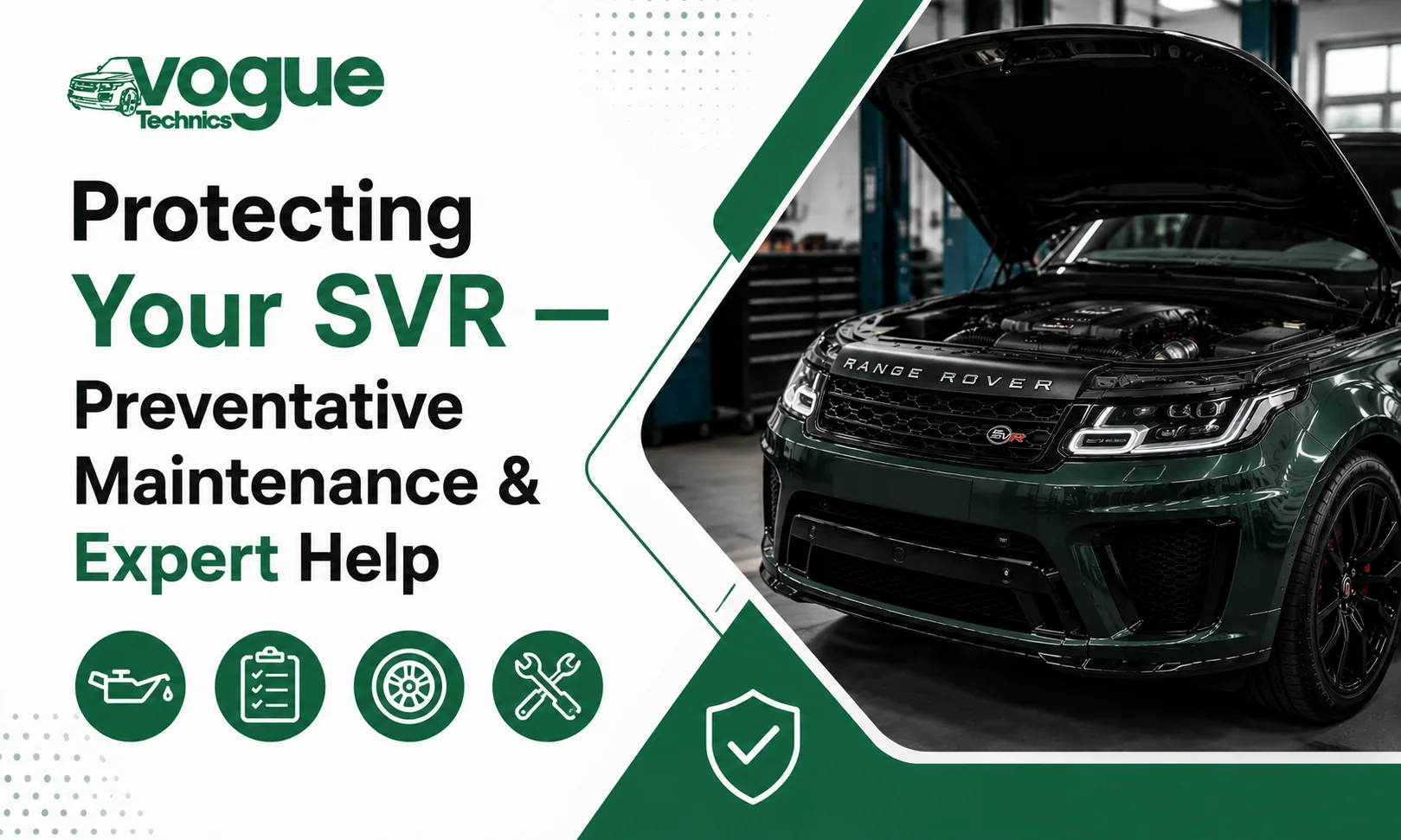
Almost every horror story we see traces back to missed maintenance. The flip side is genuinely encouraging: preventative maintenance keeps these engines strong and the running costs predictable.
The Maintenance Schedule That Prevents Most Engine Failures
You don't need to be precious about an SVR, you just need to be consistent. A sensible owner's approach looks like this:
- Oil and filter every 6,000–7,500 miles, not the extended interval the handbook may suggest. On a supercharged, chain-driven V8, fresh oil at the correct specification is the single most protective thing you can do.
- Proactively refresh cooling components as the car ages, the water pump, thermostat housing, and plastic coolant pipes are wear items, not lifetime parts.
- Service the ZF 8-speed transmission fluid periodically despite the "sealed" label.
- Address small leaks immediately rather than topping up.
- Periodic carbon cleaning to keep misfires and rough running at bay.
- Listen to your car — new rattles, whines, or smells are information, not background noise.
Follow that, and you sidestep the overwhelming majority of expensive range rover sport svr engine problems before they ever start.
Why an SVR Engine Specialist Beats a General Garage
A general garage can change your oil. But correctly distinguishing a P0016 sensor fault from genuine timing chain wear, identifying supercharger coupling noise versus a belt issue, or judging repair against engine rebuild that takes hands-on experience with this specific engine.
The wrong diagnosis on an SVR doesn't just cost you a part. It can cost you the engine. That's the real argument for specialist help: not the headline labour rate, but getting it right the first time.
How Vogue Technics Rebuilds SVR Engines in Grays, Essex
At Vogue Technics in Grays, Essex, the supercharged V8 is exactly the kind of engine we work on day in, day out. When an SVR comes to us, we diagnose properly before we quote, separating engine faults from transmission, electrical, and suspension issues so you only pay for what's actually wrong.
When a rebuild is the right call, we don't just reassemble the engine, we address the known weak points at the same time, so it leaves stronger than a like-for-like fix. And when a rebuild isn't the smart money, we'll tell you that too. You can reach us at voguetechnicsenginerebuild.co.uk for a straight assessment.
Frequently Asked Questions
Does the Range Rover Sport SVR have a BMW engine?
No. This is a common mix-up. Older Range Rovers from the early 2000s did use BMW engines, but the SVR runs Jaguar Land Rover's own 5.0-litre supercharged V8 (the AJ133), which traces back to a Jaguar/Ford V8 lineage, not BMW.
What is the life expectancy of an SVR engine?
With disciplined preventative maintenance, the engine can comfortably reach 100,000–150,000 miles and beyond. With neglected servicing, coolant neglect, or ignored warning signs, failures can arrive much sooner. History matters more than mileage on these cars.
How much does it cost to rebuild a Range Rover Sport SVR engine?
A full engine rebuild typically lands in the £8,000–£15,000+ range in the UK depending on the extent of internal damage and which components need replacing. It's frequently more economical than a complete engine replacement and addresses root causes at the same time.
Is the SVR V8 worth fixing or should I replace it?
In most cases where the block and core are sound, a properly executed engine rebuild makes more financial sense than replacement, it costs less, fixes the underlying weak points, and restores genuine reliability. Replacement is sometimes necessary, but it's usually the most expensive route. A specialist assessment is the only way to know for sure on your specific car.
The bottom line: the Range Rover Sport SVR isn't an unreliable car, it's a high-performance one with very specific, very predictable weak points. Learn the early warning signs, keep on top of the cooling system and oil changes, take cold-start rattles seriously, and get a specialist involved before small faults snowball.
If your SVR is showing any of the symptoms in this guide, a rattle, a temperature wobble, a timing code, or a quote that doesn't sit right, get it looked at by people who know the engine intimately. A proper diagnosis from Vogue Technics in Grays, Essex could be the difference between a manageable repair and a five-figure rebuild. Get in touch at voguetechnicsenginerebuild.co.uk and find out exactly where your engine stands.