
Range Rover Sport 3.0 Diesel Timing Belt Replacement (TDV6 & SDV6)
The Range Rover Sport 3.0 diesel (TDV6/SDV6) doesn't use a timing chain — it relies on two timing belts, a front cam belt and a rear fuel pump belt, both prone to failure if neglected. Jaguar Land Rover recommends replacement every 7 years or 112,000 miles, as failure on this interference engine can cause severe internal damage and costly rebuilds. This guide covers replacement costs (£600–£1,200), the step-by-step process, genuine vs aftermarket parts, and why timely servicing is far cheaper than waiting for a breakdown.
Hearing a strange rattle from under the bonnet of your Range Rover Sport is never a good feeling. If you've landed here because your 3.0 diesel is due a service, making an odd noise, or you've simply heard that the timing belt on these engines can cause serious damage if ignored, you're in the right place.
The 3.0-litre TDV6 and SDV6 diesel engines fitted to the Range Rover Sport are excellent when properly maintained, but they have one well-known weak spot: the timing belt. Unlike many modern engines that use a timing chain designed to last the engine's lifetime, this engine relies on belts and belts wear out. When they fail, the damage is rarely cheap.
This guide walks you through everything you need to know: which models are affected, when to replace the belt, what the replacement process actually involves, what it costs, and how to avoid an expensive engine rebuild. We'll also answer the exact questions Range Rover Sport owners are typing into Google right now.
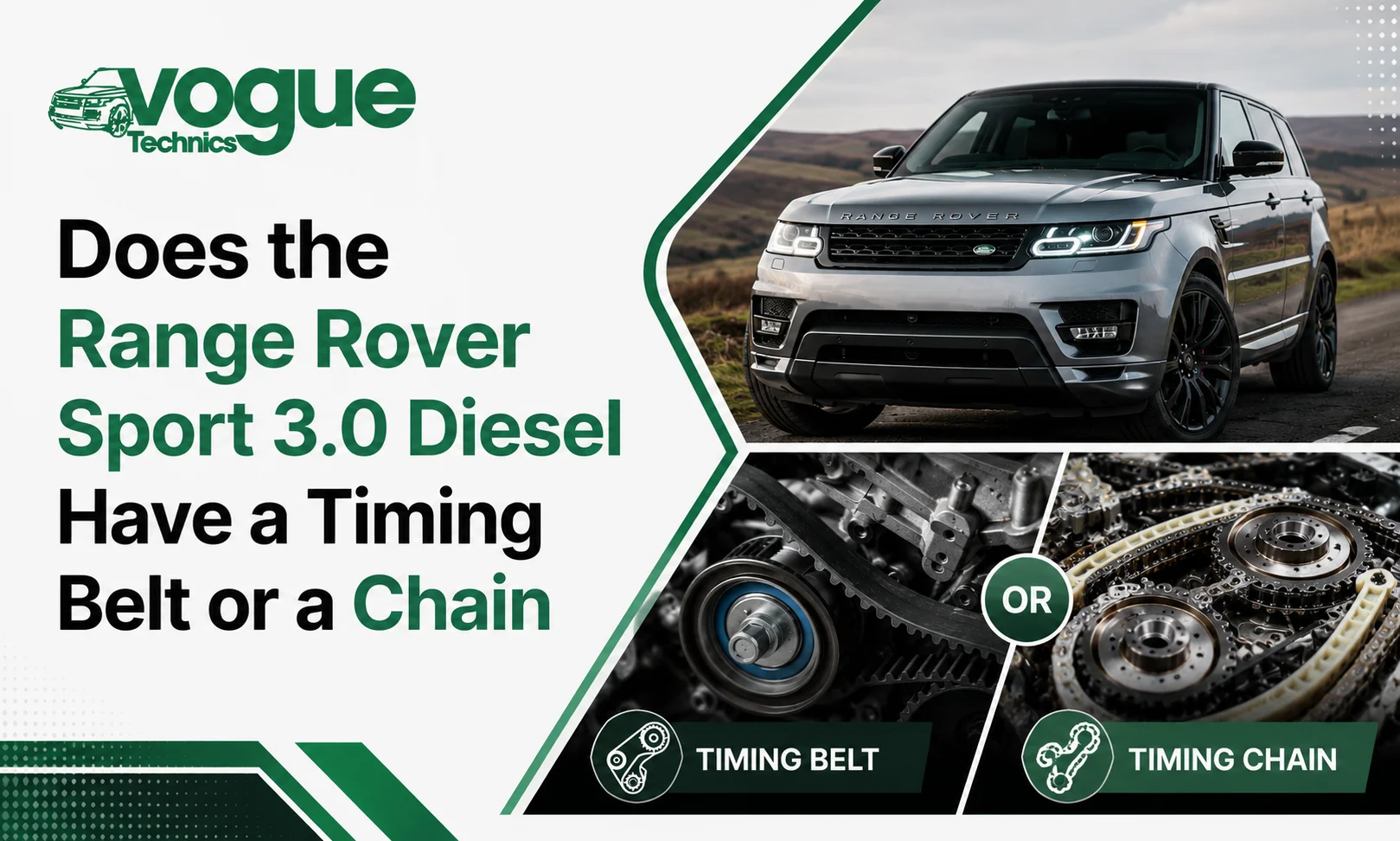
Does the Range Rover Sport 3.0 Diesel Have a Timing Belt or a Chain?
This is the first thing every owner should know, and it catches a lot of people out, especially those coming from petrol Range Rovers or other diesel SUVs where a timing chain is more common.
The Range Rover Sport 3.0 diesel does not use a timing chain. It uses a timing belt, in fact, it uses two.
This engine, badged as the TDV6 on earlier models and SDV6 on later, more powerful versions, was developed jointly with Peugeot-Citroën (part of the Lion V6 diesel family) and later adapted by Jaguar Land Rover across several platforms. It's found across a wide range of vehicles built on the same engineering base.
TDV6 vs SDV6 — What's the Difference?
The TDV6 and SDV6 are variations of the same 3.0-litre V6 diesel architecture, but they aren't identical:
- TDV6: the earlier version, typically producing around 245-256bhp depending on year and tune. Found in early Discovery 4, Range Rover Sport L320, and Range Rover L322/L405 models.
- SDV6: a later, more refined and more powerful iteration, often producing 288-306bhp, with revised turbocharging and improved efficiency. Found in later Range Rover Sport L494, Range Rover L405, and Range Rover Velar models.
Despite the power differences, both variants share the same fundamental timing belt design and the same failure risks if maintenance is neglected.
Why the 3.0 Diesel Uses Two Timing Belts, Not One
This is one of the most overlooked facts about this engine and one that most workshops don't explain clearly to customers.
Front Cam Belt Explained
The front timing belt is the one most people picture when they think "cambelt." It sits behind the timing cover at the front of the engine and controls the camshafts, keeping valve timing perfectly synchronised with the crankshaft. If this belt slips or snaps, the pistons and valves can collide, usually resulting in bent valves at best, and a wrecked cylinder head or block at worst.
Rear Fuel Pump Belt Explained
Less well known is the rear timing belt, tucked away at the back of the engine, driving the high-pressure fuel injection pump. This belt doesn't get the same attention as the front belt because it's harder to inspect and easy to forget about during a service. But if it fails, fuel delivery timing is thrown off completely, and the engine can suffer serious internal damage just as easily as a front belt failure would cause.
Any garage that only replaces the front belt and skips the rear fuel pump belt is leaving your engine exposed to exactly the kind of failure this service is meant to prevent.
Models & Model Years Affected
The 3.0 TDV6/SDV6 engine and its timing belt system appear across a broad range of Jaguar Land Rover vehicles, which is worth knowing if you're comparing notes with other owners or researching a used purchase.
Range Rover Sport (L320 & L494)
Covers Range Rover Sport 3.0 diesel models from roughly 2009 through to current SDV6 variants, spanning both the original L320 platform and the later L494.
Discovery 4 / Discovery 5 3.0 Diesel
Shares the same engine family and timing belt configuration, meaning the same intervals and risks apply.
Jaguar XF & F-Pace 3.0 Diesel (Shared Engine Platform)
Because Jaguar and Land Rover share engineering resources under Jaguar Land Rover, the same 3.0 diesel unit and its timing belt vulnerabilities appears in the Jaguar XF (X250 and X260), XJ (X351), and F-Pace.
When Should the Timing Belt Be Replaced? (Signs, Interval & Risks)
Knowing the theory is one thing. Knowing when to actually book the work in is what protects your engine.
Manufacturer Recommended Replacement Interval
Jaguar Land Rover's official guidance for the 3.0 TDV6/SDV6 timing belt is typically every 7 years or 112,000 miles, whichever comes first. This applies regardless of how the car has been driven, low-mileage vehicles are not exempt, because rubber and composite belt materials degrade with age and heat cycling, not just mileage.
It's worth being precise here: this isn't a rounded "10 year" or "100,000 mile" figure some general service guides quote. The 112,000-mile, 7-year interval is specific to this engine, and it catches out a lot of low-mileage owners who assume their car is "too new" to need the work.
Signs and Symptoms Your Timing Belt Needs Replacing
The frustrating truth about this engine is that timing belt wear often gives little to no warning before failure. Unlike a worn brake pad that squeals, a timing belt can look and sound fine right up until it doesn't. That said, there are some warning signs worth acting on immediately.
Warning Noises From the Engine
A ticking, rattling, or slapping noise from the front or rear of the engine, particularly at idle or on cold start, can indicate a belt or tensioner beginning to fail. This should never be ignored or "monitored" for a few weeks.
Rough Idling or Misfires
If the belt has stretched slightly or a tooth has slipped, engine timing can be thrown just enough to cause rough running, hesitation, or misfires, even before a complete failure occurs.
What Happens If the Timing Belt Fails or Snaps?
This engine is what's known as an "interference engine," meaning the pistons and valves occupy the same physical space at different points in the rotation. If the timing belt fails while the engine is running, the pistons will strike the valves.
The likely outcome is:
- Bent or broken valves
- Damaged pistons
- Potential damage to the cylinder head
- In severe cases, a complete engine rebuild or replacement
This is precisely why timing belt replacement on this engine falls firmly into "preventative maintenance" rather than "fix it when it breaks." A repair that costs a few hundred pounds if done proactively can turn into a multi-thousand-pound engine rebuild if the belt lets go.
Can I Still Drive Past the Recommended Interval?
Technically, yes, the car will keep running. But every mile driven past the 112,000-mile or 7-year mark increases the risk, particularly because belt failure on this engine gives so little warning. If your vehicle is approaching or has passed its interval, the safest approach is to book an inspection and replacement as soon as possible rather than waiting for symptoms that may never appear before failure.
How We Replace Your Range Rover Sport Timing Belt
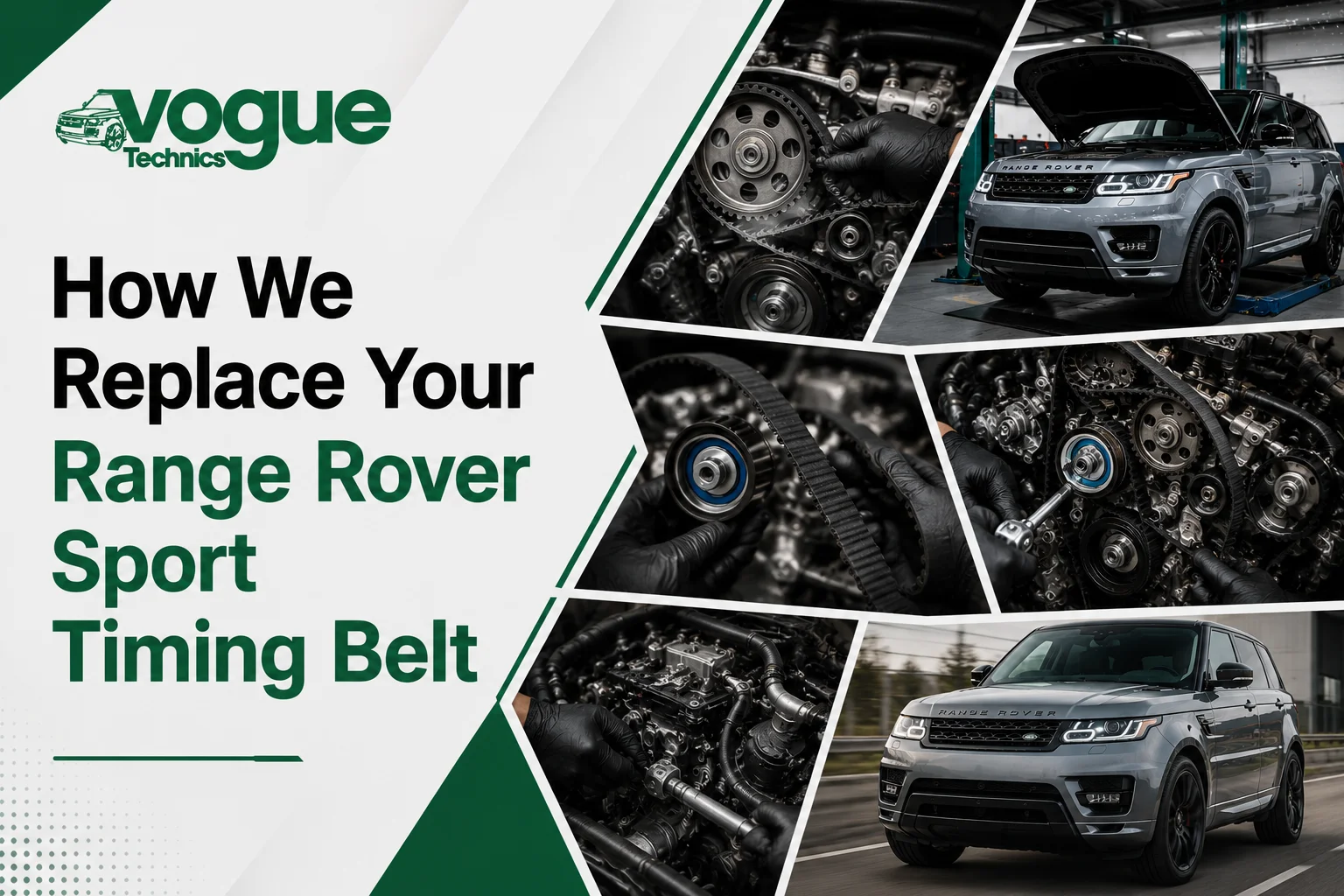
Understanding the process helps you ask the right questions of any garage quoting the work, and shows you exactly what you're paying for.
Diagnosis & Inspection Process
Before any belt is removed, a proper inspection should include checking the condition of the existing belt (where visible), assessing the tensioner and idler pulleys, checking for oil or coolant contamination around the belt area, and reviewing the vehicle's service history to confirm whether this work has been done before.
Step-by-Step Replacement Process
Front Timing Belt Replacement
The front timing cover is removed, the engine is set to top dead centre using the correct timing marks, and the old front belt, tensioner, and idler pulleys are removed and replaced as a complete set, never just the belt on its own.
Rear Fuel Pump Belt Replacement
Given how labour-intensive it is to access the rear of the engine, this belt is always replaced at the same time as the front belt, even if it appears to be in reasonable condition. Doing this work twice, once now for the front belt and again later for the rear, makes no financial or practical sense.
Water Pump Replacement (Recommended Alongside)
The water pump on this engine is typically driven by the same timing belt system, and it makes strong practical sense to replace it during the same job. Since the engine is already stripped down to this point, the additional labour cost is minimal compared to the cost of doing it as a separate job later, and it prevents a second belt-area breakdown from a failed pump.
Genuine vs Aftermarket Timing Belt Kits — Which Should You Choose?
Factor | Genuine / OEM Kit | Quality Aftermarket Kit |
| Fit & tolerance | Exact factory specification | Generally accurate, varies by brand |
| Material durability | Consistently high | Varies — reputable brands (e.g. Gates, INA, Dayco) are reliable |
| Cost | Higher upfront cost | More affordable |
| Warranty | Often longer manufacturer backing | Depends on supplier/fitter warranty |
| Availability | Can have longer lead times | Usually readily available |
For most owners, a genuine kit or a reputable branded aftermarket kit (such as Gates or INA, both original equipment suppliers to Jaguar Land Rover) offers the best balance of reliability and cost. Budget, unbranded kits are one of the most common causes of premature belt failure and should be avoided on an engine where the consequences of failure are this severe.
Labour Time — How Long Does the Job Take?
Because of the need to access both the front and rear of the engine, this job typically takes 6 to 9 hours of labour, depending on the vehicle's condition, whether the water pump is included, and whether any additional components (such as seals or gaskets) need replacing due to age-related deterioration.
Range Rover Sport 3.0 Diesel Timing Belt Replacement Cost
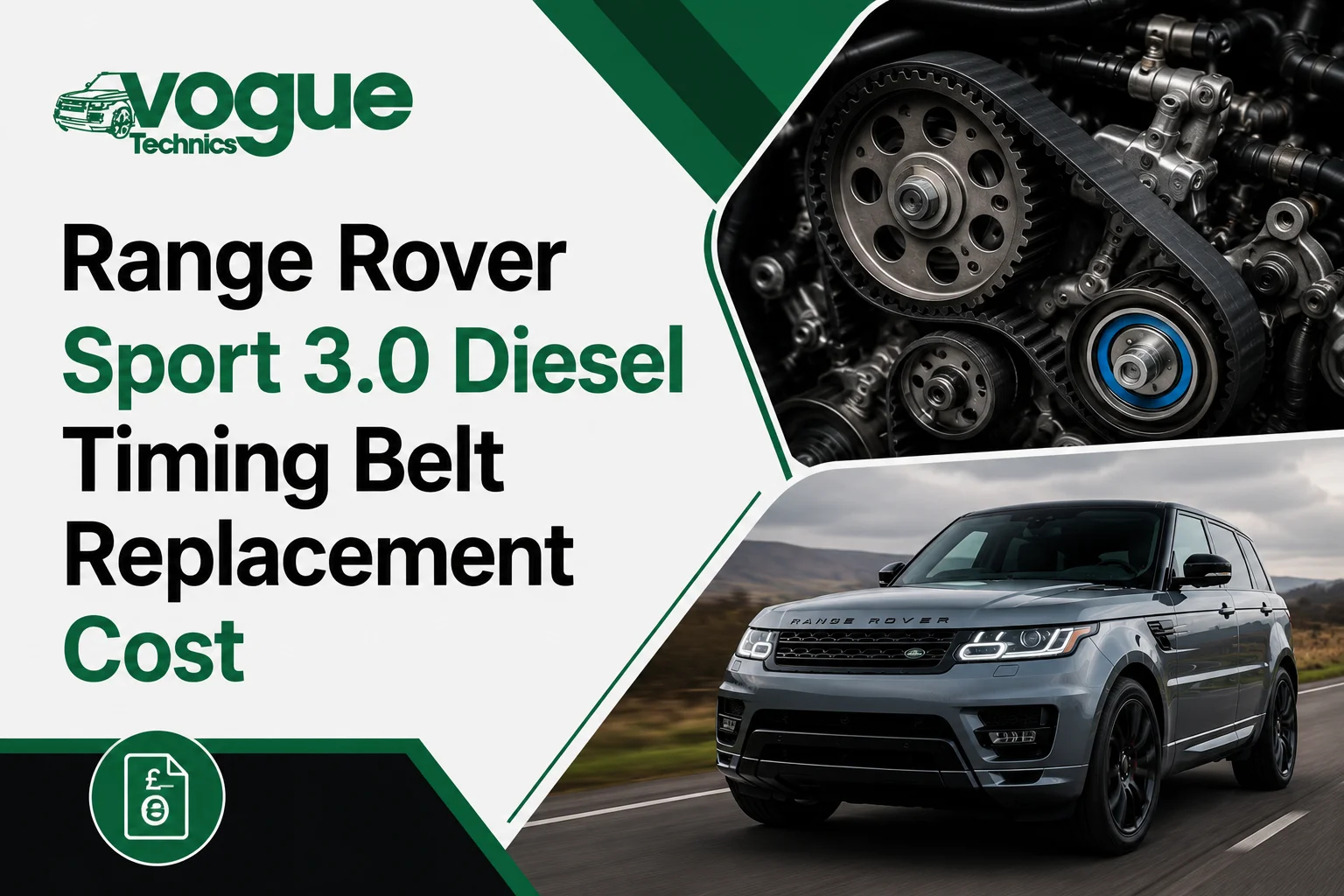
This is usually the question that brings people to this page, and it's a fair one to ask before booking any work.
Average Cost Breakdown (Parts vs Labour)
Cost Element | Typical Range (UK) |
| Timing belt kit (front & rear) | £150 - £350 |
| Water pump (if included) | £80 - £180 |
| Labour (6-9 hours) | £400 - £700 |
| Total estimated cost | £600 - £1,200 |
Prices vary depending on whether genuine or aftermarket parts are used, the specific model year, and regional labour rates. Vehicles with additional wear-related issues, such as a seized tensioner bolt or a leaking rear main seal, may incur additional costs once the engine is stripped down.
Main Dealer vs Independent Specialist Cost Comparison
Main Dealer | Independent Specialist (e.g. Voguetechnics) | |
| Typical cost | Higher — often £1,000-£1,500+ | More competitive — £600-£1,200 |
| Parts used | Genuine only | Genuine or trusted OEM-equivalent |
| Specialist knowledge | Good, but often generalist technicians | Focused specifically on Jaguar Land Rover engines |
| Booking flexibility | Often longer lead times | Typically faster turnaround |
| Warranty | Manufacturer-backed | Workshop-backed, often equally robust |
A specialist workshop that focuses specifically on Land Rover and Jaguar engines, rather than a general dealer network handling dozens of brands, often brings a level of hands-on familiarity with exactly this failure pattern that's hard to match.
Why Choose Voguetechnics Engine Rebuild in Grays, Essex
We specialise in Jaguar Land Rover 3.0 diesel engines, including TDV6 and SDV6 timing belt replacement, water pump servicing, and full engine rebuilds where damage has already occurred. Based in Grays, Essex, we work on Range Rover Sport, Range Rover, Discovery, and Jaguar vehicles from across the surrounding region.
Fixed-Price Quotes & Warranty
We provide clear, fixed-price quotes before any work begins, no surprise costs once the engine is opened up, backed by a workshop warranty on parts and labour.
Local Service Area Coverage
Based in Grays, Essex, we're well positioned for owners across Essex, East London, and the wider Thames Estuary area looking for a specialist alternative to main dealer pricing.
Frequently Asked Questions
Do I need to replace my timing belt at exactly 112,000 miles, or just every 7 years?
Whichever comes first. If your vehicle has covered fewer miles but is approaching or past the 7-year mark, the belt should still be replaced, the rubber and composite materials degrade with age and heat exposure regardless of mileage.
I'm over the recommended service interval — is it safe to keep driving?
It's not recommended. This engine gives minimal warning before a timing belt fails, and the consequences of failure typically involve serious internal engine damage. If you're over the interval, book an inspection or replacement as a priority rather than waiting for symptoms.
Is there really no way to check if the belt needs replacing without removing it?
Largely, no. Because both belts sit inside the engine's timing covers, a full visual inspection isn't practical without partial disassembly. This is exactly why the manufacturer's interval-based approach, rather than a "wait and inspect" approach, exists for this engine.
Should the water pump be replaced at the same time as the timing belt?
Yes, in almost all cases. Since the water pump is driven by the same belt system and the engine is already stripped down for the job, replacing it at the same time avoids paying for the same labour twice down the line.
Can an independent specialist replace the timing belt, or does it need to go to a main dealer?
An independent specialist with genuine Jaguar Land Rover engine experience can carry out this work to the same standard as a main dealer, often at a lower cost and with more flexible booking availability.
Is a genuine timing belt kit worth the extra cost over aftermarket?
Genuine or reputable branded aftermarket kits (such as Gates or INA) are worth the investment on this engine given the severe consequences of belt failure. Budget, unbranded kits are best avoided.
Booking Your Timing Belt Replacement
The Range Rover Sport 3.0 diesel is a capable, well-engineered vehicle, but its timing belt system is not something to leave to chance. Whether you're approaching the 112,000-mile mark, you've noticed an unusual noise, or you're simply due your 7-year interval, addressing it proactively is far cheaper — and far less stressful — than dealing with the aftermath of a snapped belt.
If you're in Grays, Essex, or the surrounding area and your Range Rover Sport, Discovery, or Jaguar 3.0 diesel is due this work, get in touch with Voguetechnics Engine Rebuild for a fixed-price quote. We'll talk you through exactly what your vehicle needs, with no guesswork and no unnecessary upselling — just straightforward, specialist advice from people who work on these engines every day.