
Range Rover P2263 Fault Code: Symptoms, Causes and How to Fix It
The Range Rover P2263 fault code means your turbo isn't delivering the boost pressure the engine requested, often leading to power loss and limp mode. This guide explains the symptoms, the most common causes on Evoque and Discovery 4 models, and how to diagnose the problem step by step. You'll also learn why resetting the code alone won't fix it, and when to get a specialist to check it.
The turbo warning light is on, the car feels flat on the motorway, and your scan tool has just thrown up the Range Rover P2263 fault code. It's a stressful moment, especially when the engine drops into limp mode and you're still miles from home.
The good news is that P2263 is a fault you can diagnose methodically. Most of the time the cause is a boost leak, a sticking turbo actuator or a faulty sensor, and not a ruined engine. Below, we explain what the code means, what causes it on Land Rover and Range Rover models, and how to fix it without throwing parts at the car.
What Does the Range Rover P2263 Fault Code Mean?
P2263 is a generic OBD-II code for turbocharger boost system performance. The engine control unit (ECU) compares the boost pressure it asked for with the pressure the turbo actually delivers. If the two don't match, the ECU stores the code and often cuts power to protect the engine.
In plain terms, the ECU wanted more air than your turbo supplied. Finding out why is the real job.
What do the P2263-21 and P2263-22 suffixes mean?
Land Rover diagnostic tools show the code with an extra suffix, such as P2263-21 or P2263-22. This failure-type suffix tells the technician how the ECU detected the fault, for example a signal below or above its expected range.
The suffix narrows the search but doesn't name the faulty part. Two Evoques with P2263-21 can have completely different causes, so the suffix should guide testing and never replace it.
Which models show the Land Rover fault code P2263?
We see the Land Rover fault code P2263 most often on turbocharged diesels, including:
- Range Rover Evoque (2.2 diesel), where P2263-21 is a common entry in the fault log
- Land Rover Discovery 4, where P2263-22 is regularly reported
- Range Rover Sport and full-size Range Rover diesel variants
- Freelander 2 and other platform-sharing models
Is the P2263 code the same on a Nissan?
You may see searches for "range rover p2263 fault code nissan". The code definition is the same because P2263 is a generic OBD-II code, so Nissan owners see it too. The causes are not the same. Every manufacturer uses a different turbo design, sensor layout and software logic, so a Nissan fix doesn't transfer to a Range Rover. Use Land Rover-specific diagnostics for your vehicle.
Range Rover P2263 Fault Code Symptoms and Common Causes
Drivers usually notice the symptoms before they ever plug in a scanner. Knowing them helps you describe the problem accurately when you call a workshop.
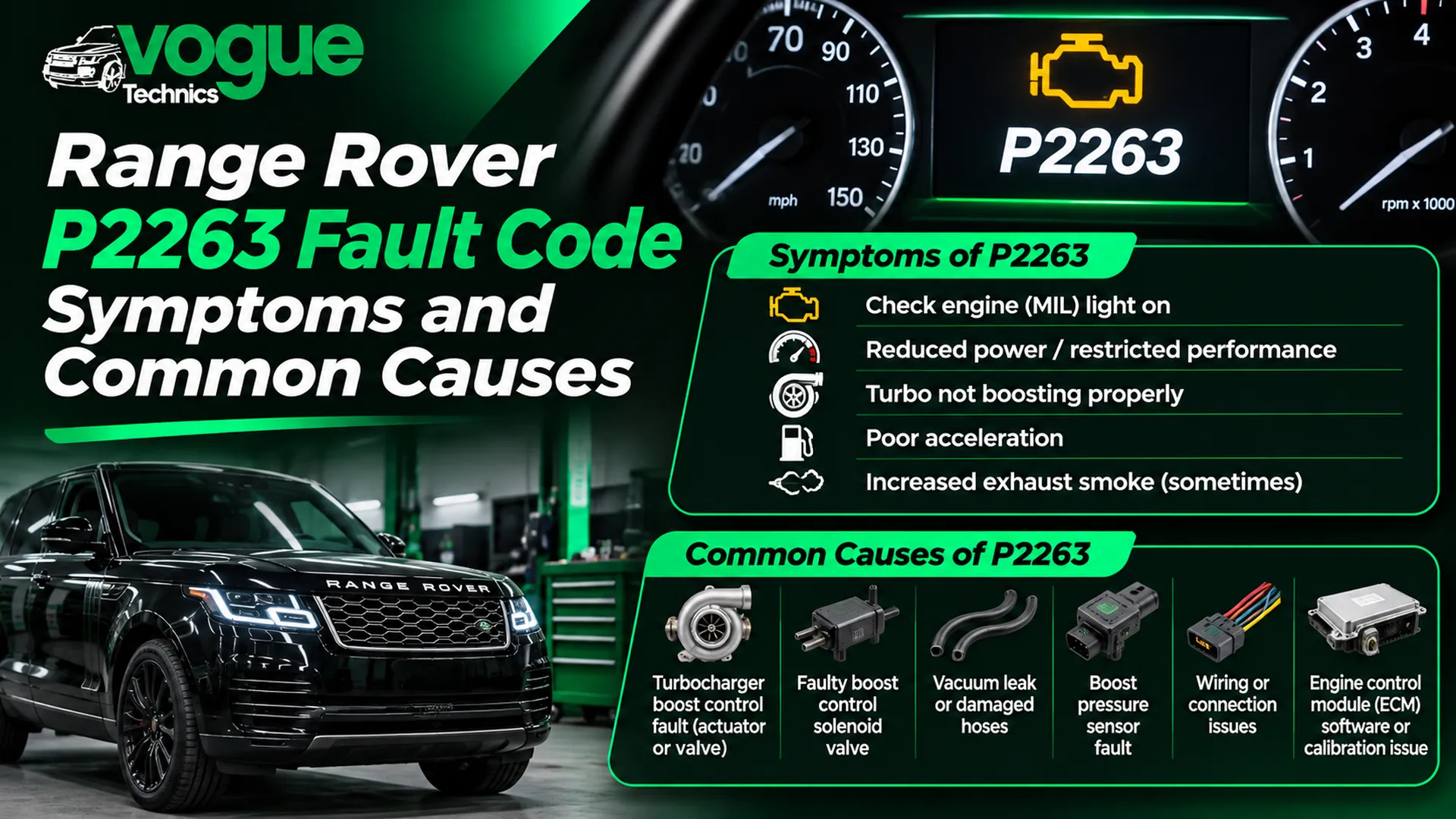
Range Rover P2263 fault code symptoms
Common signs include:
- Noticeable loss of power, especially on hills or when overtaking
- Limp mode with a reduced rev limit
- An illuminated engine management or turbo warning light
- Black or grey smoke from the exhaust
- A whistling, hissing or fluttering sound from the engine bay
- Poor fuel economy
One symptom on its own proves little. Several together, particularly power loss plus a hiss under load, point strongly to a boost problem.
What causes the P2263 code on a Land Rover?
Here are the usual suspects, from most to least common:
Likely cause | What it does | How it's tested |
| Split or loose intercooler hose | Lets boost pressure escape before it reaches the engine | Pressure test and visual inspection |
| Sticking turbo actuator or variable-vane mechanism | Prevents the turbo building or controlling boost | Live data and actuator test |
| Faulty boost pressure or MAF sensor | Sends the ECU incorrect readings | Compare live values against expected figures |
| Blocked DPF or exhaust restriction | Creates back pressure that upsets turbo performance | Pressure readings and DPF status check |
| Sticking EGR valve | Leaks exhaust gas into the intake and disrupts airflow | Valve function test |
| Worn turbocharger | Can't produce the requested boost | Shaft play check and boost logging |
Soot build-up on the variable-vane mechanism is a classic issue on diesels used mainly for short journeys. It's one reason an occasional longer run helps these engines.
Can you keep driving with a P2263 code?
A short trip to a workshop is usually fine. Continuing for weeks is a bad idea. Running with low or uncontrolled boost strains the turbo, can put extra load on the DPF and may turn a small repair into a major one. If you hear grinding or see heavy smoke, stop driving the car.
How Do I Fix Error Code P2263 on a Range Rover?
The simple answer is to find the cause, repair it, then clear the code. Skipping the middle step is how the code returns a week later.
Step-by-step diagnosis
A proper diagnosis follows a logical order:
- Read all stored codes. Check for related faults and freeze-frame data, not only P2263.
- Inspect the intake and boost pipework. Look for splits, oil residue around joints and loose clamps.
- Pressure-test the intake system to find leaks you can't see.
- Check live data. Compare requested and actual boost, and check the MAF and boost sensor readings.
- Test the turbo actuator. Confirm it moves freely and responds to commands.
- Check the EGR valve and DPF for restrictions.
- Road test with data logging to confirm the fix.
Cheap checks come first. Replacing a turbo before testing a £15 hose clamp is an expensive mistake.
Can you reset the Range Rover P2263 fault code yourself?
You can, but a Range Rover P2263 fault code reset only wipes the stored code. It doesn't repair anything. If the underlying fault remains, the ECU will log the code again, usually within a few drives.
A reset is worth doing only after the repair, to confirm the fault stays gone. Any other time, it just hides the problem for a short while.
DIY or specialist workshop?
DIY repair | Specialist workshop | |
| Best for | Visible hose or clamp issues | Actuator, turbo or sensor faults |
| Tools needed | Basic hand tools, basic scanner | Land Rover-capable diagnostics, pressure testing equipment |
| Risk | Misdiagnosis, repeat faults | Low, with testing and a verified repair |
| Typical outcome | Quick fix if the cause is simple | Root cause found and confirmed |
If you've checked the obvious items and the code keeps returning, the fault is likely deeper than a hose.
Range Rover Turbo and Fault Code Repairs in Grays, Essex
Anyone can read a code. Fixing the cause is what matters, and that needs experience with how these turbo systems fail in real use.
Why drivers trust a specialist for Range Rover fault codes
At voguetechnicsenginerebuild.co.uk, we work on Land Rover and Range Rover diesels from our base in Grays, Essex. We diagnose first and quote after, so you only pay for work the car needs. A typical job includes:
- Full fault code read-out and live data analysis
- Boost leak and intake pressure testing
- Turbo actuator and sensor testing
- Repair or replacement, with the fault cleared and confirmed on a road test
You'll leave knowing what failed and why, with the evidence to back it up.
Frequently asked questions
What does the Range Rover P2263 fault code mean?
It means the turbo isn't delivering the boost pressure the ECU requested. The cause could be a leak, an actuator fault, a sensor fault or an exhaust restriction.
How do I fix error code P2263?
Diagnose the cause first, then repair it. Check hoses and clamps, test the actuator and sensors, then clear the code and road test.
What does P2263-21 mean on an Evoque?
It's the code with a failure-type suffix that shows how the fault was detected. It narrows down the diagnosis but doesn't identify a single part.
What does P2263-22 mean on a Land Rover Discovery 4?
It's the same boost performance fault with a different failure-type suffix. Testing is still needed to find the actual cause.
Will clearing the code fix the problem?
No. Clearing removes the stored fault, but it returns if the cause is still there.
Are other Range Rover fault codes related to P2263?
Often, yes. Boost, MAF, EGR and DPF codes can appear alongside it, which is why a full scan matters.
Can a Range Rover turbo be repaired instead of replaced?
Sometimes. A sticking actuator or a cleanable vane mechanism may not need a new turbo. A specialist can tell you after testing.
Final thoughts
The Range Rover P2263 fault code is a warning, not a verdict. Caught early, it's usually a manageable repair. Left alone, it can damage the turbo and the engine. Sort the cause properly and the car will drive the way it should.
If your Range Rover or Land Rover is showing P2263, contact voguetechnicsenginerebuild.co.uk today and book a diagnostic check at our Grays, Essex workshop.