
Range Rover NOx Sensor Fault: Symptoms, Location, Replacement Cost & Expert Repair in Grays, Essex
A Range Rover NOx sensor fault can trigger warning lights, limp mode and even a restart countdown. This guide explains where the sensors sit on the Range Rover, Sport and Evoque, what the symptoms mean, and whether it is safe to keep driving. You will also see what affects replacement cost in the UK and how a proper diagnosis, reset and repair works at Voguetechnics in Grays, Essex.
You start the engine and an amber warning appears. Maybe the dash reads "Exhaust Fluid System Fault," maybe the car feels flat on the motorway, or maybe a restart countdown has started. If that sounds familiar, a Range Rover NOx sensor fault is one of the most likely causes.
The good news is that this fault is common and fixable. The bad news is that it is easy to misdiagnose, and replacing the wrong part can cost you hundreds of pounds. This guide explains where the sensors sit, what the symptoms look like, whether you can keep driving, what a fix costs in the UK, and how a proper repair is done.
What Is a Range Rover NOx Sensor Fault and Where Is the Sensor Located?
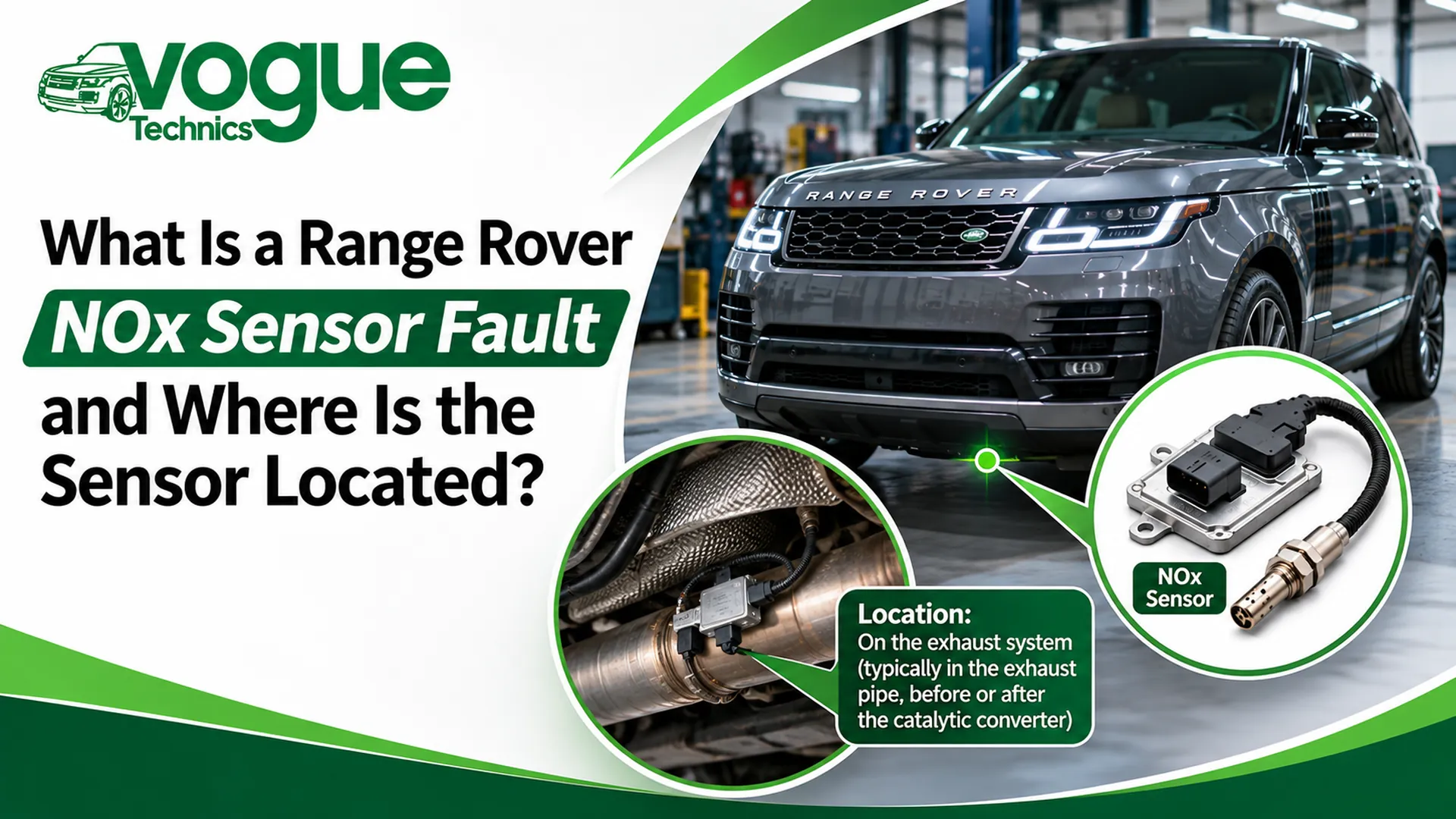
Modern Range Rover diesels use a Selective Catalytic Reduction (SCR) system. It injects AdBlue (diesel exhaust fluid) into the exhaust to convert harmful nitrogen oxides (NOx) into nitrogen and water. NOx sensors are the system's eyes. They measure NOx levels in the exhaust gas, and the ECU uses those readings to decide how much AdBlue to inject.
Most diesel models carry two sensors. The upstream sensor reads NOx before the SCR catalyst. The downstream sensor reads what comes out after it. The ECU compares the two to check the system is working. When one sensor gives an implausible reading, or stops responding, the car logs a fault and lights a warning.
Where Is the NOx Sensor on a Range Rover, Range Rover Sport and Evoque?
On most diesel models the sensors sit in the exhaust system under the car, one ahead of the SCR catalyst and one behind it. Each sensor has a small control module attached by a wiring harness. This matters because the fault can sit in the sensor, the module, the wiring or the connector.
Exact positions vary by engine and model year, but here is the general picture:
- Range Rover and Range Rover Sport (TDV6, SDV6, SDV8 and later diesels): underbody exhaust, upstream and downstream of the SCR unit. The range rover nox sensor location is usually reachable only with the car on a ramp.
- Range Rover Evoque and Velar (Ingenium diesels): the evoque nox sensor location is also on the underside, close to the DPF and SCR assembly.
- Petrol models: these have no NOx sensors, so a NOx fault code means you have a diesel.
Because access is awkward, most owners cannot confirm a fault by looking. A diagnostic scan comes first.
Why Do Range Rover Sensor Problems Keep Happening, and Do Mercedes Have the Same NOx Sensor Issues?
Range Rover sensor problems around the NOx system usually come down to the harsh environment the sensors live in. They sit in hot, wet, vibrating exhaust gas for years. Common causes include:
- Heat and age: the sensing element degrades over time.
- Moisture and corrosion: water gets into the connector or module.
- AdBlue crystals or contamination: poor-quality fluid or leaks can foul the sensor.
- Short journeys: the exhaust never gets hot enough for the system to run its self-checks properly.
- Wiring faults: chafed or corroded harnesses mimic a failed sensor.
Mercedes-Benz NOx sensor issues follow the same pattern. BlueTEC models use the same SCR logic, with the same two-sensor layout and the same exposure to heat and moisture. If you have seen Mercedes NOx sensor issues discussed online, the diagnosis approach is very similar. Test first, replace second.
What Are the Symptoms of a Range Rover NOx Sensor Fault and Can You Keep Driving?
Symptoms range from a single dashboard message to a car that refuses to restart. Catching them early usually keeps the repair simpler and cheaper.
Which Warning Lights and Messages Point to a NOx Sensor Fault, and What Does a NOx Exceedance Mean?
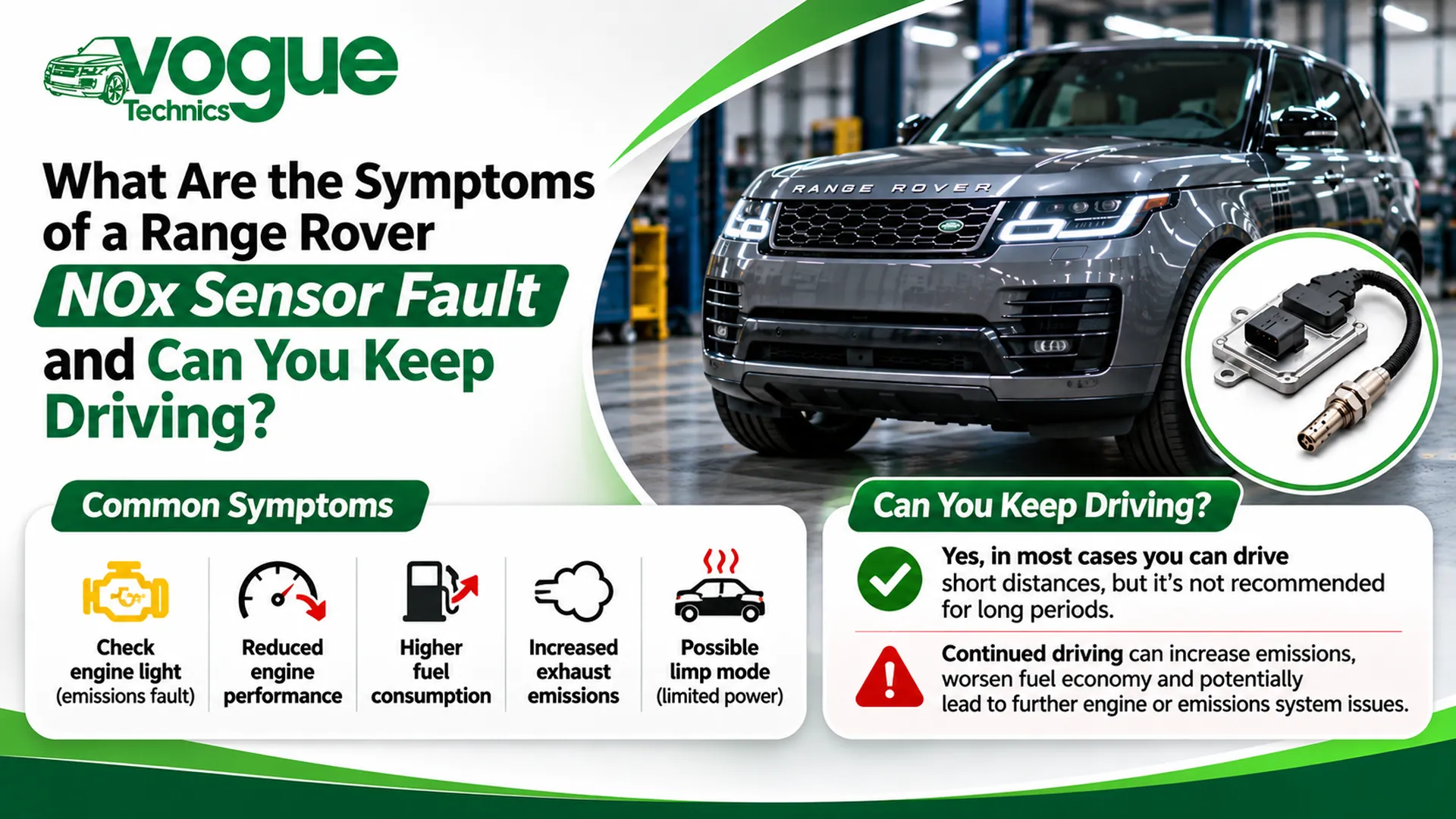
Typical Range Rover NOx sensor fault symptoms include:
- An amber engine or emissions warning light
- An AdBlue or "Exhaust Fluid System" message on the dash
- A restart countdown ("engine will not restart in X miles")
- Reduced power or limp mode
- Poorer fuel economy
- A failed emissions check at MOT time
Fault codes in the P2200 range and nearby (such as P229F) often point to NOx sensor circuits or plausibility, but codes alone do not prove the sensor has failed. Wiring, the module, an AdBlue dosing problem or a blocked DPF can set similar codes.
A Range Rover NOx exceedance message means the system believes tailpipe NOx is above the permitted level, or cannot verify it is within limits. The cause may be a failed sensor, a dosing fault or a genuine SCR problem. Either way, the car is telling you it cannot confirm it is meeting emissions limits.
Here is how the most common symptoms usually break down:
Symptom | Common cause | Is the sensor always to blame? |
| Amber warning light only | Sensor signal fault or implausible reading | Often, but not always |
| Restart countdown | System cannot verify NOx control | Could be sensor, AdBlue dosing or SCR |
| Limp mode / low power | ECU protecting the exhaust system | Sometimes wiring or DPF-related |
| NOx exceedance message | Readings out of range or unverifiable | Needs diagnosis |
| Warning returns after reset | Underlying fault not fixed | Likely wrong part or deeper issue |
Is It Safe to Drive With a Faulty NOx Sensor, and for How Long?
Many owners ask, "can you drive with a faulty NOx sensor?" and "is it safe to drive with a faulty NOx sensor?" In the short term the car will usually still run, so it is not an immediate mechanical danger. But it is not something to ignore:
- The ECU may cut power to protect the system.
- A restart countdown can leave you stranded if it reaches zero.
- Emissions may exceed legal limits, and the fault can fail an MOT.
- Prolonged AdBlue dosing errors can stress the SCR catalyst, a far costlier part than a sensor.
Our advice is simple. If a countdown has started, book a diagnosis straight away. If it is only a warning light, get it checked within days rather than months.
How Much Does Range Rover NOx Sensor Replacement Cost and How Is the Fault Fixed?
What Affects the Range Rover NOx Sensor Fault Repair Cost?
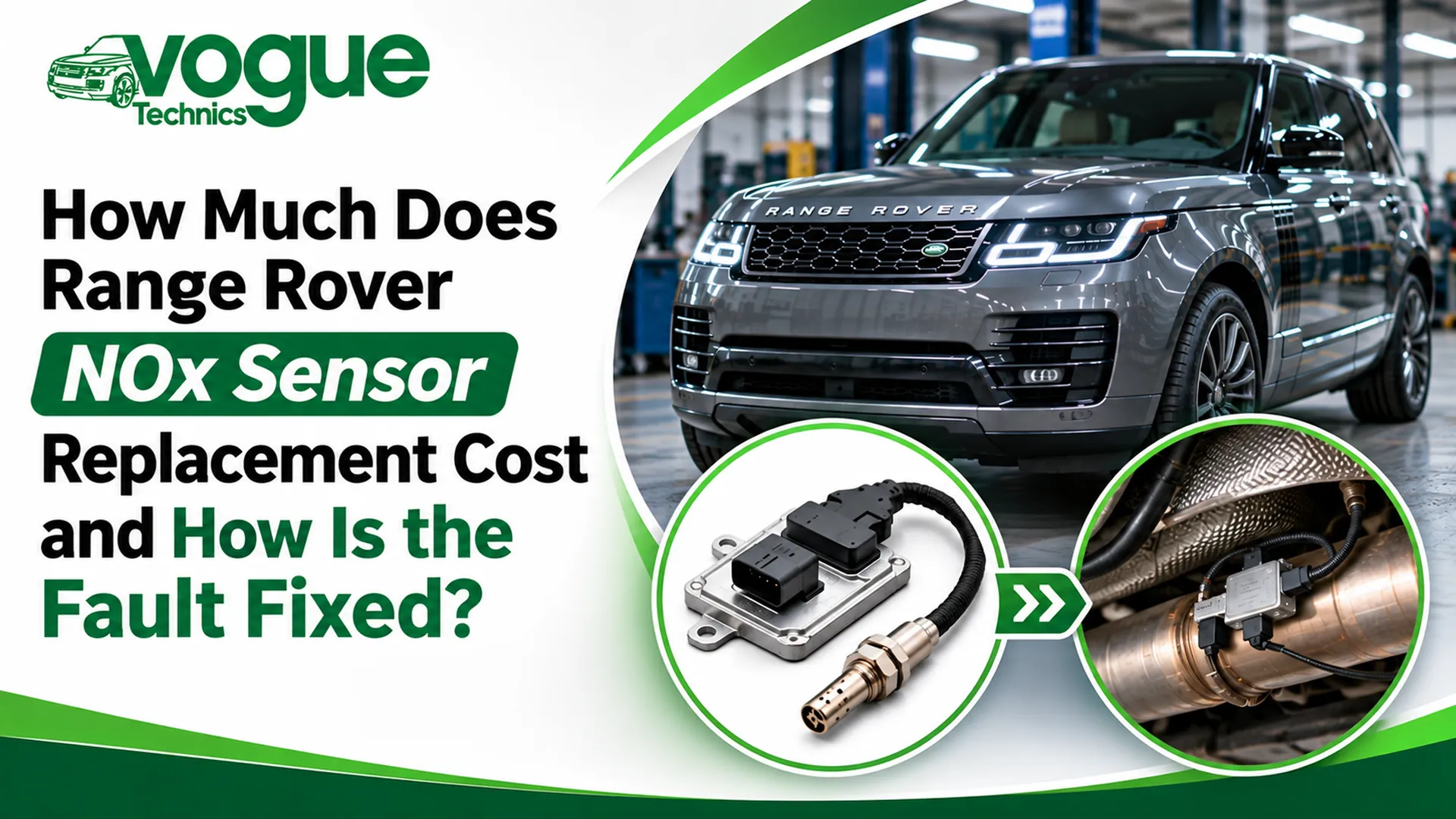
There is no single price. Range Rover NOx sensor replacement costs in the UK depend on several things:
- Model and engine: Range Rover, Sport, Evoque and Velar parts differ.
- Which sensor failed: upstream, downstream or both.
- Part quality: genuine and OE-quality sensors cost more than cheap online units, but cheap units often fail early or trigger further faults.
- Labour and access: some sensors are quick to reach, others need more dismantling.
- Diagnostic time: proving the fault before fitting anything adds time but saves money.
- Coding and adaptation: a new sensor often needs the ECU to learn it.
As a rough guide, a single-sensor job commonly falls somewhere between a few hundred pounds and several hundred more, with main-dealer quotes typically higher than independent specialists. Treat any figure as indicative. The only reliable Range Rover NOx sensor fault repair cost is a quote after a proper diagnosis.
Here is how the options compare:
Option | Typical outcome | Risk |
| Diagnose first, then replace if faulty | Correct fix, fewer repeat visits | Small diagnostic cost upfront |
| Replace with a cheap unit without testing | Lower upfront price | Wrong part, early failure, repeated faults |
| Reset the fault only | Warning may clear briefly | Returns if the cause remains |
| Dealer repair | Strong parts backing | Usually higher labour rates |
How Do We Check, Reset and Fix a Range Rover NOx Sensor Fault at Voguetechnics in Grays, Essex?
A fault light is a starting point, not a verdict. At Voguetechnics in Grays, Essex, the process runs in a clear order:
- Scan and record: read all stored and pending codes, plus freeze-frame data.
- Live data check: compare upstream and downstream NOx readings and AdBlue dosing behaviour.
- Physical inspection: check wiring, connectors, the sensor module, exhaust leaks and AdBlue condition.
- Prove the fault: confirm whether the sensor, module or wiring is at fault before parts are ordered.
- Repair or replace: fit the correct part, or repair the harness or connector if that is the real cause.
- Adapt, reset and road test: clear the codes, run the required adaptations and confirm the fault does not return.
That order covers the Range Rover NOx sensor fault check, reset and fix. A reset on its own clears a message but cures nothing. If the cause remains, the warning comes back, often within a few drives. We repair the emissions system properly and do not delete it. Removing emissions equipment is illegal on road vehicles in the UK and will fail an MOT.
A real-world example: an owner arrives with an Evoque showing an AdBlue warning after a long run of short trips. A scan shows a downstream NOx plausibility code. Live data and a wiring check reveal a corroded connector rather than a dead sensor. A connector repair and re-test fix it, and the owner avoids buying a sensor they did not need. That is why diagnosis comes before parts.
If your Range Rover, Sport, Evoque or Velar is showing any of these signs, call or message Voguetechnics in Grays, Essex for a diagnosis and a clear, itemised quote. We will tell you what is wrong before we ask you to approve any work.
Frequently Asked Questions
Can I reset a Range Rover NOx sensor fault myself?
You can clear the message with a scan tool, but if the sensor, wiring or dosing fault is still there, the warning returns. A proper fix finds and corrects the cause first.
How long does a Range Rover NOx sensor last?
There is no fixed lifespan. Heat, moisture, journey type and AdBlue quality all affect it. Many owners see a first failure after several years of use.
Do I need to replace both NOx sensors?
Not always. Often only the failed one needs replacing, though a technician may recommend both on a high-mileage car. Testing shows which.
Will a NOx sensor fault cause an MOT failure?
An illuminated emissions warning or a failing emissions system can lead to an MOT failure, so it is best to fix the fault before the test.
Is the NOx sensor the same as the AdBlue sensor?
No. NOx sensors measure exhaust gas content. AdBlue systems also use level, quality and temperature sensors, plus a pump and injector, and any of these can trigger similar warnings.
Can poor-quality AdBlue damage the NOx sensor?
Contaminated or diluted fluid can cause dosing and reading problems. Always use correctly specified AdBlue from a reputable source.
Get Your Range Rover NOx Sensor Fault Sorted Properly
A NOx sensor fault does not fix itself, and guessing at it costs more than diagnosing it. Whether you drive a Range Rover, Sport, Evoque or Velar, the right sequence is the same: scan, test, prove the fault, fix the cause and road test.
Contact Voguetechnics in Grays, Essex today to book your diagnosis and get an honest quote before you spend a penny on parts.