

Range Rover L322 Timing Chain Replacement | Grays, Essex Specialists
A cold-start rattle in your Range Rover L322 usually signals early timing chain wear — and ignoring it can turn a controlled repair into a full engine rebuild. This guide breaks down the warning signs, fault codes (P0016, P0017, P0008), and how the fix differs across the TDV8, AJ133, M62, and Supercharged engines. It also covers what a proper engine-out repair involves and realistic cost expectations, so you know what you're paying for before work starts.
That rattle on cold start isn't going away on its own. If you've just turned the key on your Range Rover L322 and heard a metallic clatter that settles down after a few seconds, you already know something's wrong. You just don't know how wrong yet.
Here's the uncomfortable truth: on the L322, a timing chain rattle is rarely a "keep an eye on it" problem. It's an early warning that a chain guide, tensioner, or the chain itself is wearing out, and if it's ignored, the cost of fixing it can jump from a controlled repair to a full engine rebuild within a matter of weeks.
We're Vogue Technics, based in Grays, Essex, and we work on L322s every week, TDV8 diesels, the 5.0 V8, the Supercharged AJ133, the older M62 4.4. This guide walks you through exactly what's happening under the bonnet, how it differs by engine, what a proper repair involves, and what it actually costs. No vague guesswork, no upselling scare tactics, just what we'd tell a customer standing in our workshop.
Signs Your Range Rover L322 Timing Chain Is Failing

The L322 timing chain doesn't fail overnight. It's a gradual process, and the earlier you catch it, the cheaper and less invasive the fix.
Timing chains stretch slightly as they wear. That extra slack lets the chain slap against guides and tensioners, which is where the noise comes from. Left unchecked, that slack eventually throws the cam and crank timing out of sync, and that's when real engine damage starts.
What Does an L322 Cold Start Rattle Actually Mean?
A cold start rattle happens because engine oil drains away from the top of the engine overnight. When you start the car, the hydraulic tensioner needs a second or two to build oil pressure and take up the slack in the chain. If the tensioner or guides are worn, that gap is bigger than it should be, so you hear a rattle or knock for a second or two before it quietens down.
Early on, this might only happen on the first start of the day. As wear progresses, you'll notice:
- The rattle getting louder or lasting longer
- The noise starting to appear on warm restarts too, not just cold ones
- A rougher, more metallic edge to the sound rather than a soft rattle
If you're not sure whether what you're hearing is a timing chain issue or something else, a loose heat shield, a worn pulley, exhaust noise, it's worth getting it checked rather than guessing. Diesel engines in particular can mask timing chain rattle under normal injector noise, which is why an ear alone isn't always reliable.
Warning Lights & Fault Codes Linked to Timing Chain Wear
The L322's ECU monitors cam and crankshaft position constantly. When timing chain wear pushes those signals out of their expected relationship, it triggers a camshaft or crankshaft correlation fault, and that almost always means the engine management light comes on.
P0016, P0017 & P0008 Explained
These are the three fault codes we see most often on L322s with timing chain wear:
- P0016 – Crankshaft/camshaft correlation fault (Bank 1). Usually points to chain stretch or a slipped tooth on the sprocket.
- P0017 – Crankshaft/camshaft correlation fault (Bank 2). Same root cause as P0016, just affecting the opposite bank on V8 engines.
- P0008 – Engine position system performance. A broader correlation fault, often appearing alongside P0016 or P0017 on more advanced wear.
None of these codes tell you exactly which component has failed, tensioner, guide, or chain, on their own. That's why a proper diagnostic scan needs to be followed by a physical inspection, which we'll cover shortly.
Is It Safe to Keep Driving an L322 With a Timing Chain Rattle?
Short answer: not for long, and definitely not on a diesel where the interference engine design means valves and pistons occupy the same space at different points in the cycle.
Here's the failure progression we see time and again:
Guide wear → tensioner weakness → chain slack → rattle → timing deviation → chain jump → valve/piston contact → engine damage
Once a chain jumps even one tooth on the sprocket, valve timing is compromised. On an interference engine like the L322's, that's often the difference between a £1,500–£3,000 timing chain repair and a £6,000+ engine rebuild or replacement. We've seen both outcomes come from the exact same starting noise, the only difference was how quickly the car came in.
If you're hearing a rattle, the safest move is to limit driving to short, essential journeys until it's been inspected.
L322 Timing Chain Replacement by Engine
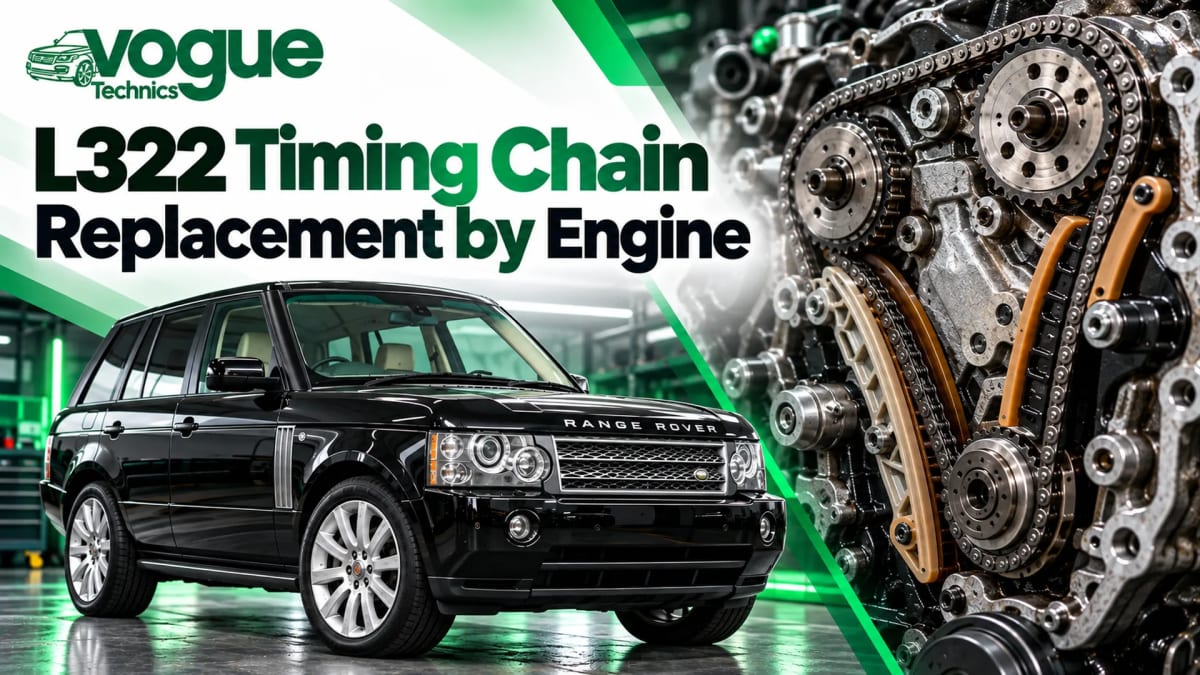
This is the part most guides get wrong. The Range Rover L322 was built between 2002 and 2012 with a genuinely wide spread of engines, BMW-derived, Jaguar-derived, and Land Rover's own TDV8 diesels, and they don't all fail the same way, or cost the same to fix.
Treating "L322 timing chain replacement" as one job is where a lot of quotes go wrong. Here's how it actually breaks down.
Engine | Common Failure Point | Typical Repair Scope |
| 3.6 TDV8 | Guide wear, tensioner fatigue | Chain, guides, tensioner |
| 4.4 TDV8 | Chain stretch, correlation faults | Chain, guides, tensioner, sprockets |
| 5.0 V8 (AJ133) | Tensioner/guide wear, cold-start rattle | Full kit, revised components |
| 5.0 Supercharged | Same as 5.0 V8, accelerated by heat/load | Full kit, revised components |
| 4.2 Supercharged | Chain guide wear | Chain, guides, tensioner |
| M62 4.4 V8 | Guide degradation over time | Chain, guides, tensioner |
3.6 & 4.4 TDV8 Timing Chain Replacement
The TDV8 diesels use their own dedicated timing chain, guide, and tensioner setup, separate from the petrol V8 range. We most commonly see wear-related rattle on these engines linked to guide degradation rather than the chain itself stretching prematurely, though by the time a customer notices the noise, both are usually due for replacement together.
Because the timing chain sits at the front of the engine behind the timing cover, and access is tight on the TDV8 layout, this is typically an engine-out job to do properly and permanently.
5.0 V8 & 5.0 Supercharged (AJ133) Timing Chain Replacement
The 5.0 AJ133, fitted to both the naturally aspirated V8 and the Supercharged variant, is the engine most strongly associated with timing chain tensioner and guide wear on the later L322. Land Rover issued a technical bulletin specifically covering this engine, documenting revised tensioner and blade components and warning against mixing old-specification and new-specification parts within the same repair.
That last point matters more than it sounds. If a workshop replaces only the chain but reuses an old-spec tensioner, or vice versa, the mismatch can cause premature failure again within a relatively short time. Every AJ133 repair we carry out uses matched, current-specification components for exactly this reason.
The Supercharged variant runs under more thermal and mechanical load, which tends to accelerate wear slightly compared to the naturally aspirated 5.0, but the failure pattern and repair process are the same.
4.2 Supercharged & M62 4.4 V8 Timing Chain Replacement
Earlier L322s (broadly pre-2005) used the BMW-derived M62 4.4 V8, while the 4.2 Supercharged is a Jaguar-derived unit. Both are now well over 15 years old in most cases, so timing chain wear on these engines is increasingly common simply as a function of age and mileage, even on cars with a solid service history.
Guide degradation is the main culprit on the M62, with the plastic-composite guides becoming brittle over time rather than the chain itself stretching significantly.
Not Sure Which Engine You Have? How to Check Your VIN
Because the L322 spans so many engine variants across a single model generation, it's easy to assume you know what's under the bonnet and be wrong, particularly on cars that have had an engine swap or import history.
The quickest ways to confirm:
- Check the engine code stamped on the block or listed on your V5C logbook
- Decode your VIN, the eighth digit typically identifies the engine variant
- Look for the badge on the tailgate (5.0, TDV8, Supercharged), though these aren't always reliable after resprays or replacements
- Pull up your service history, which usually references the engine explicitly
If you're unsure, send us your registration or VIN before booking a diagnostic, it takes us a couple of minutes to confirm and means we can quote accurately from the start.
How We Replace an L322 Timing Chain
A proper timing chain replacement isn't just "fit new chain, done." It's a sequence of checks and processes designed to catch the actual root cause and make sure the repair holds, not just for a few thousand miles, but for the life of the engine.
Diagnosis: Scan, Borescope & Cold Start Inspection
Every repair starts with confirming what we're actually dealing with, not assuming.
Our diagnostic process typically follows this order:
- Cold start listen, we want to hear the rattle ourselves, in the state it presents naturally
- Diagnostic scan, pulling fault codes (P0016, P0017, P0008, or others) and checking live cam/crank correlation data
- Physical inspection, where access allows, a borescope inspection to visually assess chain and guide condition without opening the engine unnecessarily
- Correlation verification, confirming the scale of the timing deviation, which tells us how advanced the wear is
This matters because two L322s with the exact same rattle can be at very different stages of wear. One might need a straightforward chain and guide replacement; another might already have sprocket or valve damage that changes the entire scope of the job. Diagnosing properly before quoting protects you from surprise costs halfway through a repair.
Engine-Out Repair, What Gets Replaced
On most L322 engines, the timing chain sits deep at the front of the engine block, behind ancillaries, mounts, and in some cases the subframe. Proper access, the kind that lets you fit components correctly and torque everything to specification, usually means removing the engine rather than trying to work around it in the bay.
We know that sounds like a bigger job than some quotes suggest. It is. But it's also the difference between a repair that lasts and one that needs redoing in 20,000 miles.
A complete replacement typically includes:
- Timing chain(s), matched to the correct engine specification
- Chain guides, replaced as a full set, not selectively
- Hydraulic tensioners, current specification, matched to new guides
- Sprockets, inspected and replaced where wear or tooth damage is found
- Seals and gaskets disturbed during the removal process
- Engine oil and filter, since metal debris from a worn chain can contaminate the existing oil
- Coolant, where the crossover pipe or related components require disturbance
Skipping any of these to save cost is usually a false economy, a new chain running against a worn guide, or a new guide against an old tensioner, simply wears again at an accelerated rate.
Timing Verification & Road Test Before Handover
Once everything is reassembled, the job isn't finished until we've proven it. That means:
- Verifying cam and crank timing against manufacturer specification
- Clearing fault codes and confirming they don't return under load
- A road test cycle to check for noise, performance, and stable running across normal driving conditions
We don't hand a car back on the same day we finish mechanical reassembly. Timing-related faults have a habit of reappearing under heat cycles that a five-minute test drive won't reveal, so we build in a longer test window before your L322 comes home.
Cost, Warranty & Why Choose Vogue Technics

Range Rover L322 Timing Chain Replacement Cost
This is the question everyone wants answered first, and understandably so. The honest answer is that it depends on which engine you have and how far the wear has progressed, but here's a realistic breakdown of what goes into the price.
Cost Factor | Why It Affects Price |
| Engine variant | TDV8, AJ133, M62, and 4.2 SC all use different parts and labour time |
| Engine-out vs engine-in access | Most L322 chains need engine removal, adding labour hours |
| Parts specification | Revised/updated components (per the JLR bulletin) cost more than superseded parts |
| Scope of wear | Sprocket or valve damage from a jumped chain significantly increases cost |
| Additional wear items found | Oil leaks, mounts, or ancillaries discovered during engine-out access |
As a rough guide, straightforward L322 timing chain replacement, caught early, no secondary damage, tends to fall in the low-to-mid thousands, depending on engine. Jobs complicated by a jumped chain, sprocket damage, or valve contact climb substantially higher, sometimes into full engine rebuild territory.
We don't quote a single flat number for every L322 because it wouldn't be accurate. What we do is diagnose first, then give you a clear, itemised quote before any work starts, so there's no ambiguity about what you're paying for.
What Happens If the Timing Chain Fails Completely?
If a worn chain jumps timing or snaps entirely, the consequences depend on the engine design. On the L322's interference engines, pistons and valves occupy overlapping space at certain points in the rotation. When timing is disrupted, valves can be struck by pistons, bending valves, damaging piston crowns, and in severe cases, cracking the cylinder head.
We've seen L322s come in for what the owner assumed was a simple rattle, only for inspection to reveal bent valves requiring a cylinder head rebuild alongside the timing chain work. That's the scenario early diagnosis is designed to prevent.
Why Grays & Essex Drivers Choose Vogue Technics
We specialise specifically in Range Rover and Land Rover engine work, which means L322 timing chain jobs aren't an occasional task for us, they're a core part of what we do every week.
What that means for you:
- Engine-specific expertise across TDV8, AJ133, M62, and Supercharged variants, not a generic "one process fits all" approach
- Current-specification parts used throughout, matched correctly to avoid the mixed-component failures the JLR bulletin warns against
- Transparent, itemised quoting after diagnosis, not before
- Full timing verification and road testing before your car is handed back
- Based in Grays, Essex, with straightforward access for customers across the wider Essex and London area
If you're weighing up a specialist against a main dealer or a general garage, the difference usually comes down to how many L322 timing chains they've actually done, not just heard of.
Frequently Asked Questions
Does the Range Rover L322 have a timing chain or a timing belt?
The L322 uses timing chains across its engine range, not a timing belt. The exact chain, guide, and tensioner setup varies depending on which engine your L322 has, TDV8, AJ133, M62, or 4.2 Supercharged.
How long does an L322 timing chain last?
There's no fixed mileage interval published for the L322 timing chain, unlike a cambelt with a set replacement schedule. Wear depends on engine variant, driving style, service history, and oil maintenance, which is why symptom-based inspection matters more than a mileage countdown.
Can I drive my L322 with a timing chain rattle?
Short journeys at low risk, but it's not something to put off. Once wear progresses to the point of chain slack affecting timing, damage can escalate quickly, particularly on the interference engine designs used across the L322 range.
Does the engine need to be removed to replace the timing chain?
On most L322 engines, yes. The timing chain sits at the front of the block with limited access in situ, so engine removal is usually required to fit new components correctly and to the right torque specifications.
How much does L322 timing chain replacement cost?
It varies by engine and the extent of wear found during diagnosis, but expect the job to fall in the low-to-mid thousands for a straightforward replacement, rising if secondary damage such as sprocket wear or valve contact is present.
How do I know which engine my L322 has?
Check your V5C logbook for the engine code, decode your VIN (the eighth digit typically identifies the variant), or check your service history. If you're unsure, we can confirm it from your registration before you book.
What are the first signs of timing chain wear on an L322?
A rattle or metallic knock on cold start is usually the earliest sign, sometimes followed by an engine management light and camshaft or crankshaft correlation fault codes (P0016, P0017, P0008).
Book an L322 Timing Chain Inspection
A cold start rattle on your Range Rover L322 isn't a noise to live with, it's a question with a time limit attached. The sooner it's diagnosed properly, the more control you have over the cost and scope of the repair.
We're based in Grays, Essex, and we diagnose and repair L322 timing chains across the full engine range, TDV8, 5.0 V8, Supercharged, and the earlier M62. If you're hearing that rattle, or you've had a fault code come up, get in touch and we'll book in a proper diagnostic scan and inspection before anything else happens to your engine.