

Range Rover Evoque vs Range Rover Sport: Which Is Better to Drive, Own and Live With?
Choosing between the Range Rover Evoque and Range Rover Sport comes down to far more than horsepower and boot space. This expert guide compares both SUVs on size, performance, luxury and everyday usability, then goes where dealer pages won't, into reliability, common Ingenium engine faults and the true cost of ownership. Written by Range Rover engine specialists in Grays, Essex, it helps you pick the right model and keep it running for years.
You've narrowed your shortlist to two badges that wear the same Range Rover crest, yet they ask very different things of your wallet and your driveway. One is a compact, style-led SUV built for school runs and city streets. The other is a heavyweight that swallows motorways and tows a horsebox without breaking a sweat. Pick wrong, and you either overpay for space you'll never use or buy too little car for the life you actually lead.
Most comparison pages stop at the brochure: horsepower here, boot litres there, a tidy verdict, done. That's fine if you're buying new and walking away after three years. But if you plan to keep the car, or you're shopping used, the question that really matters is the one nobody answers honestly: what is each of these going to cost you to keep running?
That's the part we deal with every week. As Range Rover engine specialists based in Grays, Essex, we see both of these models come through the workshop, not in a showroom under flattering lights, but on a ramp with a fault code and an anxious owner. This guide blends the spec comparison you came for with the ownership truth you'll thank us for later.
Range Rover Evoque vs Range Rover Sport — What's the Real Difference?
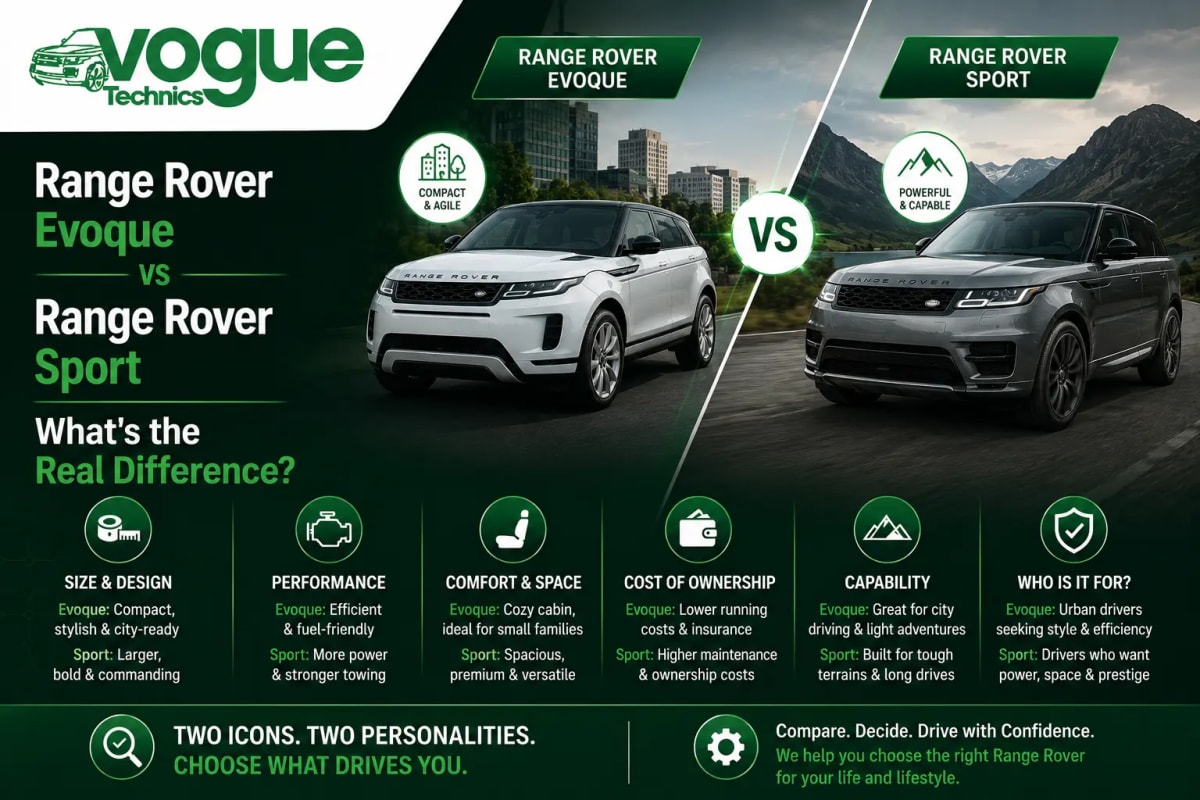
On paper, both are luxury SUVs with the Land Rover badge, all-wheel drive and a posh cabin. In reality, they sit in different segments and chase different buyers. The Evoque is the compact, fashion-forward member of the Range Rover family, sitting below the Velar. The Sport is a midsize performance flagship that sits just under the full-fat Range Rover.
Here's the short version before we get into detail: the Range Rover Evoque is smaller, cheaper to buy, easier to park and lighter on fuel. The Range Rover Sport is bigger, faster, far more capable when towing or carrying, and significantly more expensive to buy and run. Neither is "better" in a vacuum, only better for a particular person.
Is the Range Rover Sport bigger than the Evoque?
Yes, and not by a small margin. This is the single biggest practical difference between the two, and it touches everything from boot space to running costs.
Evoque vs Sport dimensions, boot space and rear legroom compared
The Evoque is a genuinely compact SUV at around 4,370mm long, which is what makes it so easy to thread through tight town streets and squeeze into multi-storey bays. The Sport is a far larger machine that prioritises presence, passenger room and load space over nip-and-tuck manoeuvrability.
The numbers below give you the realistic picture for current models:
Specification | Range Rover Evoque | Range Rover Sport |
| Length | ~4,370 mm | ~4,946 mm |
| Boot space (seats up) | ~575–591 litres | ~780–835 litres |
| Boot space (seats down) | ~1,383–1,445 litres | ~1,860 litres |
| Seating | 5 | 5 (some configs offer extra) |
| Best suited to | City, small families, style | Long trips, towing, big families |
A few things stand out from those figures. The Sport's boot is in a different league for luggage capacity, which is why it suits family holidays, dogs and bulky gear. The Evoque, meanwhile, still offers a usable boot space for a compact SUV, and folding the rear seats opens up plenty for flat-pack furniture or a pushchair. Rear legroom in the Evoque is acceptable for two adults but tighter than the Sport, where rear passengers genuinely stretch out.
The honest takeaway: if you regularly carry four adults and their bags, the Sport's extra cargo space earns its keep. If it's mostly you, a partner and the occasional back-seat passenger, the Evoque's footprint is the smarter daily companion.
Which Range Rover feels more luxurious inside?
Both cabins feel special, but in different ways. The Evoque punches above its price because it shares premium materials, leather upholstery and much of its design language with cars costing far more. You get the Pivi Pro touchscreen infotainment, Apple CarPlay and Android Auto, climate control and a genuinely upmarket feel even on lower trims.
The Sport goes further. It feels wider, airier and more commanding, with a higher-set driving position, more sophisticated driver assistance systems, the upgraded Meridian sound system on higher specs, and a sense of occasion the Evoque can't quite match. If "luxury interior" is your priority above all else, the Sport is the more convincing limousine.
Evoque or Sport — which suits your lifestyle?
This is where the decision usually becomes clear, because it stops being about specs and starts being about you.
Best Range Rover for city driving and smaller families
If your week is mostly city driving, school runs, supermarket car parks and the odd weekend away, the Evoque is the sensible buy. Its compact dimensions make maneuverability effortless, parking sensors and a reversing camera take the stress out of tight spaces, and its smaller engines are kinder on fuel. For a couple, a solo driver or a family with one or two young kids, it rarely feels like too little car.
Best Range Rover for motorway miles, towing and bigger families
If you cover serious motorway miles, tow a caravan or trailer, or routinely carry a full house of people and luggage, the Sport is built for it. Its towing capacity, ride comfort at speed and sheer cabin space make long journeys relaxing in a way the Evoque can't replicate. Business users who live on the motorway, and families heading off on adventure travel, are exactly who the Sport was designed for.
Performance, Engines and How They Actually Drive
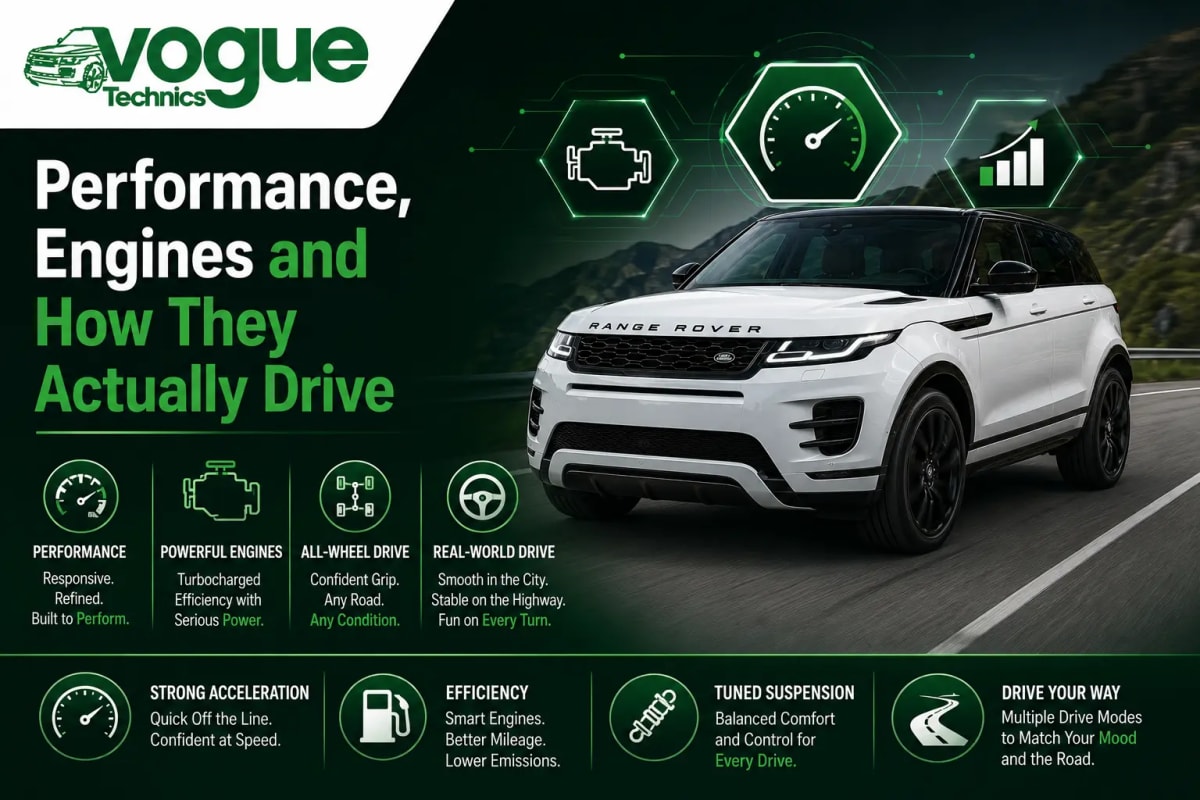
This is where our perspective shifts from "what the brochure says" to "what we see on the ramp." The engine you choose matters more than almost any other decision, because it shapes both how the car drives and how much it costs to keep alive.
Range Rover Evoque engine options explained
The current Evoque keeps things relatively simple. You'll find turbocharged four-cylinder petrol and diesel Ingenium engines, most with mild hybrid assistance, plus a plug-in hybrid option for buyers chasing lower running costs and company-car benefits. Power outputs are modest next to the Sport, but they're well matched to a lighter, smaller car, and the all-wheel drive system with Terrain Response still delivers genuine off-road capability when you need it.
Range Rover Sport engine options explained
The Sport's line-up is far broader and far punchier. Depending on year and trim, you'll see six-cylinder mild hybrid petrol and diesel units (the P360 and P400), a potent plug-in hybrid (the P550e), and range-topping V8 petrol versions producing supercar-shaming horsepower and torque. The Sport is genuinely quick, with the muscle to tow heavy loads and the air suspension to keep it composed while doing it.
Ingenium, V6 and V8 — which Range Rover engines are most reliable?
Here's the part you won't get from a dealer. Land Rover's Ingenium engine family, used across the Evoque, Discovery Sport, Velar, Sport and beyond, has a known weak spot, and we deal with the consequences regularly.
The 2.0-litre Ingenium diesel in particular is notorious for timing chain stretch and failure. The root cause is usually oil dilution from incomplete DPF regenerations combined with the design of the chains and guides themselves. The first warning is often a rattle on cold start, sometimes alongside a "Restricted Performance" message. Left unchecked, a stretched chain can jump time or snap, the pistons meet the valves, and what started as a service item becomes a destroyed engine.
There's a secondary failure mode worth knowing too: as the plastic chain guides wear, debris can block the oil pump pickup, starving the bottom end and turbo of lubrication. That's how a neglected chain turns into spun bearings and a turbo failure at the same time.
The broad picture across the range:
- Early 2.0 Ingenium diesels carry the highest timing-chain and oil-dilution risk, especially with patchy service history.
- Later revisions and the six-cylinder petrol units (P360, P400) addressed many of the early issues and are generally more robust when serviced properly.
- The V8 petrol Sports are strong engines, but they're thirsty and expensive to maintain, so factor that into ownership cost.
The thread running through all of it: reliability on these engines is overwhelmingly a function of servicing. Frequent oil changes, watching for the cold-start rattle, and acting early on warnings are the difference between a long life and a five-figure bill. If you'd like the deeper breakdown, our workshop has written separately on common Range Rover Evoque engine problems and Ingenium timing chain failure.
Which Range Rover is better to drive day to day?
The Evoque feels light, nimble and easy, ideal for everyday errands and tight roads. The Sport feels planted, powerful and effortless at speed, with adaptive suspension soaking up bumps and a commanding view of the road. For pure driving pleasure on a long route, the Sport wins. For low-stress daily usability, the Evoque often makes more sense.
Reliability, Common Faults and the True Cost of Ownership
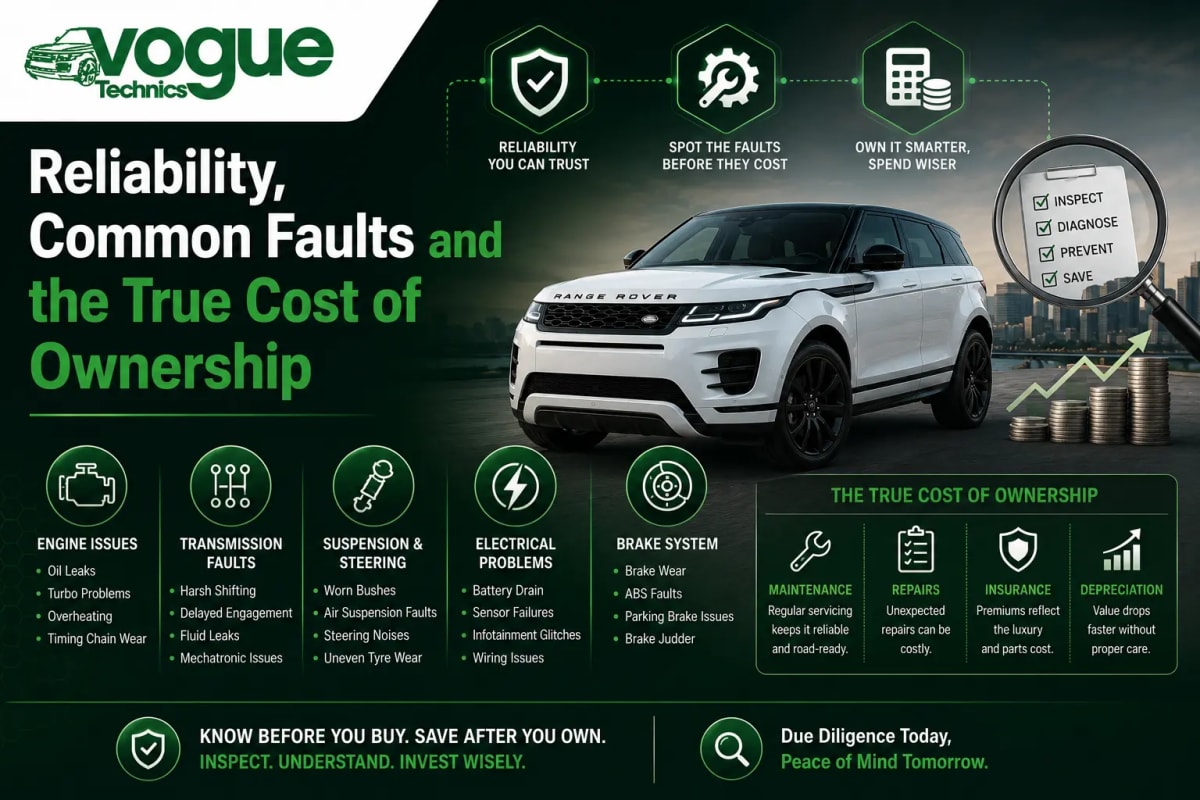
This is the section the dealership pages and magazine reviews quietly skip, and it's the one that decides whether you enjoy your Range Rover or resent it. Buying either car is the cheap part. Keeping it healthy is where the real money lives.
Common Range Rover Evoque problems (and which years to avoid)
The Evoque's headline issues cluster around the 2.0 Ingenium engine: timing chain stretch, oil pump and oil-starvation faults, turbo failures on diesels, and assorted gasket and sensor niggles on early units. Early diesel examples (roughly the 2013–2016 era and very early Ingenium cars) carry the most reliability baggage, particularly without a watertight service record.
If you're shopping used, the rule is simple: a full service history with regular oil changes is non-negotiable. A cheap Evoque with gaps in its paperwork isn't a bargain, it's a gamble on a chain you can't see.
Common Range Rover Sport problems by model year
The Sport shares the Ingenium lineage on its six-cylinder cars, so the same chain and oil-system vigilance applies. Beyond the engine, the Sport's complexity adds its own watch-list: air suspension components, electronics and infotainment gremlins, and the higher consumable costs that come with bigger brakes, bigger tyres and more powerful engines. None of it is a dealbreaker, but it all costs more than the equivalent Evoque part.
Timing chains, oil pumps and the Ingenium issues owners should know about
Whichever model you choose, if it has a 2.0 Ingenium unit, treat the timing chain as a known quantity, not a surprise. Listen for that cold-start rattle. Don't ignore oil-pressure warnings, even briefly. Keep oil changes frequent and use the correct specification. Catching a stretching chain early can mean a planned repair; ignoring it can mean a full rebuild. We've seen chains fail as early as 22,000 miles on neglected cars, and survive past 70,000 on well-serviced ones, which tells you everything about how much maintenance matters here.
Evoque vs Sport — maintenance and repair costs compared
As a rule, the Evoque is the cheaper car to live with. Smaller engines, smaller tyres, less complex suspension and lower fuel economy penalties all add up. The Sport asks more across the board: more fuel, pricier consumables, and costlier repairs when something major goes wrong.
A realistic running-cost comparison looks like this:
- Servicing: generally lower on the Evoque; higher on the Sport, especially V8 and air-suspension cars.
- Fuel: the Evoque (and especially the PHEV) is noticeably more economical; the Sport's bigger engines drink more.
- Tyres and brakes: cheaper and longer-lasting on the lighter Evoque.
- Major repairs: the dreaded timing-chain or engine job costs broadly similar in labour terms on the four-cylinder cars, but six-cylinder and V8 work runs higher.
- Depreciation: both lose money, but a well-bought used example softens the blow considerably.
Is the Range Rover Sport worth the extra money to run?
If you genuinely need its space, towing muscle and motorway composure, yes, the Sport earns its higher running costs by doing jobs the Evoque simply can't. If you're buying it for the badge and the image but your real-world needs are modest, you'll likely find the Evoque delivers most of the luxury for meaningfully less money, both at purchase and at every service thereafter.
Which Range Rover Should You Buy — and Who to Trust With It
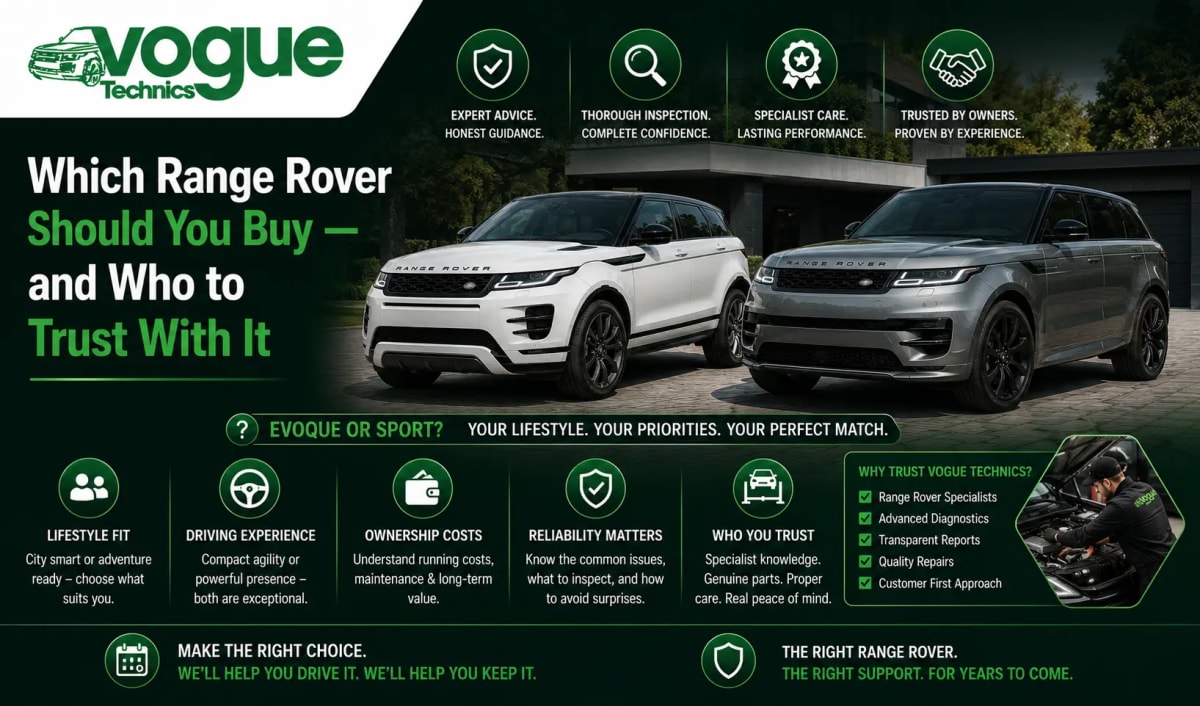
After all the specs and cautionary tales, the decision usually comes down to honesty about how you'll actually use the car, and how you'll look after it.
Final verdict: Evoque or Sport?
Choose the Range Rover Evoque if you want a stylish, manageable, more affordable luxury SUV for city life, smaller families and everyday driving. It gives you the Range Rover look and feel without the size or the heavier running costs.
Choose the Range Rover Sport if you need genuine space, serious towing ability, V6 or V8 performance and a commanding motorway cruiser, and you've budgeted for the higher fuel and maintenance bills that come with it.
Both are excellent. The wrong choice is only ever the one that doesn't match your real life.
Best used Range Rover Evoque and Sport years to buy
On the used market, the guidance is consistent for both models: prioritise service history over age or mileage. Later cars with revised engines and a documented oil-change record are the safer bet than an early, high-mileage example with a thin paper trail, however tempting the price. Whatever you're considering, a pre-purchase inspection that checks the timing chain, oil system and air suspension can save you thousands.
Keep your Evoque or Sport running — Range Rover engine specialists in Grays, Essex
Here's the part that genuinely protects your investment, whichever model you pick. These are sophisticated cars with a known engine weak spot, and they reward owners who catch problems early and trust the right people with the work.
At Vogue Technics, based in Grays, Essex, Range Rover engines are our specialism, not a sideline. We diagnose the cold-start rattle before it becomes a snapped chain, supply and fit quality reconditioned engines, and give straight answers about what a car needs rather than what's profitable to sell. Whether you already own an Evoque or Sport, or you're about to buy one and want it checked first, we can help you do it with confidence.
Book a diagnostic, inspection or engine rebuild with Vogue Technics
If your Evoque or Sport has a warning light, a worrying noise, or you simply want a pre-purchase inspection before you sign anything, get in touch with our Grays workshop today. A short conversation now is a great deal cheaper than a rebuild later, and it's exactly the kind of advice we're here to give.
Frequently Asked Questions
What is the difference between the Range Rover Evoque and Range Rover Sport?
The Evoque is a compact, more affordable luxury SUV aimed at city driving and smaller families. The Sport is a larger, more powerful midsize SUV built for towing, long journeys and bigger families, with higher purchase and running costs to match.
Is the Range Rover Sport bigger than the Evoque?
Yes, considerably. The Sport is roughly half a metre longer, with a much larger boot (around 780–835 litres versus the Evoque's 575–591) and more rear passenger room.
Which Range Rover is more reliable?
Both share Land Rover's Ingenium engines, so reliability depends heavily on servicing. The Evoque is generally cheaper to maintain, but early 2.0 diesel units in either model are prone to timing chain issues. Later, well-serviced cars are the safer choice.
Which Range Rover has better fuel economy?
The Evoque, especially the plug-in hybrid, is noticeably more economical than the Sport, whose larger six-cylinder and V8 engines consume more fuel.
Is the Range Rover Sport worth the extra money?
If you need its space, towing capacity and motorway performance, yes. If your needs are modest, the Evoque offers most of the luxury for less, both upfront and in running costs.
What are the most common Range Rover Evoque engine problems?
Timing chain stretch (often signalled by a cold-start rattle), oil pump and oil-starvation faults, turbo failures on diesels, and early gasket or sensor issues. Frequent oil changes and early intervention are the best defence.
Which used Range Rover Evoque or Sport years should I buy?
Favour later cars with revised engines and, above all, a complete service history with regular oil changes. A pre-purchase inspection of the timing chain, oil system and air suspension is strongly recommended before buying either model.
A quick, honest note on a couple of the figures: exact boot capacities and engine outputs vary by model year, trim and how the manufacturer measures them, so treat the numbers here as accurate guidance for current cars rather than a fixed spec for one particular example. For the precise figures on a specific car you're considering, the V5 and build sheet are the final word, and we're happy to verify anything as part of an inspection.