

Land Rover Td5 Engine Problems: Common Faults, Symptoms & Expert Solutions
Land Rover Td5 engines are known for a few recurring issues, injector loom oil contamination, cylinder head and head gasket failures, and early oil pump bolt faults. This guide breaks down the causes, symptoms, and diagnostic steps for each problem, along with prevention tips and buying advice. It also explains when a simple repair is enough versus when a full rebuild is the smarter option. Voguetechnics Engine Rebuild in Grays, Essex offers expert diagnosis and rebuild services for Td5-powered Defenders and Discovery 2s.
If your Land Rover Defender or Discovery 2 has started cutting out at idle, struggling to start on cold mornings, or losing power on the motorway, you're not imagining it, and you're certainly not alone. The Td5 engine has a loyal following among Land Rover owners, but it also has a well-documented list of weak points that catch out even experienced mechanics who haven't worked on one before.
This guide walks through exactly what goes wrong with the Td5, why it happens, how to spot it early, and what your realistic options are, from a simple part swap to a full engine rebuild. Whether you're troubleshooting a fault right now or trying to decide whether a Td5-powered vehicle is worth buying, you'll find the practical detail here that most generic "top 5 problems" articles skip over.
What Are the Most Common Land Rover Td5 Engine Problems?

The Td5 was Land Rover's last in-house diesel engine, fitted to the Defender and Discovery Series II between 1998 and 2006. It's a 2.5-litre, five-cylinder turbodiesel with electronic engine management, a big step up in sophistication from the mechanically simpler 300Tdi that came before it. That electronic control is exactly why Td5 faults often look more complicated than they actually are.
Three problems come up again and again in workshops and owners' forums alike:
- Injector wiring loom and ECU oil contamination, the single most common electrical-mechanical fault on the engine
- Cylinder head and head gasket failures, often tied to the early plastic head dowels
- Oil pump bolt failure, a well-known critical fault on early engines
Let's break each one down properly.
TD5 Injector Wiring Loom and Oil Contamination Issues
This is the fault that catches most owners off guard, because the symptoms look electrical even though the root cause is mechanical.
Diesel injectors on the Td5 sit under the rocker cover, and each one is connected via a wiring harness that runs through a rubber grommet. Over time, engine oil can seep past worn seals and travel along this injector loom. From there, it migrates toward the ECU red plug, the connector where the engine wiring meets the ECU itself.
Once oil reaches the ECU connector, you'll typically see:
- Rough running or a persistent misfire
- Poor or hard starting, especially when the engine is cold
- Intermittent cutting out, sometimes with no warning
- Fault codes that don't clearly point to one component
The fix usually involves replacing the injector loom, cleaning or replacing the ECU connector, and addressing whatever seal allowed the oil to escape in the first place. Patching just the symptom, say, cleaning the plug without fixing the seal, tends to bring the fault straight back within a few months.
TD5 Cylinder Head and Head Gasket Failures
Head gasket failure on a Td5 rarely comes out of nowhere. It's usually preceded by warning signs that get ignored because they seem minor at first.
Watch for:
- Coolant disappearing with no visible external leak
- White smoke from the exhaust, particularly on start-up
- The engine running hotter than normal under load
- Coolant that looks discoloured or has a faint oily sheen
A related and often confused issue is what's known as cylinder head shuffle, where the head itself moves slightly on its locating dowels under thermal cycling. This isn't the same as a blown gasket, but it produces overlapping symptoms and often accelerates gasket wear if left unaddressed.
TD5 Oil Pump Bolt Failure Explained
This is arguably the most serious fault associated with early Td5 engines, and it's one every prospective buyer should ask about directly.
The oil pump is secured by a bolt that, on early production engines, was prone to working loose over time. If it fails completely, oil pressure can drop suddenly and catastrophically, and a Td5 running without adequate oil pressure can suffer serious internal damage within seconds, not minutes.
The good news is that this is a well-known, inspectable fault. A specialist can check and, where necessary, upgrade the bolt as a preventative measure long before it becomes a five-figure repair bill.
Early vs Late TD5 Engines, Plastic vs Steel Head Dowels
One detail that separates a genuinely useful Td5 guide from a surface-level one is understanding how the engine changed over its production run.
Feature | Early TD5 (1998–2001) | Later TD5 (2002–2006) |
| Head locating dowels | Plastic, prone to failure | Steel, significantly more durable |
| Oil pump bolt | Known weak point | Revised design |
| Emissions standard | Pre-Euro 3 | Euro 3, with EGR introduced |
| Electronics | Earlier ECU mapping | Updated engine management |
If you're buying a Td5-powered Defender or Discovery 2, knowing which side of this line the vehicle falls on tells you a lot about what to check first.
How Do You Know If Your TD5 Engine Has a Fault? (Symptoms & Diagnosis)

Spotting a Td5 fault early is almost always cheaper than waiting for it to get worse. The engine tends to give warning signs well before something fails completely, the trick is knowing which symptom points to which system.
Why Is My TD5 Cutting Out or Hard to Start?
This is one of the most common complaints owners search for, and it has several possible causes rather than one single culprit:
- Oil-contaminated ECU plug, as covered above, this is often the first suspect
- Low fuel pressure, a failing fuel pump or a leaking fuel pressure regulator can starve the engine under load
- Air in the fuel system, even a small leak on the low-pressure side can cause intermittent starting issues
- Crankshaft position sensor fault, the engine may crank but fail to fire if this sensor's signal is unreliable
A useful diagnostic starting point is fuel pressure testing, a healthy Td5 typically runs at around 4 bar of low-pressure fuel supply. Readings well below that point strongly toward the fuel pump or regulator rather than an electrical fault.
Why Is My TD5 Losing Power or Misfiring?
Loss of power under load is usually a boost or fuel delivery problem rather than a fault with the engine's core mechanicals. Common causes include:
- A failing turbo wastegate or actuator
- Boost leaks at the intercooler hoses or clips
- A dirty or faulty MAF or MAP sensor feeding incorrect data to the ECU
- A blocked EGR valve restricting airflow (more common on later, EGR-equipped engines)
Misfires, meanwhile, often trace back to the injector loom fault discussed earlier, which is why it's worth ruling out first before chasing more expensive turbo or sensor repairs.
Why Is My TD5 Overheating or Losing Coolant?
Overheating deserves quick attention on any Td5, because prolonged running at high temperature is exactly what accelerates head gasket and cylinder head problems.
Typical causes include:
- A failing thermostat stuck closed
- A radiator or hose leak, sometimes small enough to be easy to miss
- Early-stage head gasket failure allowing coolant into the combustion chamber
- A failing water pump reducing coolant circulation
If you're topping up coolant regularly with no visible puddle underneath the vehicle, that's a strong hint the loss is happening internally, and it's worth having checked before it turns into a head gasket replacement.
How to Diagnose a TD5 Engine Problem (Fault Codes & Testing)
A methodical approach saves both time and money. Rather than replacing parts based on guesswork, a proper diagnosis typically follows this sequence:
- Retrieve fault codes using a diagnostic scanner compatible with the Td5's electronic management system
- Inspect the ECU red plug and injector loom for visible oil contamination
- Test fuel pressure at the rail to rule in or out fuel delivery issues
- Check boost pressure and inspect intercooler hoses for leaks or splits
- Carry out a compression test if internal engine wear is suspected
This symptom-to-cause approach is far more reliable than treating each fault code as an isolated problem, since several different faults on the Td5 can trigger overlapping codes.
Is the Land Rover Td5 Engine Reliable? Buying & Ownership Guide

It's easy to read a list of faults like the ones above and assume the Td5 is a troublesome engine. In practice, that's not a fair conclusion. Like most turbodiesels of its era, the Td5 is generally robust when it's been maintained properly, the issues above are well-documented precisely because they're well-known and, in most cases, preventable.
TD5 Reliability by Mileage and Service History
Service history matters more with the Td5 than with many simpler diesels, because several of its known faults are directly linked to maintenance intervals rather than random component failure.
A Td5 with a genuine, documented service history, particularly one showing regular oil changes and any preventative work on the oil pump bolt or injector seals, can comfortably cover well over 150,000–200,000 miles. A vehicle with a patchy or unknown history is a much bigger gamble, regardless of how low the mileage on the clock appears.
How to Prevent Common TD5 Engine Problems
Prevention is considerably cheaper than repair on this engine. A few habits make a real difference:
- Stick to regular oil changes, oil breakdown accelerates several of the faults covered above, particularly around the injector seals
- Monitor the cooling system, catching a small coolant leak early avoids a much bigger head gasket bill later
- Inspect filters on schedule, fuel and air filter neglect puts unnecessary strain on the injection and turbo systems
- Have the timing chain and tensioner checked at service intervals, since wear here can affect running quality
- Use good-quality diesel, poor fuel quality is a common, avoidable contributor to injector and fuel pump wear
None of these are expensive to do proactively. All of them are expensive to ignore.
Frequently Asked Questions About TD5 Engine Problems
Is the TD5 Engine Expensive to Repair?
It depends entirely on which fault you're dealing with. An injector loom replacement is a moderate, manageable expense. A full head gasket replacement or an oil pump bolt failure that's caused internal damage sits at the more serious end of the scale. Catching problems early through regular inspection is the biggest factor in keeping repair costs down.
How Long Does a Land Rover TD5 Engine Last?
With consistent maintenance and prompt attention to the known weak points covered in this guide, a Td5 can realistically last well beyond 200,000 miles. Neglected examples, particularly those with ignored oil pump bolt concerns or overheating history, tend to fail far earlier.
What's the Difference Between TD5 Engine Problems in the Defender and Discovery 2?
The core engine faults are identical, since both vehicles share the same Td5 unit. Where they differ is installation and access, some repairs are more time-consuming on one platform than the other, which can affect labour costs slightly.
Should I Buy a Vehicle with a TD5 Engine?
Yes, provided you go in informed. Ask specifically about service history, whether the oil pump bolt has been checked or upgraded, and whether there's any sign of oil contamination in the injector loom or ECU plug. A pre-purchase inspection from a specialist familiar with the Td5 is well worth the cost.
TD5 Engine Repair, Rebuild & Replacement Services in Grays, Essex
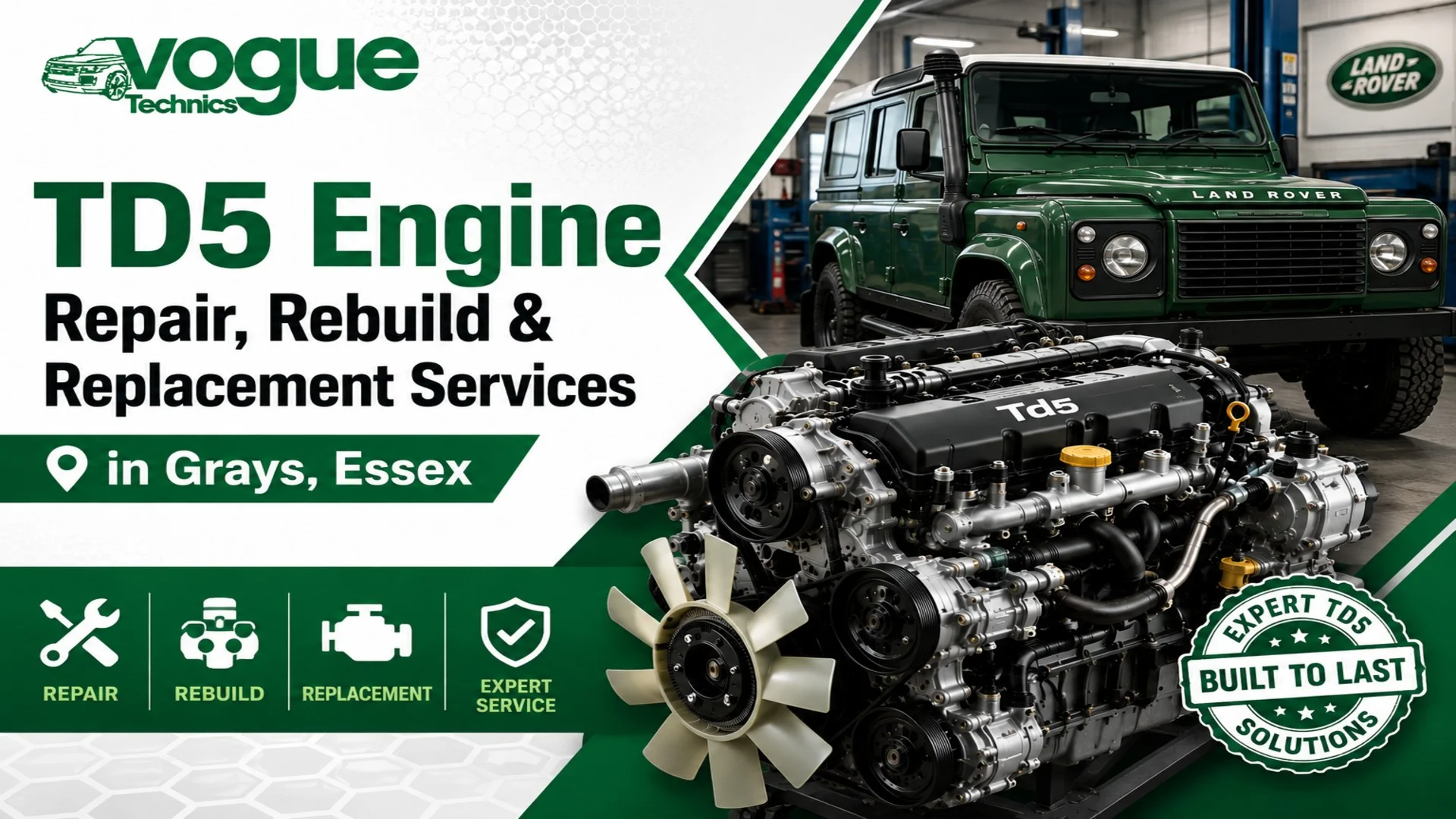
Not every Td5 fault needs a full rebuild, but knowing when a repair has reached the point of diminishing returns is important, both for your budget and for your vehicle's long-term reliability.
When Does a TD5 Need a Rebuild or Full Engine Replacement?
A rebuild or replacement typically becomes the sensible option when:
- The oil pump bolt has failed and caused internal bearing or bottom-end damage
- The cylinder head has cracked, or head gasket failure has gone unaddressed long enough to cause overheating damage
- Multiple systems are failing simultaneously, making a patchwork of individual repairs less cost-effective than a rebuild
- The engine has covered very high mileage with a poor or unknown service history
In these situations, a professionally rebuilt or reconditioned Td5 engine often works out more cost-effective, and far more reliable, than chasing repeated repairs on a tired unit.
Why Choose Voguetechnics Engine Rebuild for Your TD5
Based in Grays, Essex, Voguetechnics Engine Rebuild works specifically with Land Rover Td5 engines day in, day out, which means the faults covered in this guide aren't theoretical to us. We see them on the bench regularly, and we know which symptoms point to which root cause without needing to work through a lengthy trial-and-error process at your expense.
Our TD5 Engine Rebuild Process
Every Td5 that comes through our workshop goes through the same structured approach:
- Full diagnostic assessment to confirm the actual root cause, not just the visible symptom
- Complete strip-down and inspection of the cylinder head, oil pump, and injector system
- Replacement or upgrade of known weak points, including oil pump bolts and head dowels where applicable
- Rebuild using quality parts, matched to the engine's specific production year and known revisions
- Post-rebuild testing before the engine goes back into your vehicle, or before a reconditioned unit is supplied
Request a Free TD5 Engine Repair Quote
If your Td5 is showing any of the symptoms covered in this guide, cutting out, overheating, losing power, or anything that just doesn't feel right, it's worth getting it looked at before a manageable fault turns into a much bigger repair.
Get in touch with Voguetechnics Engine Rebuild in Grays, Essex for an honest assessment and a straightforward quote. We'll tell you exactly what's wrong, what your options are, and what it will actually cost to fix it properly.