
Land Rover Head Gasket Replacement Cost UK (2026 Price Guide)
A blown head gasket is one of the most common, and most feared, issues Land Rover owners face, but it's rarely a death sentence for the engine. This guide breaks down real UK repair costs across the full range, from the Freelander to the Range Rover Sport, along with the warning signs, proper diagnostic steps, and honest advice on when a repair makes sense versus a full engine rebuild.
There's a particular sinking feeling that comes with lifting the bonnet of a Land Rover and finding mayonnaise under the oil filler cap. If you're reading this, chances are you've spotted one of the warning signs, coolant disappearing week after week, white smoke hanging behind the exhaust on cold mornings, or a temperature gauge that climbs faster than it should on the A13.
The good news? A blown head gasket is rarely a death sentence for a Land Rover. The bad news? The cost varies enormously depending on which engine sits under your bonnet, and plenty of owners get quoted eye-watering figures at franchise dealers for work an independent specialist can do properly for far less.
This guide breaks down real-world Land Rover head gasket replacement costs across the whole range, from a Series 3 to a Range Rover Evoque, plus the symptoms, the diagnosis process, and the honest answer to the question every owner eventually asks: is it actually worth repairing?
How Much Does a Land Rover Head Gasket Replacement Cost?
In the UK, a Land Rover head gasket replacement typically costs between £850 and £2,500 at an independent specialist, depending on the model, engine, and whether the cylinder head needs skimming or further repair. At a franchise dealer, expect those figures to climb, often to £2,000–£4,000+, largely due to higher hourly labour rates.
The gasket itself is the cheap part. What you're really paying for is labour. Getting to the head gasket means stripping the top end of the engine, intake manifold, exhaust manifold, turbocharger on diesel models, timing components, camshaft on some engines, and then rebuilding it all to precise torque specifications. On some Land Rover engines that's a solid day's work. On others, it's two or three.
Here's what owners typically pay at an independent Land Rover specialist:
Model / Engine | Typical Independent Cost | Typical Dealer Cost |
| Freelander 1 (1.8 K-Series) | £850 – £1,200 | £1,800 – £2,500 |
| Freelander 2 (2.2 Diesel) | £1,100 – £1,600 | £2,200 – £3,000 |
| Defender / Discovery 300Tdi | £900 – £1,400 | Rarely dealer-serviced |
| Discovery 2 TD5 | £1,000 – £1,600 | £2,000 – £2,800 |
| Discovery 3/4 (2.7 TDV6) | £1,800 – £2,800 | £3,500 – £4,500+ |
| Range Rover (Rover V8) | £1,200 – £2,000 | Specialist territory |
| Range Rover Sport (3.0 SDV6) | £1,900 – £2,900 | £3,800 – £5,000 |
| Range Rover Evoque (2.2 / 2.0 Ingenium) | £1,200 – £1,900 | £2,500 – £3,500 |
Treat these as realistic ranges rather than fixed quotes, the honest truth is that no garage can give you an exact figure until the head is off and inspected. A warped cylinder head that needs skimming adds machine shop costs. A cracked cylinder head changes the conversation entirely.
Three things worth knowing before you ring around for quotes:
- A proper quote includes more than the gasket. Head bolts on most modern Land Rover engines are stretch bolts and must be replaced, not reused. The quote should also cover fresh coolant, engine oil and filter, and pressure testing afterwards. If a quote looks suspiciously cheap, something on that list is missing.
- Diagnosis should come before the quote, not after. Any specialist worth their salt will run a compression test or combustion gas test first. Replacing a head gasket on an engine with a cracked block is throwing money away.
- Location matters less than expertise. A general garage that's never had a TDV6 apart will take longer, and charge for the learning curve. A Land Rover specialist has done the job dozens of times and owns the correct tooling.
What Affects the Cost? Engine Type, Labour Hours and Parts
Two Land Rovers parked side by side can have wildly different head gasket bills, and the engine is almost always the reason.
Labour time is the biggest variable. A Freelander 1 transverse K-Series engine is compact and relatively quick to strip. A Discovery 3's 2.7 TDV6, by contrast, is a V6 diesel buried deep in the engine bay, the accepted wisdom among specialists is that serious top-end work often means lifting the body off the chassis or removing the engine entirely. That's why the TDV6 sits at the expensive end of every price table.
Parts quality matters more than owners realise. A genuine or OEM-quality MLS head gasket (multi-layer steel) costs more than a bargain composite item, but on an engine with an aluminium cylinder head mated to a cast iron or aluminium engine block, the MLS design handles thermal expansion far better. Fitting a cheap gasket to save £40 on a £1,500 job is false economy, we've seen the comebacks to prove it.
Then there's the condition of the head itself. Overheating is what kills most head gaskets, and the same heat that destroys the gasket often warps the head. Every head we remove gets checked with a straight edge and feeler gauges. If it's out of tolerance, it goes to the machine shop for cylinder head skimming, typically £60–£150 extra, and the valves, valve guides and valve seats get inspected while it's on the bench. Skipping this step is how a "cheap" repair fails again within six months.
Other cost factors to budget for:
- Timing components, on chain-driven engines like the Ingenium and TD5, if the timing chain and guides show wear, replacing them while everything's apart saves paying the labour twice later.
- Ancillary parts, thermostat, water pump, and radiator hoses are cheap to replace during the job and expensive to fail a month after it.
- Coolant system flush, contaminated coolant (oil in the water, or combustion deposits) must be flushed completely, or the new gasket inherits a dirty system.
Rover V8, TD5 and 300Tdi Head Gasket Replacement, Classic Engine Costs
Most cost guides online only cover modern Land Rovers. That's a glaring gap, because a huge share of head gasket work in the real world involves the classics, and they each fail in their own distinctive way.
The Rover V8 (found in older Range Rovers, Discovery 1 and 2 V8s, and countless Defenders) is a lovely engine with a well-known weakness: as the 4.0 and 4.6 versions age, cylinder liners can shift and blocks can develop porosity, producing symptoms that mimic head gasket failure. A proper Rover V8 head gasket replacement runs £1,200–£2,000, but here's the crucial part, a specialist should pressure test and inspect the block first. Replacing gaskets on a V8 with a slipped liner fixes nothing, and an honest garage will tell you that before taking your money. When it genuinely is the gaskets, the job is straightforward for anyone who knows the engine: both banks done together, composite or tin gaskets to specification, heads checked for flatness.
The TD5 in the Discovery 2 and later Defenders is actually one of the tougher engines in the family, genuine TD5 head gasket replacement is less common than owners fear, and apparent "head gasket symptoms" often trace back to a cracked injector seal washer letting oil into the harness or a failing oil cooler mixing fluids. Real TD5 gasket jobs typically land between £1,000 and £1,600, and the head should always be checked for cracking between valve seats.
The 300Tdi, the workhorse in Defenders and Discovery 1s, is famously simple, which keeps costs sensible at £900–£1,400. The Land Rover 300Tdi cylinder head is cast iron and durable, but decades of hard use mean many need skimming, and it's the perfect moment to cut new valve seats and fit a new timing belt, since half the front of the engine is already off.
Series 3 head gaskets deserve a mention too: the old 2.25 petrol and diesel engines are about as simple as engines get, and gasket replacement is one of the more affordable jobs in the Land Rover world, often under £800 at a specialist, parts availability permitting.
Is It Cheaper to Repair or Replace the Engine on an Older Land Rover?
This is the fork in the road for classic owners, and the honest answer depends on what the strip-down reveals.
If the head comes off and the bores, pistons and crankshaft look healthy, a head gasket replacement is nearly always the right call, you're restoring a fundamentally sound engine for a fraction of replacement cost. But if the engine has been run hot repeatedly, has low compression across multiple cylinders, or (on the Rover V8) shows liner or block problems, pouring £1,500 into a gasket job just delays the inevitable.
As a rough rule of thumb from the workshop floor:
- Head gasket replacement: £850 – £2,500
- Full engine rebuild: £3,500 – £7,000+ depending on engine and parts needed
- Replacement engine (reconditioned or good used unit): £2,500 – £6,000 fitted
A rebuild costs more upfront but resets the clock on everything, bearings, rings, valves, the lot. For a cherished Defender or a classic Range Rover you plan to keep for a decade, that maths often works out. For a high-mileage daily hack, a good used engine can be the pragmatic middle ground. Any specialist quoting you for a head gasket on a tired engine without discussing these options isn't giving you the full picture.
What Are the Signs of a Blown Head Gasket on a Land Rover?
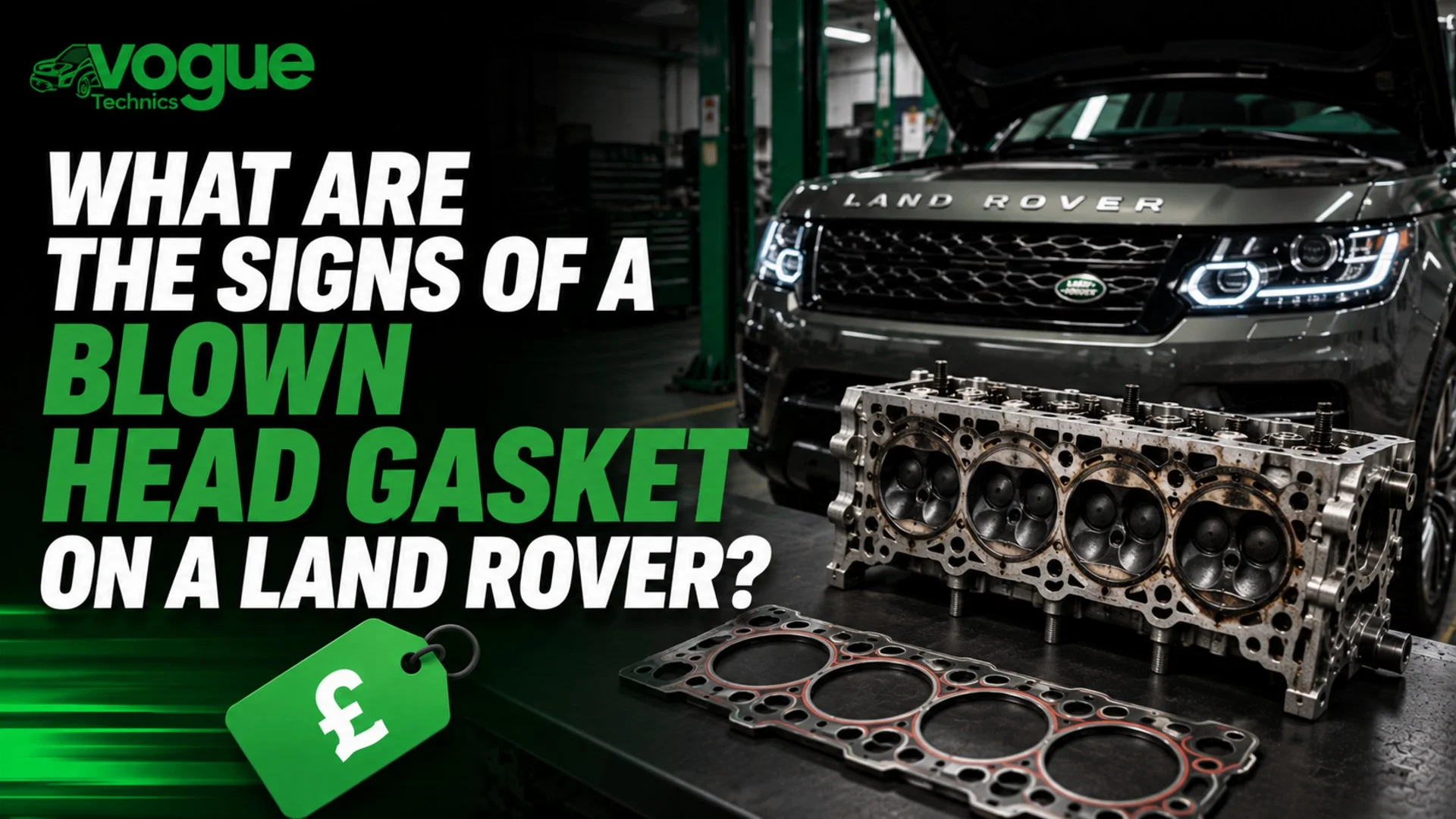
The head gasket seals three things simultaneously: combustion pressure inside each cylinder, coolant passages, and oil galleries. When it fails, those systems start leaking into each other, and the symptoms depend on which breach happens first.
Watch for these warning signs:
- White exhaust smoke that smells sweet and doesn't clear once the engine warms up, that's coolant burning in the combustion chamber. (Don't confuse it with normal cold-morning steam, which disappears within a few minutes.)
- Coolant loss with no visible leak. If you're topping up the expansion tank every week and there's no puddle on the driveway, the coolant is going somewhere, often out of the exhaust.
- Milky, mayonnaise-like residue under the oil filler cap or on the dipstick, the classic sign of coolant contaminating the engine oil.
- Bubbles in the coolant reservoir with the engine running, combustion gases forcing their way into the cooling system and pressurising it.
- Engine overheating, especially under load, up a motorway incline or towing, as the cooling system loses its ability to hold pressure.
- Rough idle or misfire on cold starts that smooths out as the engine warms, caused by coolant pooling in a cylinder overnight.
One symptom alone doesn't confirm a blown head gasket. A failing oil cooler on a TD5 produces oil-in-coolant contamination that looks identical to gasket failure. A leaking radiator, water pump or thermostat housing explains coolant loss without any gasket involvement. This is exactly why diagnosis matters, and why guessing gets expensive.
One more thing, from experience: don't keep driving it. A Land Rover with a suspected blown head gasket might limp along for weeks, but every heat cycle risks warping the aluminium head further or washing the bearings with contaminated oil. What starts as a £1,200 gasket job can become a £5,000 engine rebuild in a fortnight of school runs.
How Is a Blown Head Gasket Diagnosed? (Compression, Leak-Down and Pressure Tests)
A proper diagnosis follows a sequence, and each test tells us something different. Here's how we approach it in the workshop:
1. Combustion gas test (block test). The quickest first check. A block tester draws air from the top of the expansion tank through a blue fluid that changes colour if exhaust gases are present in the coolant. Positive result? Combustion is leaking into the cooling system, strong evidence of a head gasket breach or cracked head.
2. Cooling system pressure test. We pressurise the cooling system with the engine off and watch the gauge. A system that won't hold pressure has a leak; if no external leak is visible at the radiator, hoses, water pump or expansion tank, the leak is internal.
3. Compression test. A gauge in each cylinder measures cranking pressure. One or two cylinders reading significantly lower than the rest, particularly two adjacent cylinders, points to a gasket failure between them. Even readings across the board with other symptoms present shifts suspicion elsewhere.
4. Leak-down test. The most precise tool in the box. Compressed air is fed into each cylinder at top dead centre, and we listen for where it escapes: bubbles in the coolant mean a head gasket or crack, air hissing from the exhaust means a valve, air in the crankcase means rings or bores. This test is what separates "probably the head gasket" from "definitely the head gasket."
5. Diagnostic scan. Modern Land Rovers with OBD diagnostics log misfire counts and coolant temperature behaviour through the ECU. Fault codes don't diagnose a gasket by themselves, but they corroborate the physical evidence, a persistent misfire on cylinder 3 alongside a failed block test tells a very clear story.
Expect a thorough diagnosis to cost £60–£120 at an independent specialist, many, ourselves included, deduct it from the repair bill if you go ahead. It's the cheapest insurance in this whole process.
Is a Land Rover Head Gasket Worth Repairing?
Scroll through any Land Rover owners' forum and you'll find this debate raging: repair it, replace the engine, or cut your losses and sell. Having seen hundreds of these decisions play out, here's the honest framework.
Repair makes sense when:
- The vehicle is otherwise sound, good chassis, gearbox, and history
- The engine hasn't been severely or repeatedly overheated
- Diagnosis confirms the gasket (not a cracked block or slipped liner)
- The vehicle's value comfortably exceeds the repair cost, which, for most Defenders, Discoverys and Range Rovers, it does
Think harder when:
- The engine has been driven hot for weeks and compression is down across multiple cylinders
- It's a Rover V8 showing liner symptoms rather than clean gasket failure
- Rust or other major work means the repair bill is one of several big bills coming
On longevity: a properly done head gasket replacement lasts the life of the engine. The gasket itself isn't a wear item on most of these engines, it fails because something caused it to fail, usually overheating from a coolant leak, failed thermostat, or airlocked system. Fix the root cause along with the gasket and there's no reason to expect a repeat. Skip the root cause and you'll be back within the year.
Will a blown head gasket fail an MOT? Not directly, there's no head gasket check on the test. But its symptoms can fail you: excessive white or blue smoke is an emissions failure, and visible coolant or oil leaks can earn a fail or advisory. More to the point, driving to the MOT station on a blown gasket is how engines die.
Head Gasket Replacement vs. Engine Rebuild, Which Makes Sense?
When the head comes off, the engine's internals are laid bare, and that inspection drives the decision.
Factor | Head Gasket Replacement | Engine Rebuild | Replacement Engine |
| Typical cost | £850 – £2,500 | £3,500 – £7,000+ | £2,500 – £6,000 fitted |
| Best when | Bottom end is healthy | Wear throughout, keeper vehicle | Engine badly damaged, budget-led |
| Downtime | 2 – 5 days | 2 – 4 weeks | 1 – 2 weeks |
| What you get | Sound engine restored | Effectively a new engine | Unknown history (used) or rebuilt unit |
The middle-ground question owners rarely ask, but should, is what else to replace while the engine is apart. Labour is the expensive part of this job, and access you're already paying for is access you shouldn't waste:
- Water pump and thermostat, both are frequent root causes of the overheating that killed the gasket in the first place. Replacing them adds modest parts cost and near-zero extra labour.
- Timing belt (300Tdi, TDV6), the front of the engine is already stripped; a belt kit now saves a full labour charge later.
- Coolant hoses and expansion tank, old hoses that have been overheated go brittle. A £15 hose failing on the motorway can undo a £1,500 repair.
This "while you're in there" thinking is the difference between a repair that lasts and one that boomerangs, and it's a conversation any good specialist will have with you before quoting, not after.
Land Rover Head Gasket Replacement in Grays, Essex, Get a Fixed Quote

If your Land Rover is losing coolant, running hot, or showing any of the symptoms above, the worst thing you can do is wait, and the second worst is hand it to a garage that's guessing.
At Vogue Technics Engine Rebuild in Grays, Essex, Land Rover engines are what we do all day. From Defender and Discovery 300Tdi and TD5 units through Rover V8s to the modern Ingenium, TDV6 and SDV6 engines, we've had them all on the bench, stripped, skimmed, pressure tested, and rebuilt to factory torque specs with genuine and OEM-quality parts, including MLS gasket kits where the engine calls for them.
Here's what you get with us:
- Proper diagnosis first, compression, leak-down and combustion gas testing before any quote, so you're paying to fix the actual fault
- Fixed, transparent quotes, the price we agree is the price you pay, with any additional findings discussed and approved before work continues
- Genuine and OEM Land Rover parts, no bargain-bin gaskets, no reused stretch bolts
- Warranty on our work, because a repair done right should be guaranteed
- Honest advice, if a rebuild or replacement engine makes better sense than a gasket, we'll tell you straight and price both options
We're easy to reach from across Essex and East London, Thurrock, Basildon, Romford, Brentwood, Dartford and beyond, and we can arrange recovery if your Land Rover isn't safe to drive.
Ready for a straight answer and a fair price? Call Vogue Technics Engine Rebuild or request your free, no-obligation quote through voguetechnicsenginerebuild.co.uk today. Tell us your model, engine and symptoms, and we'll tell you exactly where you stand, usually the same day.
Frequently Asked Questions
How long does a Land Rover head gasket replacement take?
Typically 1–3 days depending on the engine. A 300Tdi or Freelander is usually a one-to-two-day job; a Discovery 3 TDV6 can take longer due to access. Add a day if the head needs to visit the machine shop for skimming.
Can I drive my Land Rover with a blown head gasket?
You can, briefly, but you shouldn't. Continued driving risks warping the cylinder head, contaminating the oil, and destroying bearings, turning a four-figure repair into a five-figure one. If you must move it, keep the journey short, watch the temperature gauge, and stop the moment it climbs.
What causes Land Rover head gaskets to fail?
Overheating is the number one culprit, usually triggered by a coolant leak, failed water pump, stuck thermostat, or airlocked cooling system. Age and thermal cycling play a part on high-mileage engines, and certain designs (the Freelander 1's K-Series, notably) are simply more gasket-prone than others.
Can a head gasket fail without the engine overheating?
Yes. A gasket can breach between a cylinder and an oil gallery, or leak combustion gases slowly into the coolant, long before the temperature gauge moves. Unexplained coolant loss and cold-start misfires are the tell-tales to watch even when temperatures look normal.
Should the water pump be replaced at the same time as the head gasket?
In most cases, yes. The pump is frequently implicated in the overheating that caused the failure, and with the engine already stripped, the additional cost is small. The same logic applies to the thermostat and, on belt-driven engines, the timing belt.
How long will the repair last?
Done properly, head checked and skimmed if needed, quality MLS or OEM gasket, new stretch bolts, root cause fixed, it should last the remaining life of the engine. The repairs that fail early are almost always the ones where a corner was cut.
Is head gasket sealant a real fix?
As a get-you-home bodge on a car worth scrap money, perhaps. On a Land Rover you intend to keep, no, sealants can clog radiators, heater matrices and narrow coolant passages, adding to the eventual repair bill. Every specialist has flushed the aftermath of a sealant bottle out of a cooling system.