
Land Rover Freelander 2 Engine Problems: Common Faults, Symptoms, Causes & Repair Options in Essex
Is your Land Rover Freelander 2 in limp mode, smoking or losing power? This guide explains the most common engine problems on the 2.2 TD4/SD4 diesel and the 3.2 i6 and 2.0 Si4 petrols, including DPF, EGR, turbo, injector and timing belt faults. It covers symptoms, likely causes, how a proper diagnosis works, and when to repair, rebuild or replace the engine. Written by the Voguetechnics team in Grays, Essex, it also includes indicative UK costs and a buyer's checklist.
Your Freelander 2 has dropped into limp mode on the motorway. Or it's blowing grey smoke, drinking coolant, or refusing to start on a cold morning. Whatever you're seeing, you want to know two things: what's wrong, and what it will cost to fix.
This guide covers the most common Land Rover Freelander 2 engine problems on the 2.2 TD4 and SD4 diesels and the 3.2 i6 and 2.0 Si4 petrols. We explain the symptoms, the likely causes, how a proper diagnosis works, and when repairing stops making sense. It's written by the team at Voguetechnics Engine Rebuild in Grays, Essex. If you'd rather skip straight to an answer, send us your registration for a free engine quote.
What Are the Most Common Land Rover Freelander 2 Engine Problems?
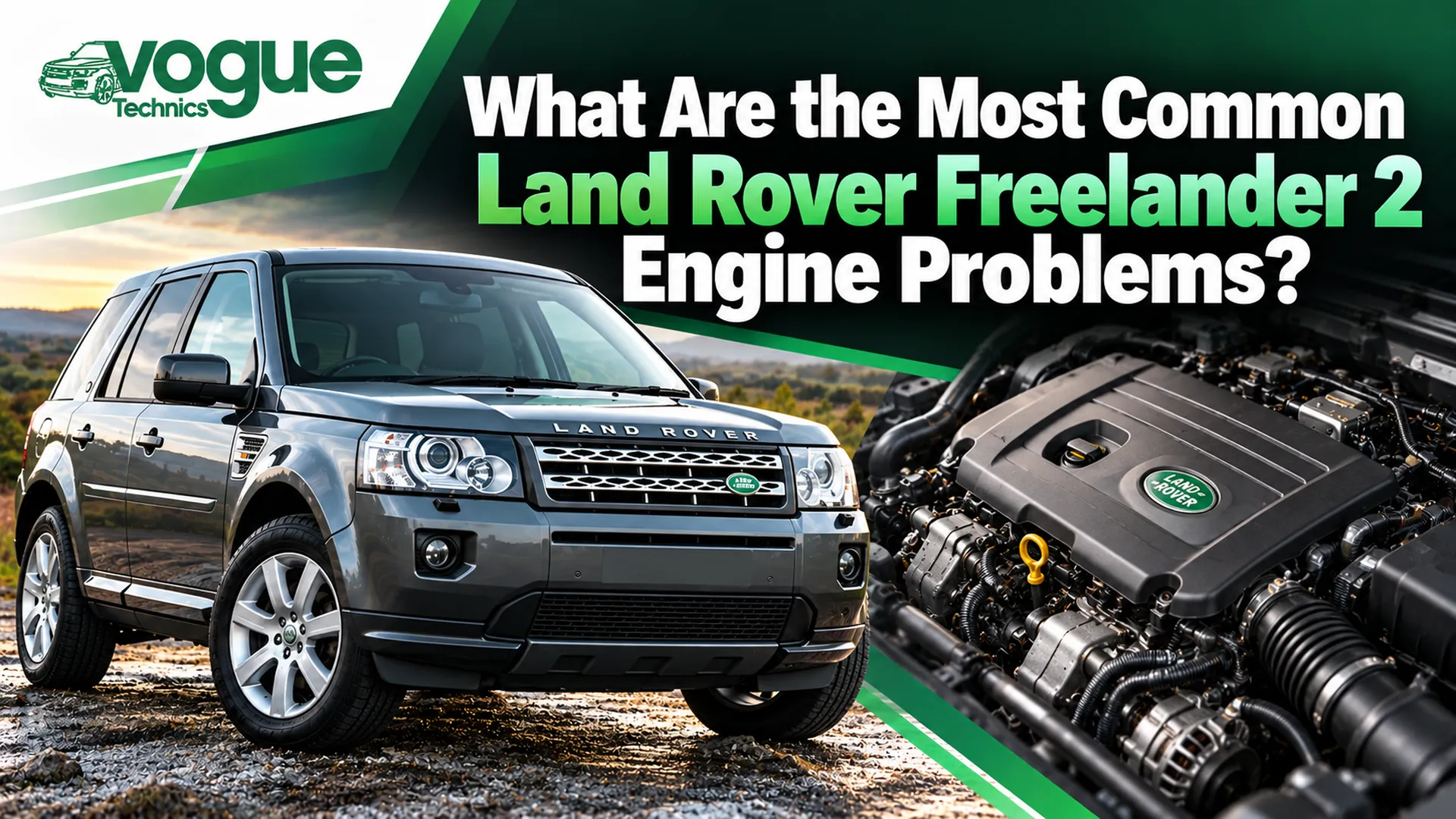
The Freelander 2 (L359) has a good reputation for comfort and capability. The engines are mostly sound, but they punish neglect. Short journeys, stretched service intervals and ignored warning lights cause most of the failures we see.
Most of the Freelander 2 engines on UK roads are the 2.2 diesel, sold as the TD4 and later the SD4. It's a Ford/PSA-developed common-rail turbo diesel, and most diesel faults trace back to the fuel, air, boost and emissions systems working together. The petrols are the Volvo-sourced 3.2 i6 and, in later cars, the 2.0 Si4. They tend to give less trouble, but they have their own wear points.
Why Is My Freelander 2 Losing Power, Smoking or Going Into Limp Mode?
Limp mode is the engine management system protecting the engine. The ECU has seen something it doesn't like, such as low boost, poor fuel pressure or a blocked exhaust, so it cuts power. The warning light is a symptom. The cause sits behind it.
Here's how the common symptoms map to causes on a typical Freelander 2:
Symptom | Likely causes | First diagnostic check | Typical repair |
| Loss of power / limp mode | Blocked DPF, sticking EGR valve, turbo fault, boost leak, fuel pressure fault | Full diagnostic scan, then live data | Clean or replace EGR, regenerate or replace DPF, repair boost leak, service or replace turbo |
| Rough idle | Injector fault, dirty EGR or intake, air leak | Injector balance readings, intake inspection | Injector repair, EGR and intake clean |
| Black smoke | Over-fuelling, restricted airflow, turbo or EGR fault | Air flow and boost readings | Fix airflow or fuelling fault |
| Blue smoke | Oil burning: turbo seal leak or internal engine wear | Check for oil in the intercooler piping, then compression test | Turbo repair, or engine work if wear is internal |
| White smoke | Coolant entering the combustion chamber, or cold-start condensation | Coolant level, pressure test | Head gasket or EGR cooler repair |
| Overheating | Thermostat, water pump, radiator, coolant loss | Pressure test, thermostat operation check | Replace the failed cooling component |
| Hard starting / won't start | Battery, glow plugs, starter motor, fuel pressure, crankshaft sensor | Battery test, then scan | Replace the failed part |
The DPF and EGR chain reaction. Many guides treat the diesel particulate filter (DPF) and EGR valve as separate problems. On a Freelander 2 they usually aren't. The sequence goes like this:
- Short journeys stop the DPF reaching regeneration temperature.
- Soot builds up in the filter.
- Exhaust back pressure rises.
- The EGR system and intake manifold clog with soot and oily residue.
- Airflow drops, performance falls and the car goes into limp mode.
Replacing the DPF alone won't cure a car whose EGR and intake are choked. Fix the cause, or the fault comes back.
Turbocharger faults. The turbo on the 2.2 diesel uses variable geometry. Typical warning signs are:
- Whistling or siren-like noises under load
- Underboost or overboost faults
- Blue or grey smoke
- Sluggish acceleration, especially in the mid-range
Always rule out cheaper causes first: split intercooler hoses, loose clips, a sticking actuator or a blocked oil feed. Oil starvation destroys turbos quickly, so we check the oil feed pipe and oil condition before condemning the unit.
Fuel system and injectors. Common-rail systems run at very high pressure and are intolerant of dirty fuel. Failing injectors cause rough running, hesitation, smoke and hard starting. A weak high-pressure fuel pump can produce the same symptoms, so testing comes before replacement.
Timing belt and tensioner. The 2.2 diesel uses a timing belt, not a chain. If the belt or tensioner fails, the engine can suffer severe internal damage. Follow the manufacturer's schedule as a maximum, not a target. A car with no belt history is a risk, whatever the mileage.
Fault codes: what they mean. Codes point you towards a system, not a part. These are the ones we see most often:
- P0299: turbo underboost. Check for boost leaks, a turbo fault or a stuck actuator (diesel).
- P0401 / P0402: insufficient or excessive EGR flow (diesel).
- P0087 / P0089: low rail pressure and fuel pressure regulator performance. Points to the fuel system (diesel).
- P0101: mass airflow sensor out of range. Check the sensor and intake for leaks.
- P0300–P0304: random or cylinder-specific misfire. Applies to diesel and petrol.
- P0335 / P0340: crankshaft and camshaft sensor faults. These can cause cutting out or no-start.
A code is the start of the diagnosis. We confirm it with live data before recommending a repair.
Petrol engines. The 3.2 i6 is smooth and durable, but worry about oil leaks, coolant system condition and ignition components as it ages. The 2.0 Si4 is a turbocharged direct-injection engine, so look for boost control faults, carbon build-up and oil consumption. Neither is the main source of complaints, but neither is maintenance-free.
What we typically find in the workshop. Engines that arrive with these faults often share the same backstory: a long run of short trips, overdue oil changes, and a warning light that was ignored for months. Early diagnosis is almost always cheaper than waiting.
How Do You Diagnose Freelander 2 Engine Faults and Decide Between Repair, Rebuild or Replacement?
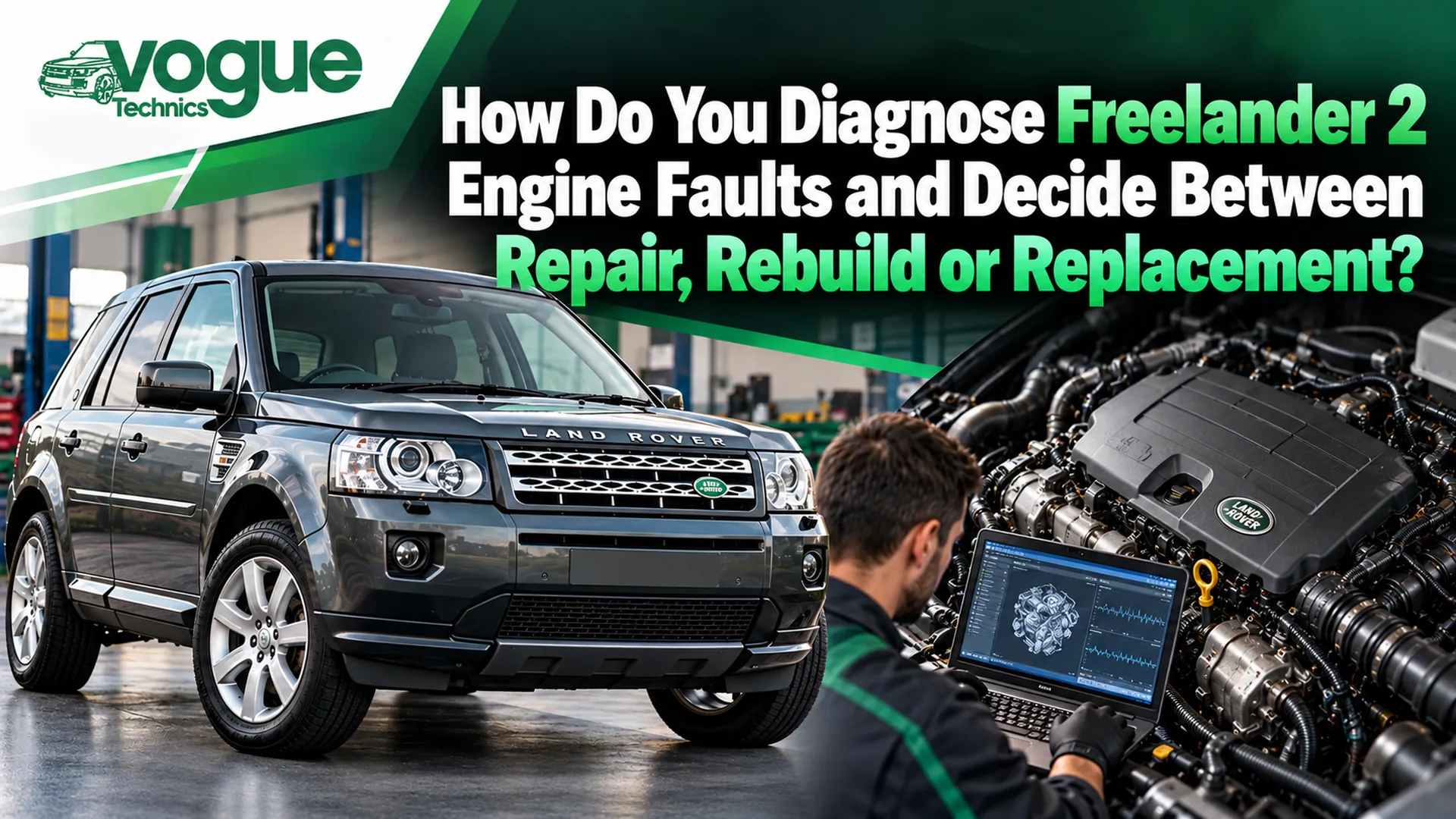
A good diagnosis follows a sequence. Guessing at parts costs money and delays the fix.
Our usual order is:
- Diagnostic scan: read stored and pending fault codes and live data.
- Visual and pressure checks: hoses, intercooler piping, coolant system, oil condition.
- Component testing: injectors, EGR, turbo actuator, sensors.
- Compression test: if internal wear or damage is suspected.
- Oil pressure test: to confirm the bottom end is healthy.
When Is a Reconditioned or Replacement Freelander 2 Engine Better Than Repairing the Old One?
Repair makes sense when the fault is external or ancillary: EGR, turbo, injectors, sensors, hoses. Replacement or rebuild comes into the conversation when the damage is internal.
Signs of internal engine damage:
- Deep knocking or rattling that changes with engine load
- Low or fluctuating oil pressure
- Metallic particles in the oil or filter
- Coolant mixing with oil (a milky look under the filler cap)
- Low or uneven compression across cylinders
- Heavy blue smoke that isn't down to the turbo
If several of these appear together, more bolt-on repairs usually won't solve it.
Here's how the main routes compare:
Option | Best when | Typical downtime | Warranty | Cost level |
| Repair | Fault is ancillary or external | Shortest | Parts and labour only | Lowest |
| Engine rebuild | Block is sound, internal parts worn or damaged | Longer | Workshop-backed | Medium |
| Reconditioned engine | Original engine is beyond economic repair | Moderate | Supplier-backed | Medium to high |
| Replacement (used or exchange) | Quick turnaround is the priority | Moderate | Varies widely | Varies |
A real-world scenario. A Freelander 2 TD4 arrives with limp mode and a rattle on start-up. A scan shows boost and EGR faults. The owner assumes the turbo has gone. A proper check finds a blocked EGR and intake, plus oil starvation to the turbo, and the rattle turns out to be a failing tensioner. Fixed early, that's a repair job. Left alone, the belt could have failed and turned it into an engine replacement.
Matching the specification matters. Freelander 2 engines vary by year, output and emissions equipment. A replacement unit must match your engine code and ancillaries, otherwise fitting problems and warning lights follow. Give us your registration and we'll confirm the exact specification before quoting.
Not sure how serious it is? Send us your registration for a free engine assessment and quote. We'll tell you plainly whether a repair, rebuild or replacement makes sense.
What Should You Know About Cost, Buying and Choosing a Freelander 2 Engine Specialist in Grays, Essex?

Who Is the Best Freelander 2 Engine Specialist Near Me, and What Does Repair or Replacement Cost?
A good specialist should do four things: diagnose before quoting, explain what they find, give written pricing, and stand behind the work with a warranty. If a garage suggests a replacement engine without a compression or oil pressure test, get a second opinion.
Typical UK cost ranges. These are indicative only. The final price depends on the vehicle's condition, the engine variant and the work needed:
Job | Indicative range |
| Ancillary repairs (hoses, sensors, small components) | £600 – £1,800 |
| EGR and intake clean or repair | £450 – £950 |
| Full engine rebuild | £4,200 – £6,500 |
| Reconditioned or replacement engine (supply and fit) | Quoted by specification |
Ask for your quote by registration, and confirm what's included: parts, labour, VAT, fluids and warranty.
Should you buy a Freelander 2 with engine problems? Sometimes, if the price reflects the risk and you know what you're taking on. Before you commit, check:
- Mileage and service history: regular oil changes matter more than a low number on the clock.
- Timing belt record: no proof of replacement means budgeting for it.
- Engine noise: knocking, rattling or a loud tensioner on a cold start.
- Smoke: note the colour on start-up and under acceleration.
- Coolant and oil condition: look for low coolant, milky oil or sludge.
- DPF health: ask about warning lights and regeneration issues.
- Diagnostic scan: pay for a full scan, not just a basic code read.
- Previous engine work: ask for invoices, not just promises.
If the car needs significant work, set the repair budget before you agree the price.
Keeping your Freelander 2 engine healthy.
- Use the correct oil specification and change it on time. Diesels that regenerate often can suffer oil dilution, so don't stretch intervals.
- Replace the timing belt, tensioner and water pump together, ahead of the maximum interval.
- Give the car regular longer runs so the DPF can regenerate.
- Act on warning lights quickly.
- Have the EGR, intake and turbo oil feed checked as part of servicing.
Why choose Voguetechnics Engine Rebuild? We're based in Grays, Essex, and work on Land Rover and Jaguar Land Rover engines, with supply-and-fit options and warranty cover. Ask us for the warranty terms on your specific engine, and we'll put them in writing.
Frequently Asked Questions
Is the Freelander 2 diesel engine reliable?
Generally yes, if it's serviced on time and driven properly. Most failures trace back to missed maintenance, short journeys or ignored warnings, not poor design.
How long does a Freelander 2 engine last?
With correct oil changes and timing belt replacement, many run well beyond 150,000 miles. Condition and history matter more than mileage alone.
Which Freelander 2 engine should I avoid?
No engine is a write-off, but avoid any car with an unknown timing belt history, poor service records or unresolved DPF and EGR faults.
Why does my Freelander 2 keep going into limp mode?
Usually a boost, EGR, DPF or fuel pressure fault. A diagnostic scan will show which system triggered it.
Why is my Freelander 2 losing coolant?
Possible causes include a leaking EGR cooler, a hose, the radiator or a failing head gasket. A pressure test finds the source.
Can I fix a Freelander 2 engine, or do I need a new one?
Ancillary faults are usually repairable. Internal damage may call for a rebuild or replacement, which a compression test will confirm.
Get Your Free Freelander 2 Engine Quote
Freelander 2 engine problems are easier and cheaper to solve the earlier you catch them. If your car is losing power, smoking, overheating or showing a warning light, don't wait for a small fault to become an engine replacement.
Enter your registration for a free engine quote, or call or email the Voguetechnics Engine Rebuild team in Grays, Essex. We'll diagnose the problem, explain your options plainly, and give you a clear price.