

Land Rover Defender Timing Chain Rattle: Symptoms, Causes & Expert Repair in Grays, Essex
A rattling noise from your Land Rover Defender's timing chain, especially on cold starts, is a common but often misunderstood issue, particularly in the 2.0 Ingenium diesel and petrol engines. This guide breaks down what causes the rattle, how to tell it apart from normal engine noise, and which warning signs mean you should stop driving immediately. It also covers the risks of ignoring the problem, from chain wear to costly engine damage if left unchecked. For Defender owners in Grays and Essex, Voguetechnics offers a proper diagnose-first approach before recommending any repair.
You turn the key on a cold morning, and there it is, a metallic rattle from somewhere behind the grille. It lasts a few seconds, then disappears as the revs settle. You tell yourself it's nothing. Then it happens again the next morning. And the one after that.
If you drive a Land Rover Defender and you're hearing this, you're not imagining it, and you're not alone. A Land Rover Defender timing chain rattle is one of the most common, and most misunderstood, issues raised by Defender owners, particularly those running the 2.0 Ingenium diesel and petrol engines. Some owners are told it's harmless. Others are quoted thousands of pounds before anyone has actually diagnosed the fault. Neither response is good enough.
This guide walks through exactly what the noise means, why it happens, how to tell it apart from normal engine sounds, and what a proper repair actually involves, so you can make an informed decision rather than a guess.
What Does a Land Rover Defender Timing Chain Rattle Sound Like?
Not every noise from under the bonnet is a timing chain problem, and not every timing chain problem sounds the same. Getting the description right matters, because it's the first thing a technician will ask you.
A genuine timing chain rattle on a Defender typically presents as a light, metallic, chattering sound, similar to a handful of loose coins being shaken in a tin. It's distinct from a knock (which is deeper and more mechanical) or a whine (which usually points to a belt-driven accessory, not the chain).
Cold-Start Rattle vs a Warmed-Up Engine
The timing chain relies on oil pressure to keep the hydraulic tensioner working correctly. When the engine has been sitting overnight, oil drains back into the sump, and it takes a moment for pressure to build once you start the car. That short window, typically one to four seconds, is when chain slap is most audible.
Once oil pressure builds and the tensioner takes up the slack, the noise should vanish. If it doesn't, or if it starts appearing when the engine is already warm, that's a meaningful escalation, not a quirk of Ingenium engines in general.
How Long Should the Rattle Last Before It's a Concern?
As a general guide:
- Under 2 seconds, only on the coldest mornings, worth monitoring, but not automatically alarming on its own.
- 3–5 seconds, every start regardless of temperature, indicates measurable chain wear or a tensioner beginning to lose efficiency.
- Persisting after the engine is running, or returning at idle, this points to advanced wear, low oil pressure, or a tensioner that's failed to hold tension, and should be assessed without delay.
The duration and consistency of the rattle tell a technician far more than a single description. If you can, note how many seconds it lasts and whether it's happening every single start or only occasionally, this detail speeds up diagnosis considerably.
Rattle, Tick, or Knock, Telling Defender Engine Noises Apart
Owners often describe several distinct engine noises using the same word, which muddies the diagnosis. Here's how they typically differ:
Noise type | Sound description | Most likely cause |
| Timing chain rattle | Light, metallic, chattering | Chain wear, tensioner, or guide wear |
| Injector tick | Sharp, rapid, ticking (diesel) | Normal high-pressure injector operation |
| Belt squeal | High-pitched squeal, often on startup or cold days | Auxiliary belt tension or condition |
| Deep knock | Heavy, rhythmic knocking under load | Bottom-end wear, a more serious concern |
| VCT/VVT rattle | Brief buzz or whirr, often at idle | Variable camshaft timing solenoid, not the main chain |
Is Timing Chain Rattle or Normal Engine Noise?
This is where a lot of confusion happens on owner forums, and it's a fair question. Ingenium engines are direct-injection units, and direct injection is naturally noisier than older port-injection engines, that sharp ticking at idle is usually the injectors, not the chain.
The distinguishing factor is location and pattern. Injector noise is consistent and doesn't change dramatically between cold and warm starts. Timing chain rattle is heavily temperature-dependent, concentrated at the very front of the engine, and tends to worsen, however gradually, over weeks and months. If you're unsure which you're hearing, a proper diagnostic listening test resolves it in minutes rather than leaving you guessing for months.
Why Is My Defender Timing Chain Rattling? Common Causes
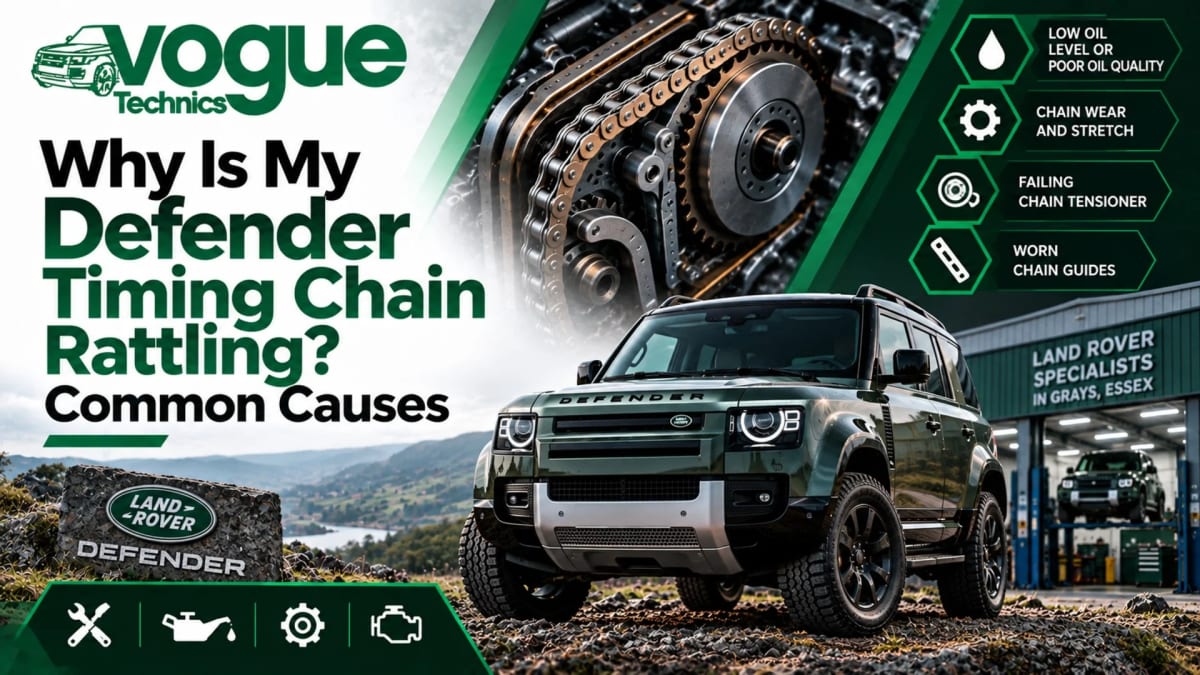
A rattle doesn't appear from nowhere. It's the audible result of a specific mechanical change inside the timing system, and understanding the cause matters because it determines the correct repair, not every rattle needs a full chain replacement.
Chain Stretch and Wear Over Time
Despite the name, a timing chain doesn't physically stretch like an elastic band. What happens is that the pins and bushings inside each link wear against each other, and that wear accumulates as extra clearance, commonly described as "chain stretch" or chain elongation. As clearance increases, the chain has more room to move, which is what produces the slapping or rattling noise, particularly before the tensioner takes up hydraulic pressure.
Left unaddressed, chain elongation eventually shifts the timing relationship between the crankshaft and camshaft. That's when a noise problem becomes a performance and reliability problem.
Failing Hydraulic Tensioner or Worn Guide Rails
The tensioner's job is to keep constant pressure on the chain so it can't slap against the guides. It's a hydraulic tensioner, meaning it depends entirely on oil pressure and oil condition to function correctly. When oil pressure is low, or the tensioner's internal non-return valve wears, it can't maintain pressure quickly enough on startup, producing exactly the cold-start rattle described above.
The chain guides (fixed and moving guide rails made from a hard plastic composite) are the second common failure point. They wear gradually against the moving chain, and in more advanced cases they can crack or shed material into the oil system, which is a more serious and more expensive problem to catch late.
Oil Dilution and Low Oil Pressure on the 2.0 Ingenium Diesel
This is a cause that's frequently underexplained elsewhere, and it's particularly relevant to diesel Defenders. During DPF regeneration cycles, a small amount of unburned fuel can find its way into the engine oil, a process known as oil dilution. Diluted oil is thinner than it should be, which means it holds less pressure and provides weaker lubrication exactly where the tensioner and chain need it most.
Combine oil dilution with an extended service interval, and you have a scenario where the oil itself, not a mechanically defective part, is accelerating chain and tensioner wear. This is why oil condition should always be checked as part of a proper timing chain assessment, not just the chain and tensioner hardware.
Which Defender Engines Are Most Prone to This?
Not every Defender engine carries the same risk profile, and it's worth being specific here rather than treating "Land Rover timing chains" as one generic issue.
2.0 Ingenium Diesel Applications
The 2.0-litre Ingenium diesel, found across D200, D240, D250, and D300 engine codes in the Defender range, is the most commonly reported for timing chain rattle, largely due to the oil dilution factor described above combined with the chain's position at the front of the engine.
2.0 Ingenium Petrol Applications
The 2.0 Ingenium petrol (P300) doesn't face the same DPF-related oil dilution risk, but chain, tensioner, and guide wear can still occur over time and mileage, particularly where service intervals have been stretched or the wrong oil specification has been used.
Six-cylinder Defender variants (P400, D300, P400e) use a different engine architecture and shouldn't automatically be assumed to share identical timing chain characteristics, if you drive one of these, a specific assessment is more reliable than applying general 2.0 Ingenium advice.
Is It Safe to Keep Driving a Defender with Timing Chain Rattle?
This is usually the real question behind everything above, so it deserves a direct answer: it depends on the stage of wear, and driving on regardless is a gamble with an engine that's expensive to put right if it goes wrong.
A very brief, consistent cold-start rattle that disappears within a couple of seconds is something to have checked at your next service rather than something requiring you to pull over immediately. A rattle that's getting longer, louder, or is now present when the engine is warm is a different situation entirely, and continuing to drive increases the risk of the chain skipping timing or, in the worst case, contacting valves or pistons.
Warning Signs That Mean Stop Driving Immediately
Certain symptoms combined with a rattle indicate the issue has moved beyond "monitor it" territory:
- Engine management light illuminated alongside the rattle, particularly if it's flashing rather than steady, which often signals a misfire.
- Rough idle or a noticeable loss of smoothness, suggests the timing relationship is already being affected.
- Reduced power or hesitation on acceleration, the engine's ability to breathe and fire correctly is compromised.
- The rattle is now present at idle, not just on startup, this means the tensioner isn't maintaining pressure even once oil pressure is fully established.
- A sudden change from occasional light rattle to a loud, constant noise, this pattern often precedes a guide failure or chain jump.
If any of these appear together with the rattle, the safest and most cost-effective decision is to stop driving and have the vehicle assessed before covering further mileage.
What Happens If the Timing Chain Fails or Jumps?
Defender Ingenium engines are interference engines, which means the pistons and valves occupy the same physical space at different points in the combustion cycle. The timing chain is what keeps them perfectly out of each other's way.
If the chain jumps a tooth on the sprocket, or fails outright, that separation is lost. The consequences range from a rough-running engine that needs a timing reset, right through to bent valves and piston damage that require a partial or full engine rebuild. The cost difference between catching a rattle early and catching it after a jump is typically the difference between a four-figure repair and a five-figure one.
Fault Codes Linked to Timing Chain Problems
If your Defender has thrown a warning light, a diagnostic scan often returns one of the following:
- P0016, Crankshaft/camshaft position correlation, Bank 1 Sensor A. This indicates the timing relationship has deviated from what the engine control unit expects.
- P0017, Crankshaft/camshaft position correlation, Bank 1 Sensor B. A closely related fault, often appearing alongside P0016.
- P0341, Camshaft position sensor circuit, range/performance problem. This can indicate a genuine timing deviation, but can also point to a faulty sensor rather than chain wear.
It's worth being clear about something competitor pages often gloss over: a fault code alone doesn't confirm chain failure. These codes tell a technician where to look, not what's definitely wrong. A proper diagnosis combines the fault code with a physical inspection, checking chain tension, tensioner function, and camshaft/crankshaft correlation on a live data scan, before any parts are recommended.
Land Rover Defender Timing Chain Diagnosis & Repair at Voguetechnics, Grays
Reading about symptoms and causes only gets you so far. At some point, the rattle needs a proper set of hands and diagnostic equipment on it, and this is where we come in.
At Voguetechnics Engine Rebuild, based in Grays, Essex, we work on Land Rover and Range Rover engines regularly, including the full range of Defender Ingenium and six-cylinder applications. We've seen the difference between a rattle that needs a tensioner and one that needs a full chain kit, and we don't recommend the latter unless the inspection genuinely supports it.
Our Diagnostic Process for Timing Chain Rattle
We don't diagnose a timing chain rattle by ear alone, and we'd be cautious of any garage that does. Our process typically includes:
- A cold-start listening assessment, replicating the exact conditions under which you've heard the noise, since a warm engine can mask the fault entirely.
- A full diagnostic scan for fault codes, including P0016, P0017, P0341 and any related stored or pending codes.
- Live data analysis of camshaft and crankshaft correlation, to see whether the timing relationship has actually deviated or whether the sensors are reporting a fault without a real mechanical cause.
- Oil condition inspection, checking for signs of dilution or degradation that may be undermining tensioner performance independently of chain wear.
- Physical inspection of chain tension, guides, and tensioner where access allows, before any parts are ordered.
This sequence matters because it protects you from paying for a full timing chain kit when the actual fault is a weak tensioner, contaminated oil, or a sensor, and equally, it catches genuine chain wear before it becomes an engine-damaging failure.
Timing Chain Replacement: What's Involved and What It Costs
Where a genuine chain kit replacement is needed, the job typically involves removing the front timing cover, replacing the chain, tensioner, and guide rails as a complete kit (mixing new and worn components is false economy and a common cause of repeat failures), resetting camshaft and crankshaft timing precisely, and carrying out an oil and filter change before a post-repair verification scan.
Costs vary depending on the engine variant, the extent of wear discovered during inspection, and whether any secondary damage (such as guide material in the oil system) has occurred. Rather than quoting a generic figure that may not reflect your specific Defender, we provide a firm price once the diagnostic stage has confirmed exactly what's required, which is a fairer approach than a flat rate that assumes every job is identical.
Why Grays and Essex Defender Owners Choose Voguetechnics
Defender and Ingenium engines aren't generic vehicles to work on, timing accuracy, correct tooling, and genuine understanding of how Land Rover's chain and tensioner systems behave under real-world conditions all matter. We approach every timing chain enquiry with a diagnose-first philosophy, meaning you get an honest assessment before any repair recommendation, not a pre-decided quote.
If you're local to Grays, Essex, or the wider Thurrock and South Essex area and you've noticed a rattle you're not sure about, it's worth getting it looked at properly before it becomes a bigger job. You can also read more about our approach to Land Rover engine diagnostics and Ingenium engine repairs elsewhere on our site.
Book a Timing Chain Diagnostic Check, get your Defender properly assessed before a minor rattle turns into a major repair bill.
Frequently Asked Questions About Defender Timing Chain Rattle
Why does my Land Rover Defender rattle on cold start?
Cold-start rattle happens because oil pressure takes a moment to build after the engine has been sitting. Until the hydraulic tensioner receives full pressure, the timing chain has slightly more freedom to move, producing a brief metallic rattle. If it disappears within a couple of seconds and doesn't return when the engine is warm, it's often an early-stage wear pattern rather than an emergency, though it's still worth having checked.
Is a Defender timing chain rattle normal, or should I worry?
A very short rattle on the coldest mornings only isn't unusual on higher-mileage Ingenium engines. A rattle that's getting longer, louder, or appearing on every start regardless of temperature indicates genuine wear that should be assessed rather than ignored.
How much does Defender timing chain replacement cost?
Cost depends on the engine variant, the parts required (chain only vs full chain, tensioner, and guide kit), and whether any secondary wear or damage is found during inspection. We provide an accurate quote after diagnosis rather than a blanket figure, since the right repair genuinely varies between vehicles.
Should I keep driving if I've noticed a rattle or warning light?
A brief, isolated cold-start rattle with no warning light and no change in how the vehicle drives is generally safe to monitor until your next service. If a warning light appears alongside the rattle, or you notice rough idling, hesitation, or reduced power, it's safer to have the vehicle assessed before continuing to drive it.
Does the Defender 2.0 Ingenium have known timing chain problems?
The 2.0 Ingenium diesel is commonly associated with timing chain rattle, largely linked to oil dilution from DPF regeneration cycles affecting oil pressure and tensioner performance. It's a known characteristic of the engine family rather than a fault present on every single vehicle, and proper servicing with the correct oil specification significantly reduces the risk.
Can worn guides or a bad tensioner cause rattle without the chain itself being worn?
Yes. In many cases, the tensioner or guide rails wear before the chain shows significant elongation, and replacing only the worn component (following inspection) resolves the noise without needing a full chain kit.
What fault codes indicate a Defender timing chain problem?
P0016, P0017, and P0341 are the most commonly associated codes, relating to camshaft/crankshaft correlation and camshaft position sensor performance. None of these codes confirm chain failure on their own, they indicate where a technician should focus a physical inspection.
The Bottom Line
A timing chain rattle on your Land Rover Defender isn't something to dismiss, but it's also not automatically a five-figure engine rebuild waiting to happen. The right response is proper diagnosis, understanding whether you're dealing with early chain wear, a failing tensioner, worn guides, or an oil condition issue, before any repair decision is made.
If your Defender has developed a rattle you're not sure about, the sooner it's properly assessed, the more options you have and the less it's likely to cost. Get in touch with Voguetechnics Engine Rebuild in Grays, Essex, and we'll give you a straight answer on what's actually happening under the bonnet, and what it'll take to put right.