
Land Rover Defender Timing Chain Problems: Symptoms, Causes & Repair Costs (Essex Specialists)
Land Rover Defender timing chain problems can start with a simple cold-start rattle and develop into serious engine damage if ignored. Learn the key symptoms, causes and affected Defender engines, including the 2.0 Ingenium, TD5 and Puma. Discover typical repair options, costs and what a professional timing chain diagnostic involves. Get expert Defender timing chain repairs and engine solutions from specialists in Grays, Essex.
There's a specific kind of dread that sets in when you turn the key on your Defender and hear a rattle you didn't hear last week. You tell yourself it's probably nothing. Maybe it's cold outside. Maybe it'll go away once the engine warms up.
Sometimes it does. Often, it doesn't.
Land Rover Defender timing chain problems are one of the most common, and most misunderstood, mechanical issues affecting these vehicles, particularly on certain diesel variants. Some owners get away with a cheap tensioner swap. Others end up facing an engine rebuild because a rattle got ignored for six months too long. The difference usually comes down to how early the fault is caught and how well it's diagnosed.
This guide walks through exactly what's going on inside your engine, which Defender models are most at risk, what the early warning signs sound and feel like, and what a proper repair actually involves, so you can make an informed decision before it becomes an expensive one.
What Are the Symptoms of Land Rover Defender Timing Chain Problems?
A timing chain's job is simple in theory: keep the crankshaft and camshaft perfectly synchronised so valves open and close at exactly the right moment. When that chain wears, stretches, or the tensioner holding it taut starts to fail, that synchronisation slips, and the engine starts telling you about it, usually before it tells you with a warning light.
Common symptoms include:
- A rattling or metallic noise on startup, especially in cold weather
- Rough idle that smooths out once the engine reaches operating temperature
- A hesitant or jerky feel under light acceleration
- Reduced power output, particularly noticeable pulling away from a standstill
- An illuminated check engine light, sometimes accompanied by a "reduced performance" message
- Occasional misfires, especially on cold mornings
None of these symptoms are exclusive to timing chain wear on their own, which is exactly why so many owners delay getting it checked. That's the trap. The engine often runs fine enough, day to day, right up until it doesn't.
Why Is My Defender Timing Chain Rattling on Cold Start?
Cold-start rattle is the single most reported symptom associated with Defender timing chain wear, and there's a mechanical reason it shows up specifically when the engine is cold.
Engine oil is thicker and slower to circulate when cold. The hydraulic tensioner that keeps the timing chain under correct tension relies on oil pressure to do its job properly. If the tensioner is worn, or if oil isn't reaching it quickly enough, the chain gets a moment of slack before pressure builds, and that slack lets the chain slap against its guides.
That's the rattle you're hearing.
As the engine warms and oil pressure normalises, the tensioner usually takes up the slack and the noise quietens or disappears entirely. This is precisely why so many owners assume it's "just a cold engine thing" and drive on. Unfortunately, every cold start that produces that rattle is another small dose of wear on the chain, guides, and sprockets, and the problem rarely stays the same. It tends to progress.
What Does a Failing Timing Chain Sound Like vs. Normal Engine Noise?
Diesel engines are noisy by nature, and that makes self-diagnosis genuinely difficult for most owners. It's worth knowing the difference before you assume the worst, or dismiss something serious.
- Normal diesel injector clatter sounds like a light, consistent ticking, present at all times and largely unaffected by temperature.
- Timing chain rattle is a looser, more metallic slapping sound, concentrated specifically at cold start and easing off within a minute or two as the engine warms.
- VVT (variable valve timing) noise can sound similar to chain rattle but is often linked to a specific fault code rather than a general cold-start pattern.
- Auxiliary belt noise tends to be a squeal or chirp, especially on damp mornings, and is unrelated to the internal timing system.
- Tappet or lifter noise is a lighter, more rhythmic ticking that usually persists at idle regardless of temperature.
- Turbo noise typically presents as a whine or whistle under acceleration, not at idle or startup.
If you're not confident telling these apart by ear, and honestly, most people aren't, that's exactly what a proper diagnostic check is for. Guessing wrong in either direction costs money: either you replace parts that didn't need replacing, or you ignore a fault that needed attention weeks ago.
Can a Timing Chain Fault Cause a Check Engine Light or Rough Idle?
Yes, and this is often the point where owners stop guessing and book a diagnostic. As chain wear progresses, the camshaft and crankshaft positions can drift slightly out of sync. The engine control module monitors this relationship constantly, and once it detects a discrepancy beyond tolerance, it logs a fault code and triggers the check engine light.
Common fault codes associated with timing-related issues include camshaft/crankshaft correlation faults and, in some cases, codes relating to variable valve timing performance. A rough idle often appears around the same time, because the engine is compensating for timing that's no longer perfectly accurate.
The important thing to understand: the warning light appearing is not the start of the problem, it's confirmation that the problem has already been developing for a while.
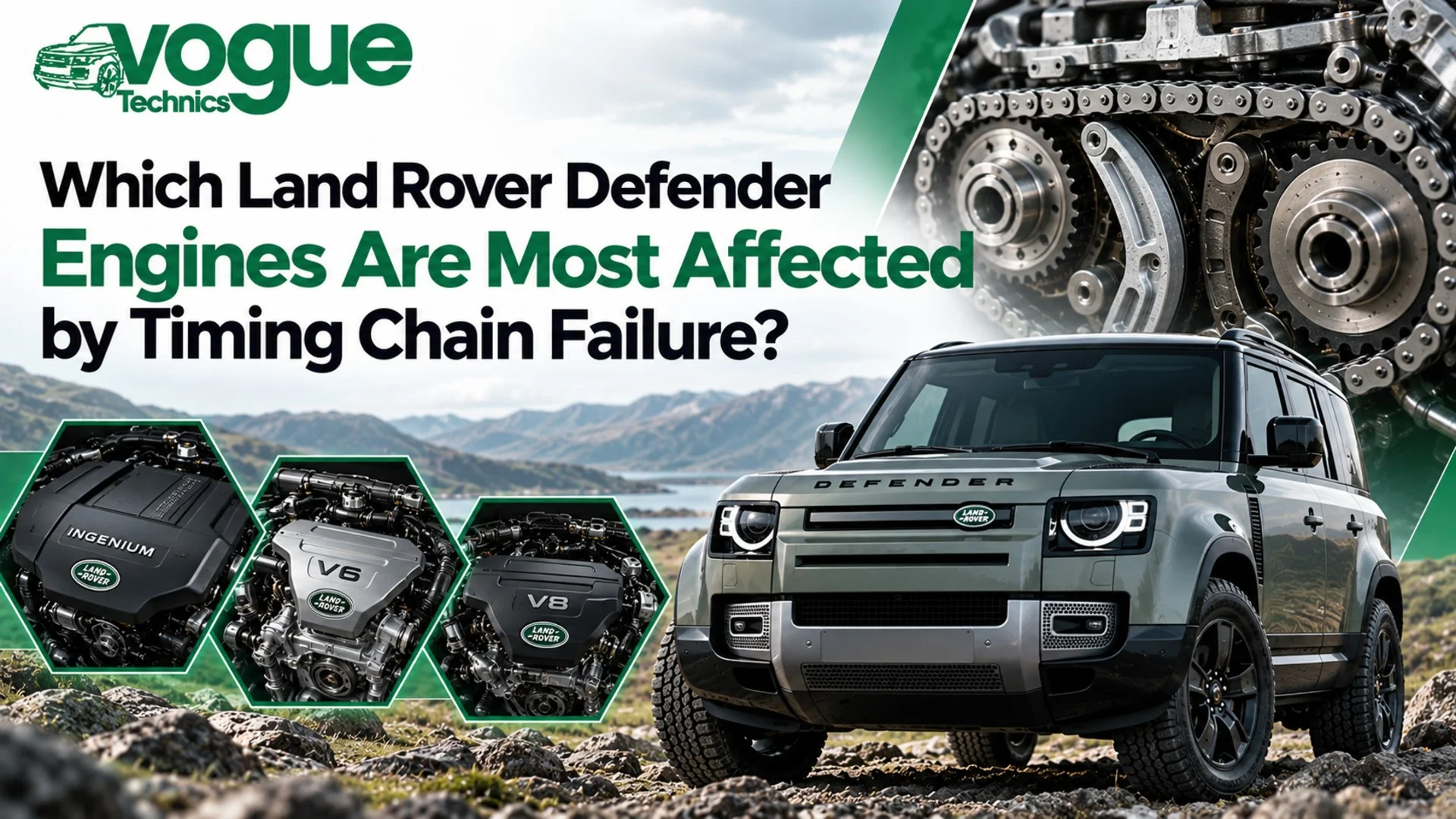
Which Land Rover Defender Engines Are Most Affected by Timing Chain Failure?
This is where a lot of online advice gets vague, and vague advice isn't useful when you're trying to figure out whether your specific vehicle is at risk. "Defender timing chain problems" gets used as a blanket term across multiple completely different engines and generations, and lumping them together does owners a disservice.
The Defender name has spanned several very different platforms, the classic TD5, the Puma-era 2.2 and 2.4 TDCi, and the modern L663 Defender with its Ingenium engines. Each has its own timing system, its own failure patterns, and its own repair considerations.
Does the Defender 2.0 Ingenium Diesel Have Known Timing Chain Problems?
The 2.0-litre Ingenium diesel, fitted to the modern L663 Defender (90, 110, and 130), is the engine most frequently associated with premature timing chain and tensioner wear in current specialist and technical discussion. It's a compact, high-output engine, and that compact design leaves relatively little margin for error when lubrication or maintenance intervals slip.
Several specialist workshops and technical sources have independently flagged a recurring pattern on this engine: cold-start rattle developing at comparatively low mileage compared to older, simpler diesel timing systems. This doesn't mean every 2.0 Ingenium will develop a fault, plenty run trouble-free for years, but it does mean owners of this engine should be more attentive to early symptoms than owners of older platforms might need to be.
It's also worth being precise here rather than alarmist: this is a documented pattern reported by independent specialists and owner communities, not a confirmed manufacturer-wide recall. If you're unsure whether your specific vehicle has been subject to any official manufacturer bulletin or action, it's worth checking your VIN directly against Land Rover's own records rather than relying on generalised online claims.
TD5 and Puma (2.2/2.4 TDCi) Timing Systems Explained
Older Defenders run entirely different engines with their own timing arrangements, and it's a mistake to assume advice for one automatically applies to the other.
- TD5 (2.5-litre diesel): Uses a timing chain arrangement, with wear concerns typically centred on the tensioner and chain components rather than the chain itself failing outright at low mileage.
- Puma 2.4 TDCi: A Ford-derived engine with its own specific timing system; concerns here are usually maintenance and wear-related rather than a widely documented design weak point.
- Puma 2.2 TDCi: The later, revised version of the Puma engine, sharing similar maintenance considerations to the 2.4.
Defender Engine Timing Chain Comparison Table
Defender Generation | Engine | Timing System | Primary Concern |
| Classic | TD5 (2.5 diesel) | Chain | Tensioner and chain component wear over high mileage |
| Puma | 2.4 TDCi | Engine-specific chain system | General wear, maintenance-dependent |
| Puma | 2.2 TDCi | Engine-specific chain system | General wear, maintenance-dependent |
| L663 | 2.0 Ingenium diesel | Chain | Cold-start rattle, tensioner wear, oil-related wear |
| L663 | 2.0 Ingenium petrol | Chain | VVT-related timing faults |
| L663 | 3.0 Ingenium (I6) | Chain system | Timing and VVT-related faults |
If you're not certain which engine your Defender runs, checking your logbook or VIN plate is the safest starting point before assuming which set of symptoms and repair costs apply to you.
What Causes Land Rover Defender Timing Chain Failure?
Timing chains don't usually fail suddenly out of nowhere. In the vast majority of cases, failure is the end result of a gradual process, one that often starts small and goes unnoticed for months.
How Oil Dilution and DPF Regeneration Can Affect the Timing Chain
Diesel particulate filter (DPF) regeneration is a normal, necessary process, but it can have a knock-on effect on oil condition if a vehicle does a lot of short journeys and rarely reaches the temperatures needed for a full regeneration cycle. During regeneration, small amounts of unburned diesel fuel can find their way into the engine oil, gradually diluting it.
Diluted oil is thinner and less effective at maintaining the correct hydraulic pressure the timing chain tensioner relies on. Over time, this can contribute to the kind of chain slack and rattle discussed earlier.
It's worth being clear-eyed about this relationship rather than overstating it: oil dilution is a contributing factor that specialist sources have connected to accelerated wear, it is not the sole or guaranteed cause of every timing chain fault. Driving style, service history, oil quality, and mileage all play a role too. A Defender used mainly for short urban runs is generally at higher risk than one regularly driven on longer motorway journeys that allow full regeneration cycles to complete.
Worn Tensioners and Chain Guides: The Hidden Wear Points
The timing chain itself is only one part of the system. In practice, the tensioner and guides often wear out before the chain does, and because they're smaller, cheaper components, catching the problem here is usually far less expensive than waiting for chain stretch to develop.
- Chain tensioner: A hydraulic component that maintains constant pressure on the chain. Once worn, it can't take up slack properly, which is the direct mechanical cause of cold-start rattle.
- Chain guides: Plastic or composite rails that keep the chain running true. These can wear, crack, or break down over time, particularly if oil quality or condition has been compromised.
- Sprockets: The toothed wheels the chain runs on. Excessive chain wear can accelerate sprocket wear, and vice versa.
What Happens If You Keep Driving With a Rattling Timing Chain?
This is the question that matters most, because it's the one that determines whether a repair costs a few hundred pounds or several thousand.
The typical progression looks like this: wear develops → the chain gains slack → you hear a rattle → timing gradually drifts out of correct alignment → in worst cases, the chain can jump a tooth on the sprocket, or in severe scenarios, fail completely.
If the chain jumps or breaks while the engine is running, valves and pistons, which are timed to avoid contact by a matter of millimetres, can collide. On many engine designs, this causes catastrophic internal damage: bent valves, damaged pistons, and in the worst cases, a scored cylinder head or block that makes an engine rebuild the only realistic option.
Not every rattle ends this way. Plenty of Defenders get diagnosed and repaired at the rattle stage with nothing more than a tensioner and guide replacement. But the outcome depends entirely on how quickly the fault is caught, which is really the whole point of this article. A rattle you can hear today is far, far cheaper to deal with than the same rattle ignored for another 10,000 miles.
Land Rover Defender Timing Chain Replacement, Cost, Process & Booking
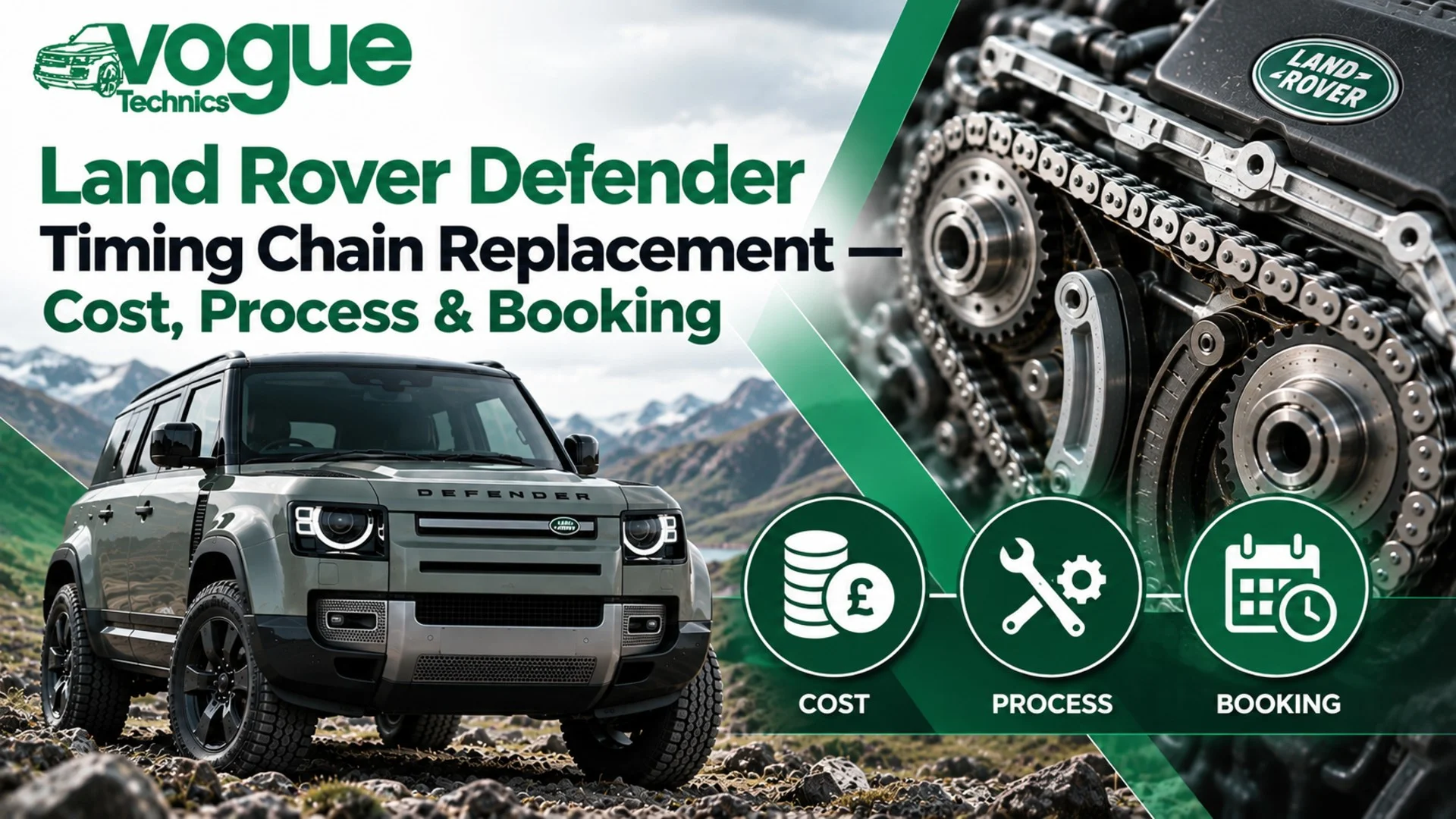
How Much Does Land Rover Defender Timing Chain Replacement Cost?
There's no single honest answer to this question, because the cost genuinely depends on how far the fault has progressed and which engine you're dealing with. Anyone quoting you a fixed price without inspecting the vehicle first is guessing.
Factors that influence the final cost include:
- Which engine is fitted, labour time and parts pricing differ meaningfully between the TD5, Puma, and Ingenium platforms
- Whether it's a tensioner/guide repair or a full chain replacement, catching it early keeps costs down substantially
- Whether the timing chain kit includes sprockets and other related components, which is usually recommended rather than replacing the chain in isolation
- Labour time, which varies depending on how accessible the timing chain assembly is on that particular engine layout
- Whether any secondary damage has occurred, if the fault progressed to the point of affecting valves, pistons, or other internals, the cost bracket changes considerably
As a general rule: a tensioner and guide repair caught early sits at the lower end of the cost spectrum. A full timing chain kit replacement sits in the middle. An engine rebuild following chain failure sits well above both, often several times the cost of early intervention. This is the single strongest argument for getting a rattle checked the week you first hear it, not the month after.
What's Included in a Professional Timing Chain Repair?
A proper repair isn't just "fit new chain, close bonnet." A thorough job typically follows this sequence:
- Cold-start listening test to confirm and characterise the noise
- Fault code scan to check for any stored camshaft/crankshaft correlation or VVT-related codes
- Cam and crank timing correlation check, confirming how far out of alignment the system currently is
- Oil condition inspection, checking for signs of dilution or contamination
- Physical inspection of the chain, tensioner, and guides once the timing cover is accessed
- Replacement of the full timing chain kit, chain, tensioner, guides, and sprockets where required, rather than replacing components individually and leaving worn parts in place
- Oil and filter change, since old, diluted, or contaminated oil should never go back into a freshly repaired timing system
- Post-repair verification, confirming correct cam/crank timing and a clean cold-start test before the vehicle is handed back
Skipping steps in that sequence is exactly how some repairs end up needing to be redone within a year, for example, replacing a chain but leaving a worn guide in place, which then fails and causes the same symptoms to return.
Book a Timing Chain Diagnostic at Our Grays, Essex Workshop
If your Defender is rattling on cold starts, hesitating under load, or has thrown a check engine light, the smartest move is getting it properly diagnosed before the problem has a chance to develop further. At voguetechnicsenginerebuild.co.uk, based in Grays, Essex, we carry out full Land Rover Defender timing chain diagnostics, covering TD5, Puma, and Ingenium engines, and provide a clear, honest assessment of what's actually happening under the bonnet before any work begins.
We'll tell you straight whether you're looking at a tensioner and guide repair, a full chain kit replacement, or something more involved, and what each option genuinely costs, with no inflated "worst case" quoting. If your Defender needs a full engine rebuild following chain failure, that's an area we specialise in directly.
Get in touch to book a diagnostic, or give us a call to talk through what you're hearing and hesitating over. Catching this early is almost always the cheaper, less stressful path.
Frequently Asked Questions
How do I know if my Defender has a timing chain problem?
The clearest early sign is a rattling or metallic noise on cold start that eases off as the engine warms up. Combined with rough idle, hesitation, or a check engine light, it's worth booking a diagnostic rather than waiting to see if it worsens.
Which Land Rover Defender engines have timing chain problems?
The 2.0-litre Ingenium diesel, fitted to the modern L663 Defender, is the engine most commonly associated with early tensioner and chain wear in current specialist reporting. Older TD5 and Puma-engined Defenders can also experience timing chain and tensioner wear, typically at higher mileage.
How much does Defender timing chain replacement cost?
It depends on the engine and how far the fault has progressed. A tensioner or guide repair caught early costs considerably less than a full chain kit replacement, and both cost far less than an engine rebuild following chain failure. An accurate quote requires a physical inspection.
Can I drive my Defender with a timing chain rattle?
You can, in the short term, but it's not advisable. A rattle indicates the chain already has slack, and that wear tends to progress the longer it's left. What starts as a repairable tensioner issue can develop into chain jump or failure, and the resulting engine damage is significantly more expensive than early repair.
Why does the Defender timing chain fail prematurely on some vehicles?
A combination of factors is usually involved: tensioner wear, chain guide degradation, and, particularly on Ingenium diesels doing frequent short journeys, oil dilution linked to incomplete DPF regeneration cycles. Service history and driving style both play a role in how quickly wear develops.
Does oil dilution affect the timing chain?
It can contribute to accelerated wear by reducing the oil's effectiveness at maintaining correct tensioner pressure, particularly on engines that regularly undergo DPF regeneration without reaching full operating temperature. It's one contributing factor among several, not a guaranteed cause on its own.
What fault codes are associated with Defender timing chain problems?
Codes relating to camshaft and crankshaft position correlation are the most common, alongside occasional VVT performance-related codes. A fault code scan is a standard part of a proper timing chain diagnostic.
Do you carry out Defender timing chain repairs in Essex?
Yes. We diagnose and repair Land Rover Defender timing chain issues across TD5, Puma, and Ingenium engines at our Grays, Essex workshop, including full engine rebuilds where chain failure has caused internal damage.
A cold-start rattle on your Defender is rarely a coincidence, and it's almost never worth waiting out. The engines most commonly affected, particularly the 2.0 Ingenium diesel, tend to follow a fairly predictable pattern: mild noise first, gradually worsening symptoms, and a widening gap between "cheap fix" and "major repair" the longer it's ignored.
If you've heard that rattle, or you're simply not sure whether what you're hearing is normal diesel clatter or something more serious, get it looked at properly. Contact voguetechnicsenginerebuild.co.uk in Grays, Essex today to book a timing chain diagnostic, a short conversation now could save you a very expensive one later.