
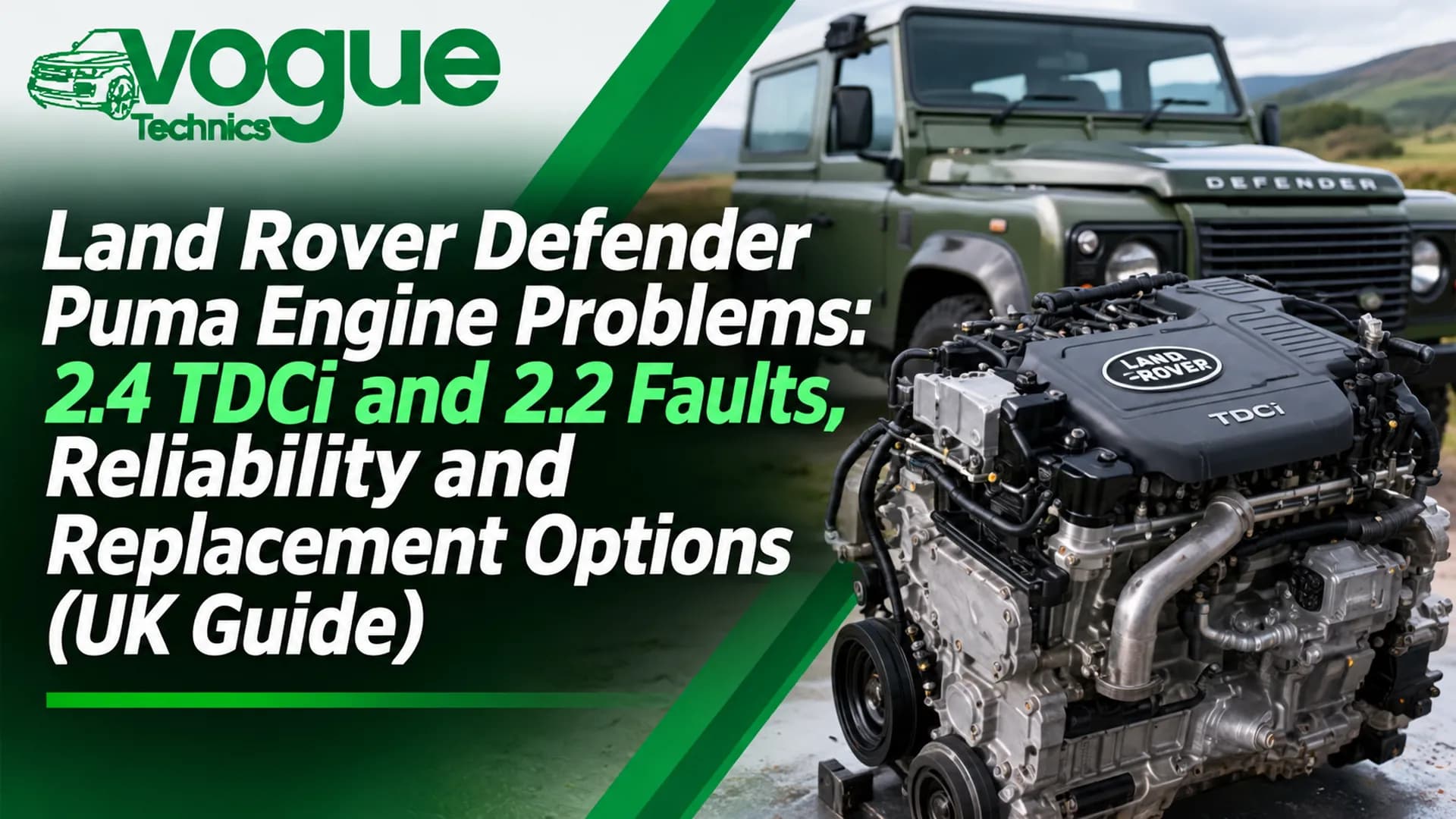
Land Rover Defender Puma Engine Problems: 2.4 TDCi and 2.2 Faults, Reliability and Replacement Options (UK Guide)
Discover the most common Land Rover Defender Puma engine problems affecting 2.4 TDCi and 2.2 diesel models. Learn about EGR cooler failures, turbo actuator faults, timing component wear, injector issues and warning lights. Compare engine reliability, recognise early symptoms and understand when repair, rebuilding or replacement makes financial sense. Get specialist advice and a warranty-backed engine supply and fit quote in the UK.
A warning light has come on. Or the Defender has gone flat on a hill, or the coolant level keeps dropping and nobody can tell you why. You search for answers and land on forum threads that run to forty pages and contradict each other.
This guide gives you the short version. It covers which Land Rover Defender Puma engine problems actually matter, how the 2.4 and the 2.2 compare on reliability, and the point where repair stops making sense and replacement starts.
At voguetechnicsenginerebuild.co.uk, we supply and fit replacement engines from our base in Grays, Essex, and we deliver across the UK. If you already know your registration, you can get a quote by reg and skip straight to the answer.
What Are the Most Common Land Rover Defender Puma Engine Problems?
The Puma is the diesel engine family fitted to the Defender in its final years. The 2.4 TDCi came first, followed by the 2.2 Puma from the 2012 model year.
Both are capable engines, and both have known weak points. Most owners searching for defender puma engine problems or defender puma engine issues are dealing with one of the faults below. Knowing which ones are warnings and which are emergencies saves a lot of money.
Which Faults Affect the 2.4 TDCi and the 2.2 Puma (EGR Cooler, Turbo Actuator, Timing Components, DPF, Injectors)?
Here is how the main faults compare. Use it to judge urgency, not to diagnose by yourself.
Fault | Typical symptoms | Mainly affects | Seriousness | Usually ends in |
| EGR cooler failure | Coolant loss, white smoke, milky oil, overheating | Both, widely reported on the 2.2 | Stop driving if coolant reaches the oil | Repair if caught early, replacement if oil is contaminated |
| Turbo actuator or VGT fault | Limp mode, loss of power, whistling | Both | Repair soon | Repair |
| Timing component wear | Rattle or ticking at start-up, rough running | Both (belt on the 2.4, chain on the 2.2, confirm for your vehicle) | Stop and check | Repair if caught early, replacement if it has jumped |
| Injector and high-pressure fuel faults | Rough idle, hard starting, smoke, fuel smell | Both | Repair soon | Repair, replacement if debris has spread |
| DPF blockage | Warning light, regeneration smell, power loss | DPF-equipped vehicles | Get it checked | Repair or cleaning |
| Glow plug and GPCM faults | Hard cold starts, glow plug light | Both | Low | Repair |
| Thermostat failure | Overheating or slow warm-up | Both | Get it checked | Repair |
Three of these deserve a closer look.
EGR cooler failure and coolant in the oil. This is the one that turns a repair into a replacement. If the cooler leaks, coolant can pass into the engine. Oil that has been thinned by coolant stops protecting bearings, and the damage compounds quickly. Watch your coolant level. It is the earliest and cheapest warning you will get.
Turbo actuator problems. The Defender goes into limp mode with little warning, which is frightening but usually fixable. The risk comes from carrying on and stressing the turbo, or from a fault that is actually a boost leak.
Timing components. A ticking noise at start-up is easy to ignore, and ignoring it is how a repair becomes a rebuild. The 2.4 has a belt with a service interval, and the 2.2 is generally chain-driven. Check your handbook and service history for the details on your vehicle.
Not everything is the engine. Many Defender owners blame the engine for faults that belong elsewhere. A clutch slave cylinder, a gearbox that is stiff to select, a driveline clunk and bulkhead corrosion are all common on these vehicles. They are separate repairs, so get a proper diagnosis before assuming the worst.
What Does the Defender Puma Engine Warning Light Mean, and When Should You Stop Driving?
Searches for land rover defender puma engine warning light usually come from people who want a simple rule. This is ours:
- Engine management light (steady). Get it checked soon. It often points to a sensor, injector, boost or EGR fault. Drive gently and avoid towing until it has been read.
- Engine management light (flashing, or with limp mode). Reduce load and get it diagnosed promptly. Repeated limp mode can mask a turbo or boost fault that is getting worse.
- Glow plug light staying on or flashing. Usually a glow plug or GPCM fault. It is a nuisance rather than an emergency, although cold starts will suffer.
- DPF warning. The filter needs a regeneration drive or a service. Ignoring it risks blockage and extra cost.
- Oil pressure light. Stop now. Do not drive to see if it clears.
- Coolant temperature warning or rising gauge. Stop now. Overheating can crack heads and ruin gaskets within minutes.
A simple rule: red warnings and any noise that wasn't there last week mean you stop. Amber warnings mean you get it checked within days, not months.
Is the Defender Puma Engine Reliable? How the 2.4 and 2.2 Compare Year by Year

Owners ask is the 2.4 Puma engine reliable? when they are about to buy, or when they are deciding whether to keep the car.
Here is a balanced answer. Both engines can run for a long time when they are serviced properly, and both punish neglect. The reputation for trouble usually comes from three things: skipped service intervals, short-trip use that stresses the diesel particulate and EGR systems, and warning signs that got ignored.
Many Land Rover Puma engine reviews are written after a failure, so forums lean negative. In practice, Land Rover Puma engine reliability depends on:
- Service history. Regular oil changes and a documented timing service matter more than the badge.
- How the vehicle is used. Long runs are kinder than short, cold trips. Heavy towing adds heat and load.
- Cooling system condition. Coolant loss or overheating history is a red flag on any Puma.
- Whether faults were fixed early. A tidy repair history is a better sign than a perfect-looking engine bay.
What Are the 2.4 and 2.2 Puma Engine Specs, and Does the 2.2 Share Anything With the Peugeot Boxer?
The table below compares the two engines. Confirm details against your own V5C, VIN and engine code before ordering anything.
2.4 Puma (TDCi) | 2.2 Puma | |
| Capacity | About 2.4 litres | About 2.2 litres |
| Cylinders | Four, turbo diesel | Four, turbo diesel |
| Years fitted to the Defender | From the 2007 model year | From the 2012 model year to the end of production in 2016 |
| Power | Around 122 PS | Around 122 PS |
| Emissions | Euro 4 | Euro 5 |
| Timing drive | Belt (confirm for your vehicle) | Chain (confirm for your vehicle) |
| Common concerns | Injectors, fuel system, glow plugs, DPF on some versions | EGR cooler, turbo actuator, timing components, DPF |
The 2.4 Puma engine specs and the 2.2 figures look similar on paper, but the engines are not interchangeable. Emissions equipment, wiring and ancillaries differ, so match any replacement by registration and engine code, not by engine size.
Does the 2.2 Puma share anything with the Peugeot Boxer? Yes, in broad terms. The 2.2 Puma engine Peugeot Boxer connection comes from the engine family. It was developed jointly and used in vans from Ford, Peugeot and Citroën as well as in the Defender. That family link explains why you will see similar faults discussed across forums. It does not mean a van engine will bolt into a Defender. The Defender 2.2 Puma engine is built and specified for the Land Rover, so buy by registration, not by family name.
What about Puma engine oil? Oil is one of the cheapest ways to protect the engine, and one of the most often skipped. Follow these principles:
- Use the specification in your handbook, not just a viscosity grade. DPF-equipped engines need a low-ash oil.
- Keep to the service interval, or shorten it if the Defender does short trips, tows or works hard.
- Check the level and the condition regularly. A rising level can mean fuel or coolant is getting in. Milky oil means stop.
- Short journeys and repeated DPF regenerations can dilute oil with fuel, so shorter intervals are sensible for town use.
How the years differ
- 2007 Defender Puma. Early 2.4 cars are now old, so age-related issues pile up. Injectors, glow plugs, the cooling system and bulkhead corrosion all deserve attention. If you're researching 2007 Land Rover Defender Puma engine problems, check the fuel system and service history first.
- 2012 and 2013. These are the first years of the 2.2, with newer emissions equipment. Searches for 2012 Land Rover Defender Puma engine problems and 2013 Land Rover Defender Puma engine problems usually point to EGR cooler, turbo actuator and timing component concerns. Check coolant condition and oil.
- 2016. The final year of Defender production. 2016 Land Rover Defender Puma engine problems are mostly the same family of faults, on a car that is the youngest and often the best preserved. Don't skip the checks because of that.
- A note on 2018. Searches for 2018 Land Rover Defender Puma engine problems are common, but Defender production ended in 2016. A "2018 Defender" is usually a late-registered, imported, restored or remanufactured vehicle, or a limited special edition. Before you order any engine, confirm exactly which engine your vehicle has.
Should You Repair, Rebuild or Replace a Defender Puma Engine, and What Affects the Cost?

A good workshop will tell you when repair is enough. Many faults are cheap to fix when caught early. A turbo actuator, a thermostat, glow plugs and a leaking injector return are all single-component jobs.
Replacement becomes the sensible choice when the damage is internal.
When Does a Puma Engine Need Replacing, and Is a Reconditioned Engine Better Than a Used One?
Replacement is usually the right call when:
- Coolant has contaminated the oil and the engine has been run in that state
- Bearings have failed, with a knock that gets louder under load
- A timing component has failed and valves or pistons have been damaged
- Overheating has cracked or warped the head or block
- The engine has a history of repeat faults, and each repair just moves the problem
Our decision rule: if the repair bill is approaching the cost of a reconditioned engine, or if the same engine has needed repeated attention, replacement gives better value and more peace of mind.
A typical scenario. A Defender owner notices the coolant level dropping and tops it up for several weeks. A thin, milky film appears on the oil cap. They keep driving because the engine still pulls. By the time it reaches a workshop, bearing wear is already present. What might have been an EGR cooler repair has become an engine replacement. The cheapest moment to act is when the coolant first goes down.
Once you've decided to replace, choose between a used and a reconditioned engine:
Factor | Used engine | Reconditioned engine |
| Upfront cost | Lower | Higher |
| Wear and history | From a donor vehicle, often undocumented | Dismantled, inspected, wear parts renewed |
| Expected lifespan | Depends on the donor | Generally longer and more predictable |
| Warranty | Usually more limited | Usually fuller cover |
| Best for | Older vehicles, tight budgets, short-term ownership | Working Defenders, towing, long-term ownership |
Our view: for a Defender you plan to keep and use, a reconditioned engine is usually the safer investment. For a vehicle you may sell soon, a good used unit can be enough.
What affects the cost? We don't print figures here because engine prices move with stock and demand. Every honest quote is built from the same parts:
- The engine. Used, reconditioned or new, and which version you need.
- Labour. Removing and refitting an engine takes skilled time.
- Ancillary parts. Gaskets, coolant, oil, filters and often a turbo, injectors or timing components.
- Delivery. This applies if you are buying supply only and using your own garage.
Make sure every quote covers the same items. A low headline price that excludes labour or ancillaries is rarely cheapest in the end.
Before you buy from any supplier, ask:
- What parts were replaced during the rebuild?
- Was the engine bench-tested?
- What are the warranty length, mileage limits and exclusions?
- Does the warranty need fitting by an approved workshop?
- Has the engine code been confirmed against my registration?
A supplier who answers these clearly is worth talking to. One who avoids them is not.
Why Choose voguetechnicsenginerebuild.co.uk for Your Defender Puma Engine Supply and Fit in Grays, Essex?

We are a UK engine supplier based in Grays, Essex. We work on Land Rover, Range Rover and other premium and off-road vehicles, and we keep the process straightforward.
Here is what customers value most:
- Supply and fit under one roof. One point of contact from quote to completion.
- UK-wide delivery. If you prefer your own garage, we can supply only.
- Engines matched to your vehicle. We check your registration, engine code and specification before we quote.
- Honest advice. If your fault can be repaired, we'll say so.
- Warranty-backed engines. Cover details are confirmed in your quote.
We are easy to reach from Essex, London and Kent, and we arrange delivery for owners further away.
How Do I Get an Exact Quote for My Defender 2.4 or 2.2 Puma Engine?
Prices move with stock and market conditions, so a live quote is the only reliable way to know your real cost. It takes three steps:
- Enter your registration. We pull up your vehicle details and likely engine.
- Confirm your engine and symptoms. We check your code and talk through what the Defender is doing.
- Receive your quote. You get a clear price for supply only or supply and fit, with warranty details.
Frequently Asked Questions
What are the most common Land Rover Defender Puma engine problems?
EGR cooler failure, turbo actuator faults, timing component wear, injector and fuel system faults, DPF blockage and glow plug problems are the main ones.
Is the 2.4 Puma engine reliable?
It can be, with regular servicing and early attention to faults. Service history and use matter more than the badge.
What are the 2.4 Defender TDCi engine problems?
Injectors, the fuel system, glow plugs, timing belt condition and, on some versions, the DPF. Many other faults owners blame on the engine are actually clutch, gearbox or bulkhead issues.
What are the 2.2 Puma engine problems?
EGR cooler failure, turbo actuator faults and timing component wear are the best-known concerns. Watch coolant level and oil condition.
Is the 2.2 Puma the same as the Peugeot Boxer engine?
They share an engine family, but the Defender engine is built to a different specification. Fitment is not interchangeable, so match by registration and engine code.
What oil should I use in a Defender Puma engine?
Use the specification in your handbook. DPF-equipped engines need a low-ash oil. Keep to the service interval, or shorten it for short trips or towing.
What does the Defender engine warning light mean?
It depends on the light. An amber engine light means get it checked soon. Oil pressure or coolant temperature warnings mean stop driving immediately.
Can I drive with coolant in the oil?
No. Stop driving and get it inspected. Continued use can destroy bearings.
Is it worth replacing a Defender Puma engine?
Often yes, if the damage is internal and the rest of the vehicle is sound. If the fault is a single component, repair is usually cheaper.
Are there 2018 Defender Puma engines?
Defender production ended in 2016. A vehicle described as a 2018 Defender is usually late-registered, imported or remanufactured, so verify its engine before ordering.
Final Word: Catch It Early, Choose the Right Engine
Most Puma problems are manageable when you act early. Watch the coolant, take new noises seriously, and treat red warnings as instructions to stop. If the engine does need replacing, match the code to your registration, choose between used and reconditioned based on how long you'll keep the vehicle, and compare quotes like for like.
If you want a clear, current price from a team that supplies and fits engines from Grays, Essex, and delivers across the UK, we're ready to help.