

Land Rover Defender P400 Timing Chain Issues: Symptoms, Causes & Repair (Grays, Essex Specialists)
Hearing a rattle from your Defender P400 on a cold start? This guide explains the real symptoms of Land Rover Defender P400 timing chain issues and how to tell chain noise from normal VCT behaviour. It covers what causes chain, tensioner and guide wear in the 3.0-litre Ingenium six-cylinder, and how a proper diagnosis works. It also outlines the repair options and why catching a fault early saves money, with advice from Voguetechnics Engine Rebuild in Grays, Essex.
Your Defender P400 shouldn't sound like it's chewing gravel on a cold morning. If you've noticed a rattle when you first turn the key, a metallic tick that fades once the engine warms up, or a note in your service history that mentions "monitoring" a noise — you're already asking the right question: is this the timing chain, or something else entirely?
That question matters more than it might seem. The 3.0-litre Ingenium inline-six in the P400 is a different engine from the 2.0-litre Ingenium four-cylinder fitted to earlier Defenders and other Land Rover models, and the two don't share identical timing chain histories. A lot of what's written online about "Ingenium timing chain problems" is actually about the 2.0-litre unit — not the six-cylinder MHEV engine under your bonnet. Mixing the two up leads owners to either panic unnecessarily or dismiss a genuine issue as normal.
We work on Defenders and other Land Rover models at our workshop in Grays, Essex, and P400 timing chain enquiries are ones we take seriously precisely because the diagnosis needs care. This guide walks through what the noises actually mean, what typically causes wear in this specific engine, how a proper diagnosis is done, and what your options look like if a repair is needed.
What Are the Symptoms of Defender P400 Timing Chain Issues?

Timing chain wear rarely announces itself with a single, unmistakable symptom. Instead, it tends to show up as a pattern — a noise that starts small and becomes more consistent, sometimes alongside changes in how the engine runs.
Here's what owners typically report when a timing chain component is genuinely involved:
- A rattle or tick on cold start that lessens or disappears once oil pressure builds
- A persistent metallic noise that doesn't go away with engine temperature
- Rough idle or a slight hesitation when the engine is under light load
- A warning light on the dash, sometimes accompanied by a noticeable drop in power
- Occasional misfires, particularly at low revs
None of these symptoms are exclusive to the timing chain on their own. That's exactly why they need to be read together, and ideally alongside a proper scan, rather than diagnosed from a description over the phone.
Cold-Start Rattle, Ticking & Metallic Noise
A cold-start rattle is the symptom most P400 owners come to us with first. It's also the one most easily confused with something else.
When it's genuinely chain-related, the noise usually has a specific character: a fast, metallic rattle from the top of the engine, present for the first few seconds after starting, that quietens as oil circulates and the hydraulic tensioner takes up slack. If the noise lingers well past the initial warm-up period, or if it returns under load once the engine is fully warm, that's a stronger indicator of tensioner or chain wear rather than a normal cold-start characteristic.
Defender P400 Timing Chain Rattle vs VCT Noise – What's the Difference?
This is where a lot of confusion happens, and it's worth being direct about it.
The P400's variable camshaft timing (VCT) system — the actuators and solenoids that adjust cam timing on the fly — can produce its own noise signature, particularly during the brief window when oil pressure is building after a cold start. Some of what gets reported as "timing chain rattle" in online forums is actually normal VCT operation, or at least within the range a dealer or specialist would call unremarkable.
The distinction generally comes down to:
- Duration — VCT-related noise is usually very brief (a second or two); chain-related noise tends to persist longer
- Consistency — a genuine chain issue tends to get more noticeable over weeks or months, not stay static
- Load behaviour — VCT noise is typically confined to start-up; chain wear can produce noise under acceleration too, not just at idle
We've seen owners understandably alarmed by a noise that turned out to be normal VCT behaviour, and we've also seen the opposite — a noise dismissed as "just the hybrid system" that turned out to be early tensioner wear. Neither guess is safe. This is precisely the kind of call that needs a trained ear and, ideally, a scan tool, not a forum thread.
What Causes Timing Chain Problems in the 3.0 Ingenium P400?
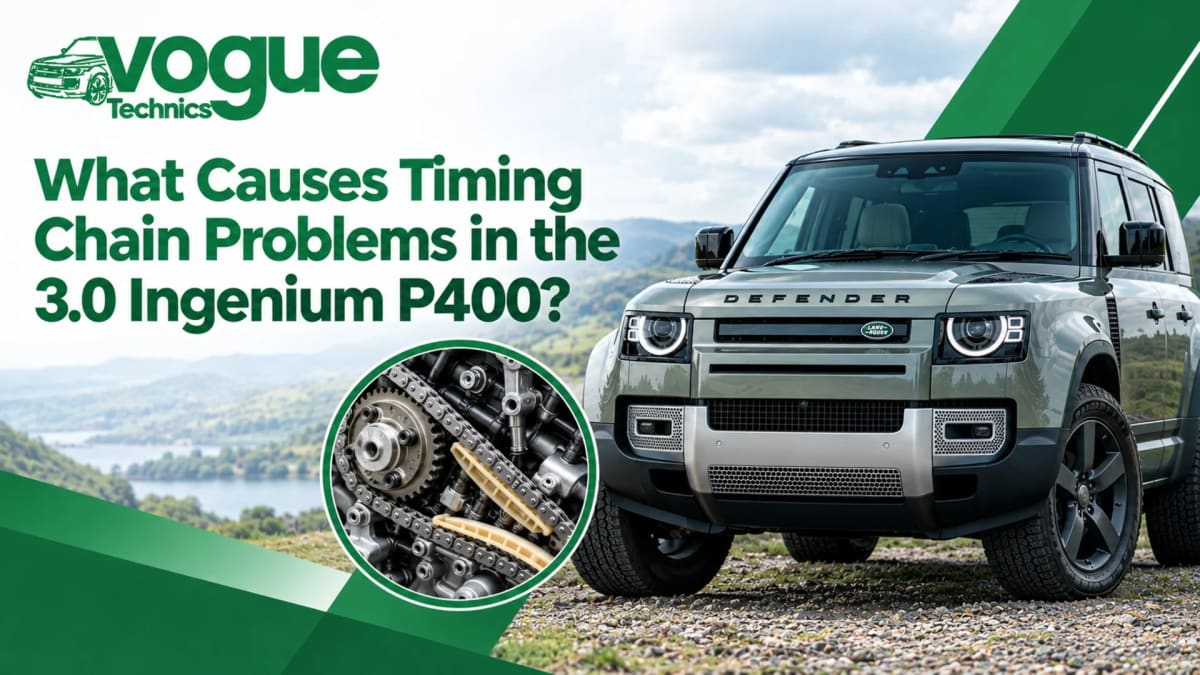
Timing chains are designed to last the life of the engine under normal conditions. When problems do develop, they're usually the result of a small number of contributing factors working together rather than one dramatic failure.
Understanding the mechanism helps make sense of why prevention — covered further down — actually works.
Timing Chain Stretch, Tensioner Wear & Oil Pressure Issues
Chain stretch is the term used for the gradual elongation of a timing chain as its links wear against each other over tens of thousands of miles. It's not that the chain physically stretches like elastic — the pins and bushings wear, and the cumulative effect lengthens the chain's effective pitch. As this happens, the chain runs looser than the tensioner was originally set up to manage.
That's where the hydraulic tensioner comes in. Its job is to take up slack automatically, using engine oil pressure to maintain constant tension as the chain wears. A tensioner in good condition compensates for a reasonable amount of wear. A tensioner that's degraded — or an engine running with low or inconsistent oil pressure — loses that ability to compensate, and slack in the chain starts to show up as noise, and eventually as timing inaccuracy.
The factors that most commonly contribute to this chain of events include:
- Oil quality and specification — using an oil outside the manufacturer's specified grade can affect hydraulic tensioner response and long-term wear rates
- Extended oil change intervals — degraded oil loses lubricating properties and can allow accelerated wear on chain, guides, and tensioner
- Short-journey driving patterns — frequent cold starts without the engine reaching full operating temperature can affect oil condition over time
- Chain guide wear — the plastic or composite guides that keep the chain aligned can wear alongside the chain itself, adding to slack
It's worth being clear here: mileage alone doesn't tell you whether a chain is at risk. We've seen higher-mileage P400s with a clean bill of health because service history and oil condition were properly maintained, and lower-mileage examples showing early symptoms because of inconsistent servicing or short-journey use. The diagnostic picture matters more than the number on the odometer.
It's also worth separating this from unrelated issues that sometimes get lumped in with "engine problems" in general discussion — oil filter housing service actions and camshaft carrier or oil gallery concerns are different faults with different causes, and shouldn't be assumed to be timing chain issues just because they involve the same engine family.
How Do You Diagnose a Defender P400 Timing Chain Fault?
Guessing costs more than diagnosing properly — both in money and in risk to the engine if a real fault goes unaddressed. A proper diagnosis follows a sequence, and skipping steps is how misdiagnoses happen.
Our Diagnostic Process – From Fault Codes to Mechanical Verification
When a P400 comes in with a suspected timing chain issue, the process generally looks like this:
- Cold-start listening test. We start the engine from cold and listen carefully to the noise's character, duration, and location before anything else happens.
- Warm idle and load check. We compare behaviour at idle against behaviour under light load, since chain-related noise often changes character between the two.
- Fault code scan. We connect diagnostic equipment to check for camshaft or crankshaft correlation faults, misfire codes, and any stored codes relevant to VCT operation.
- Camshaft and crankshaft correlation review. This compares the actual relative position of the cam and crank against expected values — a meaningful timing deviation shows up clearly here.
- Oil condition and pressure check. Since oil pressure directly affects tensioner performance, we check both the condition of the oil and, where appropriate, system pressure.
- VCT system testing. We isolate whether actuators and solenoids are operating within normal parameters, ruling out VCT as the source before attributing noise to the chain itself.
- Mechanical verification where required. In cases where the above steps point toward genuine chain, guide, or tensioner wear, physical inspection confirms the extent of the problem before any repair is quoted.
This sequence exists because several different faults can produce overlapping symptoms. A camshaft correlation fault code, for example, can be triggered by a genuinely stretched chain, by a failing VCT actuator, or occasionally by a sensor issue — and the correct repair is completely different depending on which one it is. Treating a sensor fault as a chain problem wastes money; treating a real chain problem as "just a sensor" risks further engine wear.
Defender P400 Timing Chain Repair & Replacement in Grays, Essex

If diagnosis confirms genuine timing chain, tensioner, or guide wear, the repair itself is a precision job — not something suited to a general garage without specific experience on this engine.
Depending on what the diagnosis shows, the work can range from a tensioner or guide replacement to a full timing chain replacement, carried out with correct timing verification once the job is complete. Getting the timing marks and chain tension exactly right matters enormously here — an incorrectly set timing chain can cause far more damage than the original wear it was meant to fix, which is why post-repair verification is a non-negotiable part of the process rather than an optional extra.
At Voguetechnics Engine Rebuild, based in Grays, Essex, we work specifically with Land Rover engines, including the 3.0-litre Ingenium fitted to the P400. We don't quote a fixed price for timing chain work without a proper diagnosis first, because the correct repair — and its cost — genuinely depends on what's actually worn: a tensioner replacement is a very different job from a full chain and guide replacement, and quoting blind serves nobody well.
What we can tell you upfront is what the process looks like:
Stage | What Happens | Why It Matters |
| Initial diagnostic | Cold-start listening, fault code scan, correlation check | Confirms whether the chain system is genuinely involved |
| Detailed inspection | Mechanical verification of chain, tensioner, guides | Establishes exact scope of repair needed |
| Repair | Tensioner, guide, or full chain replacement as required | Addresses the actual worn components, not guesswork |
| Timing verification | Cam/crank timing checked and confirmed post-repair | Prevents incorrect timing from causing further damage |
| Road test | Noise, idle, and performance checked under real conditions | Confirms the fix has resolved the original symptom |
If you're weighing up whether to get a noise checked now versus waiting, the honest answer is that early diagnosis gives you more options. A tensioner or guide caught early is a smaller job than a chain that's been left to wear against worn guides for another 10,000 miles.
Frequently Asked Questions About Defender P400 Timing Chains
Does the Land Rover Defender P400 have timing chain problems?
The P400's 3.0-litre Ingenium inline-six can experience timing chain wear, tensioner wear, and related symptoms, though this shouldn't be confused with issues reported on the separate 2.0-litre Ingenium four-cylinder engine. Not every P400 develops chain-related symptoms, and proper servicing and oil maintenance play a real role in long-term reliability.
What does a P400 timing chain rattle sound like?
Typically a fast, metallic rattle or tick heard most clearly on cold start, which may fade as oil pressure builds. If the noise persists after warm-up or reappears under acceleration, it warrants a proper diagnostic check rather than being assumed normal.
How do I tell the difference between timing chain noise and VCT noise?
VCT-related noise is usually very brief and limited to the first second or two after starting. Chain-related noise tends to last longer, can be more consistent over time, and may appear under load as well as at idle. A scan tool and trained diagnosis are the reliable way to distinguish the two rather than sound alone.
At what mileage does the P400 timing chain become a concern?
There's no fixed mileage threshold that determines risk. Service history, oil condition, and driving pattern (particularly frequent short journeys) influence chain and tensioner wear more than mileage alone. We've assessed both high-mileage examples in good condition and lower-mileage vehicles showing early symptoms.
Can a timing chain failure damage the engine?
Left unaddressed, chain stretch can progress to timing deviation, which may trigger correlation faults, rough running, and in more advanced cases, valve timing issues that risk further engine damage. This is why symptoms are worth investigating early rather than monitored indefinitely.
How much does Defender P400 timing chain replacement cost?
Cost depends entirely on what the diagnosis finds — a tensioner or guide replacement is a smaller job than a full chain replacement. We provide a clear quote once diagnostic findings confirm the actual scope of work needed, rather than publishing a generic figure that may not reflect your vehicle.
How can I prevent timing chain problems on my P400?
Sticking to manufacturer-specified oil grade and change intervals, addressing unusual noises early rather than waiting, and having the vehicle checked if you notice a persistent change in engine sound are the most practical steps within an owner's control.
A rattle you can hear is easier — and usually cheaper — to deal with than the timing fault it can turn into if it's ignored. If your Defender P400 has developed a noise you're not sure about, or a fault code has flagged something related to camshaft timing, don't wait for it to get worse.
Get in touch with Voguetechnics Engine Rebuild in Grays, Essex. We'll listen to it properly, scan it, and tell you exactly what we find — no guesswork, no upselling a repair you don't need.