
Jaguar XF 3.0 V6 Diesel Problems: Common Faults, Symptoms, Fault Codes and Repair Costs (X250 vs X260)
Jaguar XF 3.0 V6 Diesel problems can range from DPF blockages and turbo actuator faults to oil dilution, cambelt wear and crankshaft issues. This guide covers common X250 and X260 faults, warning signs, diagnostic codes and repair options. Learn what causes these problems, how to spot them early and when specialist diagnosis is needed.
A "Restricted Performance" message flashes up halfway down the A13. Or the engine rattles for a few seconds on a cold morning, and you start wondering whether a new engine is on the way.
Those fears are understandable, but a Jaguar XF 3.0D rarely goes from healthy to scrap overnight. The 3.0 V6 diesel (AJD-V6, also written 306DT or DT306) is a strong, torquey engine. Its fault profile differs between the X250 and the X260, though, and most of its problems cost far less when caught early.
This guide covers the faults we see most, what each one feels like, how it's diagnosed, and what it costs to put right. It comes from the team at Vogue Technics Engine Rebuild, a specialist engine diagnostics, repair and rebuild workshop in Grays, Essex.
What Are the Most Common Jaguar XF 3.0D Problems on the X250 and X260?
Most pages treat every XF as one car. That's unhelpful, because the X250 (2007 to 2015) and the X260 (2015 onward) carry different versions of the same V6 diesel family. The faults you should expect depend on which one you own or are thinking of buying.
The engine itself is a 3.0 litre twin-turbo V6. In the X250 it came in 237/240 PS and 275 PS (3.0D S) form. The X260 uses the later 300 PS DT306 version. The Sportbrake estate shares these engines, so everything below applies to it too.
Is the Jaguar XF 3.0 V6 Diesel Reliable, and Which Faults Differ by Generation?
Short answer: yes, it can be, if it's been serviced properly. It's not an engine that forgives neglect, though. Poor oil changes, ignored warning lights and stretched cambelt intervals are behind many of the expensive failures we see.
Here's how the two generations compare:
X250 (2007–2015) | X260 (2015 onward) | |
| Typical 3.0D output | 237/240 PS, 275 PS (3.0D S) | 300 PS (DT306) |
| Turbo set-up | Twin-turbo, with a secondary turbo actuator | Twin-turbo, later-generation components |
| Most reported faults | Inlet manifold, turbo actuator, DPF, timing belt, crankshaft and bearing concerns | Throttle body, inlet manifold and rocker-cover leaks, timing belt |
| Typical warning | Restricted Performance, DPF light, rising oil level | Power loss, rough running, leaks around the top of the engine |
| Higher-risk mileage | Often 100,000 miles and above | Depends heavily on service history |
A few patterns hold across both:
- Short-journey cars suffer most. The DPF and oil both struggle when the engine rarely gets hot.
- Mileage matters less than history. A 140,000-mile car with documented oil changes and a recent cambelt is a safer bet than a 90,000-mile one with gaps in the paperwork.
- No single model year is "the one to avoid". Condition, maintenance and how the car was used tell you far more.
This engine technology isn't unique to the XF. The Jaguar XJ, Range Rover, Range Rover Sport and Land Rover Discovery use closely related diesel V6 units, so many diagnostic lessons carry across.
Why Does My Jaguar XF 3.0D Say Restricted Performance or Go Into Limp Mode?
This is the most searched problem on the car, and it's frightening because it often hits at speed.
The problem: the engine management system has detected something it considers a risk, usually in the air, boost or exhaust side, so it cuts power to protect the engine. That's limp mode, and the message on the dash reads "Restricted Performance".
Typical symptoms:
- Sudden loss of power, especially under acceleration or load
- Poor acceleration and hesitation
- The engine management light and a warning message on the dashboard
- Sometimes smoke, rough running, or the engine cutting out
Common causes:
- Turbo actuator faults, including the secondary turbo actuator on the twin-turbo setup
- Boost leaks from a split intercooler hose or a cracked inlet manifold
- Faulty MAF or boost pressure sensors sending bad airflow readings to the ECU
- A blocked DPF or related exhaust temperature sensor faults
- Throttle body or EGR valve faults, more commonly on later cars
Fault codes owners and technicians connect with this problem:
Code | General area | Usual direction of investigation |
| P006A | Air pressure/airflow correlation | Intake leaks, sensor readings, manifold condition |
| P00BD | Airflow sensor performance | MAF sensor, intake hoses, air leaks |
| P0235 | Boost pressure sensor circuit | Sensor, wiring, boost leaks |
| P2263 | Boost system performance | Turbo actuator, intercooler hoses, inlet manifold |
| P22D2 | Turbo boost control faults | Turbo actuator and control circuit |
| P22CF | Turbo boost control faults | Turbo actuator and control circuit |
| P22D3 | Turbo boost control faults | Turbo actuator and control circuit |
A fault code tells you which system is complaining, not which part has failed. The exact wording can vary by scan tool and software version, so treat this table as a starting point and confirm against your own scan data. Replacing a turbo actuator because of a boost code, when the real cause is a cracked inlet manifold, is an expensive way to learn that.
How we diagnose it:
- Read the stored and pending fault codes with a Jaguar SDD-capable scanner.
- Check live data: boost pressure, airflow and fuel pressure under load.
- Run a smoke test to find air leaks in the intake and intercooler pipework.
- Inspect the inlet manifold, hoses, vacuum pipes and actuator linkages by eye.
- Road test with data logging to reproduce the fault.
Repair: this ranges from replacing an intercooler hose or a vacuum pipe, to a new turbo actuator, to an inlet manifold replacement. The cost depends entirely on the cause.
If you ignore it: the car may keep switching in and out of limp mode, and a persistent boost or airflow fault can make the DPF and fuel system work harder than they should. Small leaks become big bills.
If your XF is showing Restricted Performance now, book a diagnostic scan before replacing anything. It's the cheapest step in the process and it saves guesswork.
How Do DPF Faults and Oil Dilution Damage a Jaguar XF 3.0D Engine?
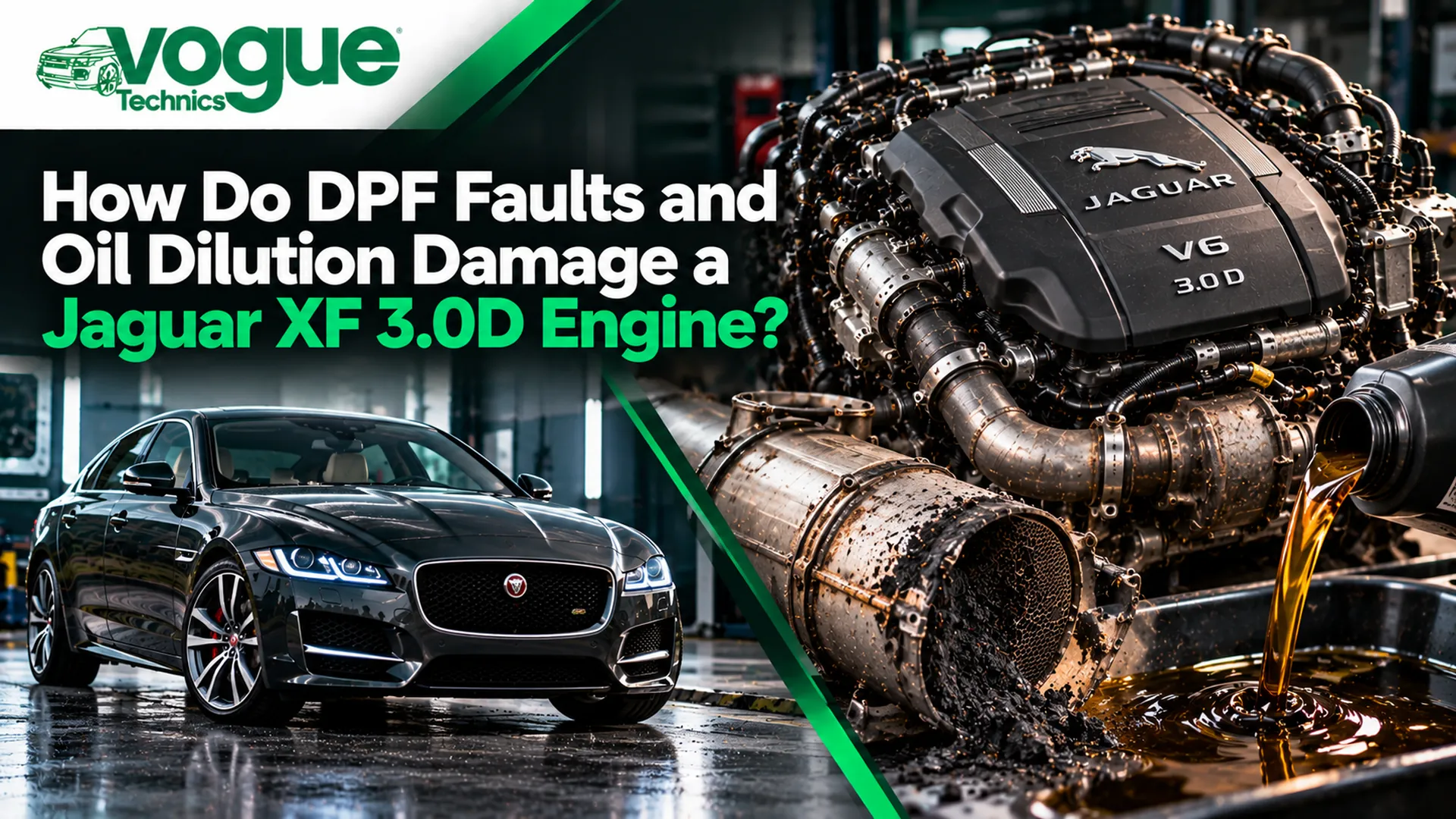
The diesel particulate filter (DPF) is a regular source of dashboard warnings. The problem that gets less attention is what a struggling DPF can do to the engine oil, because that's where real engine damage can start.
Why Is My Jaguar XF 3.0D DPF Light On, and Can Regeneration Cause Oil Dilution?
Yes, it can. Here's the chain of events:
- Soot builds up in the DPF.
- The ECU triggers a regeneration, injecting extra fuel late in the combustion cycle (post-injection) to burn the soot off.
- Some of that unburnt diesel runs down the cylinder walls into the sump.
- The oil level rises, and the oil thins out.
- Thinner oil means weaker lubrication, and that puts bearings and the crankshaft at risk.
This happens most on cars used for short trips, where regenerations are repeatedly interrupted before they finish. Each failed attempt adds a little more diesel to the oil.
Symptoms to watch for:
- Oil level creeping above the maximum mark on the dipstick
- A diesel smell from the oil
- DPF warning light or message
- Smoke on acceleration
- Poor acceleration or a general lack of response
Typical causes:
- Repeated short journeys with no chance for a full regeneration
- Failed or incomplete regenerations
- A faulty EGR valve or exhaust temperature sensor feeding the ECU bad data
- Leaking or worn injectors
Repair and prevention:
- Change the oil and filter promptly if dilution is confirmed, using the correct approved specification
- Clean the DPF (professional cleaning is often cheaper than replacement) or replace it if it's beyond saving
- Fix the underlying cause, whether that's an injector, sensor or EGR fault
- Where possible, give the car a sustained 20 to 30 minute run at steady speed now and then so a regeneration can complete
If you ignore it: diluted oil accelerates wear on crankshaft and big end bearings, which is the road to the most expensive failure on this engine. We cover that in the next section.
A real-world scenario: an owner who does a 4-mile school run each way notices the DPF light on and the oil level slightly high. They top up nothing, because it looks "fine". Three months later the oil is thin and smells of fuel. A diagnostic scan, an oil change and a cleaned DPF at that stage is a modest bill. Leaving it for another year of the same use could mean bearing damage.
Oil level rising? Don't keep driving on it. Book a check at Vogue Technics before it becomes an engine job.
What Causes Jaguar XF 3.0D Engine Failure, and Is a Rebuild or Replacement Better?
Most XF 3.0D owners will never see a full engine failure. When it does happen, though, the consequences are serious, which is why this is the topic worth understanding properly.
Why Do Crankshaft and Big-End Bearings Fail on the Jaguar XF 3.0D, and How Do You Spot It Early?
Crankshaft and big end bearing wear is regularly reported by owners of the Ford/Jaguar V6 diesel family. It doesn't affect every engine, and oil quality and condition play a large role in whether it does.
The failure path usually looks like this:
bearing wear → increased clearance → knocking → low oil pressure → crankshaft damage or breakage → seizure → engine replacement
Early warning signs:
- A deep knocking noise, particularly when warm or under load
- Ticking noise when accelerating
- Cold-start rattle that doesn't fade within a few seconds
- Low oil pressure warnings
- Metal particles in the oil or filter
- Rough running or loss of power
Rattles and ticks aren't always bearings. A loose heat shield, a leaking inlet manifold or a failing injector can sound similar. That's why a proper inspection beats guessing.
Scenario: an X250 at around 120,000 miles has a faint knock on cold start that disappears once warm. Service history shows a long gap between oil changes. The sensible move is to stop using the car for long runs, get the oil pressure and bearing condition checked, and decide on a repair path while the crank is still salvageable. Driving it until it fails is how a rebuild becomes a replacement.
Don't forget the cambelt. The 3.0D uses a timing belt, not a chain, so it's a scheduled replacement item. Follow the interval for your VIN and don't stretch it. If a belt breaks, the valves and pistons can collide, and the engine is usually written off. A cambelt replacement costs a fraction of that, and it's worth doing the auxiliary belt and tensioners at the same time.
Your options when an engine has failed:
Option | What it involves | Cost range | Turnaround | Best for |
| Repair | Fix a specific fault (e.g. bearing or oil pump) if damage is limited | £[insert] | Short | Caught-early faults |
| Rebuild | Strip, inspect, replace worn components, rebuild | £[insert] | Medium | Engines with sound blocks, owners keeping the car long-term |
| Reconditioned engine | Factory-spec engine rebuilt to standard, fitted to your car | £[insert] | Short to medium | Best balance of cost and reliability |
| Replacement (used) | Second-hand unit from a donor car | £[insert] | Short | Short-term, lowest-cost fixes, though history is often unknown |
For most owners keeping the car, a reconditioned engine or a full rebuild gives the best long-term value. A used replacement is cheaper upfront, but you inherit someone else's history. We'll talk you through which option fits your car and your budget.
What Should You Check Before Buying a Used Jaguar XF 3.0D?
Buying one? This checklist will save you money. Print it or keep it on your phone when you view the car:
- Cold start: insist the engine is cold when you arrive. Listen for rattles and ticking.
- Engine noise: knocking, tapping or whining while idling and on the move.
- Smoke: blue, black or white smoke on start-up or acceleration.
- Oil level and condition: check the dipstick. Overfull, thin or smelling of diesel is a red flag.
- Service history: regular oil changes and a stamped book or digital record.
- Timing belt evidence: an invoice or sticker showing when it was last changed.
- DPF history: any cleaning, replacement or repeated warnings.
- Diagnostic scan: pending and historic fault codes.
- Restricted Performance history: ask directly whether it has ever gone into limp mode.
- Turbo boost: does it pull cleanly under load, without hesitation?
- Inlet manifold and intercooler hoses: look for cracks, splits and oily residue.
- Transmission and differential: smooth shifts, no whine, no leaks.
- Suspension: knocks, uneven tyre wear, leaking dampers.
- Rust: sills, wheel arches and subframe areas.
- Electrics: windows, infotainment, warning lights on start-up.
Extra scrutiny is warranted for cars over 100,000 miles or ones with patchy paperwork. If anything on the list bothers you, book a pre-purchase diagnostic with us before you hand over money.
How Much Does Jaguar XF 3.0D Repair Cost, and Where Can You Get a Specialist Diagnosis in Grays, Essex?
Prices depend on the exact fault, the parts needed and the car's age. What we can say is that early diagnosis nearly always costs less than reactive repair. These are the typical jobs we quote for, and we confirm a fixed price before any work starts:
Job | Indicative price |
| Diagnostic scan and report | £[insert] |
| Inlet manifold replacement | £[insert] |
| Turbo actuator replacement | £[insert] |
| Intercooler hose replacement | £[insert] |
| DPF cleaning | £[insert] |
| DPF replacement | £[insert] |
| Timing belt (cambelt) replacement | £[insert] |
| Injector replacement | £[insert] |
| Engine rebuild | £[insert] |
| Reconditioned or replacement engine, fitted | £[insert] |
Why Choose a Specialist for Jaguar XF 3.0D Diagnostics, Engine Repair and Rebuilds?
A general garage can plug in a scanner. A specialist knows what the codes mean on this engine, and what usually sits behind them.
What you get from Vogue Technics:
- Engine-focused experience. Diagnostics, repair, rebuilds and reconditioned engines are what we do every day.
- The right equipment. Jaguar SDD-capable diagnostics, smoke testing and live data analysis.
- Written fault reports. You see what we found and why we're recommending it.
- Honest advice. We tell you what needs fixing now and what can wait.
- Warranty. Our parts and labour are covered, and you can read customer reviews on Google.
Keep the engine healthy between visits. Most of the failures above are preventable:
- Change the oil and filter on time, using the correct approved oil. Don't wait for the indicator if the car does lots of short trips.
- Check the oil level monthly, and investigate if it rises.
- Give the DPF a long run now and then.
- Replace the cambelt, auxiliary belt and tensioners on schedule.
- Replace the fuel filter and air filter at the recommended intervals.
- Keep coolant fresh, and service the gearbox and differential oil.
- Don't ignore warning lights. A scan is cheap, and a rebuild isn't.
We're based in Grays, Essex, and regularly look after cars from across Essex, London and Kent.
Book your Jaguar XF 3.0D diagnostic at Vogue Technics Engine Rebuild. Call [insert phone number], use our online booking form, or visit us in Grays, Essex. Give us your registration and a description of the symptoms and we'll quote you.
Frequently Asked Questions
What are the common problems with the Jaguar XF 3.0D?
The most reported faults are inlet manifold cracks, turbo actuator failure, DPF blockage, oil dilution, cambelt wear and, in some cases, crankshaft and bearing issues. X260 cars also see throttle body problems and rocker-cover leaks.
Is the Jaguar XF 3.0 V6 diesel reliable?
It can be, with consistent servicing and prompt attention to warning lights. Short-journey use and missed oil changes are the biggest risk factors. History matters more than mileage.
Why does my Jaguar XF say Restricted Performance?
The ECU has detected a fault, usually in the boost, airflow or exhaust system, and has limited power to protect the engine. Common causes are turbo actuator faults, boost leaks, sensor faults and DPF blockages. A diagnostic scan finds the cause.
When should the Jaguar XF 3.0D cambelt be changed?
Follow the interval for your specific VIN and market, and don't stretch it. If there's no proof of the last change, have it done. A broken belt can destroy the engine.
How much does a Jaguar XF 3.0D engine replacement cost?
It depends on whether you choose a rebuild, reconditioned engine or used unit, plus fitting. Contact us with your registration for a fixed quote.
What should I look for when buying a Jaguar XF 3.0D?
Check for a cold-start rattle, smoke, an overfull or thin oil level, a cambelt invoice, DPF history, stored fault codes and any Restricted Performance history. A pre-purchase diagnostic is well worth the money.
Why is my Jaguar XF 3.0D losing power?
Usually a boost leak, turbo actuator fault, sensor fault or blocked DPF. Get the fault codes read before replacing parts.
Can DPF problems cause Restricted Performance?
Yes. A blocked DPF raises exhaust back-pressure, and the ECU may cut power to protect the engine.
Conclusion
The Jaguar XF 3.0 V6 diesel isn't a bad engine, but it punishes neglect. Know which generation you have, take warning lights seriously, keep the oil fresh, and don't stretch the cambelt. That combination prevents most of the problems in this guide.
If your XF is already showing symptoms, or you're about to buy one, talk to Vogue Technics Engine Rebuild in Grays, Essex. We'll diagnose it properly, explain it clearly and quote you a fixed price.