
Jaguar Ingenium 2.0 Timing Chain Problems: Symptoms, Causes, Costs & UK Repair Guide
The Jaguar Ingenium 2.0 timing chain problem typically begins with a cold-start rattle that gradually worsens over time. Common causes include oil dilution from DPF regeneration, worn tensioners, and chain stretch affecting engine timing. If ignored, it can trigger fault codes like P0016 and P0017 and lead to serious engine damage. Early diagnosis and timely replacement can prevent costly rebuilds and restore engine reliability.
That faint rattle when you fire up your Jaguar on a cold morning, the one that fades after a few seconds and leaves you wondering if you imagined it, is the sound most owners describe right before they end up in our workshop. If you drive a Jaguar XE, XF, F-Pace, or a Land Rover Discovery Sport or Range Rover Evoque with the 2.0 Ingenium diesel, that noise is worth taking seriously. It rarely fixes itself, and it tends to get louder, longer, and more expensive the longer it's left.
We rebuild and repair these engines week in, week out at our Grays workshop in Essex, so we've seen exactly how Jaguar Ingenium 2.0 timing chain problems start, how they progress, and what it actually costs to put right. This guide walks you through the warning signs, the engineering reasons behind the failures, realistic UK repair costs, and how to decide between a chain replacement and a full rebuild, without the guesswork.
What Are the Jaguar Ingenium 2.0 Timing Chain Problems?
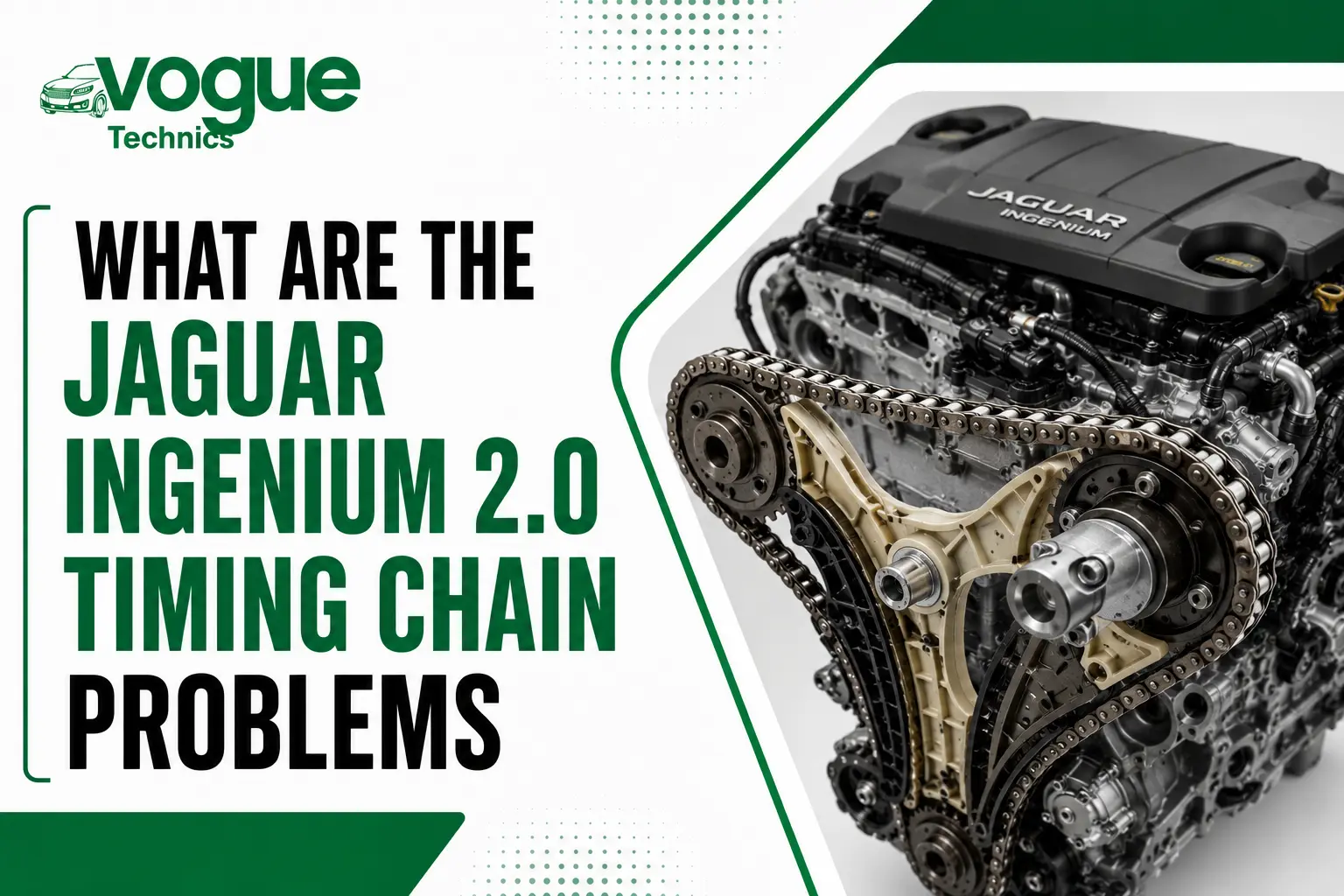
The Ingenium engine family is Jaguar Land Rover's in-house 2.0-litre four-cylinder unit, fitted across a wide range of cars from roughly 2015 onward. It's a capable engine, but the diesel versions have developed a well-documented reputation for timing chain wear, specifically chain stretch, tensioner failure, and guide wear that throws off the precise timing between the camshaft and crankshaft.
When that timing slips even slightly, the engine's management system notices. So do you. The symptoms usually arrive in a predictable order, and recognising them early is the difference between a manageable repair and a catastrophic engine failure.
Why Does My Jaguar Ingenium 2.0 Rattle on Cold Start?
The cold-start rattle is the single most common complaint we hear, and there's a clear mechanical reason for it.
When your car sits overnight, oil drains down from the upper engine into the sump. On start-up, the hydraulic timing chain tensioner, the component that keeps the chain taut — takes a moment to repressurise. If the chain has already stretched or the tensioner is weak, there's a brief window where the chain is slack and slaps against its guides. That metallic rattle on cold start is the sound of a loose chain before oil pressure builds.
A second or two of rattle on a freezing morning might seem minor. But it's the earliest physical evidence that the timing chain system is wearing, and it's your cue to get the engine inspected before the slack gets worse.
What Are the Symptoms of a Stretched Timing Chain?
A stretched timing chain rarely announces itself all at once. It builds gradually, which is part of what makes it dangerous, owners get used to the noise and assume it's "just how the engine sounds." It isn't.
Here's how the symptoms typically progress, from first hint to serious trouble:
- Brief rattle on cold start: the earliest sign, often dismissed as normal diesel clatter.
- Rattle lasting longer each week: as wear increases, the noise persists for several seconds rather than fading instantly.
- Rattle at idle when warm: once you hear it after the engine has warmed up, the chain or tensioner is significantly worn.
- Engine warning light or management light: the ECU detects a timing deviation and logs a fault.
- Rough running, hesitation, or loss of power: timing is now off enough to affect combustion and turbo response.
- Misfire under load: a strong warning that failure may be imminent.
- Loud, continuous rattling or knocking: the chain is dangerously loose and the engine is at risk of jumping timing.
The reason this matters so much: the 2.0 Ingenium is an interference engine. If the chain skips teeth or snaps, the pistons and valves can collide, turning a few-hundred-pound repair into a four-figure engine rebuild. Catching it during the rattle stage is always cheaper than catching it after the bang.
Early Warning Signs You Shouldn't Ignore
Beyond the noise itself, a few subtler clues often appear alongside chain wear. Pay attention if you notice slightly harder cold starts, a faint vibration at idle that wasn't there before, increased oil consumption, or fuel finding its way into the oil (which we'll explain shortly). On their own, each can have other causes but combined with a startup rattle on an Ingenium diesel, they point firmly toward the timing chain.
Fault Codes That Confirm a Timing Chain Fault
When the rattle is ambiguous, the diagnostic codes settle the argument. Plugging in a proper scan tool, not a basic code reader reveals whether the camshaft and crankshaft are still in agreement. Two codes come up again and again on worn Ingenium engines.
P0016 – Camshaft/Crankshaft Correlation Explained
P0016 is logged when the engine control unit sees that the camshaft position and crankshaft position no longer line up the way they should. In plain terms: the chain has stretched far enough that the top of the engine is now slightly out of step with the bottom. It's one of the clearest electronic fingerprints of timing chain stretch, and on an Ingenium with a startup rattle, it's a strong confirmation that the chain needs attention.
P0017 – What This Code Tells You About Chain Stretch
P0017 is closely related, flagging a correlation error between the crankshaft and the exhaust camshaft specifically. Seeing P0016 and P0017 together is a textbook indicator that the timing chain has worn past its acceptable limit. Once these codes appear, continuing to drive risks the chain skipping a tooth entirely and that's the failure mode that bends valves.
Which Jaguar & Land Rover Models Use the Affected 2.0 Ingenium Engine?
Because Jaguar Land Rover shares the Ingenium engine across both brands, timing chain problems aren't limited to one model. If your vehicle uses the 2.0 Ingenium diesel, the same wear patterns apply.
Model | Common Affected Years | Notes |
| Jaguar XE | 2015 onward | Frequent cold-start rattle complaints |
| Jaguar XF | 2015 onward | Same chain system and symptoms |
| Jaguar F-Pace | 2016 onward | High-mileage examples especially prone |
| Land Rover Discovery Sport | 2015 onward | Heavier vehicle, often higher load on chain |
| Range Rover Evoque | 2015 onward | Diesel variants commonly affected |
Earlier production engines tend to show the issue more often than later, revised units, but no Ingenium diesel is completely immune, service history and oil maintenance matter far more than the badge on the bonnet.
Why Do Ingenium 2.0 Timing Chains Fail?
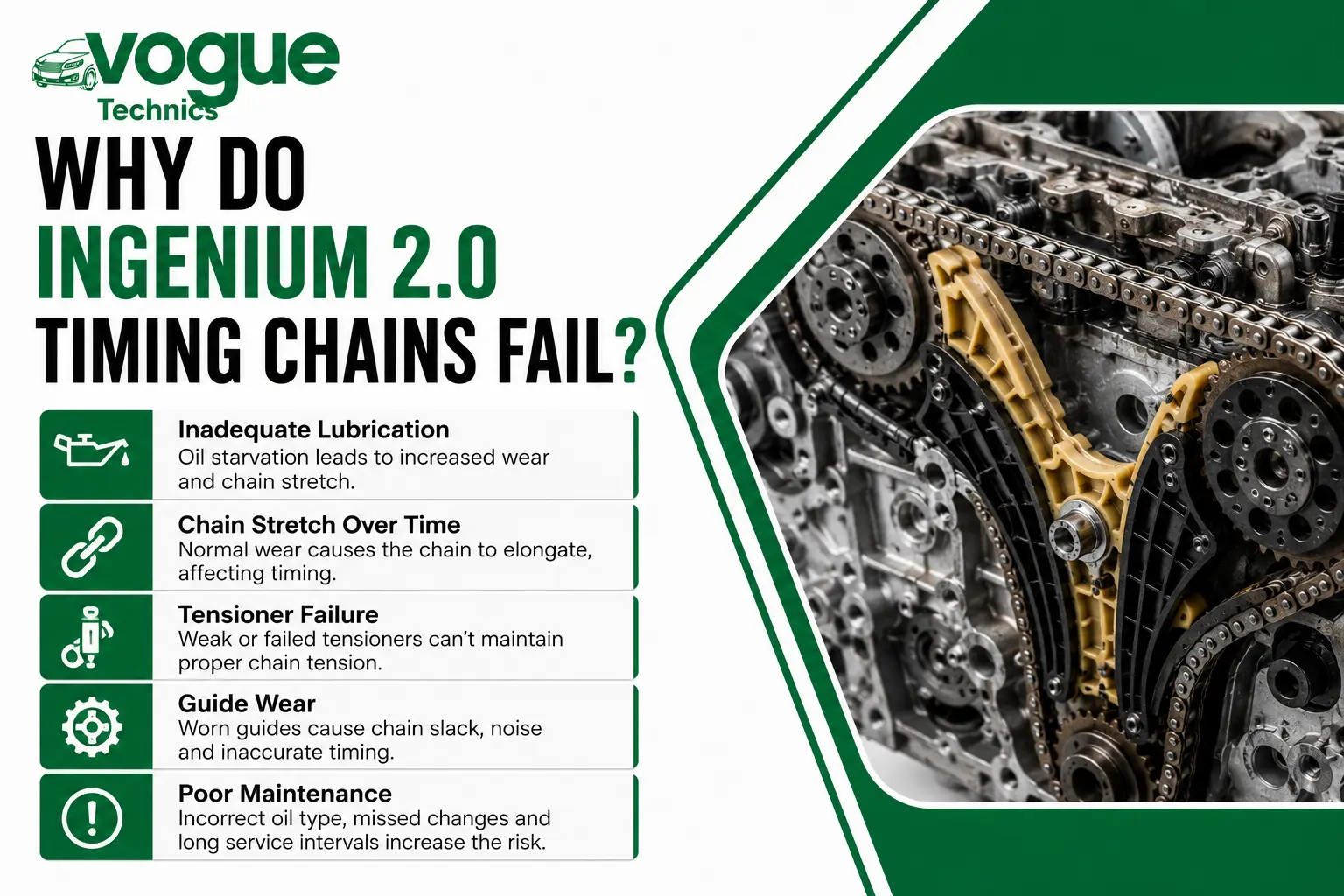
Understanding why these chains wear isn't just academic. It tells you what to look for when buying a used JLR diesel, how to slow the wear on the car you already own, and whether a quick chain swap will actually solve the problem or just delay it.
The failures come down to a combination of lubrication, component design, and how these cars are typically driven in the UK.
How Oil Dilution from DPF Regeneration Accelerates Chain Wear
This is the factor most general garages overlook, and it's central to the Ingenium story.
Diesel engines fitted with a diesel particulate filter (DPF) periodically burn off trapped soot in a process called regeneration. To do this, the engine injects extra fuel. On short urban journeys — exactly the kind many UK drivers do, regeneration often can't complete, and some of that diesel slips past the pistons and into the engine oil.
Diluted oil is thinner oil. Thinner oil holds less pressure and offers less protection. The timing chain, tensioner, and guides all depend on a clean, properly pressurised oil film to survive. When that oil is contaminated with fuel and its viscosity breaks down, wear on the chain and tensioner accelerates dramatically.
This is why two identical cars can show wildly different chain wear at the same mileage: the one doing long motorway runs with strict oil changes stays healthy far longer than the one doing short school-run trips on a stretched service interval.
Why the Hydraulic Tensioner and Chain Guides Wear Prematurely
The timing chain doesn't operate alone. A hydraulic tensioner keeps it tight, and plastic guides keep it running on the correct path. Both are wear items, and both suffer when oil quality drops.
A weakening tensioner can't keep the chain taut, so the chain whips slightly with every rotation. That whipping chews into the guides. Worn guides let the chain move even more freely, which stretches the chain faster and loads the tensioner harder. It becomes a self-feeding cycle — which is exactly why a half-job that replaces only the chain, and not the tensioner and guides together, almost always comes back. A proper repair addresses the whole timing chain system as one assembly.
At What Mileage Do Ingenium Timing Chains Usually Fail?
There's no single magic number, but a clear pattern emerges from the engines we see.
- Under 60,000 miles: Failures here are usually tied to neglected oil changes, heavy short-trip use, or an early production engine.
- 60,000–100,000 miles: This is the most common window for chain stretch symptoms to appear, especially on cars with mixed or city driving.
- 100,000+ miles: Many well-maintained examples reach this without drama, but the risk rises steadily, and the rattle should never be ignored at this stage.
The takeaway: mileage matters, but maintenance history matters more. A 50,000-mile car with skipped oil services can be in worse shape than a carefully maintained 110,000-mile motorway cruiser.
Can You Keep Driving With a Rattling Timing Chain?
Honestly — no, not safely, and not for long.
A faint, very brief cold-start rattle gives you a little time to book a diagnostic inspection. But a rattle that lasts several seconds, appears when the engine is warm, or comes with a warning light is a clear signal to stop driving and get the car recovered to a workshop.
The risk is simple and severe: if a stretched chain jumps a tooth or snaps, the valves and pistons collide. At that point you're no longer looking at a timing chain replacement — you're looking at engine internal damage and a far bigger bill. Every mile you drive on a badly rattling Ingenium chain is a gamble against that outcome.
How Much Does a Jaguar Ingenium 2.0 Timing Chain Replacement Cost in the UK?
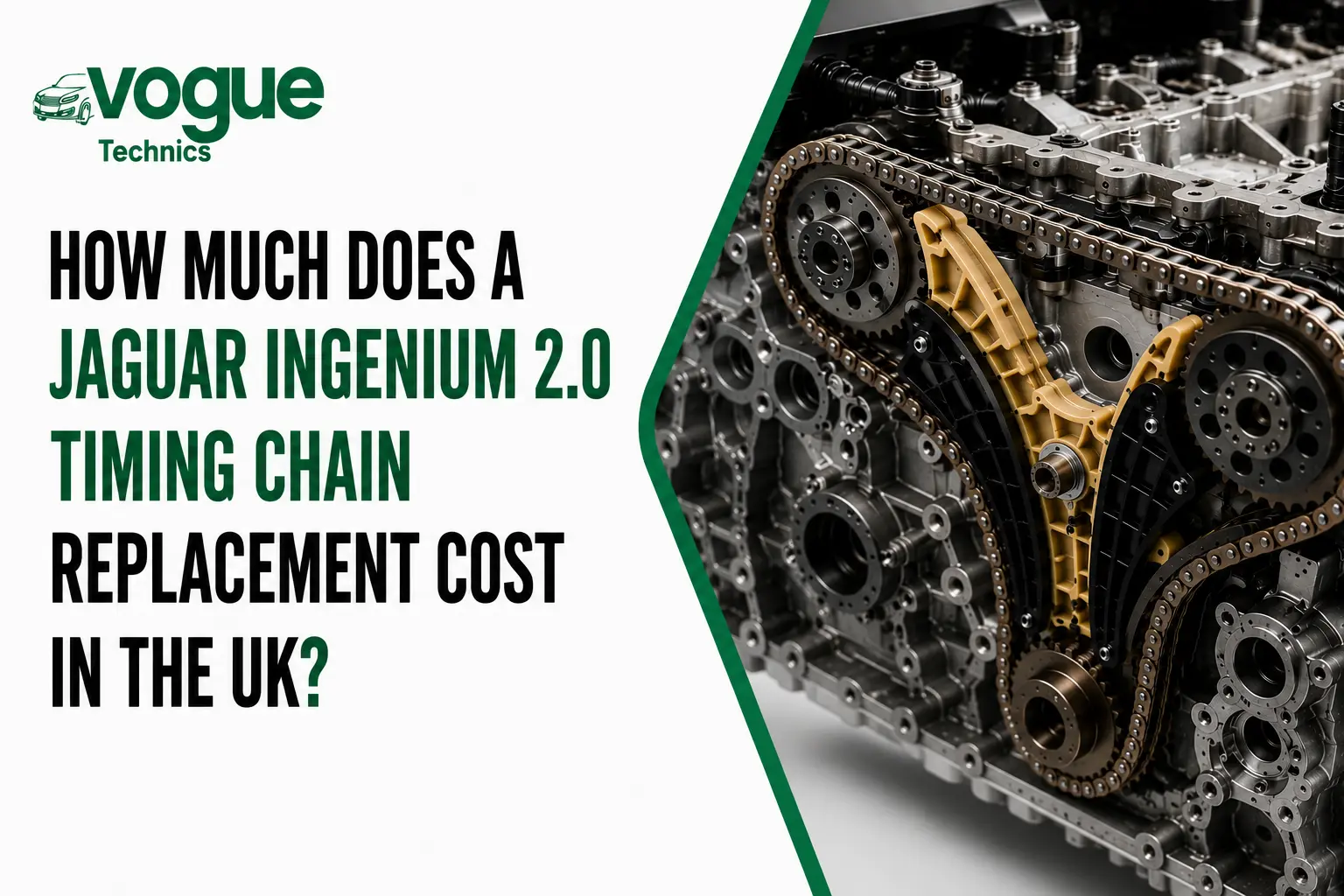
This is the question everyone wants answered, so let's be straight about it. Timing chain replacement on the Ingenium engine is a labour-intensive job, and the cost reflects the time involved rather than the price of the parts alone.
Jaguar Ingenium Timing Chain Replacement Cost Breakdown (Parts + Labour)
A complete, done-properly timing chain replacement on a 2.0 Ingenium diesel in the UK typically falls within the ranges below. Figures vary by model, location, parts choice, and the condition the engine is in when it arrives.
Cost Element | Typical UK Range | What's Involved |
| Diagnostic inspection | £60 – £120 | Scan for fault codes (P0016/P0017), confirm chain wear |
| Timing chain kit (chain, tensioner, guides) | £250 – £550 | OEM-grade kit covering the full assembly |
| Labour | £700 – £1,400+ | Extensive engine access required; many hours of work |
| Oil, filter & ancillary parts | £80 – £200 | Fresh oil to correct JLR specification, seals, gaskets |
| Typical total | £1,000 – £2,000+ | Varies by model and engine condition |
A few things drive the price up or down. The Ingenium's timing chain sits at the rear of the engine in some installations, making access genuinely difficult and time-consuming, that's where the labour cost comes from. Choosing a quality OEM-specification kit over the cheapest aftermarket part costs a little more upfront but protects you from a repeat failure. And if the engine has already suffered damage, the job stops being a chain replacement and becomes something larger.
For an exact figure on your specific car, the only honest answer is a proper inspection — guessing without seeing the engine helps nobody.
How Long Does a Timing Chain Replacement Take?
Because of how much has to come apart to reach the chain, this isn't a same-morning job. Realistically, a thorough Ingenium 2.0 timing chain replacement takes two to three working days in most cases.
That covers diagnostic confirmation, stripping back to gain engine access, replacing the chain along with the tensioner and guides as a full set, careful reassembly, refilling with the correct oil, and road testing to confirm the rattle is gone and no fault codes return. Any garage promising it in a couple of hours is either cutting corners or hasn't understood the engine.
Should You Repair the Timing Chain or Rebuild the Engine?
This is where experience earns its keep, because the right answer depends entirely on what we find when the engine comes apart.
When Replacement Is the Sensible Choice
If you've caught the problem during the rattle stage, chain stretch confirmed by fault codes, but no internal damage to valves, pistons, or the cylinder head then a timing chain and tensioner replacement is the correct, cost-effective fix. The engine is fundamentally healthy; it just needs its worn timing components renewed. This is the outcome we always hope to see, and it's exactly why early action saves money.
When the Damage Means a Full Engine Rebuild
If the chain has already skipped or snapped, the picture changes. Bent valves, damaged pistons, or a scored head mean the engine needs to come apart properly. In these cases a full or partial engine rebuild is the only reliable repair and as specialist engine rebuilders, this is precisely the work we're set up for. We can assess whether a rebuild, a reconditioned engine, or a replacement unit gives you the best value, rather than throwing parts at a problem and hoping.
The deciding factor, almost every time, is how early the problem was caught. Which brings us neatly to who should be doing the work.
Where to Get Your Jaguar Ingenium 2.0 Timing Chain Fixed Properly
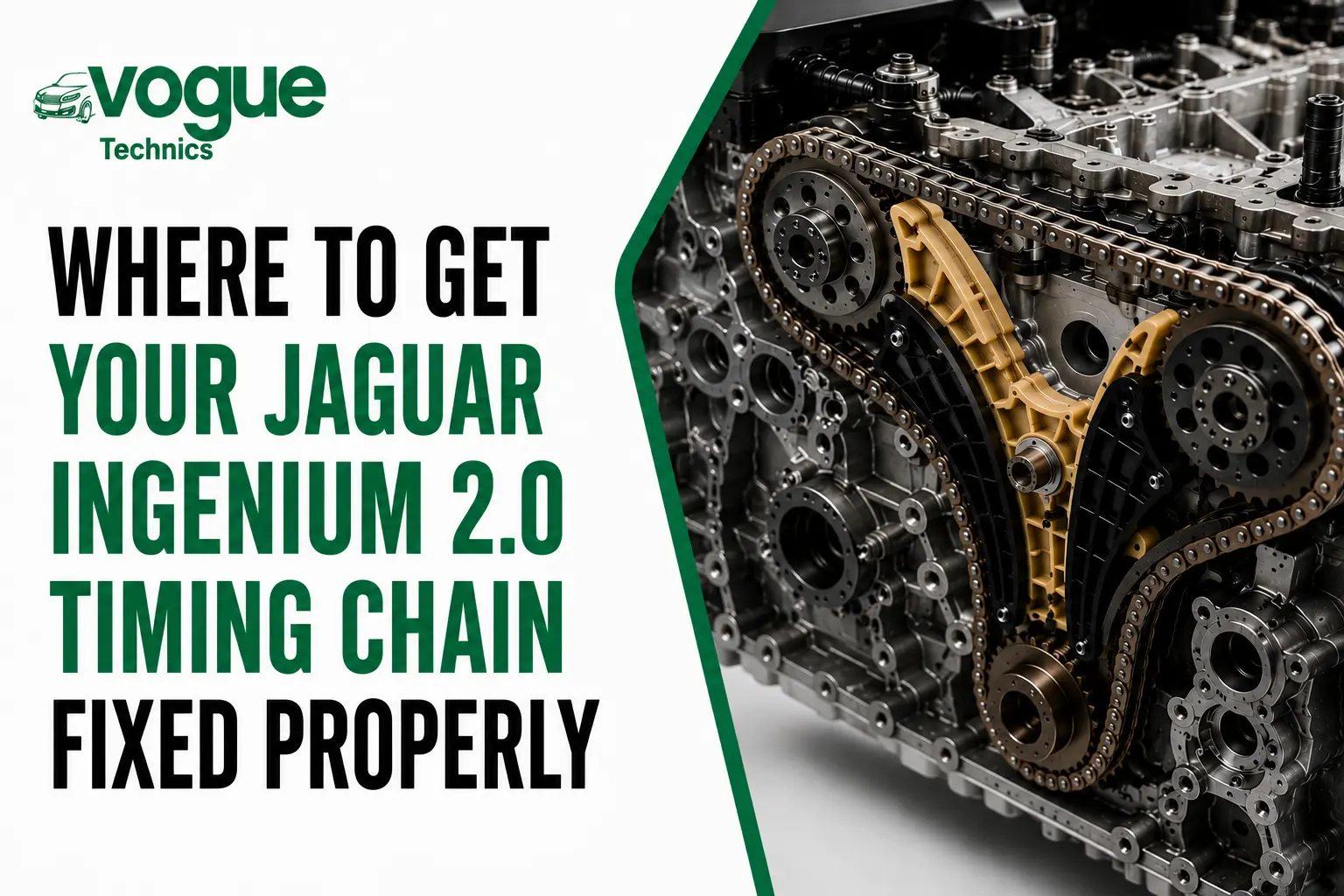
A timing chain repair on an Ingenium engine is not a job for trial and error. Getting it right the first time depends on the right diagnosis, the right parts, and a technician who has done this specific repair many times before.
Why Choose a Jaguar Ingenium Specialist Over a General Garage
A general garage can change a timing chain on plenty of engines. The Ingenium, though, has its own quirks, the rear-mounted chain access, the oil-dilution backstory, the importance of replacing the full chain assembly rather than just the chain, and the exact oil specification JLR requires.
Choosing a specialist means the underlying cause gets addressed, not just the symptom. It means the tensioner and guides are renewed alongside the chain, so the repair lasts. And it means that if the inspection reveals deeper damage, you're already in the hands of a workshop that rebuilds these engines for a living, no need to be referred elsewhere and start again. That continuity protects both your wallet and your time.
What to Ask a Garage Before Booking Your Timing Chain Repair
A few sharp questions quickly separate a genuine specialist from a garage that's improvising. Before you hand over the keys, ask:
- "Will you replace the chain, tensioner, and guides as a complete set?" If the answer is anything other than yes, walk away. A chain-only repair on a worn Ingenium tends to fail again.
- "Do you use OEM-specification parts and the correct JLR oil?" Cheap parts and the wrong oil are how these repairs come back.
- "Have you done this specific Ingenium 2.0 job before?" Hands-on familiarity with this engine matters enormously.
- "What happens if you find internal engine damage?" A good answer shows they can handle a rebuild, not just a parts swap.
- "Will you confirm the fault codes are cleared and road test the car?" Proper verification is non-negotiable.
The answers tell you everything about whether your engine is in safe hands before a single bolt is turned.
Book Your Jaguar Ingenium 2.0 Inspection in Grays, Essex
If your Jaguar or Land Rover is rattling on cold start, showing a warning light, or logging P0016 or P0017, don't wait for the noise to get worse. At Vogue Technics in Grays, Essex, we specialise in Ingenium 2.0 timing chain repairs and full engine rebuilds, so whether your engine simply needs a fresh chain and tensioner or something more involved, you're with a team that handles this exact work every week.
Get a precise diagnosis, an honest assessment, and a clear quote before any work begins. Contact Vogue Technics today to book your Jaguar Ingenium 2.0 timing chain inspection and protect your engine before a manageable repair turns into a major one.
Frequently Asked Questions
How much does a Jaguar Ingenium 2.0 timing chain replacement cost in the UK?
Most complete timing chain replacements fall between roughly £1,000 and £2,000 or more, depending on the model, parts chosen, and the engine's condition. The bulk of the cost is labour, because reaching the chain requires significant engine disassembly. An accurate figure always requires an inspection first.
Is the Jaguar Ingenium 2.0 diesel engine reliable?
It's a capable engine that can cover high mileage when looked after, but the diesel versions are known for timing chain wear, particularly when oil changes are stretched or the car does mostly short trips. Regular servicing with the correct oil is the single biggest factor in long-term reliability.
How long do Ingenium engines last?
With diligent maintenance, many Ingenium diesels comfortably exceed 100,000 miles. Neglected oil servicing and constant short-journey use shorten that significantly, mainly because of the oil-dilution effect on the timing chain and tensioner.
Can a rattling timing chain be ignored if it only happens on cold start?
No. A brief cold-start rattle is the earliest warning, not a harmless quirk. It signals chain or tensioner wear that will worsen. Booking a diagnostic inspection while it's still minor is far cheaper than waiting for the chain to fail.
What fault codes indicate an Ingenium timing chain problem?
P0016 and P0017 are the classic indicators, both flagging a correlation error between the camshaft and crankshaft positions in other words, the chain has stretched enough to throw off the engine's timing. Seeing them together strongly points to chain wear.
Will replacing just the timing chain fix the problem?
Usually not on its own. The chain, hydraulic tensioner, and guides wear together, so a lasting repair replaces all of them as a complete set. A chain-only fix on a worn engine commonly leads to the rattle returning.
Is the Ingenium engine reliable after a proper timing chain replacement?
Yes, provided the full assembly is renewed, OEM-specification parts and the correct oil are used, and the engine had no internal damage before the repair. Caught early and done properly, the engine is restored to dependable service.